
Your brain makes most of your decisions before you’re aware you’re deciding.
The hundreds of small choices you make every day – what feels trustworthy, what seems like a good deal, which information you pay attention to, when you stop scrolling, who you believe.
These decisions don’t feel automatic. They feel right.
But that feeling is coming from a set of mental shortcuts your brain uses to move faster than conscious thought. They’re not flaws – they’re part of how we’re wired. The problem is they don’t always lead you where you think they do.
Once you start noticing these patterns, they become hard to ignore. You see them in your own decisions, in how people communicate, in why certain things feel convincing even when they shouldn’t. In my work over the past 20 years in communication and business, I’ve seen these same patterns repeat in surprisingly predictable ways.
Here are seven of the most powerful ones shaping your choices every day:
These 7 Psychological Biases Shape Your Decisions – Without You Realizing It
1. Confirmation Bias: We See What We Expect to See

ID 235014870 ©Olivier Le Moal | Dreamstime.com
Confirmation bias is one of the strongest forces in human thinking. It makes you search for information that supports what you already believe – and ignore everything that doesn’t.
Even when we think we’re being objective, this bias quietly pulls the strings.
And here are some everyday examples to see just how strong this bias is:
- You decide a restaurant is “amazing,” so every positive detail stands out, and you ignore the parts that are just average. The same goes for a city or country – and can work in the negative sense too (seeing everything as being bad there).
- You believe someone is unfriendly, so every neutral gesture feels cold.
- You think a product is great because of one good review – and overlook the ten that say otherwise.
- You’re convinced a diet works, so you only look for stories of people who succeeded.
I’ve seen this bias in meetings where people choose only the data that supports their preferred idea. But I’ve also seen it in small, daily things: someone buys a perfume because the brand “is good,” then notices only the compliments – not the people who say nothing or don’t like it.
Your brain wants to prove itself right. Always. Even when being right isn’t helpful.
This is confirmation bias in real life – a perfect example of how emotions and biases influence decision-making without us noticing.
Why it happens
It’s a mental shortcut: the brain prefers consistency and avoids information that creates conflict.
Research shows that dopamine is involved in belief updating – the brain responds when new information confirms or disconfirms what we expect. Literally, our brain likes to be right.
How to counter it
Ask yourself:
- “What information would prove me wrong?”
- “What else could be true?”
- “Am I ignoring something because it doesn’t match my expectations?”
Recognizing confirmation bias is the first step to seeing reality more clearly – not just the version your brain prefers.
2. Anchoring Bias: The First Information Shapes Everything

Anchoring happens when the first number, detail, or statement you hear becomes the reference point for all your future judgments.
The anchor is powerful because it creates a “mental starting point.”
Real-life examples:
- A jacket is “€120 – now 40% off.” Suddenly €72 seems cheap, even if the jacket is worth €40.
- You hear someone is “very smart,” and suddenly everything they say feels more impressive.
- The first Airbnb you check sets the standard for all the others.
- In relationships, the first impression often becomes the anchor – holding more power than later evidence.
In communication, I’ve seen how the first sentence of a statement shapes the interpretation of the entire message. In business mentoring, people often underestimate their worth because of the first salary they ever received – the anchor remains, even years later.
Why it works
Your brain needs a starting point, and once it sticks, it’s hard to move away from it.
A classic study by Tversky & Kahneman (1974) found that people’s answers to questions were dramatically influenced by random numbers shown to them right before answering. Completely random numbers. That’s how powerful anchoring is.
How to counter it
Pause and ask:
- “Is this first number actually meaningful?”
- “What would I think if I didn’t know this first piece of information?”
- “Am I comparing things fairly?”
Anchoring affects almost every decision you make – from choosing a hotel to evaluating someone’s behavior.
3. Availability Bias: What Comes to Mind Feels True
Availability bias happens when we judge something based on how easily we can recall an example – not on actual facts.
Where you see it:
- After hearing news about a plane accident, you feel like flying is dangerous – even though statistically it’s safer than driving.
- You remember one bad dentist visit and assume all dentist visits will be painful.
- After hearing one dramatic story about someone’s headache being “something serious,” you might panic whenever you get a minor headache yourself, even though the common explanation is almost always harmless.
- You believe “everyone is getting sick” because three people you know caught a cold.
Our brains trust what is easy to remember. But what’s memorable is not always what’s true.
Why it happens
Emotionally strong, recent, or dramatic events stick in the mind. Your brain uses them as shortcuts.
A study from Princeton University found that people consistently over-estimate the likelihood of rare, extreme events simply because those events are more vivid and come to mind more easily.
The research argues that when we judge how likely something is – a risk, a dramatic incident, a vivid image we’ve seen in the news – we rely on how available that image is in memory, not actual statistical frequency. In other words, because the brain can recall dramatic events faster than common ones, it treats them as more probable than they are.
How to counter it
Ask:
- “Do I believe this because it’s true… or because it’s easy to remember?”
- “Am I basing my decision on one story instead of actual information?”
This bias affects daily decisions more than we think – especially in relationships, health choices, and how we assess risks.
4. Loss Aversion: Losing Feels Worse Than Gaining Feels Good
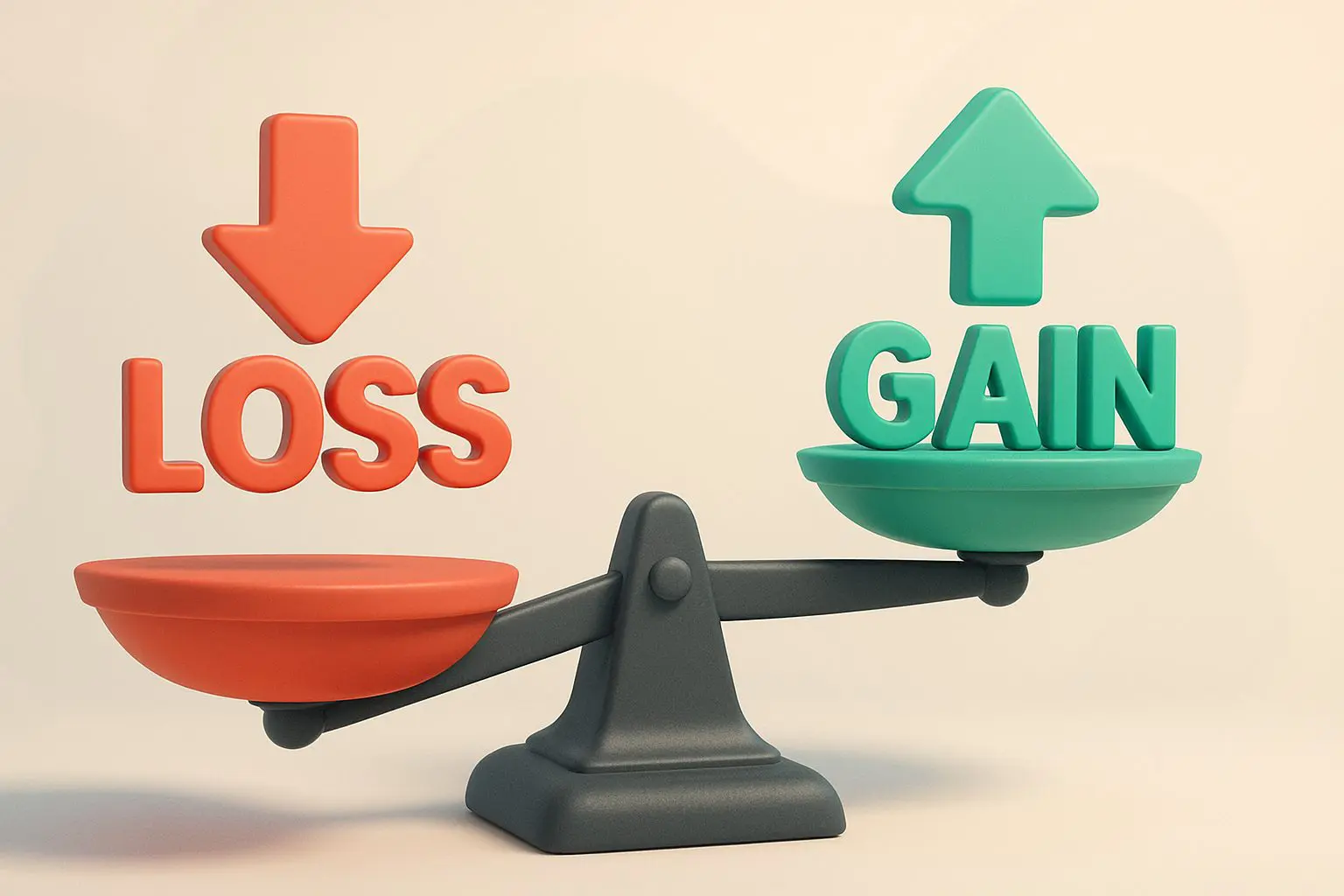
Loss aversion is the emotional principle that losing something hurts more than gaining something similar feels good.
Yes, exactly that.
No matter how strange it might seem, this is a true bias, trust me.
This bias explains why we:
- keep clothes we never wear
- stay in jobs that don’t fulfill us
- continue hobbies that no longer bring joy
- avoid trying something new because “what if I lose?”
You might hold onto old beliefs, a failing project, or a relationship simply because letting go feels like a loss – even when moving on would benefit you more.
Everyday examples:
- You keep apps you don’t use because “maybe I’ll need them someday.” (I am guilty of this and try to declutter constantly!)
- You stay subscribed to a service because canceling feels like losing value. (Even if not paid, you feel like there might be future value in the videos/newsletters/service you subscribed to)
- You avoid giving away old items because you “paid good money” for them.
In communication, I’ve seen teams desperately hold onto strategies that no longer work simply because they invested time in them. And I’ve caught myself doing the same in personal decisions.
Why it works
The brain reacts more strongly to potential loss than to potential gain. Research from Daniel Kahneman (Nobel Prize laureate) suggests losses can feel twice as powerful as gains.
How to counter it
Ask:
- “If I were starting today, would I choose this?”
- “Am I holding on just because I invested something in it?”
Letting go is not losing – it’s choosing better.
5. Social Proof: We Follow the Crowd (Even When We Think We Don’t)
We are social creatures, and social proof shapes countless decisions. It’s the bias that makes you assume something is good simply because other people like it.
Daily examples:
- Choosing the crowded restaurant over the empty one.
- Buying products with the most reviews.
- Watching the show “everyone is watching.”
- Believing a rumor because several people mention it.
I’ve observed this effect in communication campaigns: once people see others supporting an idea, they feel more comfortable joining in. But it also appears in simple everyday choices – what you wear, what you read, what you follow, and what you trust.
Why it works
The brain sees collective behavior as a shortcut for safety and accuracy.
The bandwagon effect is a psychological phenomenon whereby people adopt certain behaviors, styles, or attitudes simply because others are doing so.
How to counter it
Ask:
- “Do I want this, or do I want it because everyone else does?”
- “Would I choose this if I didn’t know it was popular?”
We all follow the crowd sometimes (and it is OK because not all trends/recommendations, etc., are bad, on the contrary) – but awareness helps us choose consciously.
6. The Sunk Cost Fallacy: We Stick to Things That No Longer Serve Us
The sunk cost fallacy is the bias that makes you continue investing time, money, or energy into something simply because you’ve already invested in it.
Everyday examples:
- Finishing a book you don’t enjoy.
- Watching a bad movie because you’re “already halfway through.”
- Staying in a relationship mainly because of “the time we’ve spent together.”
- Keeping a hobby that no longer fits your life.
I’ve seen people continue PR campaigns long after they stopped delivering results – not because they made sense, but because “we’ve already invested so much.” And I’ve kept personal projects alive simply because they felt too painful to let go.
Why it works
Your brain hates the idea of wasting effort, even when continuing wastes more effort.
How to counter it
Ask:
- “If I started today, would I choose this?”
- “Am I continuing because it still makes sense… or because I don’t want to feel like I wasted something?”
Letting go is not failure – it’s clarity. (I know, there is a lot in this article about letting go!)
7. Overconfidence Bias: We Think We Know More Than We Do
This bias makes us overestimate our abilities, predictions, and knowledge. It’s not arrogance – it’s human nature.
Examples you’ll recognize:
- Believing you can get somewhere in 10 minutes… and being late.
- Thinking “I remember this perfectly”… and being wrong.
- Feeling sure you made the right choice – without comparing alternatives.
- Planning a project that “will only take an hour”… then needing three.
Overconfidence is common even among experts. I’ve seen people deliver strong messages with absolute certainty, only to later discover their assumption was incomplete.
Why it happens
Our brain wants to feel competent. Certainty feels good. Doubt feels uncomfortable.
Research shows that people tend to overestimate how accurately they perform even very simple tasks – overconfidence is prevalent even when the task is straightforward. For instance, one review noted that in easy forms of decision-making, many participants believe their chances of being correct are higher than they actually are.
How to counter it
Ask:
- “What don’t I know yet?”
- “What assumptions am I making?”
- “Have I checked other sources?”
Confidence is good. Overconfidence blinds us.
Why Understanding These Biases Matters (More Than You Think)
ID 199414282 ©Zvonkov Eugene | Dreamstime.com
These biases shape every part of your day. Not just big decisions – the small ones too.
They influence:
- what you buy
- who you trust
- how you react
- what you believe
- how you interpret situations
- how you judge people
- what you focus on
- what you avoid
- and what you think is “true”
Understanding them doesn’t mean becoming cold or analytical. It means becoming aware. You see more clearly. You pause before reacting. You notice patterns in yourself and in others. This awareness creates calmer, smarter, more intentional decisions.
And maybe the most important part:
Once you see how these biases work, you become much harder to influence without your awareness.
You gain clarity.
You feel more grounded.
You understand people better.
You communicate more clearly.
You make decisions with more confidence – and less regret.
I recently presented you on this site some studies with different recommendations of EASY things to do to live happily and long:
- Scientists Reveal the Unexpected Longevity Habit That Costs Nothing
- Scientists Say This Overlooked Habit Could Add Years to Your Life
- Scientists Say People With This Mindset Are Far More Likely to Reach Age 90+
- Add Decades, Not Just Years: 8 Habits That Could Add 20–25 Years to Your Life (Backed by a Massive Study)
- Want a Longer, Happier Life? Scientists Say This 1-Hour Habit Could Be the Key
- Want to Live Longer? Studies Say These Mental Habits May Help (No Sweat Required)
- Eat Earlier, Live Longer? What a New Study Says About Breakfast Timing, Aging, and Longevity
- Simple daily habits for a healthier mind
- How to De-Clutter Your Mind, Backed by Science
- The Personality Traits That Can Help You Live Longer (and Be Happier)
- How to Build Real Self-Esteem That Lasts (Backed by Science, Not Buzzwords)
- 17 Signs You Are Happier Than You Think
- 11 Signs You Are More Intelligent Than You Think
- Things People With High Self-Esteem Rarely Do
- How to Reduce Sugar Intake Naturally
- Science-Backed Benefits of Eating Walnuts (and How Much You Should Actually Eat)
- Things I Didn’t Expect to Happen When I Turned 40 (But Totally Did)
- 15 Signs You’re More Emotionally Intelligent Than You Think – Backed by Science
- How to Rewire Your Brain for Calm, Focus, and Joy in Midlife
- Build a Night Routine That Boosts Longevity – Science-Based
- How Much Sleep Should You Get Per Night to Be Healthy?
- This Many Cups of Coffee Could Help You Live Longer (Science Says So)
- 8 Negotiation Tricks People Use on You Every Day – Without You Even Realizing It
Photos (except those from Dreamstime) were created by ChatGPT
More amazing articles for you:
NO More Stamps: Here’s How You’ll Enter Europe Starting THIS October
What Eating Walnuts Every Day Actually Does to Your Body (The Science Will Surprise You)
This Lisbon Neighborhood Has It All - History, Ocean Views & the City’s Best Pastries
This Tiny Himalayan Kingdom Could Be the Most Fascinating Place You’ll Ever Visit
Come for the Canals, Stay for the Secrets - A Gold-Domed Basilica, a Fishermen’s Island at the Lagoo...
Scientists Tracked 22,000 People for 28 Years - One Word Predicted Who Lived Longer
Indian Dishes You Have To Try At Least Once In Your Lifetime
Travelers Are Buying What?! 50+ of the Strangest Souvenirs Ever Made

Violeta-Loredana Pascal is a communications expert, business mentor, and the founder of Earth’s Attractions and PRwave INTERNATIONAL. A pioneer in the Romanian digital PR landscape since 2005, she holds a degree in Communication and Social Sciences from SNSPA Bucharest. Violeta is a senior trainer at AcademiadeAfaceri.ro, where she leverages over 20 years of experience to teach professional courses in PR strategy and workplace productivity. By blending high-level business consulting with a passion for holistic travel and wellness, she empowers solopreneurs to overcome procrastination, build profitable brands, and design a life of purposeful adventure.