We like to think it’s always our choice. I know I like to believe that.
But psychology and marketing shape that choice more than we’d like to admit.
It sounds strange at first. I thought so too.
After more than 20 years working in marketing and communication, I’ve seen how often people make the same decision when the options are arranged in a specific way.
Let me show you.

You’ve seen it before – maybe when booking a flight, choosing a phone plan, or browsing three versions of the same product. One option is cheap but limited. One is expensive and feels excessive. And one seems perfectly balanced, almost as if it was designed for you.
That feeling isn’t an accident.
And the part most people miss is this: the “right” option doesn’t stand on its own. It only looks right because of what’s placed next to it.
Companies have learned that when people compare options side by side, they don’t evaluate each choice independently. They react to context. They gravitate toward whatever feels like the smart middle, even when that middle option isn’t objectively better – it just looks better next to the others.
This setup has a name.
The Decoy Effect.
You’ll start noticing it everywhere – airline tickets, subscriptions, and everyday purchases.
And you can see it clearly in real airline fare structures – for instance, the price tiers used on major short-haul routes such as London ↔ Paris, where three-option displays are specifically designed to nudge travelers toward the middle fare.
What the Decoy Effect Is
The Decoy Effect arises when three choices are presented:
- An inferior option (the decoy)
- A target option (the choice intended to look best)
- A baseline option
The inferior option is deliberately designed so that the target option looks superior relative to at least one other choice. This is called asymmetric dominance: the target option dominates the decoy but not necessarily the baseline. The presence of the decoy shifts perceived value without changing the target’s intrinsic value.
Psychological research shows that decisions are rarely made in isolation; choices are shaped by context and comparison. That’s the foundation behind framing effects in decision science. This means choice architecture has predictable influences on decision outcomes.
The Decoy Effect sits alongside other well-documented persuasion strategies such as the foot-in-the-door technique and the dynamics explored in my article on negotiation tricks people use in everyday interactions. These principles show how subtle framing often shapes decisions long before the negotiation begins.
Real Airline Pricing Example: London → Paris
The London–Paris route is one of Europe’s busiest short-haul corridors, and the fare structure shows the Decoy Effect in action. The flight takes about an hour, the onboard experience is nearly identical across fare types, yet the pricing tiers differ substantially.
Typical fares on the same travel dates look like this:
- Low-cost economy on airlines such as Ryanair or easyJet: ~€45–€90 one-way, often without a checked bag and with paid seat selection.
- Standard economy on carriers like British Airways or Air France: ~€110–€180 one-way, including hand luggage and better airport schedules.
- Flexible or refundable fares on the same airlines: €300–€450+ one-way, offering change/refund rights most leisure travellers do not use.
This spread isn’t about seat comfort – it’s about how value is framed. The lowest fare signals restrictions; the highest fare signals overpayment. The middle fare becomes the “sensible” pick even when travellers might not have considered paying €150 for a one-hour flight if the flexible option were not shown beside it.
That is the Decoy Effect at work: the premium tier doesn’t just exist for flexibility seekers; it also creates a contrast that makes the mid-tier fare feel balanced, safe, and justified.
Airlines fine-tune these fare families intentionally because comparative context reliably shifts choice patterns.
Pricing Psychology Across Industries
The Decoy Effect is not limited to airlines. It’s visible in many pricing scenarios where choices are compared side-by-side:
Software as a Service (SaaS) Pricing
Many digital services rely on tiered pricing because it allows them to highlight value differences quickly. The structure also gives users a sense of control, even when the tiers are deliberately designed to guide decisions. In software pricing, the pattern becomes especially visible.
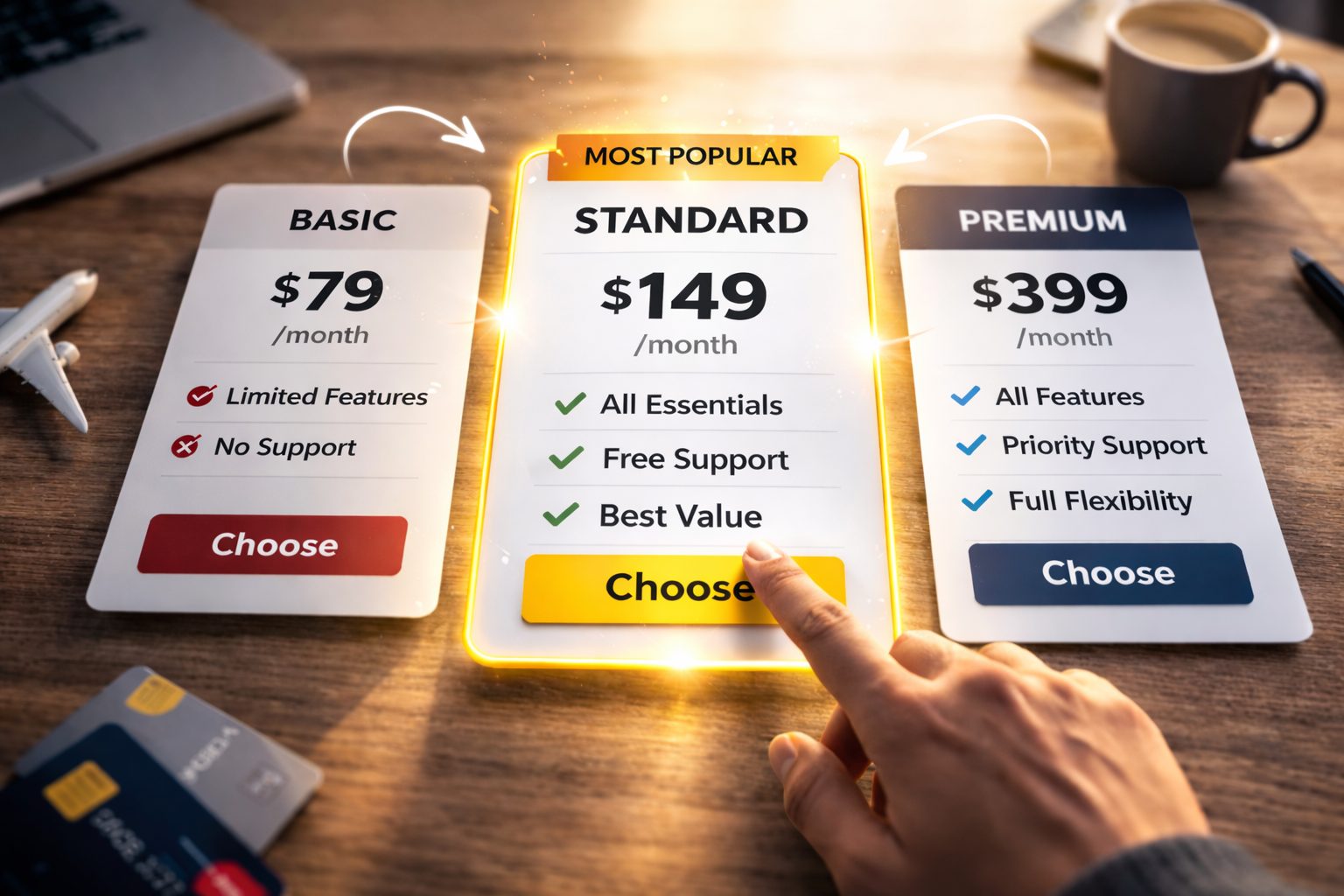
A typical SaaS structure includes a “Basic” tier with limited features, a “Standard” tier with the tools most people actually use, and a “Premium” option with advanced capabilities or priority support. Even when Premium adds features that only a small percentage of customers need, its presence reshapes perception and makes the Standard plan feel like the most reasonable choice.
The Premium plan may be only slightly more expensive than Standard, but includes extra services that a typical user does not need. This makes Standard feel like a reasonable compromise.
I would add that it has been a very long time since I saw such a service without a 3-tier offer. It is a standard, I would say.
Streaming Platforms
While individual platform pricing does not mirror airline fare families exactly, subscription bundles often work similarly – tiered plans with incremental benefits that are structured to make one tier feel like the obvious standard.
Consumer Goods and Retail
Products that come in three sizes – small, medium, large – often show price increments that make the medium option seem optimal even though per-unit cost differences may be minimal.
These are everyday manifestations of the same comparative framing.
Why the Decoy Effect Works
The Decoy Effect relies on several well-established psychological tendencies that influence how people interpret options. These tendencies operate in the background of many everyday decisions, and most of the time, people aren’t consciously aware they’re using them.
People naturally judge value by comparison rather than in isolation. A price or feature set feels meaningful only when placed next to alternatives, which is why a weaker option can shift the perceived strength of another.
There is also a strong tendency to avoid extremes. Many people feel uneasy choosing the cheapest or most expensive option, especially when the stakes involve money, commitments, or uncertainty.
Context cues matter too. A feature that feels unnecessary on its own can suddenly feel essential when contrasted with a clearly inferior alternative.
As you can see, the decoy doesn’t change the product; it changes the psychological frame through which the product is interpreted.
How to Recognize a Decoy Option
A decoy option usually reveals itself when one choice looks like a watered-down version of another without offering any meaningful unique benefit. The target option then stands out because it consistently outperforms the decoy on almost every attribute. If removing the inferior option would make the decision materially harder – or would significantly change which choice feels right – you’re likely dealing with a decoy.
If the middle option suddenly becomes the obvious pick only after a third option appears, you’re likely looking at a deliberate decoy structure.
How to Make Better Decisions When Faced With Three (or More) Options
A simple way to resist the pull of a decoy is to pause the comparison process entirely. Instead of evaluating options against one another, bring the focus back to your personal criteria and the real problem you are trying to solve. This breaks the psychological framing the options create.
You know I always provide useful recommendations and tips. So here is a practical way to bypass the Decoy Effect: shift focus from comparison to criteria. Instead of asking, “Which option looks best?” ask:
- What do I actually need?
- Does each option meet those needs independently?
- Is the extra cost justified by real utility, not relative positioning?
- Would I still choose this if one of the other options disappeared?
This approach forces the evaluation back onto your values rather than the company’s framing. Critical evaluation reduces the cognitive bias introduced by decoys.
If you want to understand how people sometimes shape outcomes through strategic sequencing or contrast, my deep dive on the door-in-the-face technique offers another useful lens for evaluating requests and offers.
In negotiations, the Decoy Effect can also be used deliberately to shape how offers are perceived. When presenting three options to a client or stakeholder, the decoy can highlight the value of your preferred proposal without overt persuasion. A basic version might present a bare-bones option, a strategically weaker mid-tier alternative, and the offer you actually recommend. The contrast makes the recommended option feel more balanced and thoughtful, even though the underlying terms remain unchanged.
How the Decoy Effect Can Be Used Responsibly
Choice architecture is unavoidable in pricing, but transparency is key. Ethical use means:
- Clear, comprehensible feature lists
- Honest differences between tiers
- No artificial restrictions created solely to make a tier look weak
When the structure helps people understand value rather than obscuring it, trust increases – even when nudges are present.
Choice Architecture Is Everywhere
Whether booking a flight between London and Paris, comparing software plans, or choosing a subscription tier, three-option structures rarely appear by accident. They are designed to shape perception, guide preference, and frame value.
Once you start noticing this pattern, it becomes difficult to ignore. The same structure shows up in food delivery apps, online shopping bundles, mobile plans, hotel rates, insurance quotes, and even museum ticketing systems. Recognizing it gives you a small but meaningful advantage: awareness. Instead of being directed toward a “default” choice, you can pause long enough to decide based on your own criteria.
Understanding the Decoy Effect turns selection from something reactive into something intentional – and that small shift changes the quality of many everyday decisions.
This article is part of my series on negotiation psychology and influence strategies, where I break down the subtle tactics that shape decisions in business and everyday life.
Photo sources: Featured by Pexels and second by ChatGPT
More amazing articles for you:
You’re Probably Ignoring the Easiest Way to Make Extra Money - 7 Ways to Turn What You Already Know ...
People Are Losing It Over This In-Flight Behavior - And You’ve Definitely Seen It
Don’t Read This While Hungry: 16 Spanish Dishes So Good You’ll Book a Trip Just to Eat — You Can Alm...
Travelers Are Buying What?! 50+ of the Strangest Souvenirs Ever Made
Everyone Has Vacation Photos. So Why Do We Still Keep Buying Fridge Magnets?
Tourists Kept Hogging the Best Sunbeds. One Man Finally Fought Back - Then His Revenge Went Viral. B...
8 Singaporean Foods That Will Blow Your Mind (and Where to Try Them)
The Words You Use About Yourself Could Predict Your Lifespan - Here’s the One That Matters Most

Violeta-Loredana Pascal is a communications expert, business mentor, and the founder of Earth’s Attractions and PRwave INTERNATIONAL. A pioneer in the Romanian digital PR landscape since 2005, she holds a degree in Communication and Social Sciences from SNSPA Bucharest. Violeta is a senior trainer at AcademiadeAfaceri.ro, where she leverages over 20 years of experience to teach professional courses in PR strategy and workplace productivity. By blending high-level business consulting with a passion for holistic travel and wellness, she empowers solopreneurs to overcome procrastination, build profitable brands, and design a life of purposeful adventure.