
My husband loves Spain. He loves the atmosphere, the relaxed feeling, the beautiful landscapes, and the way people seem to enjoy life without turning every hour into a productivity contest. I know that sounds simple, but when you compare it with the constant pressure many people live with in the U.S., in Romania, and in other busy countries, simple starts to look very appealing.
Spain also happens to have one of the highest life expectancies in the world. Recent OECD figures place Spain at around 84 years, while the United States is around 79 years. A major 2018 projection also suggested Spain could have the world’s highest life expectancy by 2040.
I don’t want to turn this into another exaggerated article about one “Mediterranean secret.” Spanish longevity is real, and the best way to understand it is to look at the habits behind it – then see which of them we can realistically bring into our own daily lives too.
So this article is not about copying Spain perfectly. It is about looking at the Spanish habits that are actually useful and easy to implement so that our lives get more relaxed, healthier, and happier. And speaking of the Spanish life, I also have for you 150 Spanish proverbs and sayings with English translations and meanings – I can assure you, you will find interesting sayings in the article!
Why Do People in Spain Live Longer?
From what I see, Spain’s longevity is not about one perfect habit, but about several habits adding up. Let’s see them one by one.
1. Meals Are Treated as a Pause, Not a Productivity Problem
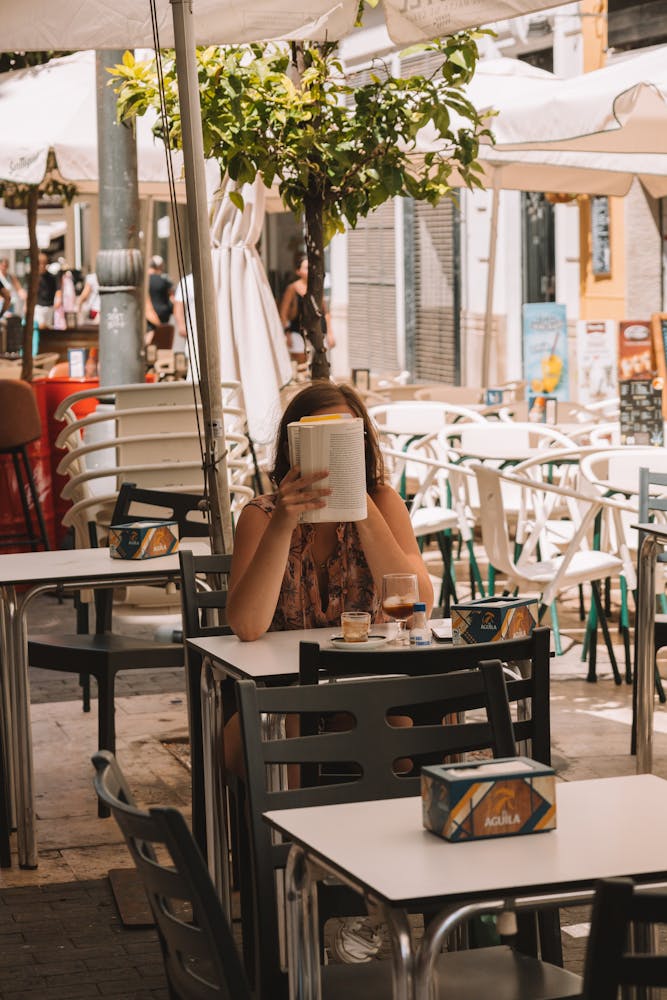
One of the most useful Spanish words for understanding the culture is sobremesa. It literally refers to the time spent at the table after the meal, when the food is finished, but people continue talking, drinking coffee, sitting together, and not rushing away immediately.
For many visitors, this is one of the first differences they feel in Spain. A meal doesn’t always end the second the last bite is gone. The bill doesn’t necessarily appear automatically, as it often does in many other places, and the table is not treated as something that must be cleared as quickly as possible.
I know this can feel strange if you come from a faster culture. You finish your food, look around, and wonder why no one is bringing the check. In Spain, in many restaurants, you usually ask for it when you’re ready. That small difference changes the whole mood of the meal. You’re not being pushed out, and you’re not expected to act as if eating is only a refueling stop.
For American readers especially – or people in countries with a huge focus on productivity and working long hours -, this may be the easiest habit to recognize because the contrast is sharp. Lunch at a desk, a sandwich in the car, coffee while answering messages, dinner in front of a screen – these are normal in many busy lives. Spain reminds you that a meal can still have boundaries around it.
And no, you don’t need to recreate a two-hour lunch every day. Even staying at the table for ten more minutes without checking your phone can make the meal feel calmer. You are eating, talking, finishing the moment properly – not swallowing food while already thinking about the next task.
2. Walking Is Built Into the Day
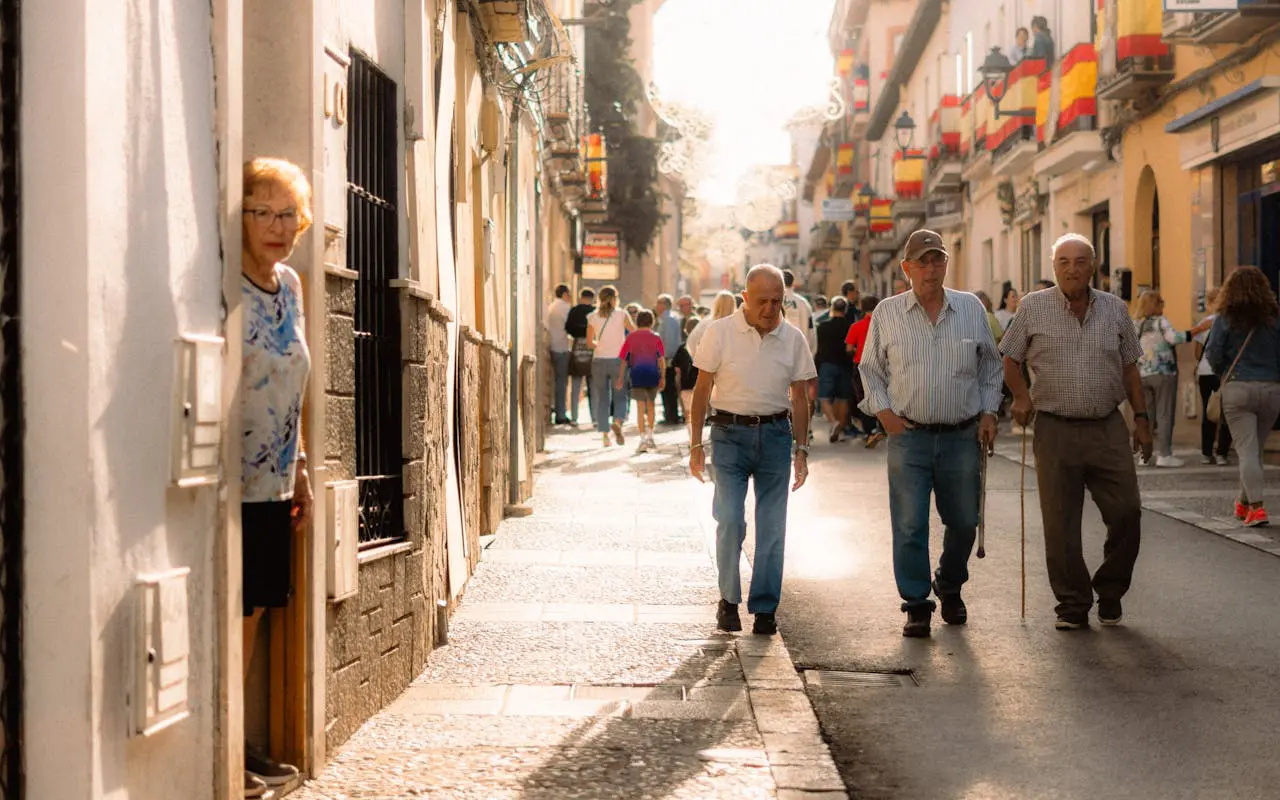
The Spanish paseo, or evening walk, is one of the habits people visiting Spain notice quickly, especially in towns and walkable neighborhoods. People go out after work, after errands, before dinner, or after dinner. They walk with family, with friends, with children, with dogs, or alone. The idea is spending time outside and moving through the place where you live.
This is a very different relationship with movement than the one many people have in car-dependent places. In the United States, movement is often separated from life. You sit most of the day, then try to compensate with a workout. That can be useful, of course, but it also makes movement feel like another obligation.
In Spain, especially in walkable cities and older towns, movement is often tied to normal life. You walk to buy bread, to meet someone, to reach the plaza, or after a meal because the evening is cooler and people are outside.
If you like slow travel and have time, you should pay attention to ordinary streets, not only famous attractions. You can learn a lot about a place by watching who uses the sidewalks at 7 or 8 PM. In Spain, you may see older people walking slowly but consistently, families with children, teenagers meeting friends, and people treating the street as part of daily life.
For anyone trying to borrow one Spanish habit at home, this is probably the easiest place to start. Don’t turn the walk into a punishing routine or another productivity project. A 15- or 20-minute walk after dinner is already useful if the alternative is sitting for the rest of the evening.
3. Lunch Is Often the Main Meal, While Dinner Can Be Lighter
ID 38757860 © Visionsi | Dreamstime.com
One thing that surprises many visitors in Spain – and my husband was surprised too – is how late dinner can be. Restaurants may not open for dinner when a hungry tourist expects them to. If you arrive ready to eat at 6 PM, you may discover very quickly that you might need to wait.
I don’t think late dinners should be presented as a universal health rule. For many people, eating very late and very heavily is not ideal, especially if they have reflux, sleep problems, blood sugar issues, or a schedule that forces them to wake early.
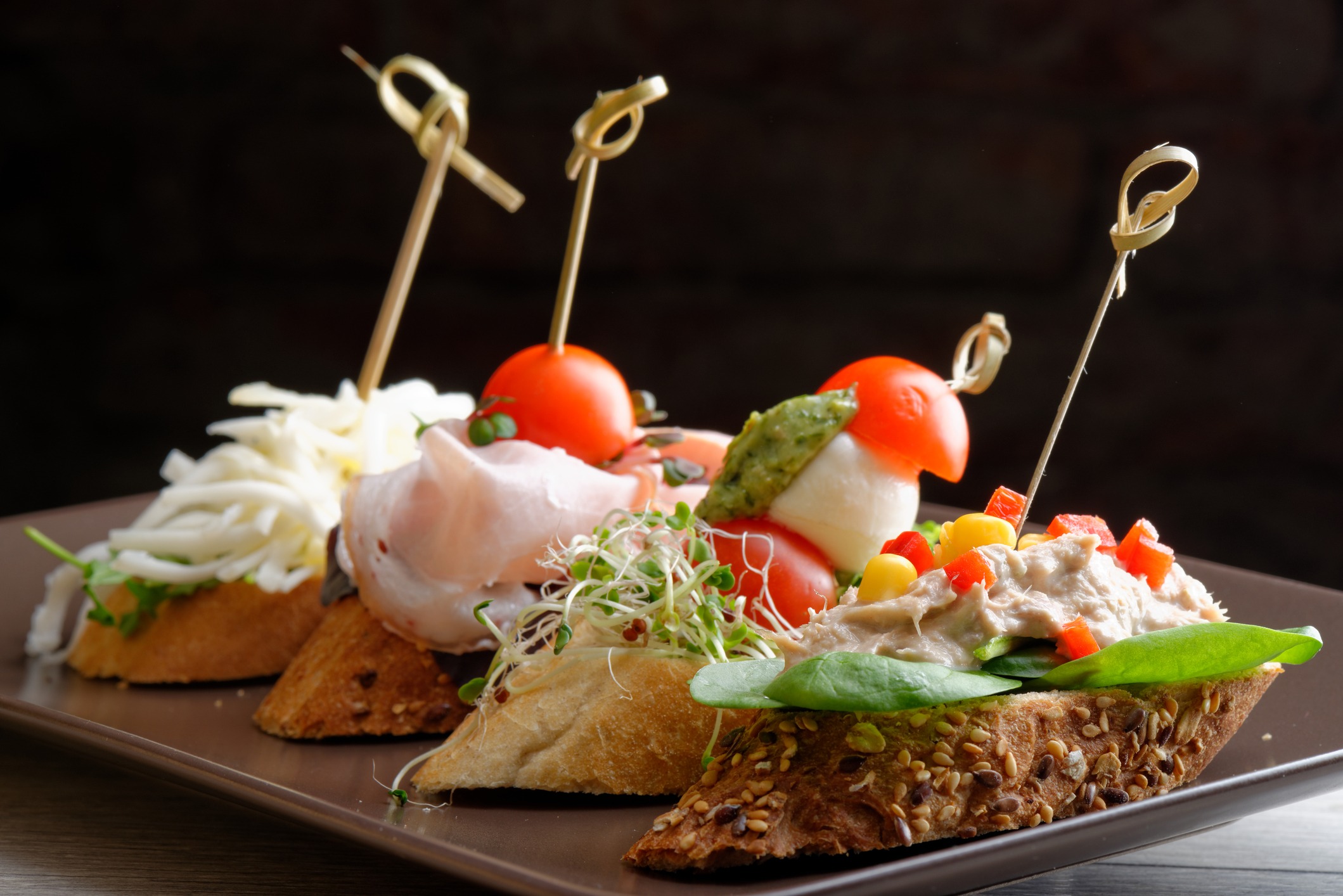
There is a logical explanation for the late dinner. In Spain, the midday meal has traditionally been the larger meal of the day, while dinner is often lighter. Tapas, a tortilla, fish, salad, soup, or smaller plates can make a late dinner feel very different from a large, heavy meal eaten right before bed.
A late dinner in Spain is not the same as skipping food all day, then eating a huge meal at night because the day collapsed into work, stress, and errands. Here, there is usually a more substantial lunch, fresh ingredients, walking, social eating, and a lighter evening meal.
As a Romanian, I also grew up hearing the idea that dinner should be earlier and lighter – I too eat it before 7 PM (sometimes even before 6 PM). Many people in Europe hear this advice. So I wouldn’t tell anyone to copy Spain’s dinner hour without thinking about their own body and schedule. But I would take from Spain the idea that dinner doesn’t need to be the biggest meal of the day.
If you’re visiting Spain, plan your meals around Spanish hours instead of fighting them. Have a proper lunch, take a late-afternoon snack if needed, and don’t expect every restaurant to serve dinner early. You’ll enjoy the trip more if you stop treating the local schedule as an obstacle.
4. Rest Is More Accepted, Even If the Daily Siesta Is Often Exaggerated
The siesta is probably the most misunderstood Spanish habit. It is often described as if everyone in Spain stops working every day, goes home, sleeps for hours, and returns perfectly refreshed. That’s not modern Spain. In big cities, many people don’t take a siesta at all, and plenty of Spaniards have demanding schedules like everyone else.
Still, the idea behind the siesta says something important about the culture. The older rhythm of pausing during the hottest part of the day had practical roots, especially in warmer regions and in agricultural life. Today, that rhythm survives unevenly. In some places, shops may still close in the afternoon. In others, the schedule is much closer to what visitors expect in any modern city.
The part worth borrowing is not necessarily a long nap. In fact, long daytime naps can be complicated, and research on napping depends heavily on duration, age, health, and sleep quality. A short rest can help some people, but long or frequent naps may also signal poor nighttime sleep or health problems.
What I like more is the permission to pause. Many people push through the afternoon crash with more coffee, sugar, scrolling, or irritation. I know the 3 PM energy crash is real because I’ve felt it too. At that point, the body may need a real break, better food, hydration, sleep, or a few minutes away from the screen – not another productivity trick.
A Spanish-inspired version of rest can be very simple: close your eyes for 10 minutes, sit outside without your phone, take a short walk after lunch, or stop treating every drop in energy as a personal flaw.
5. Public Spaces Encourage Social Life
Spanish plazas are not only pretty spaces for tourists to photograph. They are part of how daily life works. People meet there, children play there, older people sit there, friends talk there, and cafés spill out into the public space. The plaza makes social life easier because it gives people a place to be without needing a formal invitation.
This is one of the strongest contrasts with places where daily life is organized around cars, private homes, and shopping centers. If every social interaction requires a drive, a plan, a booking, and a full evening commitment, many people simply socialize less. In Spain, especially in walkable neighborhoods, connection can happen in ordinary moments.
I noticed something similar in my own life when I had our beautiful Maxie, our metis Border Collie. We went out for walks several times a day, and we knew we would meet people. Usually, they were people with dogs who became friends with Maxie first (because we adopted her from the street when she was 1 year old), and then with us. We stopped, talked, laughed, exchanged small updates, and those small interactions became part of the day.
I know that kind of contact is easy to underestimate. It is not only about having one deep conversation from time to time. It is the repeated, ordinary contact that keeps people visible to each other. You know the person at the bakery. You recognize the older man on the bench. You say hello to the woman with the dog.
Strong social connections have been linked with better health and longevity in many studies, and Spain’s daily public life gives people more chances to maintain those connections. Of course, loneliness exists in Spain too. No country is protected from it. But the built environment and social habits can make connection easier or harder, and Spain has many places where the street still supports community life.
6. Fresh Food Is Still Part of the Culture
Spain has supermarkets, processed food, fast food, delivery apps, and all the modern conveniences we know and use. It would be false to pretend every Spanish family shops daily at a traditional market and cooks everything from scratch.
But fresh food still has a stronger place in the culture than it does in many highly processed food environments. Markets, bakeries, fish counters, fruit shops, small neighborhood stores, and seasonal produce remain visible in everyday life. Even when people shop at supermarkets, the Spanish diet is still strongly connected to vegetables, legumes, fish, olive oil, fruit, potatoes, eggs, bread, and simple dishes that don’t require much processing.
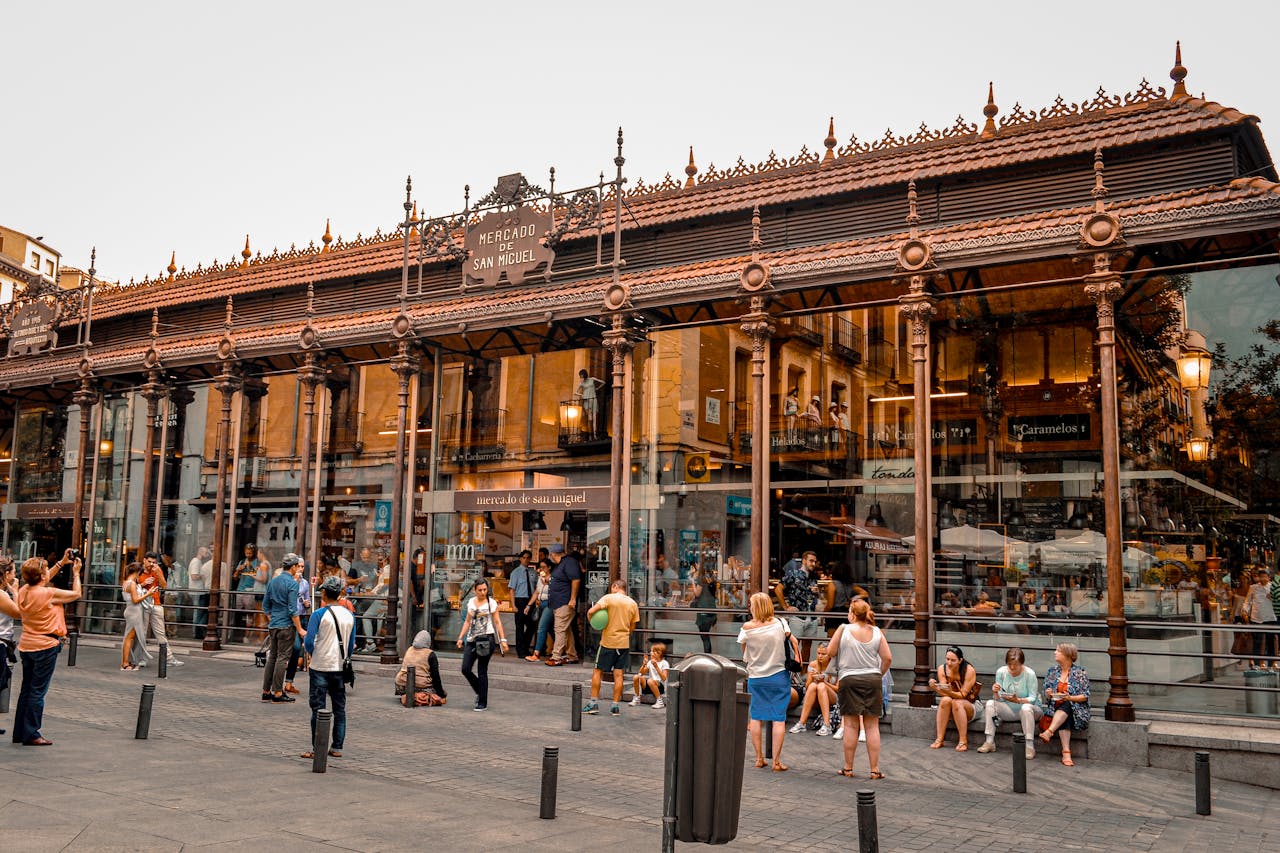
For travelers, visiting a mercado is one of the easiest ways to understand this. You see jamón, fish, olives, tomatoes, bread, cheese, fruit, and prepared foods that still look connected to the ingredients they came from. One of my husband’s colleagues told us that he and his wife are from different regions of Spain and they use different terms for the same type of fish – and that is funny when they go shopping.
7. Olive Oil Is Ordinary, Not a Wellness Product
Olive oil is one of the most famous parts of the Mediterranean diet, and Spain is one of the world’s major olive oil producers. But what I find useful is not the romantic language around “liquid gold.” It is the normality of it.
In Spain, olive oil is not treated as a rare wellness upgrade. It is part of breakfast, lunch, dinner, cooking, salads, grilled vegetables, fish, gazpacho, and pan con tomate. It is used because it tastes good and because it belongs to the food culture, not because someone is trying to turn dinner into a health performance.
The Mediterranean diet has been studied for its association with better cardiovascular health and lower risk of several chronic diseases. Olive oil is part of that pattern because it provides monounsaturated fats and polyphenols, especially when it is extra virgin olive oil.
Pouring olive oil over a poor diet will not recreate the Mediterranean lifestyle. The real Spanish habit is using olive oil alongside vegetables, legumes, fish, nuts, fruit, bread, potatoes, eggs, and meals that are often simpler than the glossy version of Mediterranean food shown online.
This is also easy to adapt at home: use good olive oil where it makes sense, eat more vegetables and legumes. A healthy diet is easier to keep when it is enjoyable 🙂
8. Joy Is Built Into Ordinary Food
One reason Spain’s lifestyle feels appealing to outsiders is that food pleasure is not treated as the enemy of health. Tapas, coffee, bread, wine, olive oil, seafood, tortillas, fruit, churros, markets, long lunches, and late dinners all exist inside the same food culture.
This is one of the reasons I think Spain’s food culture attracts so much attention. It does not look like punishment. People can enjoy tapas, bread, olive oil, coffee, seafood, and a long lunch without turning every bite into a moral decision. Of course, not every Spanish meal is automatically healthy, but the relationship with food often feels less tense than the one promoted by modern wellness culture.
Spain offers a different reminder, and it is one that travelers can feel immediately: a good meal can be part of a good life without becoming a personal identity project. You can eat slowly, enjoy the food, talk to people, and still care about health.
What Foreigners Can Realistically Learn From Spanish Habits
I don’t think the answer is to copy Spain as if culture can be imported in seven steps. Many Americans and people from various countries live in places where walking is hard, lunches are short, healthcare is expensive, work pressure is high, and fresh food can cost more than processed food. Telling people to “just live like the Spanish” ignores real constraints.
For me, the main idea is being more relaxed, less controlling, and more willing to do less.
You can make lunch a real meal when your schedule allows it. You can take a short walk after dinner. You can stop eating every meal in front of a screen. You can use olive oil, beans, vegetables, fish, eggs, fruit, and simple foods more often. You can invite people to sit longer after a meal instead of clearing everything immediately. You can choose one errand to do on foot if your neighborhood allows it.
These are simple changes, and they won’t make anyone live forever. But they are close to what researchers often find when studying longer-lived populations: daily movement, strong social connections, better food patterns, and lower chronic stress repeated over many years.
Conclusion
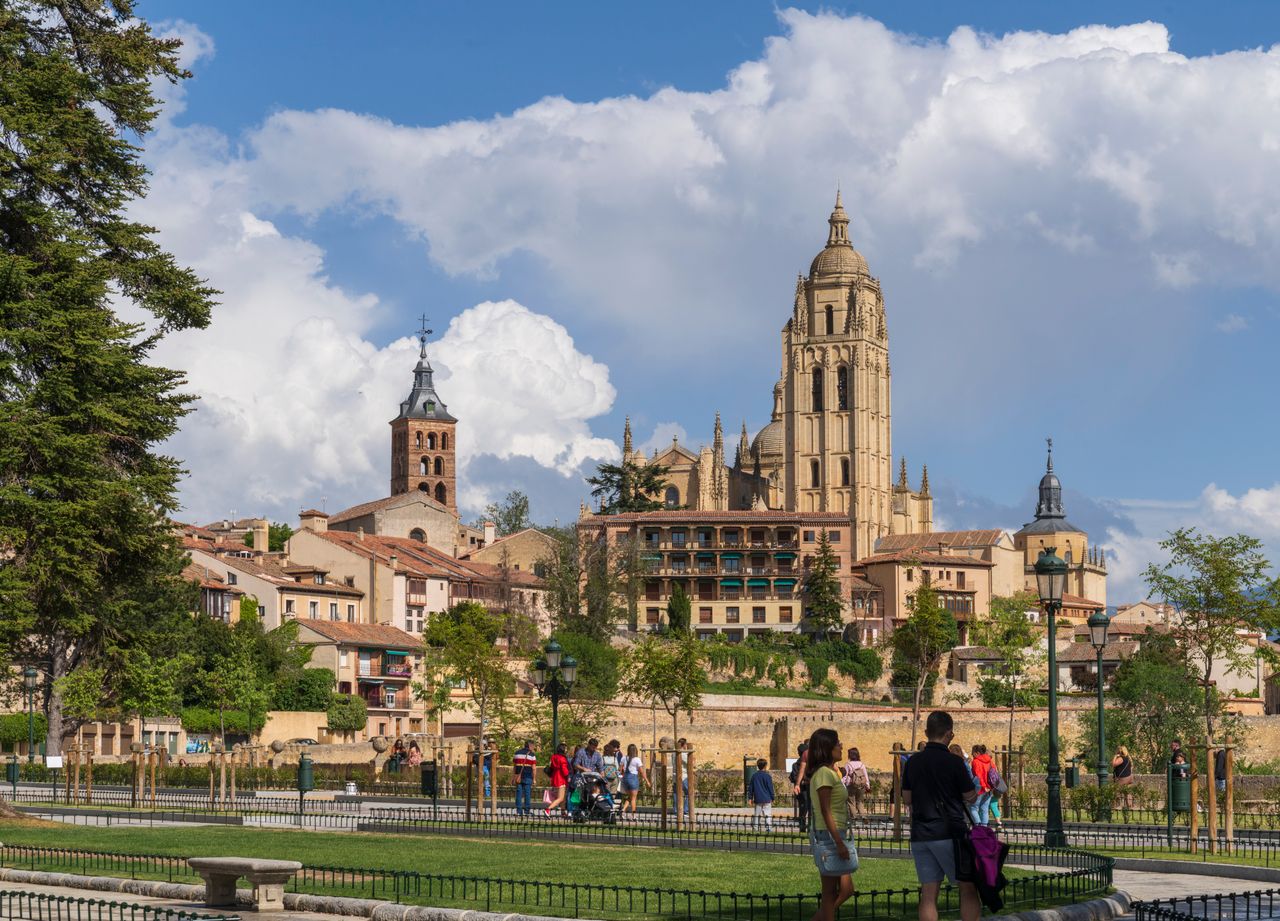
Spain’s longevity is connected to many things: food, movement, healthcare, culture, public spaces, climate, and daily routines that developed over time. I don’t think we can separate one habit and say, “This is the reason.” It is more realistic to look at the lifestyle as a whole and choose what can actually fit into our own lives.
For me, the most useful idea is not to copy Spain perfectly, but to question the way we rush through ordinary things. Eating, walking, resting, talking to people, buying food, spending time outside – these are not new ideas, and they are not complicated. In Spain, many of them feel more natural because they are part of daily life, not something added later as another task.
If one small habit makes your day calmer, healthier, or more enjoyable, it is worth trying. And if it becomes natural, you can add another.
FAQs About Spanish Habits and Longevity
Why do people in Spain live longer?
People in Spain tend to live longer because of a combination of factors, including a Mediterranean-style diet, regular walking, strong social routines, access to healthcare, and lower rates of some preventable causes of death. No single habit explains Spanish longevity on its own.
Does Spain have a higher life expectancy than the United States?
Yes. Recent OECD and CDC figures place Spain around 84 years and the United States around 79 years. That is a meaningful difference, but it is not “decades,” so headlines using that claim should be avoided.
Is Spain projected to have the highest life expectancy in the world?
A major 2018 projection published in The Lancet and widely reported at the time suggested Spain could overtake Japan by 2040. Projections can change, so it is better to phrase this carefully: Spain has been projected to lead global life expectancy by 2040, but it is not a guaranteed current fact.
Is the Spanish diet the main reason people in Spain live longer?
The Spanish diet is important, especially because it often includes olive oil, vegetables, legumes, fruit, fish, and fresh ingredients. But diet is only part of the picture. Walking, social connection, public space, rest, healthcare, and daily routines also contribute to the broader longevity pattern.
Do Spanish people really take a siesta every day?
No. The daily siesta is often exaggerated, especially in English-language travel writing. Some people still rest or nap in the afternoon, particularly in warmer regions or during summer, but many people in modern Spain do not take a daily siesta.
Is eating dinner late healthy?
Late dinner is not automatically healthy. In Spain, late dinners often make more sense because lunch is traditionally the larger meal and dinner may be lighter. For people with reflux, sleep problems, blood sugar issues, or early work schedules, eating late may not be ideal. The hour itself is not the main point. What matters more is the broader context: a proper lunch, a lighter dinner, walking, and less rushed eating.
What Spanish habits can I copy at home?
The easiest habits to adapt are walking after meals, eating more slowly, making lunch a real meal when possible, using olive oil and fresh ingredients more often, spending more time with people at the table, and taking short breaks before exhaustion builds. These are realistic changes that don’t require moving to Spain.
Sources
OECD Health at a Glance 2025: Spain: Spain life expectancy and health profile
CDC National Center for Health Statistics: Mortality in the United States, 2024
The Guardian report on the 2040 life expectancy projection: Spain projected to top life expectancy league table by 2040
NIH / PMC review on the Mediterranean diet and life expectancy: Mediterranean diet and life expectancy
El País English on the Spanish siesta myth: The Spanish siesta: myth or reality?
More amazing articles for you:
When Someone Interrupts You, It’s Usually Not Rudeness - It’s This (And How to Stop It)
7 Subtle Signs Someone Is Judging You (And How to Respond Confidently)
What to Say Instead of “Sorry” When You Want to Sound More Confident
A local's guide to Tampa: best attractions in Tampa, where to eat and stay, and tips
200 2010s Trivia Questions and Answers - Easy to Hard. How Many Can You Get Right?
You’ll Feel Better After Saying “No”: The Science-Backed Guide to Setting Powerful Boundaries
3 Large Vehicle Options for Carrying Groups of People
Why Are Airports So Stressful? The Real Psychological Reasons (And How to Stay Calm)

Violeta-Loredana Pascal is a communications expert, business mentor, and the founder of Earth’s Attractions and PRwave INTERNATIONAL. A pioneer in the Romanian digital PR landscape since 2005, she holds a degree in Communication and Social Sciences from SNSPA Bucharest. Violeta is a senior trainer at AcademiadeAfaceri.ro, where she leverages over 20 years of experience to teach professional courses in PR strategy and workplace productivity. By blending high-level business consulting with a passion for holistic travel and wellness, she empowers solopreneurs to overcome procrastination, build profitable brands, and design a life of purposeful adventure.