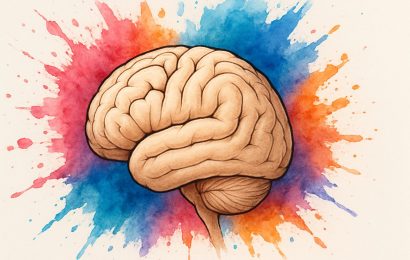
You can have an amazing day, hear one rude comment, and suddenly everything feels ruined.
Sound familiar? Neuroscientists have a fascinating explanation.
That’s your brain’s built-in negativity bias at work – an ancient survival reflex that once helped us avoid predators but now turns modern life into a mental minefield. A single criticism can loop endlessly in your thoughts, fueling stress, anxiety, and self-doubt, while praise slips quietly through the cracks.
Negativity bias affects how we think, feel, and make decisions – from relationships to work performance to personal confidence.

Neuroscientists say this isn’t weakness or oversensitivity – it’s wiring. The same system that once kept our ancestors alive now keeps many of us on edge, replaying every mistake or insult in high definition.
But here’s the good news: your brain isn’t fixed that way forever.
New research shows that we can actually reshape how we respond to the negative – training the mind to notice, process, and let go instead of clinging and replaying.
Let’s dive in.
What Is Negativity Bias? Definition, Psychology, and Why Your Brain Overreacts to the Negative
Psychologists define negativity bias as the tendency for bad events to be more influential than equally intense good events. In a landmark review – often summarized as “bad is stronger than good” – Roy Baumeister and colleagues concluded that this pattern appears across many domains: emotions, learning, relationships, and self-evaluation. It’s not just a mood habit; it’s a pervasive feature of cognition.
Psychologists define negativity bias as the built-in tendency to notice, remember, and react more strongly to negative events – one of the most researched cognitive biases. This built-in bias explains why we pay more attention to criticism, why negative memories feel sharper, and why our brain overreacts under stress.
So, negativity bias is the brain’s tendency to give more weight to negative experiences than positive ones. This means we notice threats faster, remember criticism longer, and react more strongly to unpleasant events than equally intense positive ones. Psychologists view it as an evolution-shaped survival mechanism that still influences our emotions, decisions, and relationships today.
Why We Focus on the Negative: The Evolutionary Purpose of Negativity Bias
Understanding negativity bias is the first step toward reducing overthinking, rumination, and the habit of replaying past mistakes.
From an evolutionary perspective, missing a threat (the snake you didn’t notice) was costlier than missing a treat (the berry you didn’t eat).
So our neural systems over-weight the negative to keep us alive. Modern environments rarely include predators, but the same circuitry can tag a sharp email, offhand remark, or social media jab as if it were a survival-relevant signal.
Reviews in emotion and memory research show that negative stimuli capture attention, shape learning, and are prioritized in memory formation.
Researchers frequently describe negativity bias as an adaptive survival mechanism – the reason the brain scans for danger faster than rewards.
The Amygdala and Negativity Bias: Why Your Brain Stores Negative Memories More Vividly
The amygdala works like a salience detector – it doesn’t only respond to fear, but it’s especially sensitive to emotionally charged stimuli. Neuroimaging shows that amygdala activity during the encoding of emotional material predicts what we will later remember.
In one influential study, amygdala activation at the time people viewed emotional items predicted subsequent memory for both positive and negative items- yet negative information often generates stronger, more specific recall.
A broader synthesis suggests that the amygdala enhances encoding of emotionally arousing content – particularly negative – and strengthens connections with sensory and memory systems. This helps explain why an insult’s tone, facial expression, and exact wording can feel etched in stone.
Further, research on post-encoding coupling finds that amygdala interactions with visual cortex after we experience something emotional can influence the degree of negative or positive memory bias that forms. In other words, the brain may keep “processing” and consolidating that moment after the fact.
This helps explain why negative comments feel ‘sticky,’ while positive ones fade – a common real-world experience of negativity bias.
Why Negative Memories Feel Stronger Than Positive Ones

ID 321297365 | Head ©Andrii Yalanskyi | Dreamstime.com
Often, yes. Experiments show people can remember the visual specifics of negative objects (e.g., a weapon’s details) more precisely than neutral ones, consistent with amygdala–fusiform interactions that sharpen perceptual memory.
This does not mean all negative events are remembered perfectly (memory is never a perfect recording), but it does explain why certain hurtful comments feel unusually crisp in recollection.
Multiple studies confirm that the brain encodes negative information with higher resolution, which is why insults and embarrassing moments replay so clearly.
Real-Life Negativity Bias Examples: Work, Relationships, Social Media, and Self-Talk
Negativity bias shows up in more places than we realize. Common examples include:
- Performance reviews: One constructive criticism outweighs ten compliments.
- Relationships: A tense conversation feels more memorable than dozens of warm interactions.
- Social media: A single negative comment sticks while hundreds of likes fade quickly.
- Decision-making: We avoid risks because our brain exaggerates potential losses compared to gains.
- Self-talk: We replay mistakes but rarely replay achievements.
As you can see, these patterns aren’t personal flaws – they’re predictable cognitive tendencies.
By the way: these everyday scenarios are among the most common places people notice negativity bias without realizing it.
Is the Negativity Bias Universal? What New Research Says
Not universally. Some philosophers and scientists have challenged how broadly we should apply the claim.
For instance, Jacob Corns argues that evidence is mixed across contexts, and that the bias may depend on how we define “strength” (e.g., intensity, duration, frequency) and which outcomes we measure. This is a healthy reminder that psychology is nuanced. Still, the preponderance of empirical work shows a robust tendency for the negative to exert outsized effects in many everyday situations.
A recent evolutionary and theoretical analysis likewise supports the idea that our perceptual and cognitive systems may tilt negative for adaptive reasons, while also noting boundary conditions. In practice: expect the bias, but don’t treat it as destiny.
Not all researchers fully agree on how universal negativity bias is, but most studies still show a strong tendency across memory, attention, and emotional learning.
How to Overcome Negativity Bias: Mindfulness, Gratitude, and Brain Retraining
The encouraging part: neural systems are plastic. Several lines of research suggest that mental training can reduce stress reactivity and tilt attention toward the constructive without denying reality.
One thing you should consider: these practices don’t erase negative experiences – they rebalance your attention system.
Mindfulness and the stress circuit
Mindfulness meditation has been associated with changes in stress-related neural pathways.
In a randomized study, mindfulness training altered functional connectivity between the amygdala and subgenual anterior cingulate cortex (sgACC) – a pathway implicated in emotional regulation. Participants also showed reduced stress reactivity.
Additional work comparing short- and long-term meditators found reduced amygdala reactivity to emotional images and enhanced coupling with prefrontal regions during affective processing – consistent with better top-down regulation. (Note: effects can be stimulus-specific, and not every study finds broad reductions.)
Popular summaries often show striking “before/after” fMRI images, which can be an oversimplification; still, the core finding – that training attention can modulate emotional brain responses – has support.
Gratitude practices and well-being
The classic gratitude journal experiments by Emmons & McCullough found that people who regularly listed items they were grateful for reported higher well-being, more optimism, and fewer physical complaints compared to those listing hassles. This doesn’t eliminate negativity bias, but it nudges attention toward positive inputs.
Evidence in adolescents shows similar benefits: focusing on blessings improved life satisfaction and reduced negative affect versus control conditions.
Reviews and white papers summarize multiple trials and meta-analyses of gratitude interventions, generally finding small-to-moderate improvements in well-being. Translation: gratitude is helpful, but not a cure-all.
Bottom line: Mindfulness and gratitude don’t erase pain or make criticism pleasant. They rebalance what your brain pays attention to, building habits that counter the default tilt toward the negative.
Research shows that simple practices like mindfulness, gratitude, and cognitive reframing can help retrain the brain’s threat-detection system.
Signs You’re Experiencing Negativity Bias (Psychology Checklist)
If you notice any of these patterns, you may be experiencing negativity bias:
- You dwell on mistakes long after others have forgotten them
- Compliments feel good briefly, but criticism feels heavy
- You assume the worst before the best
- You replay awkward moments or conflicts repeatedly
- You feel hyper-aware of disapproval
- Positive feedback feels “fake,” but negative feedback feels true
- A single bad moment can ruin an otherwise good day
These reactions are common – and changeable. Also, these patterns are among the most frequently reported signs of negativity bias in both clinical and everyday settings.
How to Stop Replaying Negative Comments: Science-Based Tools
Use these as experiments, not obligations. If something increases distress, stop and consult a professional.
Each of these strategies helps interrupt the loop that drives negative rumination.
Name and normalize the bias (1–2 minutes). When a critique lands, mentally label: “This feels huge because of negativity bias.” Naming reduces fusion and gives you a choice. (Framing grounded in the “bad is stronger than good” literature.)
90-second mindful reset. Sit upright, inhale gently, and track the breath’s sensations. When your mind jumps to the insult, acknowledge (“thinking”) and return to the breath. Over time, this can reduce stress reactivity (see amygdala-sgACC work). (study quoted above)
Evidence check in writing. List:
- What was actually said?
- What evidence supports it?
- What evidence contradicts it?
This leverages the brain’s bias toward rehearsing the negative by introducing counter-evidence and context. (Consistent with cognitive approaches to emotion and learning.) (study quoted above)
“One-for-five” reinforcement. Because negative inputs weigh more, deliberately collect 3–5 concrete positives (emails, screenshots, thank-yous) for every sharp critique. This is not toxic positivity; it’s counter-weight.
Gratitude log, 3×/week. Write 3 specific, fresh things you’re grateful for (avoid repeats). Two minutes is enough. The classic studies used short entries but found reliable benefits. (study quoted above)
Situation design. Reduce exposure to unnecessarily harsh channels (e.g., doomscrolling). The bias makes those inputs stickier; limiting inflow is not avoidance – it’s smart hygiene.
Compassion practice (advanced). Some people find loving-kindness or compassion meditations soften self-criticism and anger. Early evidence overlaps with mindfulness benefits, though results vary by person.
What to Know Before Trying to Overcome Negativity Bias. Disclaimer
Not medical advice. The information here is educational and not a diagnosis or treatment plan. If you have symptoms of depression, anxiety, PTSD, or are dealing with trauma, please seek a qualified clinician.
Individual differences are real. Not everyone experiences the negativity bias to the same extent. Personality, culture, context, and mental health shape both reactivity and what works. Some studies show stimulus-specific effects (e.g., changes to responses for certain image types but not others). Manage expectations.
Effect sizes are modest. Mindfulness and gratitude help many people a little to a medium amount- which is still valuable – but they are not panaceas. Reviews and meta-analyses caution against overclaiming.
Memory is reconstructive. Even if negative events feel vivid, memory is not a perfect recording. Suggestibility, rehearsal, and current mood can reshape details over time. (See affective memory overviews.)
Critiques of the bias exist. Some scholars argue that the negativity effect is context-dependent and not a universal law. That perspective is important to prevent fatalism—and to keep science honest.
A Simple Daily Routine to Reduce Negativity Bias (10-Minute Practice)
- Mon/Wed/Fri (2 min): Write three specific gratitudes (no repeats).
- Daily (3 min): Breath awareness – set a timer; when the mind replays criticism, label “thinking,” return to sensation.
- After tough feedback (3–4 min): Evidence check (for/against), plus one next action you control.
- End of day (1 min): Jot a “bias check” note: What one small positive did I underweight today?
Track mood (0–10) and stress (0–10) each day. At the end of 14 days, compare your averages to week 1. If there’s no benefit – or if distress spikes – stop and consider professional guidance.
Best Evidence-Based Techniques to Reduce Negativity Bias
Researchers recommend several evidence-based strategies to reduce the impact of negativity bias:
- Slow down your reactions (mindfulness reduces automatic emotional responses).
- Rebalance attention by deliberately noticing positive details.
- Use written reframing to counter exaggerated negative beliefs.
- Strengthen positive memory by savoring good moments for 10–20 seconds.
- Limit high-threat inputs like doomscrolling and harsh online spaces.
- Practice gratitude consistently to shift baseline emotional tone.
- Engage supportive relationships that buffer threat responses.
None of these denies negative reality – they help contextualize it.
My note (for transparency)
This article synthesizes peer-reviewed research and major reviews in psychology and neuroscience. We intentionally included both supporting studies and critiques to avoid overclaiming. The goal is to help readers understand why negative comments linger and to offer evidence-informed steps to reclaim attention and energy.
As a conclusion
Scientists have long observed that negative experiences punch above their weight compared with positive ones. This “negativity bias” helps us avoid danger, but in modern life, it can supercharge stress, replay criticism on loop, and drown out praise. The amygdala, a brain region involved in emotional salience, tags negative events as important and helps store them as vivid memories.
Good news: you can rebalance the system. Mindfulness and gratitude practices show measurable effects on stress circuits and well-being – though they’re not magic bullets and aren’t a substitute for medical or psychological care.
So, Remember
You’re not “too sensitive” – you’re human. The brain’s built-in bias to over-weight the negative was once protective; now it often over-protects, chaining us to criticism and worry.
The science shows your brain is trainable: small, steady practices like mindfulness and gratitude can dial down stress circuits, shift attention, and make room for the good without denying the hard. If symptoms persist or feel overwhelming, partner with a clinician – because no one should have to fight their brain alone.
I recently presented to you on this site some studies with different recommendations of EASY things to do to live happily and long:
- Scientists Reveal the Unexpected Longevity Habit That Costs Nothing
- Scientists Say This Overlooked Habit Could Add Years to Your Life
- Scientists Say People With This Mindset Are Far More Likely to Reach Age 90+
- Add Decades, Not Just Years: 8 Habits That Could Add 20–25 Years to Your Life (Backed by a Massive Study)
- Want a Longer, Happier Life? Scientists Say This 1-Hour Habit Could Be the Key
- Want to Live Longer? Studies Say These Mental Habits May Help (No Sweat Required)
- Eat Earlier, Live Longer? What a New Study Says About Breakfast Timing, Aging, and Longevity
- Simple daily habits for a healthier mind
- How to De-Clutter Your Mind, Backed by Science
- The Personality Traits That Can Help You Live Longer (and Be Happier)
- How to Build Real Self-Esteem That Lasts (Backed by Science, Not Buzzwords)
- 17 Signs You Are Happier Than You Think
- 11 Signs You Are More Intelligent Than You Think
- Things People With High Self-Esteem Rarely Do
- How to Reduce Sugar Intake Naturally
- Science-Backed Benefits of Eating Walnuts (and How Much You Should Actually Eat)
- Things I Didn’t Expect to Happen When I Turned 40 (But Totally Did)
- 15 Signs You’re More Emotionally Intelligent Than You Think – Backed by Science
- How to Rewire Your Brain for Calm, Focus, and Joy in Midlife
- Build a Night Routine That Boosts Longevity – Science-Based
- How Much Sleep Should You Get Per Night to Be Healthy?
- This Many Cups of Coffee Could Help You Live Longer (Science Says So)
- 8 Negotiation Tricks People Use on You Every Day – Without You Even Realizing It
- These 7 Psychological Biases Shape Your Decisions – Without You Realizing It
- How Trust Influences Well-Being and Longevity, According to a Massive New Study
Negativity Bias FAQ: Quick Answers from Psychology and Neuroscience
Does this mean I should ignore negative feedback?
No. The point is to right-size it. Negative feedback is often how we grow. Rebalancing helps you process it constructively rather than catastrophically.
Will mindfulness make me “too calm” to care?
Unlikely. Studies suggest mindfulness refines regulation, not indifference. You can still care deeply – just with less hijack.
How long until I notice changes?
Some studies observe changes after weeks of consistent practice, but timelines vary. Treat it as training, like physical fitness.
Can positivity practices backfire?
If gratitude or meditation becomes a way to avoid valid pain or systemic problems, it can feel invalidating. Use these tools to support awareness and action – not to gaslight yourself.
Why do negative comments hurt more than compliments?
Negative information triggers stronger activation in the brain’s salience and threat networks, making criticism feel more emotionally intense and longer-lasting than praise.
How do I stop replaying embarrassing or hurtful moments?
Techniques like mindful labeling (“remembering”), grounding, and evidence checking can interrupt replay loops. These strategies help the brain let go instead of reinforcing the memory.
Is negativity bias stronger in some people?
Yes. Factors like anxiety, trauma, neuroticism, and stress can amplify negativity bias. Personality, culture, and context all influence how strongly someone experiences the effect.
Does negativity bias affect relationships?
Absolutely. Couples often remember conflicts more vividly than positive interactions, which can distort how the relationship feels day to day.
Can you eliminate negativity bias completely?
No, but you can reduce its intensity. The goal is balance, not erasing negative thinking.
Photo sources (apart from Dreamstime): 1 ChatGPT, 2