
The United States has some of the most recognizable buildings and landmarks in the world. You may never have seen them in person, yet you know them the moment they appear on screen or in a photograph.
And yes, movies and TV probably have a lot to do with that for me. I often associate places with movies, actors, songs, books, or TV series. Show me the Empire State Building, the U.S. Capitol, the Golden Gate Bridge, or the Space Needle and there’s an immediate connection in my mind.
But being recognizable isn’t the only reason these places are worth knowing. Some changed architecture. Some witnessed major moments in American history. Others became symbols of their cities or even of the USA itself.
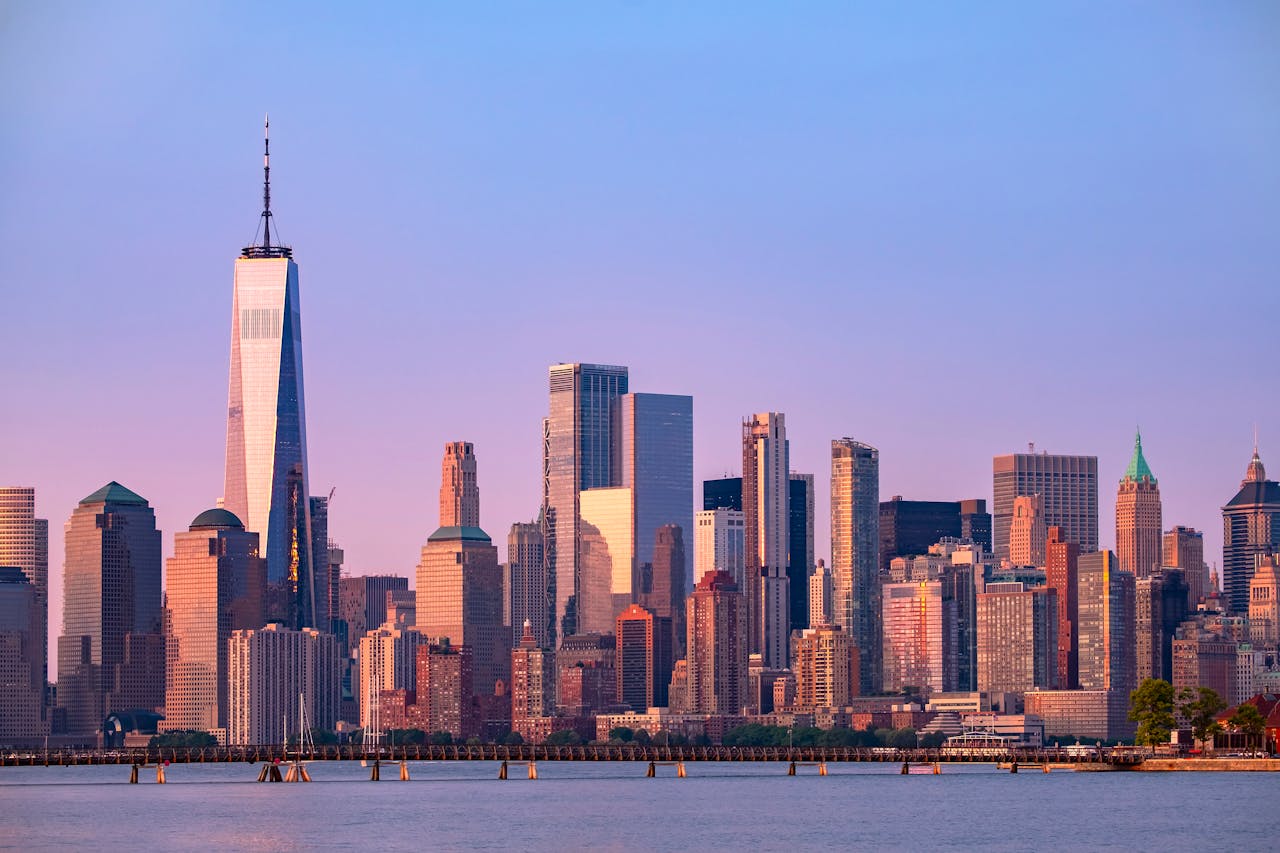
In this guide, I’ve included 27 famous buildings and landmarks in America, from Art Deco skyscrapers and historic homes to museums, monuments, bridges, and extraordinary feats of engineering.
You’ll find the stories behind them, some of the details that make them special, whether you can visit them, and a few things I find particularly interesting about them.
And if you think you know American landmarks well already, keep reading. A few of the stories are much more surprising than the buildings themselves.
What Makes a Building or Landmark Iconic?
There isn’t a mathematical formula for deciding that one building is iconic and another isn’t.
For this list, I looked at several things: how recognizable a place is, its architecture or engineering, its history, its cultural influence, its connection with a particular American city, and whether it has become part of the way we picture the United States.
That’s also why you’ll find a bridge, a statue, an arch, and a dam among the buildings.
Technically, no, the Golden Gate Bridge isn’t a building. Neither is the Statue of Liberty. But try imagining a list of America’s most famous architecture and landmarks without them. I couldn’t.
1. Empire State Building – New York City, NY
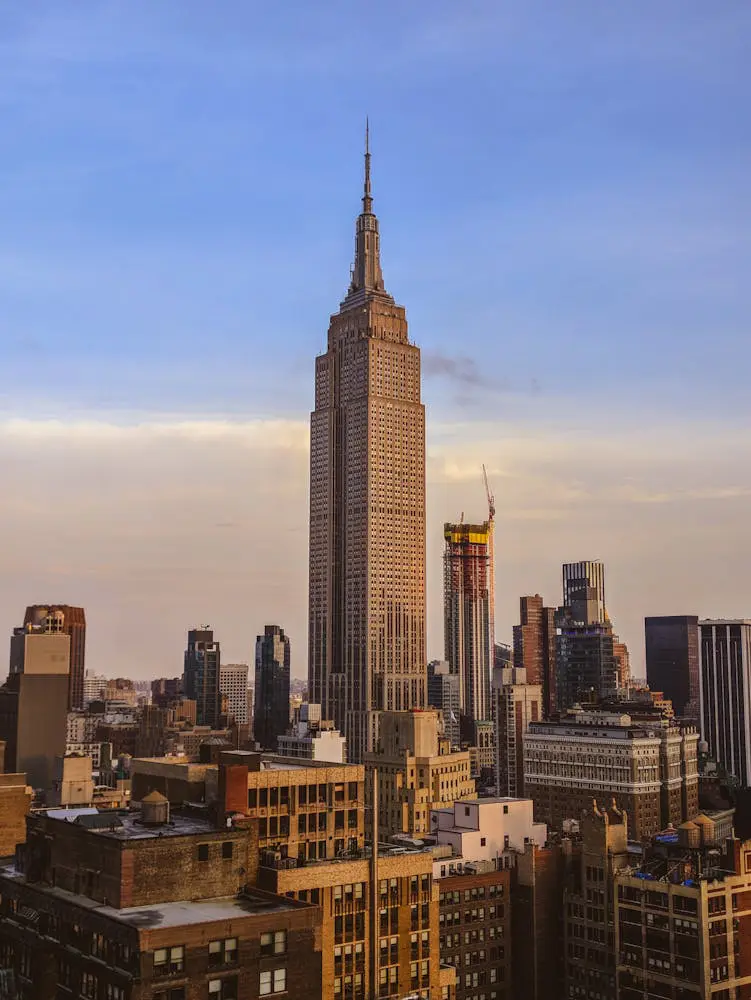
Completed: 1931
Architecture: Art Deco
Can you visit? Yes – including observation decks
If one building had to represent the classic New York skyline, the Empire State Building would be a very strong candidate.
Its Art Deco lines and distinctive silhouette have made it one of the world’s most recognizable skyscrapers, but its story is just as interesting as its appearance.
Construction took place during the Great Depression, and the building was completed remarkably quickly. For decades it was the tallest building in the world.
Then Hollywood helped turn it from a famous skyscraper into a cultural icon. I can’t think about the Empire State Building without King Kong eventually coming to mind – although the building has appeared in far more films and TV series than I could possibly list here.
If you’re visiting New York, you can go up to the observatories for panoramic views of Manhattan. The 86th-floor deck is the classic experience, while the higher observation areas give you an even wider perspective.
You can easily include it in a 3-day NYC itinerary.
If you visit: Consider going close to sunset if you want to see New York in daylight, during golden hour, and after the city lights come on.
2. The White House – Washington, D.C.
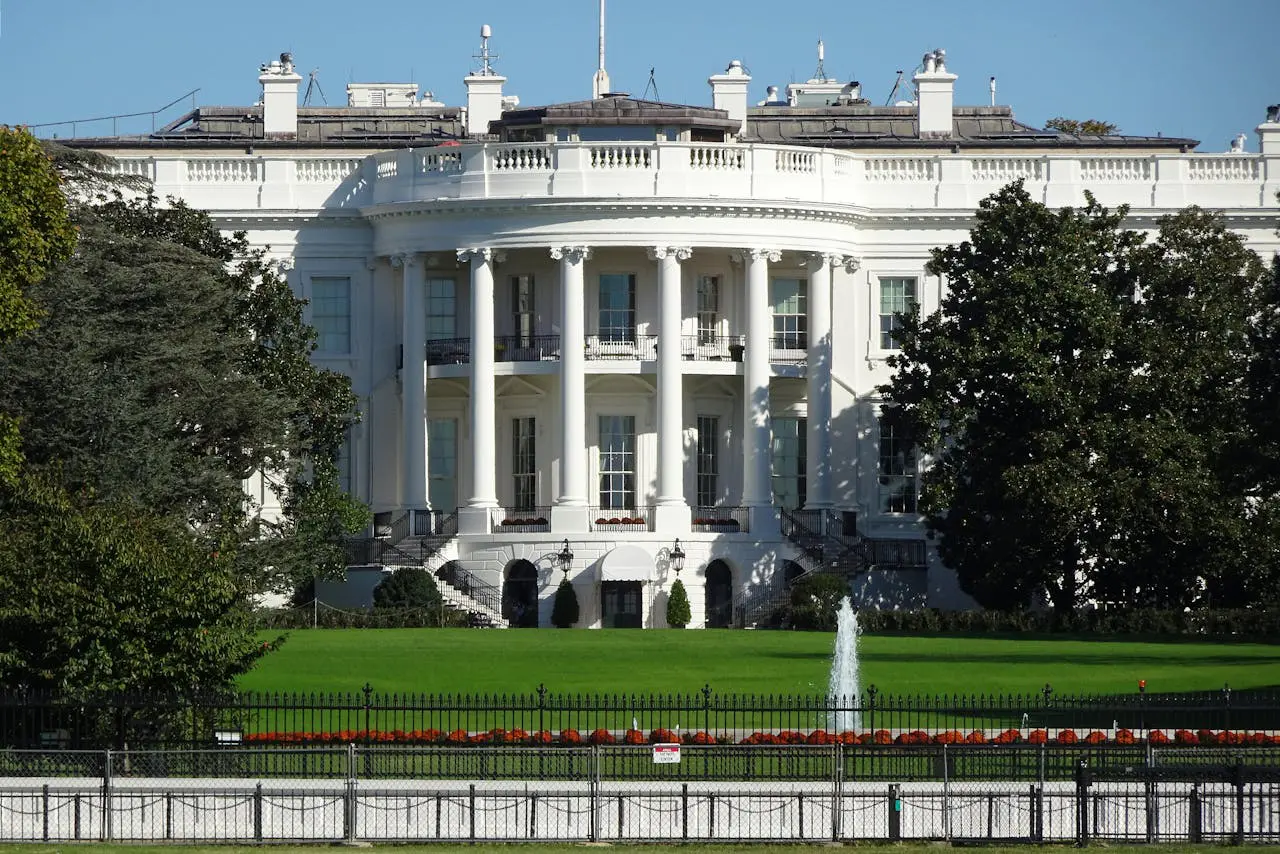
First occupied: 1800
Architect: James Hoban
Architecture: Neoclassical
Can you visit? Limited public tours are possible with advance arrangements
There are larger presidential residences and more elaborate palaces around the world, yet few houses are as instantly recognizable as the White House.
George Washington oversaw the beginning of its construction, but he never lived there. John Adams became the first U.S. president to occupy it in 1800.
The building has been burned, rebuilt, expanded, altered, and modernized over more than two centuries. Decisions made inside its rooms have affected not only the United States but countries around the world.
What I find interesting is the contrast between the image and the reality. On television it often looks enormous and almost isolated. When you look at maps and street views, you realize how firmly it sits within Washington’s urban fabric.
International visitors who want to tour the interior should check the current arrangements well in advance. Even if you don’t go inside, you can see the exterior during a visit to Washington.
If you’re planning more time in the capital, this Washington, D.C. guide includes many more places to see.
3. Golden Gate Bridge – San Francisco, CA
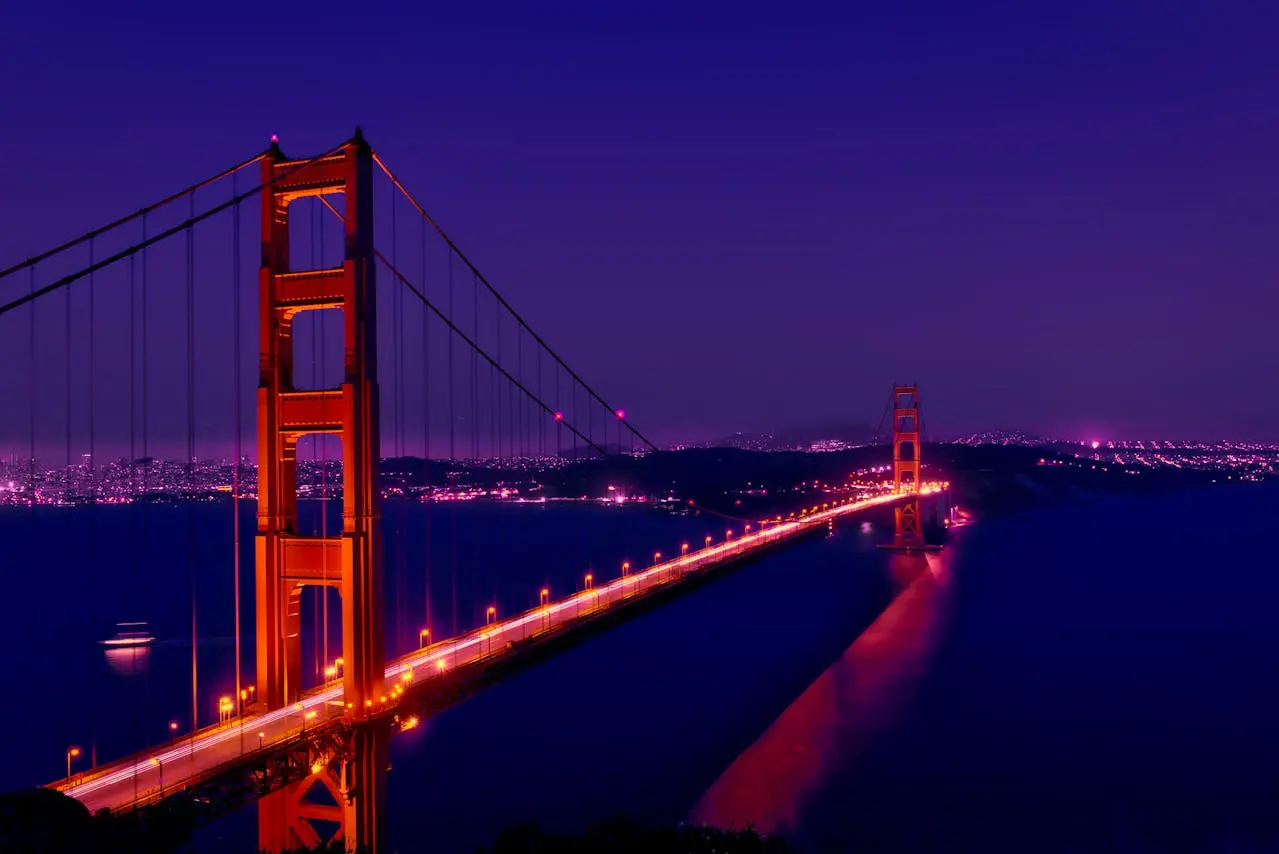
Opened: 1937
Type: Suspension bridge
Famous for: International Orange color and dramatic setting
Can you visit? Yes – you can walk or cycle across it
You don’t need to see the towers clearly to know you’re looking at the Golden Gate Bridge. Sometimes all you need is the orange-red structure disappearing into San Francisco fog.
Its official color, International Orange, wasn’t chosen simply to make the bridge photogenic. The color works beautifully with the surrounding landscape and also makes the structure more visible in changing conditions.
When it opened in 1937, the bridge was a remarkable engineering achievement and held major records for suspension-bridge design.
But what makes it iconic goes beyond engineering. It has become visual shorthand for San Francisco and, in many movies, for California itself.
You can walk or bike across the bridge, but you don’t have to be on it to appreciate it. Some of the most memorable views are from the surrounding viewpoints.
If San Francisco is part of your trip, this local’s guide to San Francisco gives you many more ideas.
If you visit: Don’t assume fog will ruin the experience. It may hide some of the view, but it can also make the bridge look incredibly dramatic.
4. Statue of Liberty – New York City, NY

Dedicated: 1886
Designer: Frédéric Auguste Bartholdi
Internal engineering: Gustave Eiffel and his team
Can you visit? Yes
Few monuments carry as much symbolism as the Statue of Liberty.
France gave the statue to the United States, Bartholdi designed it, and its internal iron structure is connected to Gustave Eiffel – yes, the Eiffel Tower Eiffel.
I love connections like this because they make famous landmarks feel less isolated from one another. Suddenly New York and Paris are connected by more than flights across the Atlantic.
For generations of immigrants arriving by sea, the statue became one of their first views of the United States. That history transformed it into a symbol of freedom, hope, and a new beginning.
Visitors can travel by ferry to Liberty Island. Pedestal and crown access require more planning, particularly if the crown is important to you.
Even if you don’t visit the island itself, there are several places in New York where you can see Lady Liberty from the water or shoreline.
5. Fallingwater – Mill Run, Pennsylvania
Designed: 1930s
Architect: Frank Lloyd Wright
Architecture: Organic architecture
Can you visit? Yes, with tours
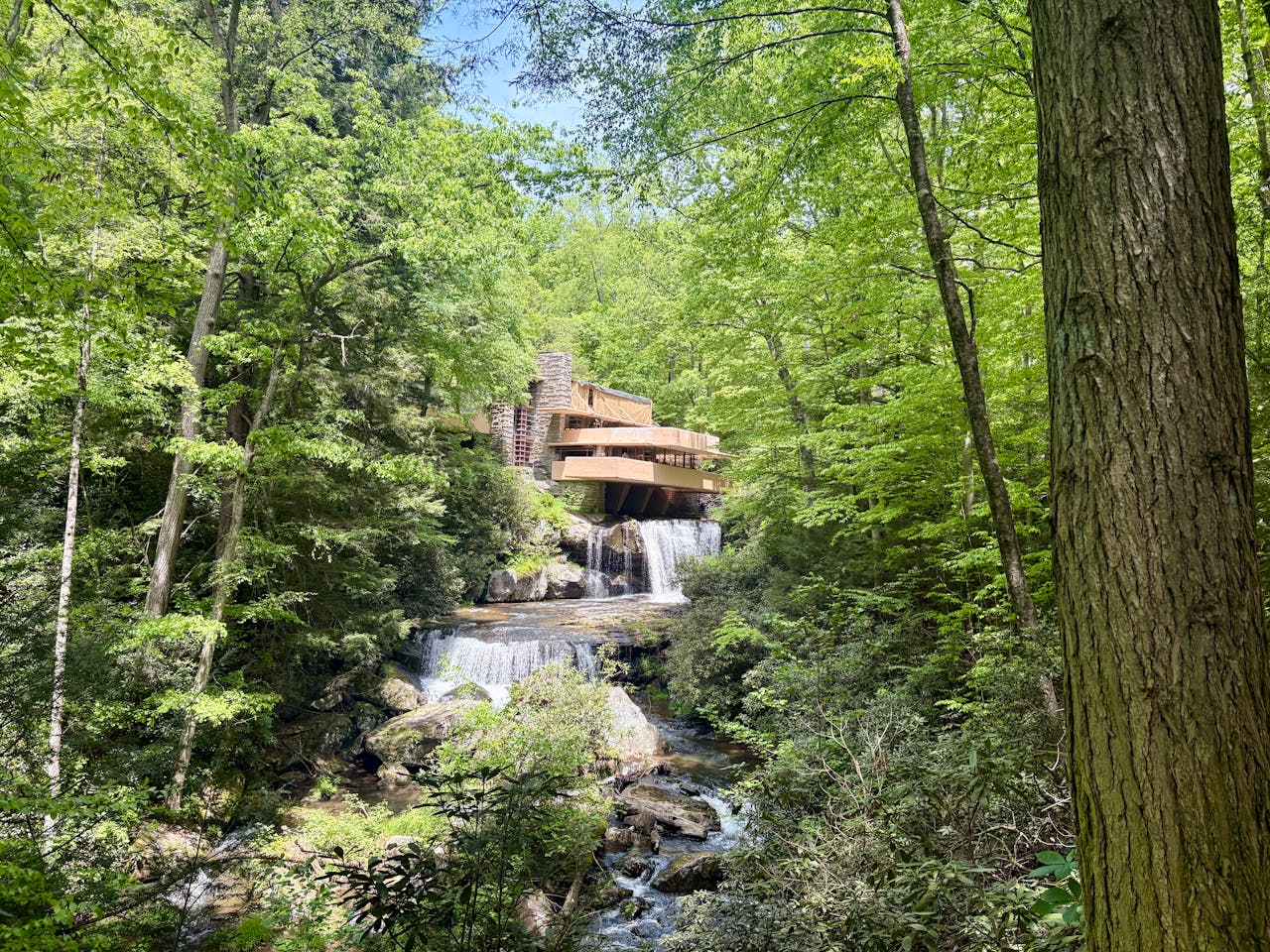
Fallingwater is the perfect reminder that an iconic American building doesn’t have to dominate a city skyline.
It can disappear into a forest.
Frank Lloyd Wright designed the house for the Kaufmann family, integrating concrete, stone, glass, terraces, forest, and water into one composition.
And here is the part I find fascinating: the house wasn’t positioned where the owners could simply sit at a distance and admire the waterfall.
Wright placed the house over it.
You don’t just look toward the landscape. The architecture becomes part of it.
That decision helped turn Fallingwater into one of the most famous private homes in modern architectural history.
Tours should be planned ahead, particularly during popular travel periods. If you’re interested in architecture rather than skyscrapers alone, this is one place I wouldn’t leave off the list.
6. U.S. Capitol – Washington, D.C.

Construction began: 1793
Architecture: Neoclassical
Famous feature: Cast-iron dome
Can you visit? Yes
The U.S. Capitol is one of those buildings that almost everyone recognizes even if they’ve never been to Washington.
Its huge dome has become one of the visual symbols of American government.
Construction began in the 18th century, while the Capitol continued to grow and change as the country did. The dome we associate with the building today was added later, during the 19th century.
And because I mentioned movies in the introduction: if I tried to list all the movies and TV series in which the Capitol appears, this article would become veeeeeeeeeeeeery long 😀
That’s part of what makes buildings like this so familiar. We’ve seen them behind fictional presidents, fictional disasters, political dramas, thrillers, news reports, documentaries, and real historical events.
Visitors can explore parts of the Capitol through organized visits, including some of its most important interior spaces.
Don’t rush past: The Rotunda deserves time. The architecture, paintings, sculptures, and sheer scale make it much more than a passage between rooms.
7. Chrysler Building – New York City, NY
Completed: 1930
Architect: William Van Alen
Architecture: Art Deco
Can you visit? Interior access is limited
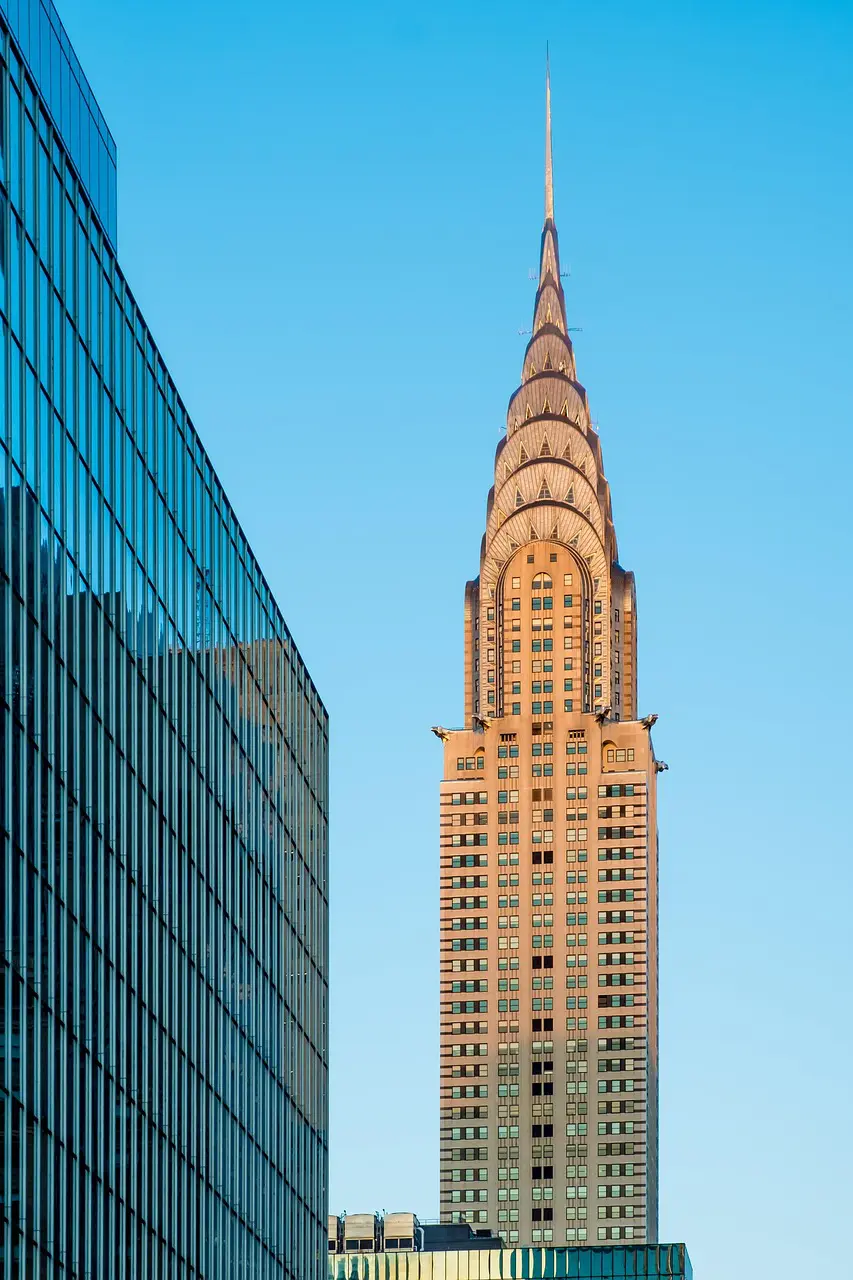
There are taller skyscrapers in New York, but very few have a crown like the Chrysler Building.
The stainless-steel arches, triangular windows, eagles, and automobile-inspired ornaments turned the tower into one of the masterpieces of Art Deco architecture.
But my favorite part is the skyscraper race behind it.
While developers in New York competed to build the world’s tallest building, architect William Van Alen had part of the Chrysler Building’s spire assembled inside the structure and then raised it into position.
I find the story of the hidden spire fascinating. Architecture suddenly turns into strategy.
The building briefly became the tallest in the world before the Empire State Building surpassed it.
Walter P. Chrysler personally financed the project rather than having Chrysler Corporation own it, making the tower part business statement, part architectural legacy.
You can admire the exterior from several nearby streets, and the lobby may be accessible depending on current building rules. This local’s guide to New York City includes other famous places nearby.
8. Hearst Castle – San Simeon, CA
Construction began: 1919
Architect: Julia Morgan
Built for: William Randolph Hearst
Can you visit? Yes, on tours
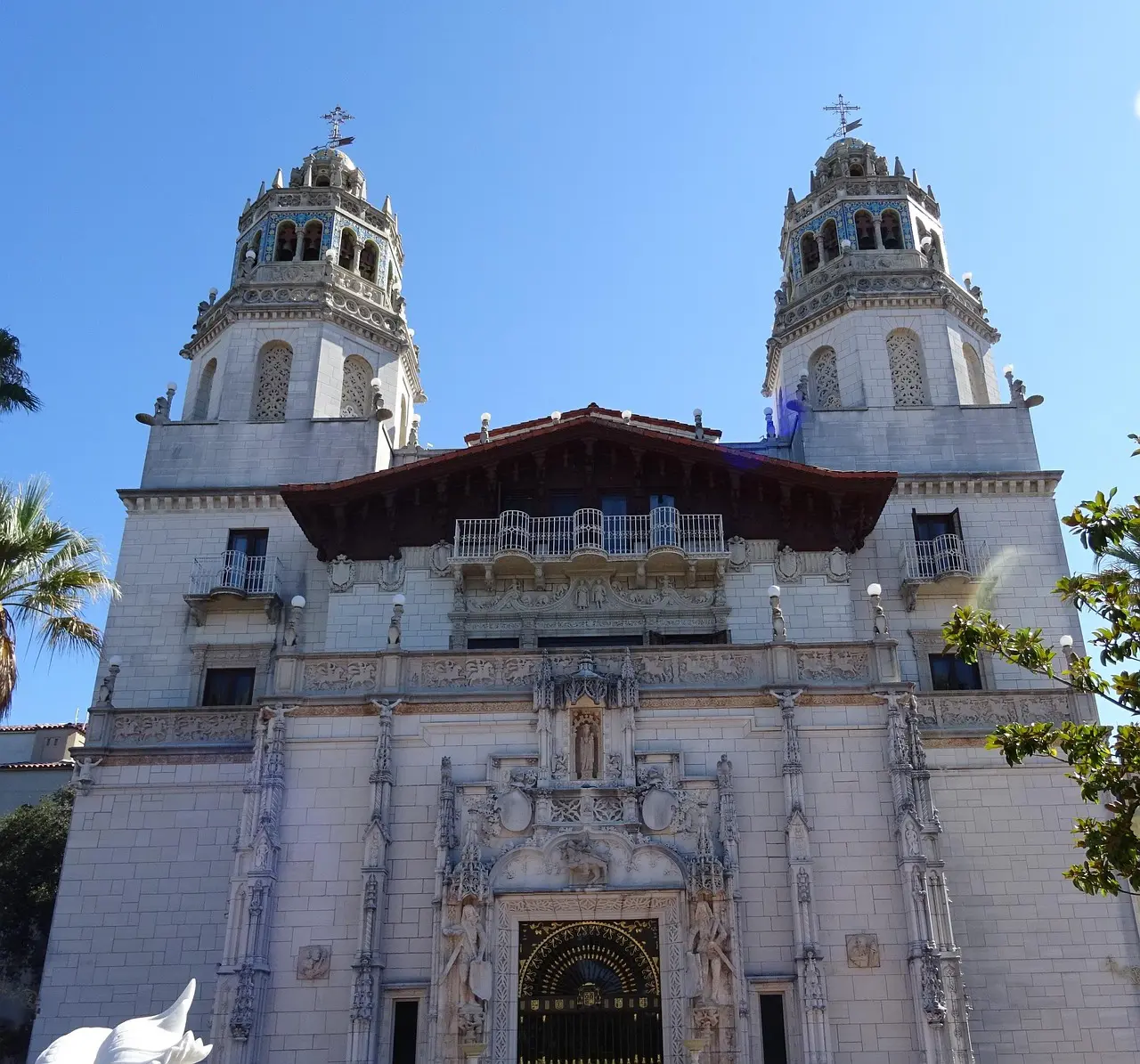
Hearst Castle feels as though someone combined European architectural inspiration, California scenery, extraordinary wealth, Hollywood glamour, and an enormous imagination.
Newspaper magnate William Randolph Hearst worked with architect Julia Morgan to create the estate high above California’s Central Coast.
It became a gathering place for movie stars, politicians, artists, and other prominent guests.
The interiors are extravagant, but the Neptune Pool is probably the image most people remember. It’s one of those places where a single photograph can send you into a rabbit hole of wanting to see the rest of the estate.
And there is a lot to see.
Different tours focus on different sections of the property, so first-time visitors should look at the available options before booking rather than assuming every tour covers the same rooms.
9. Willis Tower (Sears Tower) – Chicago, IL
Completed: 1973
Originally known as: Sears Tower
Famous for: Bundled-tube structural design
Can you visit? Yes – Skydeck Chicago
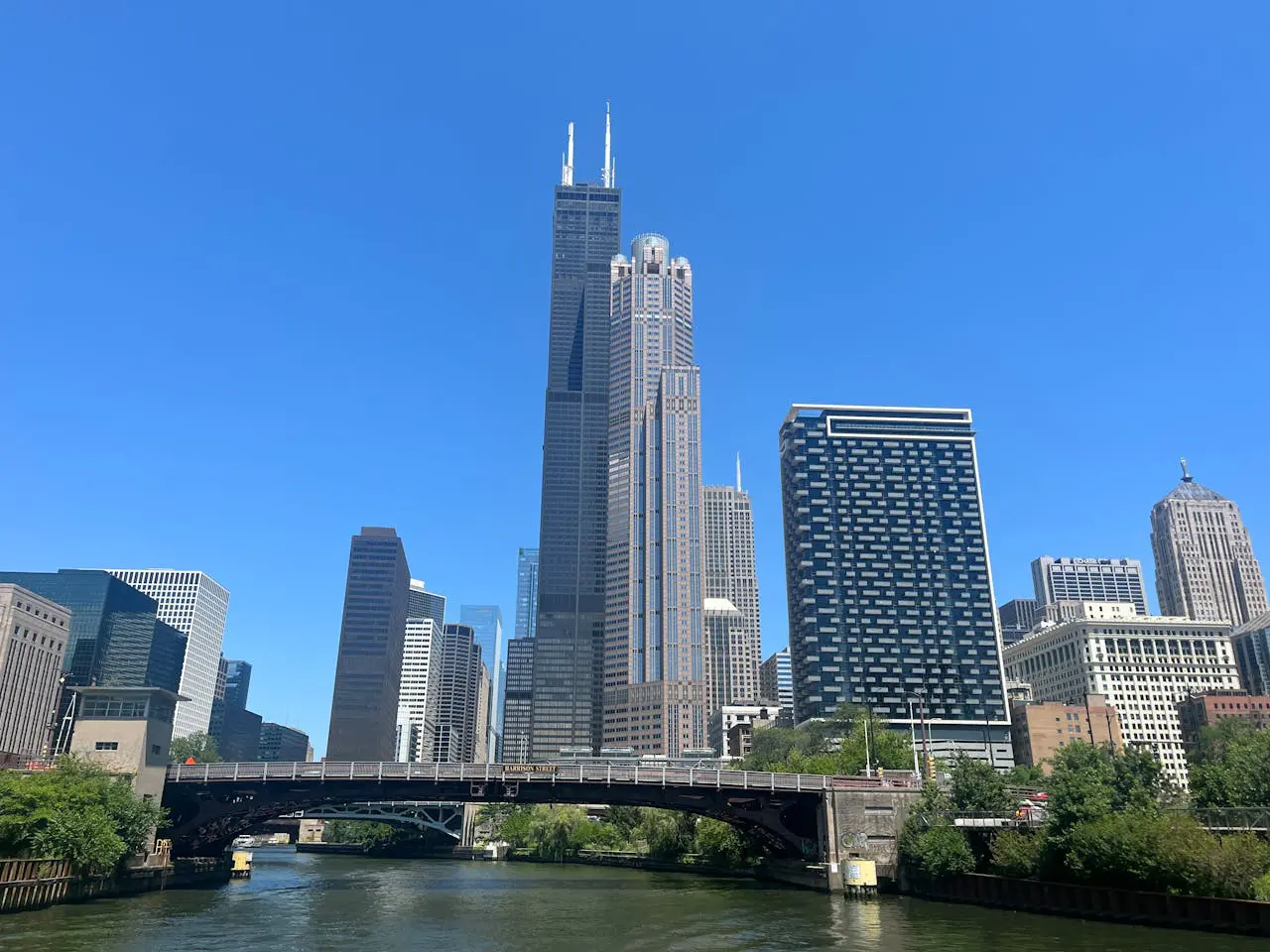
For many people, it will always be the Sears Tower.
The skyscraper dominated Chicago’s skyline and held the title of world’s tallest building for roughly a quarter of a century.
Its engineering was just as important as its height. The bundled-tube structural system associated with engineer Fazlur Rahman Khan helped change the way extremely tall buildings could be designed.
Today, visitors know the tower just as much for The Ledge: glass balconies extending outward from the Skydeck.
Standing with transparent glass under your feet more than a thousand feet above Chicago is either an irresistible experience or an immediate “absolutely not,” depending on how you feel about heights.
I admit that glass floors are fascinating to me as an idea. Whether my brain would be equally enthusiastic once I was actually standing there is another question!
Chicago is one of America’s great architecture cities, so leave time for more than one skyscraper. This Chicago travel guide is a useful starting point.
10. The Alamo – San Antonio, TX
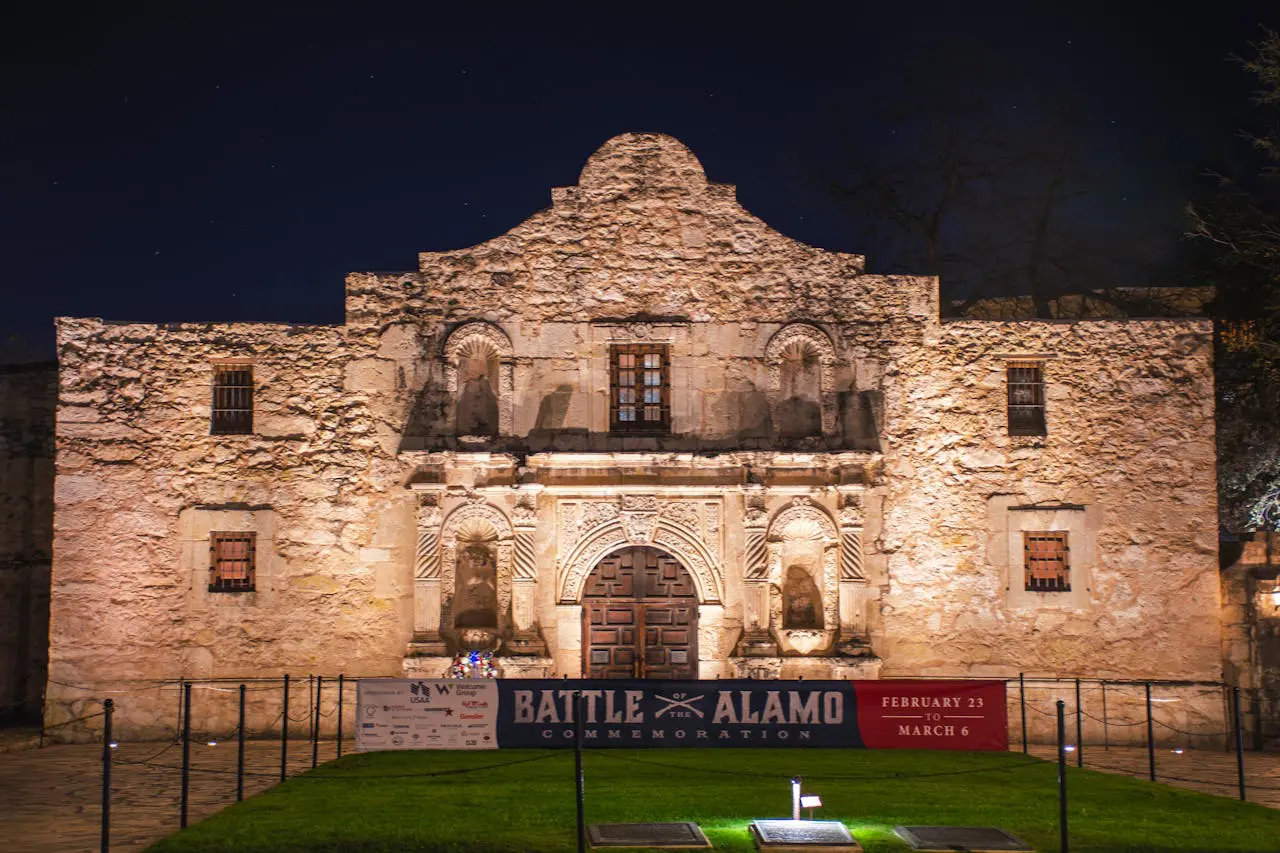
Origins: 18th-century Spanish mission
Known for: The 1836 Battle of the Alamo
Architecture: Spanish Colonial mission architecture
Can you visit? Yes
The Alamo is visually very different from the skyscrapers and monumental government buildings on this list, but its place in American history made it one of the country’s best-known historic sites.
Originally established as a Spanish mission, it later became famous because of the Battle of the Alamo during the Texas Revolution in 1836.
Names such as Davy Crockett and James Bowie became inseparable from the story, and “Remember the Alamo” became a rallying cry.
This is a landmark where knowing the history changes the visit completely. Without context, you’re looking at an old mission complex. With context, you’re standing in a place that became part of American mythology.
The site can be combined easily with San Antonio’s River Walk, but I would give the Alamo enough time that it doesn’t become a quick photo stop.
11. Space Needle – Seattle, WA

Opened: 1962
Built for: Seattle World’s Fair
Style: Space Age / mid-century futurism
Can you visit? Yes
The Space Needle may be one of the easiest American landmarks to identify from its silhouette alone.
It was built for the 1962 World’s Fair, when fascination with science, space exploration, technology, and the future influenced everything from architecture to furniture.
And this one comes with several TV and movie associations for me.
It immediately makes me think of Frasier – I love that series – and of Grey’s Anatomy, which I watch too. Then there are films such as Sleepless in Seattle and 10 Things I Hate About You.
So even before you look into the architecture, the Space Needle already feels familiar.
After a major renovation, visitors can experience expansive views over Seattle and the surrounding landscape, as well as the rotating glass-floor experience.
If you like city views, this is one of those attractions where good visibility can make an enormous difference, particularly when Mount Rainier decides to appear.
12. Walt Disney Concert Hall – Los Angeles, CA
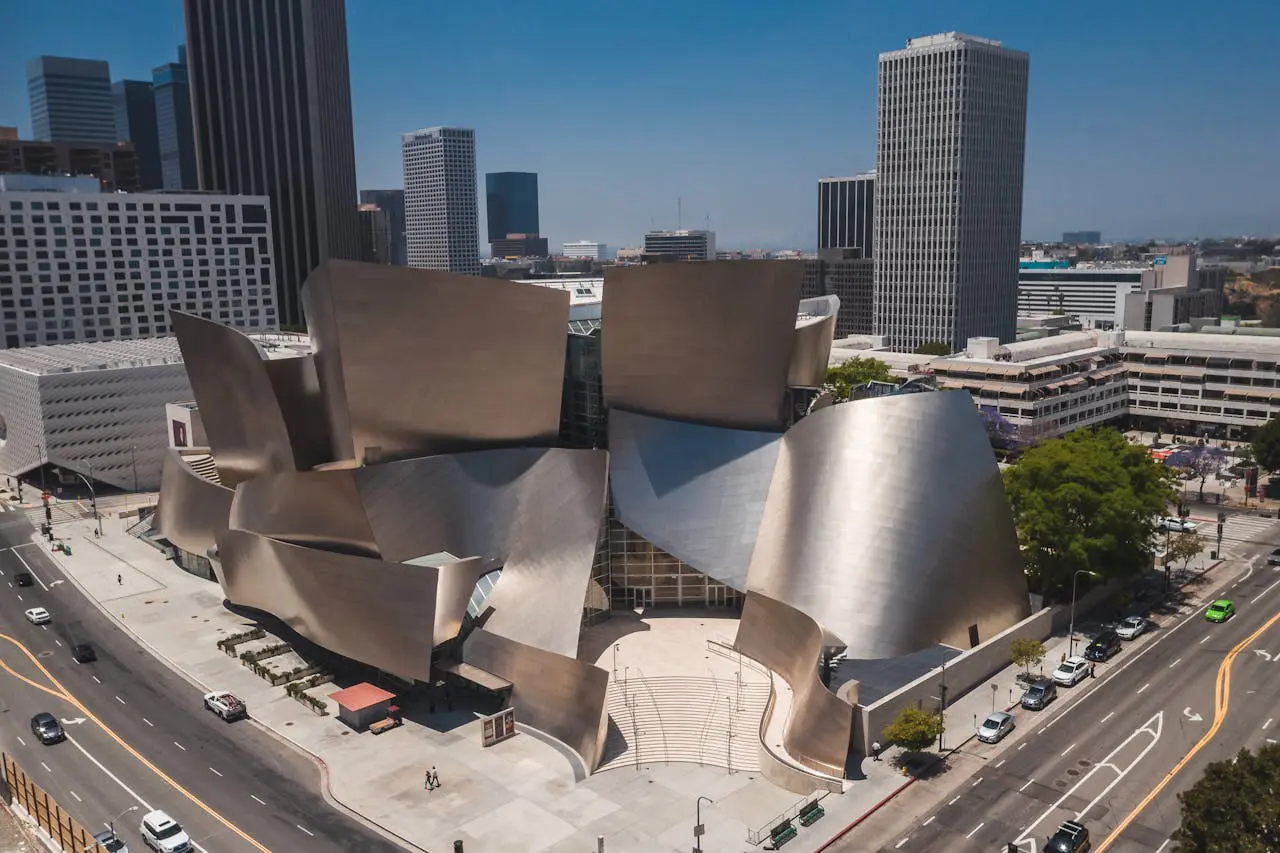
Opened: 2003
Architect: Frank Gehry
Known for: Sculptural stainless-steel exterior
Can you visit? Yes
Walt Disney Concert Hall looks as though parts of a conventional building have been pulled, twisted, folded, and transformed into a giant metallic sculpture.
Frank Gehry’s sweeping stainless-steel forms made it one of the architectural symbols of modern Los Angeles.
The building was made possible in large part by a gift from Lillian Disney, who wanted to create a concert hall in memory of Walt Disney.
I like buildings that are recognizable from one strange detail, and this is definitely one of them. You don’t need to see a sign saying “Walt Disney Concert Hall.” Those huge curved surfaces give it away.
The interior was designed with music at its heart, so attending a performance gives you an entirely different experience from simply photographing the exterior.
Los Angeles has enough attractions to fill several trips, and this Los Angeles guide gives you more ideas beyond the famous Hollywood sights.
13. Biltmore Estate – Asheville, NC
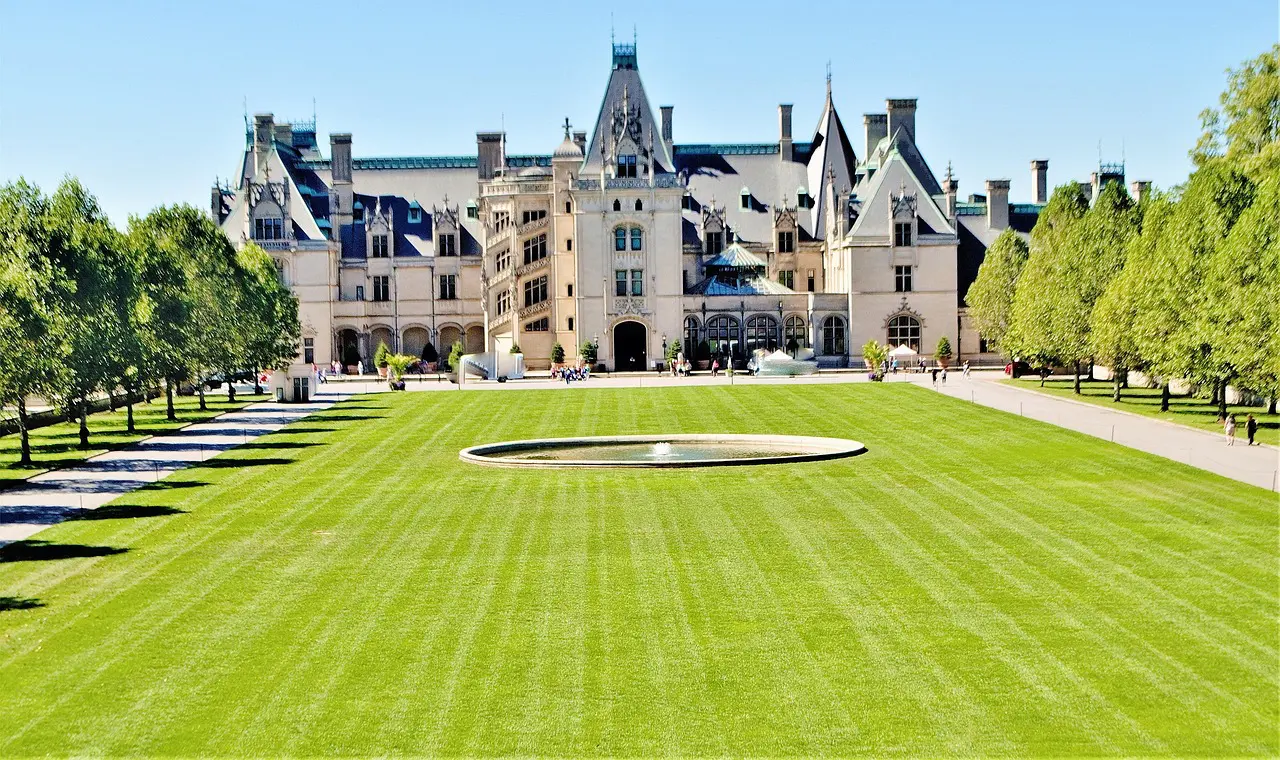
Completed: 1890s
Built for: George Vanderbilt
Architect: Richard Morris Hunt
Can you visit? Yes
Biltmore Estate gives you a completely different version of American architecture: Gilded Age wealth inspired by European châteaux.
George Vanderbilt commissioned architect Richard Morris Hunt to design the enormous home near Asheville, while Frederick Law Olmsted – the landscape architect behind Central Park – worked on the grounds.
The house has 250 rooms.
Two hundred and fifty.
Numbers like that are difficult to visualize until you start thinking about what it means to move through a house of that scale.
And I find the grand staircase particularly fascinating. It rises dramatically through the house and makes even the act of moving between floors feel theatrical.
The estate also includes gardens, grounds, a winery, and additional experiences, so this isn’t a place I’d try to squeeze into a tiny time slot.
At Christmas, the scale of the house allows for the kind of decorating that would be impossible in an ordinary home.
14. One World Trade Center – New York City, NY

Opened: 2014
Height: 1,776 feet
Status: Tallest building in the United States
Can you visit? Yes – One World Observatory
The height of One World Trade Center is deliberate: 1,776 feet, a direct reference to the year of the U.S. Declaration of Independence.
It rises beside the 9/11 Memorial on the site of the former World Trade Center complex and has become part of Lower Manhattan’s skyline.
This is one section where I don’t think dramatic language is necessary. The location already carries enormous emotional and historical weight.
Visitors can go to One World Observatory for views across New York, its waterways, and the surrounding region.
If city views are one of your favorite things when traveling, Earth’s Attractions also has a guide to places to see the NYC skyline from different perspectives.
Allow time for the memorial area as well rather than treating the observatory as an isolated attraction.
15. Metropolitan Museum of Art (The Met) – New York City, NY
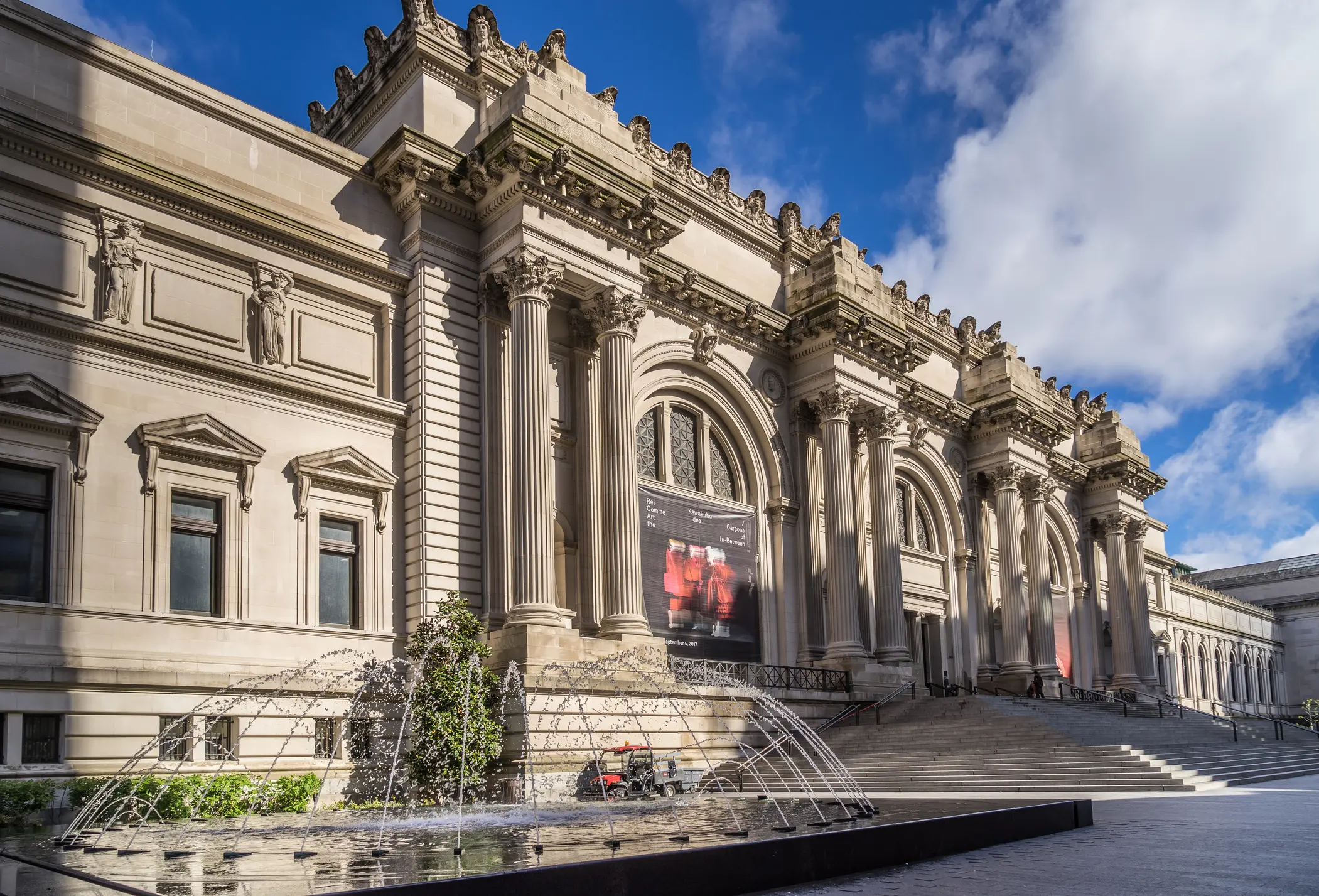
ID 92733850 ©Eileen Tan | Dreamstime.com
Founded: 1870
Location: Fifth Avenue, New York City
Known for: Monumental façade, grand steps, and vast art collections
Can you visit? Yes
The Metropolitan Museum of Art belongs on this list for two reasons.
First, it is one of America’s most important museums.
Second, the building and its famous Fifth Avenue steps have become landmarks in their own right.
The Met contains art spanning cultures and centuries, so even a long visit barely scratches the surface. This isn’t a museum I’d approach with a mission to “see everything.”
I love museums, and I’ve learned that trying to check every room off a list can turn an extraordinary museum into an endurance test. Choosing a few areas you’re genuinely interested in usually makes the experience far better.
And if you’re curious about American museums before your trip, you can explore many institutions from home through these free virtual museum tours in the USA.
More Famous American Buildings and Landmarks Worth Seeing
The first 15 may contain some of the best-known landmarks in the country, but stopping there would leave out some remarkable architecture.
So we’re not done.
The next places range from a spiraling museum and one of the world’s most beautiful libraries to Elvis Presley’s home, a giant stainless-steel arch, a dam, and an outdoor concert venue that has become part of Hollywood history.
16. Guggenheim Museum – New York City, NY
Opened: 1959
Architect: Frank Lloyd Wright
Known for: Spiral form and interior ramp
Can you visit? Yes
At the Guggenheim, the building competes with the art for your attention.
Frank Lloyd Wright rejected the conventional sequence of rectangular museum rooms and created a curving structure organized around a huge central space.
The result is instantly recognizable from the street and equally unusual inside.
I find the idea behind the visitor experience interesting too: instead of simply moving from room to room, you follow the building’s continuous spiral.
It’s one of those museums where architecture lovers may spend almost as much time looking at the building as at the works displayed inside.
17. Library of Congress – Washington, D.C.
Most famous building: Thomas Jefferson Building
Opened: 1897
Known for: Grand interiors, mosaics, marble, murals, and monumental reading spaces
Can you visit? Yes
If you think “library” means rows of shelves in a quiet rectangular room, the Library of Congress may completely reset your expectations.
The Thomas Jefferson Building is lavish: marble staircases, mosaics, paintings, sculptures, columns, arches, and intricate decorative details seem to compete for attention.
And that’s exactly why I would include it even on a trip where you aren’t planning to spend hours researching in a library.
The architecture itself is the attraction.
I also love the symbolism of giving books, knowledge, and learning such a monumental home. There is something wonderful about entering a library that has been designed with the visual drama of a palace.
18. Monticello – Charlottesville, VA
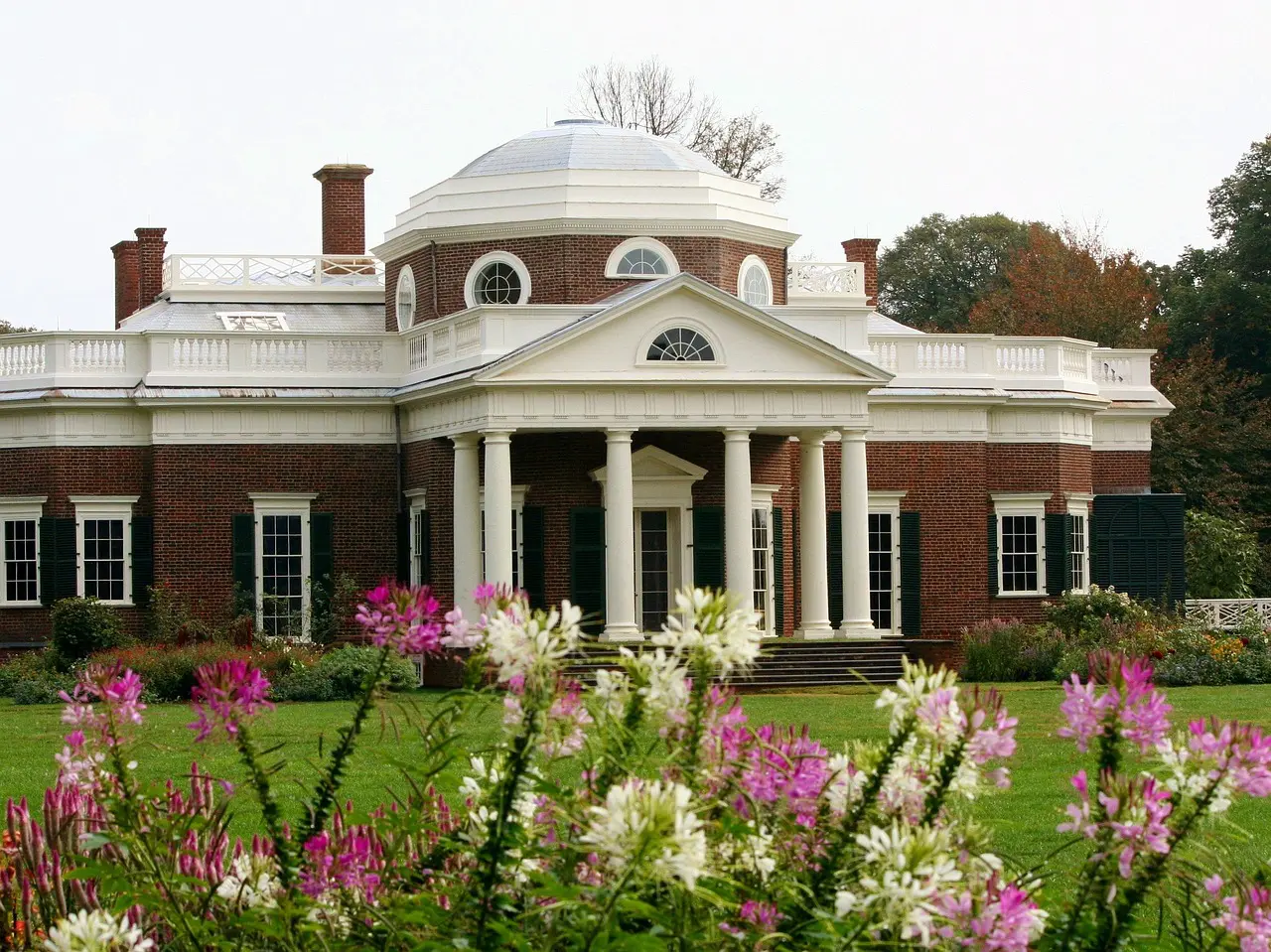
Associated with: Thomas Jefferson
Architecture: Neoclassical
Known for: Dome, classical proportions, and Jefferson’s design ideas
Can you visit? Yes
Monticello is one of those houses where the architecture tells you something about the person who created it.
Thomas Jefferson designed and repeatedly altered the property over decades, incorporating ideas inspired by classical and European architecture.
The famous dome gives the house a silhouette you can recognize immediately.
But a visit also involves confronting the full history of the property, including the lives of the enslaved people who lived and worked there.
That context is essential. Monticello isn’t just a beautiful presidential home or an architecture stop; it’s also a place where several parts of American history intersect.
19. New York Public Library – New York City, NY
Opened: 1911
Architecture: Beaux-Arts
Famous features: Grand façade, marble interiors, Rose Main Reading Room, stone lions
Can you visit? Yes
Patience and Fortitude have been watching Fifth Avenue for more than a century.
Those are the names of the two famous stone lions outside the New York Public Library’s main building, and they’ve become almost as recognizable as the façade behind them.
Inside, grand staircases, decorative ceilings, long corridors, and monumental reading rooms make this far more than a place to borrow a book.
And, once again, movies have helped make the building familiar long before many travelers ever reach New York.
If you’re exploring the city on a budget, the library also appears among these free things to do in New York City.
20. United States Supreme Court – Washington, D.C.
Opened: 1935
Architecture: Neoclassical
Famous feature: Monumental marble staircase and columned façade
Can you visit? Public access is possible under current court rules
The U.S. Supreme Court looks almost like an ancient temple transplanted to Washington.
Its wide staircase, enormous Corinthian columns, triangular pediment, and marble exterior were designed to convey permanence and authority.
The famous words “Equal Justice Under Law” appear above the main entrance.
I find monumental staircases fascinating because architects can use something as practical as getting from one level to another to completely change the way we approach a building.
Here, the steps slow you down and make the entrance feel ceremonial before you ever pass through the doors.
The Supreme Court is also easy to combine geographically with the Capitol and Library of Congress.
21. Graceland – Memphis, TN
Built: 1939
Famous resident: Elvis Presley
Known for: Elvis history and distinctive interiors
Can you visit? Yes
Then we go from government buildings and marble columns to Elvis.
Graceland became famous because Elvis Presley bought it in 1957 and lived there for the rest of his life.
The house itself is far less enormous than Biltmore or Hearst Castle, yet its cultural importance has made it one of America’s best-known celebrity homes.
And part of the appeal is that the interiors don’t feel like a generic historic mansion.
Rooms such as the Jungle Room are unmistakably connected to a particular era and personality.
Even people who aren’t planning an Elvis pilgrimage tend to know the name Graceland. That’s a pretty good definition of cultural-icon status.
22. One Vanderbilt – New York City, NY
Opened: 2020
Type: Modern supertall skyscraper
Known for: SUMMIT observation experience and Midtown location
Can you visit? Yes, via SUMMIT One Vanderbilt
New York’s list of iconic architecture didn’t stop in the 1930s.
One Vanderbilt is a much newer addition beside Grand Central Terminal, and its observation attraction has helped turn it into a visitor destination rather than simply another office tower.
SUMMIT combines skyline views with reflective spaces and visual installations.
Personally, I’d be just as interested in the contrast outside: Grand Central’s historic architecture beside a 21st-century skyscraper.
Cities become much more interesting architecturally when different eras are allowed to sit next to one another.
23. Bellagio Hotel – Las Vegas, NV
Opened: 1998
Known for: Lake, fountains, luxury resort architecture, and Italian inspiration
Can you visit? Yes
Las Vegas has no shortage of buildings designed to grab your attention, which makes becoming one of the city’s enduring visual symbols an achievement in itself.
The Bellagio is instantly associated with its lake and fountain show.
Its design draws inspiration from Italy, but what made it famous globally is the complete spectacle: architecture, water, music, lights, gardens, casino, hotel, and entertainment all functioning as one enormous attraction.
And, naturally, movies helped. Ocean’s Eleven alone permanently connected the Bellagio fountains with cinematic Las Vegas for a lot of people.
If you’re planning a trip, there are many more things to do in Las Vegas beyond the casinos.
24. The Broad – Los Angeles, CA
Opened: 2015
Architecture: Contemporary
Known for: Honeycomb-like “veil” exterior
Can you visit? Yes
The Broad is proof that museum architecture doesn’t have to look solemn or classical.
Its distinctive exterior wraps the building in a perforated geometric skin often described as a veil.
That creates an immediate identity before you’ve seen a single artwork.
I like museums that make you curious from the pavement. When the exterior raises questions – What is that material? How does the light get inside? What does it look like from behind that façade? – the architecture has already started the visit.
The museum is in Downtown Los Angeles, close to Walt Disney Concert Hall, making the two an excellent architectural pairing.
25. Gateway Arch – St. Louis, MO
Completed: 1965
Architect: Eero Saarinen
Material: Stainless steel
Can you visit? Yes, including the top
The Gateway Arch is beautifully simple from a distance: one enormous stainless-steel curve rising over St. Louis.
Getting people to the top is more complicated.
Visitors travel inside the structure in a special tram system, which makes the experience almost as unusual as the monument itself.
The arch was designed by Eero Saarinen as a monument connected with America’s westward expansion.
At 630 feet high, it completely dominates its surroundings while using an extraordinarily clean geometric form.
I think that’s part of its appeal. There aren’t dozens of decorative details demanding attention. The shape itself does all the work.
26. Hoover Dam – Nevada/Arizona
Completed: 1930s
Type: Concrete arch-gravity dam
Known for: Engineering scale and Art Deco details
Can you visit? Yes
Hoover Dam is infrastructure, architecture, engineering, history, and landscape all at once.
Built during the Great Depression on the Colorado River, it was an enormous undertaking that transformed water management and power generation in the American Southwest.
What I particularly like is that the designers didn’t treat it as purely functional concrete.
Art Deco elements appear throughout the site, giving a huge engineering project a distinctive visual identity.
The scale can also be difficult to understand from photographs until you notice roads, vehicles, doors, or people that provide a reference point.
Many travelers visit Hoover Dam as a day trip from Las Vegas, and the views from the surrounding area make the journey part of the experience.
27. Hollywood Bowl – Los Angeles, CA
Opened: 1920s
Type: Outdoor amphitheater
Known for: Shell-shaped stage and Hollywood setting
Can you visit? Yes
The Hollywood Bowl seems like a fitting place to end this list because we’ve come back to entertainment.
Its outdoor setting and famous shell-shaped stage have made it one of the most recognizable concert venues in the United States.
Over the decades, its stage has hosted orchestras, singers, bands, movie-music events, and performers from virtually every musical genre.
I like the idea that an iconic place doesn’t always have to be something you stand outside and photograph.
Sometimes the best way to understand a landmark is to use it for what it was built for.
At the Hollywood Bowl, that means sitting down and listening.
Which Famous American Buildings Can You Actually Visit Inside?
One of the useful distinctions when planning a trip is that “famous” doesn’t always mean “open to tourists.”
Some places on this list were created specifically to welcome visitors. Others remain working offices, government buildings, or private spaces with much more limited access.
Among the landmarks where visitors can normally experience substantial interiors or visitor areas are:
- Empire State Building
- Fallingwater
- U.S. Capitol
- Hearst Castle
- Willis Tower
- The Alamo
- Space Needle
- Walt Disney Concert Hall
- Biltmore Estate
- One World Trade Center
- The Met
- Guggenheim Museum
- Library of Congress
- Monticello
- New York Public Library
- Graceland
- One Vanderbilt
- Bellagio
- The Broad
- Gateway Arch
- Hoover Dam
- Hollywood Bowl
The White House and some government buildings require more planning and may have additional restrictions. The Chrysler Building is primarily a working office building, so it isn’t comparable to an attraction with observation decks and visitor tours.
My recommendation: Always check the official website shortly before your trip. Security rules, reservation systems, opening areas, and tour arrangements can change.
Best US Cities for Architecture Lovers
You could build an entire U.S. trip around architecture.
In fact, several of the American cities worth visiting at least once contain enough famous buildings to fill several days on their own.
New York City
New York gives you an extraordinary architectural timeline in a relatively compact area: Beaux-Arts buildings, Art Deco skyscrapers, historic libraries, museums, modern towers, bridges, and some of the world’s most famous skyline views.
If this article makes you want an architecture-focused city break, New York would be my first choice simply because of the concentration and variety.
Chicago
Chicago is fundamental to the story of the skyscraper and modern American architecture.
Even if you normally ignore architecture tours, this is one city where I would strongly consider one. Seeing the buildings while learning why they were innovative makes the skyline much more interesting.
Washington, D.C.
Washington gives you a completely different experience.
Instead of skyscraper competition, the visual identity comes from Neoclassical government buildings, monumental avenues, museums, memorials, domes, columns, and carefully planned public spaces.
Los Angeles
Los Angeles is much more architecturally varied than its Hollywood image suggests.
Walt Disney Concert Hall, The Broad, historic theaters, modernist homes, Art Deco buildings, and highly experimental contemporary architecture give you plenty to explore.
And if you want a complete change of scenery afterward, there are also some wonderful natural places around Los Angeles.
San Francisco
San Francisco combines famous engineering landmarks with Victorian houses, distinctive neighborhoods, hills, waterfront architecture, and one of the most recognizable bridges on the planet.
Planning a Trip Around America’s Famous Landmarks
You don’t need a complicated strategy, but a few decisions can save you time.
Book the attractions that use timed entry
Observation decks, historic houses, estates, and popular tours may have limited entry times.
If one particular landmark is a priority, I wouldn’t leave that ticket until the day you arrive.
Check whether you can actually go inside
It’s surprisingly easy to build an itinerary around a famous building and only later discover that public access is limited.
This is particularly important with working government buildings and privately used skyscrapers.
Group nearby landmarks
This can save a lot of travel time.
In Washington, for example, the Capitol, Library of Congress, and Supreme Court form an easy architectural cluster.
In New York, the Empire State Building, New York Public Library, Grand Central area, Chrysler Building, and One Vanderbilt can be combined far more efficiently than visiting them on separate days.
Don’t spend the entire trip looking at famous names
Some of my favorite discoveries when traveling are the things I didn’t know I was supposed to see.
Look up.
Walk a side street.
Enter a building that catches your attention.
The famous landmarks give a city its recognizable images, but the buildings between them give it character.
How Many of These Famous American Landmarks Would You Recognize From a Photo?
This is what I keep coming back to.
Most of us would recognize the Statue of Liberty or Golden Gate Bridge immediately.
But what if you saw only the crown of the Chrysler Building?
The curves of Walt Disney Concert Hall?
Part of Fallingwater without the forest around it?
The façade of the Alamo without a caption?
Or the two lions outside the New York Public Library?
If you enjoy testing yourself on places like these, try these famous landmark quiz questions. And if your knowledge goes beyond landmarks, there are also 150 U.S. travel trivia questions covering destinations across the country.
I’d love to know how many of the 27 places in this article you recognized before you read their names.
My Conclusion: America’s Famous Buildings Tell Very Different Stories
One of the things I like most about this list is how little these places have in common at first glance.
A presidential residence.
A skyscraper built during the Great Depression.
A house sitting over a waterfall.
A Spanish mission.
A futuristic tower created for a World’s Fair.
An Elvis mansion.
A museum wrapped in a honeycomb-like façade.
A giant arch.
A dam.
A concert hall made from sweeping sheets of steel.
And somehow, all of them have become part of the visual story of the United States.
Some changed architecture. Others matter because of what happened inside or around them. Some became famous through movies, television, photographs, music, politics, or popular culture.
And some are simply impossible to imagine anywhere else.
Which one would you most like to see in person?

Questions About Famous Buildings and Landmarks in the USA
What is the most famous building in America?
There isn’t an official winner, but the Empire State Building and White House are among the strongest candidates because they’re recognizable around the world. If monuments and other structures are included, the Statue of Liberty and Golden Gate Bridge belong in the same conversation.
What is the tallest building in the United States?
One World Trade Center in New York City is the tallest building in the United States. Its architectural height is 1,776 feet, a symbolic reference to the year of the Declaration of Independence.
What are the most famous buildings in New York City?
The Empire State Building, Chrysler Building, One World Trade Center, Metropolitan Museum of Art, Guggenheim Museum, New York Public Library, and One Vanderbilt are among New York City’s most recognizable buildings.
New York also has major landmarks that aren’t buildings, including the Statue of Liberty and Brooklyn Bridge.
Which famous American buildings can tourists go inside?
Many can be visited, including the Empire State Building, Willis Tower, Biltmore Estate, Hearst Castle, Fallingwater, One World Trade Center, The Met, Guggenheim Museum, Library of Congress, Monticello, New York Public Library, Graceland, and several others on this list.
Access rules vary, so check the official site for the building you want to visit before finalizing your itinerary.
What are the best US cities for architecture lovers?
New York City and Chicago would be my first two choices for travelers especially interested in architecture.
Washington, D.C. is excellent for monumental Neoclassical architecture and major public buildings, while Los Angeles offers a very different mix of modern, contemporary, Art Deco, and entertainment-related architecture. San Francisco combines historic neighborhoods with famous engineering landmarks and spectacular urban scenery.
Photo sources, except Dreamstime: 1, 2, 3, 4, 5, 6, 7, 8, 9, 10, 11, 12, 13, 14, 15, 16
More amazing articles for you:
9 Tips on Planning Your First Big 5 Safaris
Where Can I Go For the Weekend? COVID Edition
Grocery Store Tourism: Why Travelers Are Visiting Supermarkets Abroad
Record Your Voice over on Vacation | How To
A Local's Guide to Minneapolis–Saint Paul
Ultimate Copenhagen Travel Guide: Top Things to Do, Where to Eat & Stay, and Local Tips
Planning To Visit Mexico? Check The Travel Club Deals
Family fun in Clearwater Florida

Violeta-Loredana Pascal is a communications expert, business mentor, and the founder of Earth’s Attractions and PRwave INTERNATIONAL. A pioneer in the Romanian digital PR landscape since 2005, she holds a degree in Communication and Social Sciences from SNSPA Bucharest. Violeta is a senior trainer at AcademiadeAfaceri.ro, where she leverages over 20 years of experience to teach professional courses in PR strategy and workplace productivity. By blending high-level business consulting with a passion for holistic travel and wellness, she empowers solopreneurs to overcome procrastination, build profitable brands, and design a life of purposeful adventure.