
If your stress feels bigger than your to-do list, this might be why.
Clutter doesn’t just sit in your home.
It sits in your phone.
Your calendar.
Your bank account.
Your mind.
And the more it builds up, the heavier everything feels.
ID 67048144 ©Marek Uliasz | Dreamstime.com
Most people try to fix overwhelm by doing more.
But sometimes the fastest way to feel lighter is to remove something.
Here are the 10 things quietly raising your stress – and what happens when you clear them.
The Surprising Link Between Clutter, Stress & Mental Clarity
Before we dive into the checklist, it is worth connecting the dots: why does clutter feel so heavy?
1. Clutter quietly raises your stress hormones
The UCLA “Life at Home in the 21st Century” research found that mothers who viewed their homes as cluttered had chronically elevated cortisol, the body’s main stress hormone. Their moods were more depressed, and evenings felt particularly draining.
Chronic cortisol elevation does not just feel bad. Over time, it can contribute to sleep problems, fatigue, and difficulty regulating emotions.
2. Clutter hijacks your attention
Visual clutter – piles, stacks, crowded shelves – competes for your attention. Your brain has to work harder to filter out irrelevant stimuli, which means less focus for tasks that matter and more mental fatigue.
3. Chaotic environments encourage impulsive choices
In one study, participants in a chaotic kitchen ate significantly more cookies than people in an orderly kitchen. The cluttered space made them feel more out-of-control, which translated into less self-control with food.
Cluttered surroundings = more decision fatigue, more procrastination, more “I’ll deal with it later.”
Taken together, the research paints a clear picture: clearing clutter is not just about aesthetics. It is about mental health, decision-making, and quality of life.
Now let’s turn that science into action. Here are 10 things quietly raising your stress – and how to clear them.
10 Things to Declutter Now That Instantly Lower Stress
1. Digital Clutter to Delete

If your phone, laptop, and inbox feel like a chaotic storage unit, you are carrying invisible stress all day.
Why digital clutter matters
Notifications, unread badges, and endless folders keep your brain in a constant state of “unfinished business.” Every time you see hundreds (or thousands) of unread emails, you get a tiny spike of stress and guilt.
I did what I am sharing below myself, and the results were amazing – from multiple points of view! The unsubscribe option itself saved me!
Quick wins: Digital declutter checklist
Do these in short, focused sprints (10–20 minutes each):
a) Inbox reset
- Sort by sender and bulk-delete newsletters you never read.
- Use “Unsubscribe” ruthlessly – especially on promotional emails.
- Create 2–3 simple folders only: “Action,” “Waiting,” “Archive.”
- Move everything older than 30–60 days into “Archive” and give yourself a clean slate.
b) Photos & screenshots
- Delete obvious duplicates and 20 near-identical selfies.
- Clear out old screenshots that no longer serve you.
- Create 1–2 albums: “Favorites” and “[Year] Highlights” for instant joy.
c) Apps & notifications
- Remove any app you have not used in 3+ months.
- Turn off non-essential notifications (especially social media and shopping apps).
- Move high-distraction apps off your home screen or into a “Later” folder.
d) Desktop & downloads
- Clear your desktop so only active projects remain.
- Empty or tidy your Downloads folder; delete anything you will never open again.
- Do not aim for digital perfection. Aim for this feeling: “I can see what matters at a glance.”
2. Paper Clutter to Recycle
Paper piles are visual guilt. They sit on counters, tables, and desks whispering, “You should really deal with me.”
Why paper clutter is so mentally noisy
Each pile is a stack of decisions you have postponed. That “I’ll do it later” feeling chips away at your self-trust and adds to your mental load.
The 4-pile paper reset
Gather your paper clutter into one place (kitchen table, floor, or desk) and sort into just four categories:
Shred / Recycle
- Old flyers, expired coupons, outdated school notices
- Out-of-date brochures, event programs, and manuals you can find online
Scan & Save
- Important documents you only need digitally: warranties, receipts, policies
- Use a scanning app to create PDFs and save to a clearly named folder.
Action
- Bills to pay
- Forms to sign
- Calls to make
- Create a simple “Action” tray or folder and schedule 30–60 minutes to clear it.
Archive
- Long-term safe-keeping: tax documents, legal papers, essential medical records
- Store in clearly labeled folders or boxes.
Set a time boundary: one or two focused hours this week can knock out months (even years) of paper stress.
Over time, you’ll notice new habits forming.
Now, for me, as soon as I see paper in my house, I wonder where it should go – some go to recycle really fast!
3. Mental To-Do List Clutter

Some clutter is not on your desk – it is in your head.
The problem with “mental tabs”
When you store tasks in your brain instead of a trusted system, your mind keeps them spinning in the background. That constant “remember to…” loop increases anxiety and makes it harder to focus.
Step 1: Do a brain dump
Grab a notebook or notes app and write down everything you are holding in your head:
- errands to run
- messages to send
- appointments to book
- projects you want to start
- things you are worried about forgetting
Keep going until you feel… empty.
Step 2: Sort using the 4D method
For each item, decide:
- Do – Takes less than 2 minutes? Do it now.
- Decide (Schedule) – Takes longer? Put it in your calendar or a task app.
- Delegate – Can someone else do this? Ask or assign.
- Drop – Does this truly matter? If not, let it go.
The goal is not to do everything at once. The goal is to stop using your brain as a storage unit.
4. Schedule Clutter: Obligations to Drop
Your calendar can be cluttered too – and it may be costing you rest, creativity, and health.
What is schedule clutter?
Schedule clutter is the buildup of:
- recurring commitments that no longer fit your life
- social obligations you dread
- volunteer or extra work you said yes to out of guilt
These “time subscriptions” quietly consume evenings and weekends.
A simple decision filter for commitments
Look at each recurring commitment, and ask:
- If I were not already doing this, would I start it today?
- Does this align with my priorities for the next 12 months?
- Do I feel energized or drained after I do it?
If you get a “no” and “drained” more than once, it is a candidate to drop or pause.
How to let go (without drama)
Keep it simple and kind. For example:
“Thank you so much for including me. My schedule and priorities are shifting right now, so I need to step back from this commitment after [date]. I’m grateful for the time we’ve had together.”
Decluttering your calendar makes space for rest, health, and the projects you say you “never have time for.”
5. Social Clutter: Unfollow, Mute, and Boundary
We live in our feeds as much as in our homes. If your social world – online or offline – is cluttered, it spikes stress the same way a chaotic room does.
Digital social clutter
Ask yourself:
- Which accounts leave me feeling anxious, less-than, or angry?
- Which conversations or group chats feel like an obligation, not a connection?
Starting now:
- Unfollow accounts that trigger constant comparison or outrage.
- Mute people you cannot unfollow (family, colleagues) but need distance from.
- Leave or mute group chats that are noisy but not meaningful.
You are curating your mental environment, not being rude.
This is an extremely important step – both personally and professionally. I constantly do this and yes, the positive results are visibile.
Real-life social clutter
Social clutter can also look like:
- friendships you have outgrown
- always being the one who listens, but never feeling heard
- “friendships” built only on venting and negativity
You do not need to make dramatic exits, but you can:
- Decrease the frequency of meetups with draining people.
- Suggest shorter, more structured get-togethers.
- Invest more energy into the people who make you feel safe, inspired, and seen.
6. Money Clutter: Subscriptions & Fees to Clear

Financial clutter is stressful because it is directly tied to safety and security.
What is money clutter?
- Subscriptions you forgot about
- Small recurring fees you never use
- Old financial accounts or services you no longer need
These little leaks add up, and the background worry adds mental clutter.
A simple 3-step financial declutter
Audit the last 3 months of statements
- Bank accounts
- Credit cards
- PayPal / app store purchases
Highlight anything recurring
Examples:
- streaming services
- apps and software
- memberships and clubs
- cloud storage, fitness apps, digital magazines
Cancel or downgrade ruthlessly
Ask:
- Did I use this in the last 30–60 days?
- Does this genuinely improve my life?
- Would I consciously sign up again today?
Then, choose one simple money-organizing habit to start this week: weekly money check-in, tracking expenses, or automatically moving a small amount into savings after each paycheck.
Decluttering your finances gives you both mental clarity and hard numbers going forward.
7. Emotional Clutter: Grudges & Guilt Tasks
Some of the heaviest clutter is invisible: old resentment, guilt, and promises to yourself that you never kept.
Spot your emotional clutter
Ask yourself:
- Who or what am I still angry at from this year (or longer)?
- What “shoulds” am I carrying around—things I keep promising I will do but never actually do?
This might include:
- a course you never finished
- a hobby you no longer want but feel guilty abandoning
- projects that feel dead but you still call “in progress”
The “finish or release” rule
For each guilt task:
- Finish – If it matters and takes less than 30 minutes, schedule a specific time this week.
- Plan – If it will take longer but truly matters, give it a start date in your calendar.
- Release – If you are holding on only because of guilt or sunk cost, consciously let it go.
You can even say it out loud or write it down:
“I’m choosing to release this project/course/goal. It doesn’t fit my life or values anymore, and that’s okay.”
Micro-rituals for emotional closure
- Write a letter (that you do not send) to someone you are angry with, then tear it up. (I know, it sounds…. but it works. I did this and yes, it really helps.)
- List things you forgive yourself for from this year. (SO important, trust me!)
- Create a short “What I learned from this year” note in your journal and then close that chapter.
Clearing emotional clutter makes room for self-compassion and genuine excitement about the future.
8. Micro-Declutter Habits for This Year

Big declutters are powerful. But what keeps clutter from creeping back is the small, repeatable habits.
Here are simple micro-habits you can start now and keep long term:
1. The 10-minute nightly reset
Set a timer for 10 minutes each evening:
- clear counters
- return items to their “home”
- toss trash and recycling
- put dishes in the dishwasher
It does not have to be perfect. The goal is to wake up to a home that feels noticeably calmer.
2. One in, one out
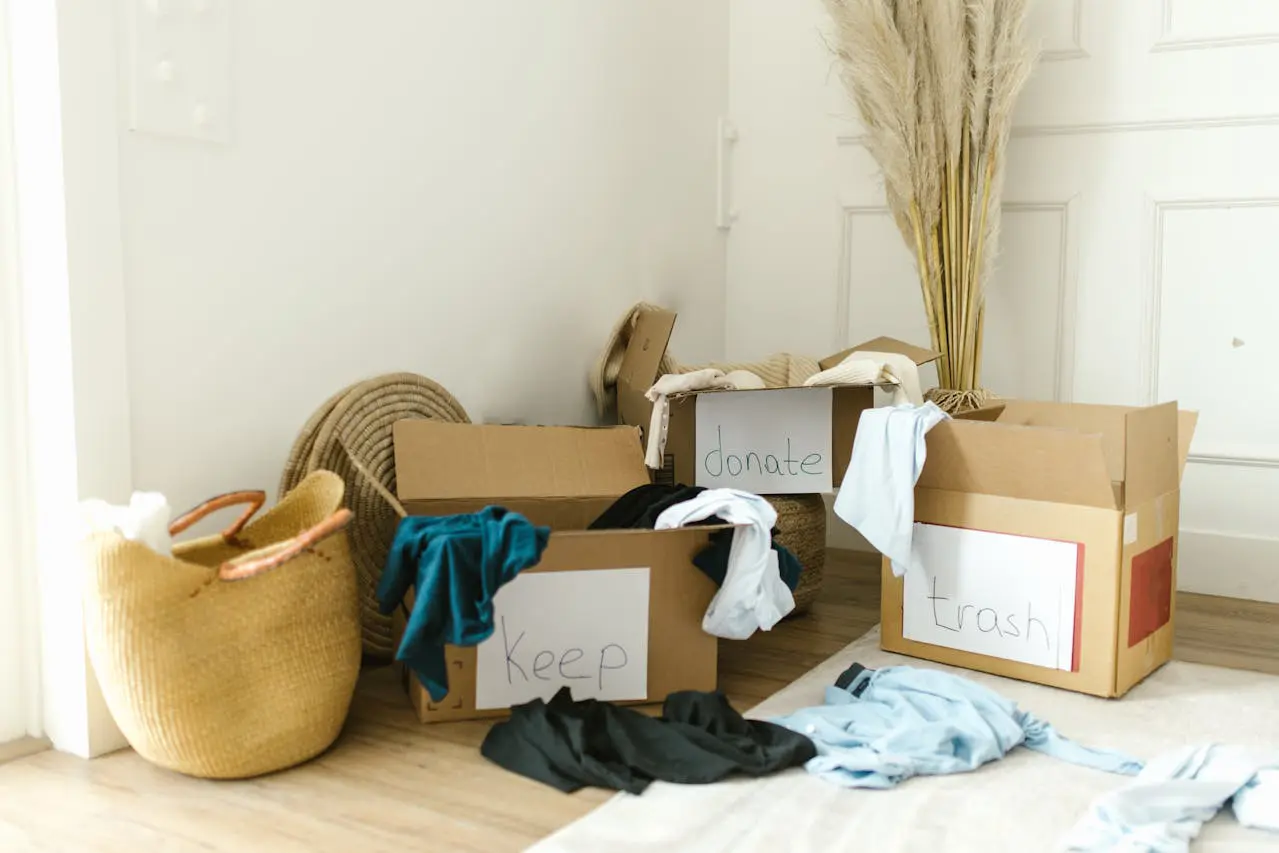
For categories that tend to multiply (clothes, mugs, beauty products):
- Every time a new item comes in, one similar item must go out.
- Keep a donation box or bag in a visible spot.
3. The doorway rule
When you leave a room, take one thing that does not belong there and put it away.
4. Weekly “hotspot” reset
Pick one clutter hotspot per week (the entryway table, the junk drawer, the bathroom counter) and set a 15-minute timer to reset it.
5. A home for everything
Clutter often appears when things do not have a clear home. When you catch yourself dropping something “just anywhere,” ask:
- “Where will this live from now on?”
- Create a simple container, hook, or basket if needed.
These habits are tiny, but they stack. Over weeks and months, they keep your home from drifting back into chaos.
Do not force yourself. Try one habit first. The one that seems the easiest to adopt. Step by step you will see changes.
9. Why Decluttering Now Makes Everything Easier
So why now?
Because motivation doesn’t only spike on January 1.
Behavioral research on the “fresh start effect” shows that people are more likely to initiate meaningful changes after temporal landmarks – the start of a new month, a birthday, a Monday, even the first day back after a trip.
These moments create a subtle psychological divide between the “old me” and the “new me.” That mental separation makes change feel more possible.
You don’t need a new year.
You need a reset point.
Decluttering creates that reset.
When you clear physical, digital, and emotional clutter, you:
- arrive at your next goal feeling lighter, not overwhelmed
- reduce the friction between intention and action
- create an environment that supports your habits instead of sabotaging them
You Reduce Decision Fatigue
Most people assume they fail new goals because they lack discipline.
More often, they’re simply exhausted.
Cluttered homes.
Overloaded schedules.
Chaotic inboxes.
Unfinished emotional loops.
Each one drains mental energy.
When you remove those background stressors, you lower your baseline cognitive load. And when your brain isn’t constantly filtering noise, it has more capacity for focus, patience, and follow-through.
Decluttering is not cosmetic.
It’s neurological relief.
You Send Yourself a Different Signal
Clearing clutter is also an identity decision.
It says:
“My time matters.”
“My energy matters.”
“My peace matters.”
That shift, seeing yourself as someone who protects their mental space, is often more transformative than the organizing itself.
Because once you experience how much lighter you feel, you become less willing to tolerate unnecessary noise.
And that changes how you move through everything else.
How to Use This Checklist
You don’t need to do everything at once.
Pick 3–4 areas that feel most urgent – maybe digital, paper, and money clutter.
- Block small pockets of time (20–40 minutes) on your calendar this week.
- Celebrate small wins: screenshots deleted, subscriptions canceled, one guilt project released.
- Choose 1–2 micro-declutter habits to keep long term.
Every item you remove frees mental space.
Every subscription you cancel reduces friction.
Every unfinished task you close lowers background stress.
Decluttering isn’t about perfection.
It’s about relief.
And relief changes everything.
Photo sources (except Dreamstime): 1, 2, 3, 4, 5