
Halloween is very popular: we know the pumpkins, costumes, candy, witches, ghosts, and orange lights. But where did all of these traditions come from? Which ones are centuries old, which ones are surprisingly modern, and how many of the Halloween “facts” we see every October are actually true?
I always like to learn more about celebrations, holidays, countries, and cultures. Of course, I can’t know everything – I’m not an encyclopedia – but I’m always open to discovering new and interesting things. Halloween is so popular worldwide, and I find it fascinating partly because it has changed so much over time.
If you’ve been here before, you may have already tried my Halloween trivia questions and answers or tested your film knowledge with these Halloween movie trivia questions. This article takes a different route. I’m sharing the stories behind the traditions, along with strange old customs, unusual Halloween laws, candy history, record-breaking pumpkins, modern spending, folklore, and several popular claims that might not be true.
ID 125420192 ©Rawpixelimages | Dreamstime.com
I checked historical claims against sources including the Library of Congress, Smithsonian Institution, National Museum of Ireland, USDA, Guinness World Records, government and municipal codes, historical collections and other specialist sources.
The Strange History Behind Halloween
Fact 1: Halloween gets its name from All Hallows’ Eve. The evening before All Saints’ Day was once called All Hallows’ Even or All Hallows’ Eve. Over time, the name shortened to Hallowe’en and eventually Halloween. Merriam-Webster’s history of the word Halloween traces this linguistic evolution.
Fact 2: “Hallow” originally referred to someone or something holy. The word is related to the Old English word for holy, and All Hallows’ Day was an older name for what we now usually call All Saints’ Day. The name Halloween therefore has a Christian linguistic history even though many customs associated with the holiday came from several different traditions.
Fact 3: The word “Halloween” is much younger than some of the customs now associated with the holiday. Merriam-Webster dates the first known use of Halloween to around 1700. Earlier forms such as Hallowe’en were already in use, while seasonal customs eventually associated with October 31 stretch back much further.
Fact 4: Samhain marked the beginning of winter in the traditional Irish calendar. The National Museum of Ireland describes Samhain, November 1, as one of the traditional Irish calendar’s important seasonal markers. Celebrations took place mainly on the evening before, October 31. The museum’s Halloween and Samhain collection preserves masks, customs, and other objects connected with these traditions.
Fact 5: Samhain was associated with the darker, colder part of the year. In agricultural communities, the seasonal shift wasn’t simply a decorative change from green leaves to orange ones. Winter brought darkness, difficult weather, and uncertainty. Irish traditions surrounding Samhain included protection rituals, feasting, games, pranks, beliefs about spirits, and remembrance of people who had died.
Fact 6: Halloween developed through more than one religious and cultural tradition. The idea that one ancient festival simply changed its name and became modern Halloween is too neat. The Library of Congress Halloween collection describes the mingling of Christian and pre-Christian beliefs, while later Irish, Scottish, British, and American customs added further layers.
Fact 7: November 1 became All Saints’ Day in the Western Church during the early Middle Ages. Merriam-Webster notes that Pope Gregory IV extended the November 1 observance of All Saints’ Day throughout the Western Church in 835. October 31, the evening before the feast, became All Hallows’ Eve.
Fact 8: All Souls’ Day added another observance centered on remembering the dead. November 2 became associated with prayers and remembrance for the faithful departed. October 31, November 1, and November 2 eventually formed a closely connected period of observance, which helps explain why death and remembrance remained close to the Halloween season.
Fact 9: Irish Halloween tradition included the belief that souls could return home. According to the National Museum of Ireland, Halloween was also known as “ghost night” or “spirit night,” and the souls of dead family members were expected to return to the family home. People also believed less welcome spirits could be active, and some avoided traveling alone.
Fact 10: Irish and Scottish immigration played a major role in the development of American Halloween. Immigrants carried customs, stories, disguises, and seasonal celebrations with them to North America. The Smithsonian’s history of trick-or-treating follows that transition and the later transformation of Halloween into a particularly American holiday.
Halloween is only one part of a month packed with seasonal traditions, history and celebrations. These October trivia questions and answers cover much more than October 31, including food, history, entertainment, nature, sports and events connected with the month.
Trick-or-Treating Has a Surprisingly Complicated Past
Fact 11: “Souling” is one of the traditions connected with the history of trick-or-treating. During the Middle Ages and later, poorer people could go from house to house asking for food in return for prayers for the dead. The custom is frequently cited as one of several predecessors of modern door-to-door Halloween visits.
Fact 12: Soul cakes weren’t handed out for a Halloween prank. The exchange was religious: food in return for prayers. A modern child saying “trick or treat” is participating in a very different activity, which is why historians usually describe souling as one influence.
Fact 13: Ireland and Scotland had another door-to-door custom known as guising. Guisers wore disguises and visited homes. The National Museum of Ireland describes masked men or children going from house to house, entertaining their neighbors and receiving treats.
Fact 14: Guisers could be expected to perform before receiving anything. Songs, poems, jokes, and other forms of entertainment could earn the visitor a reward. The modern demand for candy requires considerably less preparation.
Fact 15: The familiar words “trick or treat” are surprisingly recent. Merriam-Webster dates the first known use of trick or treat to 1927. Its history of the phrase identifies early examples in Canadian newspapers during the 1920s.
Fact 16: One of the earliest American examples appeared in Michigan in 1928. A Bay City newspaper described children appearing at doors with the ultimatum “tricks or treats.” The wording makes the underlying bargain unusually clear: provide something desirable or risk a prank.
Fact 17: Halloween pranks once caused far more trouble than many modern tricks do. Gates disappeared, windows were soaped, property was damaged, and objects could end up in astonishing places. The Smithsonian’s history of Halloween mischief in America describes pranks ranging from inconvenient to destructive.
Fact 18: Organized Halloween parties were promoted partly as a way to control the chaos. Schools, civic groups and neighborhoods encouraged parties, parades and games. Keeping children occupied offered communities an alternative to spending the next morning retrieving gates and cleaning painted walls.
Fact 19: World War II sugar rationing interrupted the growth of candy-centered Halloween celebrations in the United States. Sugar was rationed during the war, limiting candy production and distribution. Trick-or-treating expanded rapidly after rationing ended.
Fact 20: Postwar suburbs were almost perfect for modern trick-or-treating. Large neighborhoods filled with families allowed children to visit many homes in a small area. Individually wrapped candy also gave householders an easy treat to distribute. Smithsonian historian Samira Kawash notes that Halloween didn’t become firmly centered on candy until the middle of the 20th century.
Fruit, nuts, cakes, small toys, and even coins could be given to Halloween visitors before packaged candy became the expected prize. The enormous bowl of individually wrapped sweets beside the front door is connected mainly to modern Halloween.
Jack-o’-Lantern and Pumpkin Facts
ID 159785656 ©Evgenyatamanenko | Dreamstime.com
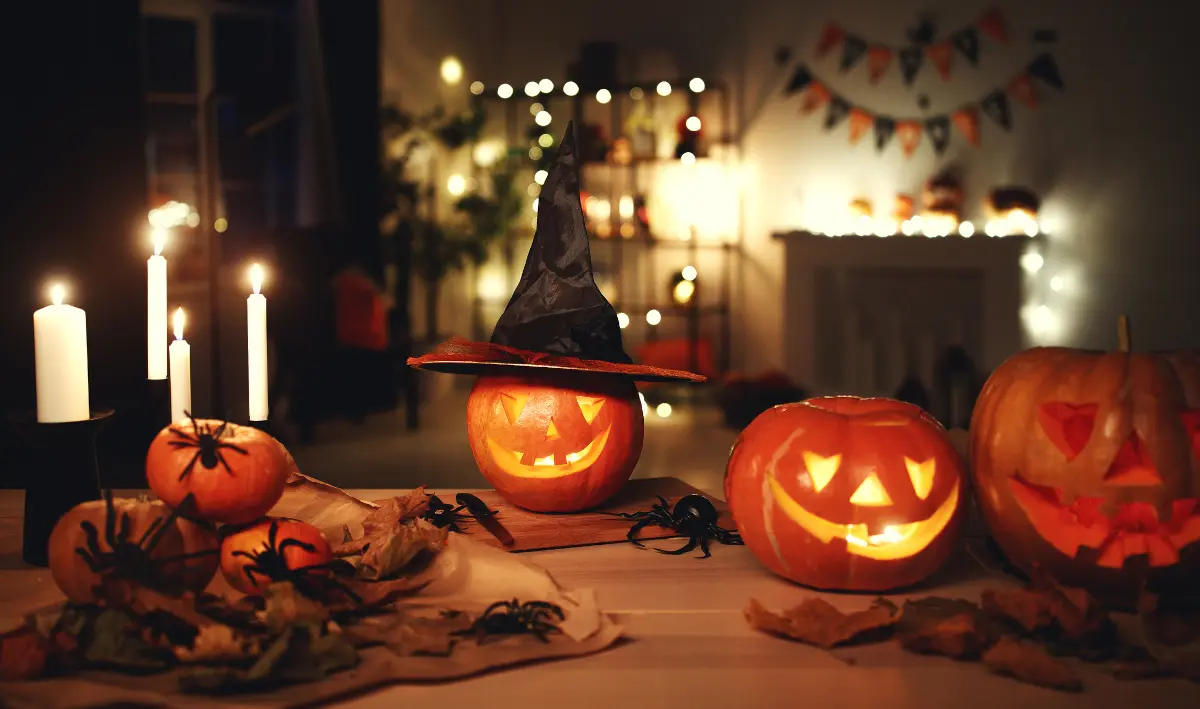
Fact 21: “Jack-o’-lantern” originally referred to something other than a carved pumpkin. In 17th-century Britain, the expression could refer to a lantern-carrying man or night watchman. It was also applied to mysterious flickering lights seen over marshy ground – all the explanations are from Merriam-Webster’s jack-o’-lantern history.
Fact 22: Nobody can prove that the Stingy Jack legend created the term jack-o’-lantern. The famous Irish folk story tells of Jack, a man who tricks the Devil and is eventually left wandering with a light in a hollowed vegetable. It’s a wonderful Halloween legend, but the term jack-o’-lantern existed in other contexts. The exact route by which the name became attached to carved lanterns remains uncertain.
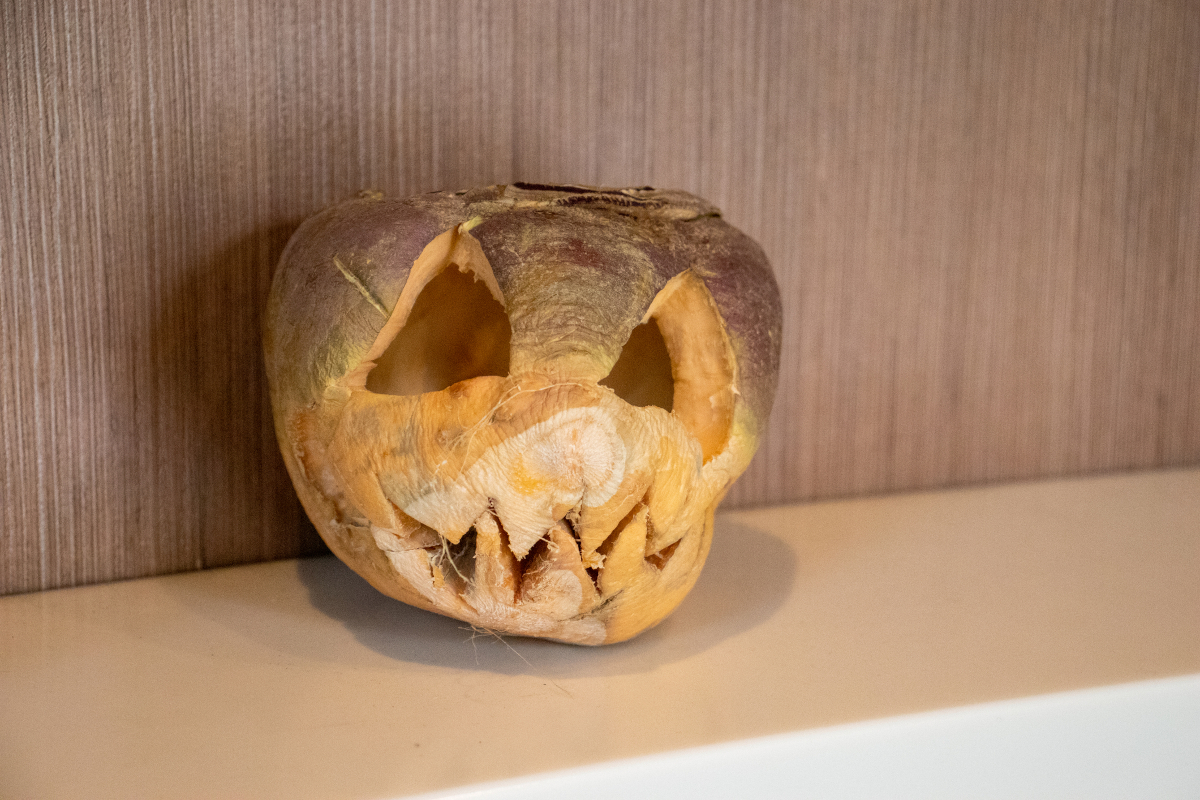
Fact 23: People in Ireland carved turnips into frightening lanterns. Candles were placed inside carved turnips, which could be carried or displayed in windows. The National Museum of Ireland describes the modern pumpkin as an American development of this older tradition.
ID 261553340 ©Londonaddict | Dreamstime.com
Fact 24: A genuinely creepy Irish turnip lantern survives in museum records. The National Museum of Ireland received a turnip lantern from a teacher in County Donegal in 1943. She said it was the type traditionally made in her locality around 1900. A plaster model of the original is now preserved as the museum’s famous ghost turnip.
Fact 25: The old lanterns were designed to frighten people. According to the museum’s record, candles were put inside the carved turnips, and the lanterns were used to scare people on October 31. The uneven surface of a turnip can produce a face considerably more unsettling than a carefully carved modern pumpkin.
Fact 26: Pumpkins were available in America because the crop is native to the Americas. The USDA notes that pumpkin cultivation dates back thousands of years in what is now Mexico. Pumpkins were therefore a New World alternative that Irish and Scottish immigrants couldn’t have used in the old European traditions. You can read the USDA’s pumpkin history and production information here.
Fact 27: Pumpkins were much easier to turn into lanterns than turnips. They’re larger, generally easier to hollow, and give carvers a much bigger surface for a face or design, and this helped the pumpkin version become one of the most recognizable symbols of American Halloween.
Fact 28: Illinois remains America’s pumpkin-producing giant. USDA data for 2025 reports about 526.9 million pounds of utilized pumpkin production in Illinois. The state is especially important for processing pumpkins, while other major pumpkin-producing states grow a larger proportion for the fresh market. The USDA’s 2025 Illinois agricultural data provides the latest state figures.
Fact 29: The world record pumpkin now weighs 2,819 pounds 4 ounces. Twin brothers Ian and Stuart Paton of the United Kingdom grew a pumpkin nicknamed Muggle that weighed 1,278.8 kg (2,819 lb 4 oz) on October 6, 2025. Guinness World Records confirms that it is the current world’s heaviest pumpkin as of this August 2026 update. It also set the record for largest pumpkin circumference.
Pumpkins are only part of what makes this season interesting. If you want to move from Halloween into foliage, harvests, seasonal food, sports, and celebrations, these fall trivia questions and answers cover the broader season.
Halloween Used to Be a Night for Finding Your Future Husband or Wife
One of my favorite discoveries while researching old Halloween customs was just how much of the evening once revolved around romance. Ghosts, spirits, and witches shared the night with a completely different concern: whom would you marry?
Fact 30: Halloween was once strongly associated with matchmaking and marriage divination. The Library of Congress has an entire collection of historical material showing young people using Halloween games to supposedly discover the identity of a future spouse. Its century-old Halloween matchmaking customs come from newspapers published more than a hundred years ago.
Fact 31: Mirrors could supposedly reveal the person you would marry. One old game instructed a person to walk backward in moonlight while looking into a mirror. Another version involved staring into a mirror while eating an apple. If everything went according to the folklore, the future spouse’s face would appear.
Fact 32: An apple peel could become a romantic prediction. In one popular game, a person peeled an apple in one long strip and threw the peel over a shoulder. The shape it made when it landed was interpreted as the initial of the future husband or wife.
Fact 33: Nuts could supposedly tell you whether a relationship would last. Robert Burns described the practice in his 1785 poem Halloween. Two nuts represented two people and were placed in a fire. If they burned peacefully together, the relationship had a promising future. If they jumped apart, the prediction wasn’t as romantic. A digitized edition of Burns’ work in the Library of Congress collection preserves his notes on the custom.
Fact 34: Pulling up kale could supposedly reveal your future spouse’s appearance. Burns also recorded a Scottish Halloween custom in which participants went into a kale patch with their eyes closed and pulled the first stalk they found. Its size and shape supposedly indicated the size and build of the person they would marry.
Fact 35: Dirt stuck to the kale root could mean money. According to Burns’ explanation, earth clinging to the root represented the future spouse’s fortune. The taste of the stalk could even be interpreted as a clue to that person’s disposition.
Fact 36: Irish barmbrack could hide predictions inside a slice of cake. The National Museum of Ireland describes the Halloween tradition of placing objects inside báirín breac, or barmbrack. A ring predicted marriage, while other objects could symbolize wealth, poverty, remaining unmarried or entering religious life. Today, the ring remains the best-known survivor of the custom.
Fact 37: Cabbages could also be used in Irish marriage divination. The National Museum of Ireland records blindfolded games in which a participant selected a cabbage. Its size, shape and roots were interpreted as clues about a future spouse. Halloween party entertainment could once require a surprisingly large amount of garden produce.
Fact 38: Four bowls could supposedly predict marriage, prosperity, emigration or death. In one Irish game recorded by the museum, a blindfolded participant chose among bowls containing objects such as water, a ring, clay or food. Each selection carried a different prediction for the person’s future.
Fact 39: Welsh folklore had a far darker Halloween prediction. A tradition from Llangernyw in North Wales told of a supernatural figure called the Angelystor, or Recording Angel. According to folklore collected in the 19th century, its voice could be heard around Halloween announcing the names of local people who would die during the coming year. The legend appears in Elias Owen’s 1896 collection of Welsh folklore and survives in Welsh cultural resources about Llangernyw and the Angelystor tradition. It is folklore, not a record of supernatural events.
I love discoveries like these because they offer more dimensions than the commercial version. A celebration we now connect so strongly with candy and horror movies once included young people examining kale roots, burning nuts, and looking into mirrors because they wanted clues about marriage.
Costumes, Witches, Black Cats and Halloween Imagery
Fact 40: Masks and disguises have been part of Irish Halloween tradition for generations. The National Museum of Ireland preserves old Halloween masks and records how groups of disguised men or children visited neighbors. The museum describes disguise, pranks, games, protection, and marriage divination as established features of Irish Halloween tradition.
Fact 41: Mass-produced costumes helped turn Halloween into a major commercial event. Ben Cooper, Inc., founded in Brooklyn in 1937, became one of America’s largest Halloween costume manufacturers. The company licensed characters from movies and television and sold inexpensive masks and costumes through major retailers. The National Museum of American History’s Halloween collection includes examples from Ben Cooper and other manufacturers.
Fact 42: Early American Halloween postcards were once a popular part of the holiday. By the early 1900s, sending and collecting Halloween greeting cards had become popular in the United States. The Henry Ford museum’s Halloween postcard collection includes cards from the early 20th century showing pumpkins, witches, hayrides, courtship, and harvest scenes.
Fact 43: Old Halloween postcards could be surprisingly romantic. Modern Halloween marketing leans heavily toward ghosts, monsters and horror, but many vintage cards mixed supernatural imagery with courtship and fortune-telling. Witches and black cats could appear alongside romantic predictions or images of young couples.
Fact 44: The familiar Halloween witch developed over a long period rather than from one single source. European witchcraft beliefs, folk stories, literature, art, theatre and film all contributed. By the early 20th century, pointed hats, broomsticks, cauldrons and black cats were already common Halloween imagery in American cards and decorations.
Fact 45: Black cats have been associated with both bad luck and good luck. Their connection with witchcraft and superstition helped make them a Halloween symbol, particularly in Europe and North America. Other traditions have treated black cats as lucky. Their reputation has never been universal.
Fact 46: Modern research still finds measurable perceptions surrounding black cats. A 2026 US study involving more than 1,000 participants found that black cats in online shelter photographs were rated as less likely to be adopted and were harder for participants to read emotionally. Superstitious beliefs themselves didn’t significantly explain those ratings. The study is available through PubMed Central.
Fact 47: Bats were appearing in recognizable Halloween imagery by the early 20th century. Their nocturnal habits, dark silhouettes and established associations with darkness made them a natural fit alongside witches, ghosts and black cats. The frequently repeated claim that bats became a Halloween symbol specifically because Samhain bonfires attracted insects and therefore bats is much harder to document as the single origin.
Fact 48: Orange and black were established Halloween colors by the early 20th century, but their exact “official meanings” are difficult to pin to one historical source. A common interpretation connects orange with harvest and autumn and black with darkness and death. The Library of Congress discusses this interpretation, while historical cards, decorations and newspaper material show the color pairing becoming part of Halloween’s visual identity.
Halloween Candy, Decorations and Money
ID 33347633 ©Elena Schweitzer | Dreamstime.com
Fact 49: Candy corn dates to the late 19th century, but its exact invention story isn’t completely documented. George Renninger of Philadelphia’s Wunderle Candy Company is usually credited with developing it in the 1880s. History.com notes that the origin relies partly on oral histories, so “credited with inventing” is more accurate than pretending we have a detailed day-by-day account of its creation. The updated history of candy corn explains what is known.
Fact 50: Candy corn was marketed as “Chicken Feed.” The Goelitz Confectionery Company, which later became part of Jelly Belly, began making the candy in 1898 and marketed the corn-shaped pieces under the agricultural name Chicken Feed. Packaging even featured a rooster.
Fact 51: Candy corn wasn’t created specifically for Halloween. It began as a year-round agricultural novelty candy at a time when confectioners sold sweets shaped like pumpkins, chestnuts, turnips and other farm products. Its colors and harvest theme later made it an obvious fit for autumn and Halloween.
Fact 52: Halloween wasn’t always a candy holiday. Smithsonian food historian Samira Kawash has pointed out that candy wasn’t the automatic trick-or-treat reward during the holiday’s earlier American years. Children might receive homemade cookies, cake, nuts, toys or money. Candy became much more dominant during the middle of the 20th century.
Fact 53: A teal pumpkin outside a house now has a useful meaning. The Teal Pumpkin Project encourages households to make non-food treats available for children who may not be able to eat traditional Halloween candy. A teal pumpkin or sign tells families that alternatives such as small toys or glow sticks are available.
I admit I like the commercial side of Halloween too – in moderation. I’ve bought dedicated Halloween pens, scrunchies, several sets of lights for the house that I reuse every year, and a few decorations. I’m not filling every room with Halloween merchandise, but I saw things I liked and bought them. The history behind the holiday makes it even more interesting for me because there’s so much beyond the shopping side.
Fact 54: Americans planned to spend a record $13.1 billion on Halloween in 2025. This is the latest National Retail Federation Halloween spending survey available at the time of this August 2026 update. The previous year’s estimate was $11.6 billion. The NRF’s 2025 Halloween survey questioned 8,045 US consumers.
Fact 55: Average planned Halloween spending reached a record $114.45 per person. That was nearly $11 higher than the 2024 figure and above the previous record of $108.24 set in 2023.
Fact 56: Costumes were projected to attract more spending than candy. The NRF estimated $4.3 billion for costumes, $4.2 billion for decorations and $3.9 billion for candy in 2025. Another $700 million was projected for greeting cards.
Fact 57: Giant Halloween yard decorations have become a modern phenomenon of their own. Home Depot’s 12-foot skeleton became a perfect example after its 2020 launch. The company reported that the giant skeleton sold out before October during its first season. It later became known by fans as Skelly and returned in subsequent Halloween collections. The same NRF survey shows how large the decorating market has become: 51% of respondents said they planned to decorate their home or yard in 2025, while 23% planned to dress a pet in costume. Pet-costume spending alone was projected at $860 million.
These Weird Halloween Laws Are Real
Halloween-law lists are very interesting, but I discovered that a few things are different than the popular knowledge.
Fact 58: Belleville, Illinois really does limit who can trick-or-treat. The city’s current code defines Halloween solicitation as trick-or-treating and says the activity is for students in eighth grade and under, with an exemption for special-needs students when accompanied by a responsible person. The official trick-or-treat period is 5:00 p.m. to 8:30 p.m. The City of Belleville’s Halloween information confirms that the ordinance was adopted in October 2008, while the ordinance itself gives the detailed rules.
Fact 59: There really is a Belleville, Missouri too – but it isn’t the place with this Halloween ordinance. Belleville, Missouri is an unincorporated community in Jasper County, and historical records show that the small mining community was also known as Zincite. Because it doesn’t have its own municipal government like the City of Belleville, Illinois, the Halloween rule above shouldn’t be attributed to it. Some Halloween fact lists have mixed up the two places, turning a real Illinois ordinance into a supposed “Belleville, Missouri” law.
Fact 60: Rehoboth Beach, Delaware has a two-hour trick-or-treating window written into its code. Children who haven’t reached age 14 may go door to door for treats between 6:00 p.m. and 8:00 p.m. on October 31. The Rehoboth Beach Halloween regulation contains an extra quirk: if October 31 falls on a Sunday, the door-to-door activity moves to October 30.
Fact 61: Dublin, Georgia has a public mask law with a specific Halloween exception. The city’s ordinance generally prohibits appearing in public with the face concealed in a way that hides identity. Children age 16 and under participating in traditional Halloween activities on October 31 are specifically exempted. Some Halloween-law lists describe the rule almost backward. You can read the wording in the Dublin Code of Ordinances.
Fact 62: Hollywood has a real Halloween Silly String restriction. Los Angeles adopted the ordinance in 2004 after concerns about cleanup, vandalism, and public safety during Hollywood’s huge Halloween crowds. Within the Hollywood Division, possessing, using, selling or distributing Silly String in places accessible or visible to the public is prohibited during a 36-hour period from midnight on October 31 through noon on November 1. The Los Angeles ordinance contains the boundaries and full wording.
Fact 63: Alabama’s famous “Halloween priest costume ban” isn’t what many lists claim. Alabama Code §13A-14-4 prohibits a person in a public place from fraudulently pretending through clothing or appearance to be a minister, nun, priest, rabbi or other member of the clergy. The current statute provides for a fine of up to $500, imprisonment for up to one year, or both. The word fraudulently is essential. The 2025 Alabama statute isn’t written as a Halloween costume ban.
| Place | What the rule actually covers | Key detail |
|---|---|---|
| Belleville, Illinois | Halloween trick-or-treat solicitation | Eighth grade and under; 5:00–8:30 p.m.; stated exceptions apply |
| Rehoboth Beach, Delaware | Door-to-door Halloween treats | Under 14; 6:00–8:00 p.m.; moves to Oct. 30 if Oct. 31 is Sunday |
| Dublin, Georgia | Public mask law | Halloween exception for children 16 and under |
| Hollywood, Los Angeles | Silly String during Halloween | 36-hour restriction in the Hollywood Division |
| Alabama | Fraudulent impersonation of clergy | Not a blanket ban on priest or nun Halloween costumes |
Halloween Pop Culture and Strange Coincidences
Fact 64: John Carpenter’s Halloween was made in only 21 days. A Library of Congress essay on the 1978 film gives its production budget as about $320,000 and its shooting schedule as 21 days. California had to stand in for Illinois and March had to look like October. The movie later became one of the most influential horror films ever made and was added to the US National Film Registry in 2006. The Library of Congress essay on Halloween covers its production and legacy.
Fact 65: Michael Myers’ famous mask started as a William Shatner mask that cost about $2. Production designer and editor Tommy Lee Wallace modified the mask to create Michael Myers’ blank expression. A cheap prop became one of the most recognizable faces in horror cinema.
If you like this kind of behind-the-scenes detail, the Halloween movie quiz goes much further into horror classics, family Halloween films, supernatural movies, and famous characters.
Fact 66: It’s the Great Pumpkin, Charlie Brown dates to 1966. The Halloween television special became one of the best-known seasonal Peanuts programs. The Smithsonian’s National Museum of American History preserves an original animation cel from the special showing Charlie Brown after he receives a rock in his trick-or-treat bag.
Fact 67: “Monster Mash” became a No. 1 US hit in 1962. Bobby “Boris” Pickett and the Crypt-Kickers released the novelty song in the early 1960s, and it reached the top of the Billboard Hot 100 shortly before Halloween. More than six decades later, it still reappears on Halloween playlists and charts.
Fact 68: Mamie Eisenhower was the first First Lady to publicly decorate the White House for Halloween. On October 30, 1958, she transformed the State Dining Room for a lunch with staff wives. According to the White House Historical Association, the decorations included skeletons, jack-o’-lanterns, corn stalks, pumpkins, apples, miniature witches, black cats, owls and goblins.
Fact 69: Harry Houdini really did die on Halloween. The famous escape artist died on October 31, 1926, at age 52 from peritonitis following a ruptured appendix. The punches he received in Montreal shortly before his final illness became part of the story surrounding his death, but the causal relationship has remained disputed. The Smithsonian’s account of Houdini’s death notes that his appendix may have ruptured even without the blows.
Scary entertainment also raises another interesting question: why do we voluntarily watch something designed to frighten us? Research into why people enjoy being scared looks at recreational fear, excitement, relief, curiosity and the social side of sharing a controlled scare.
And horror films have their own unwritten rules. Characters investigate suspicious noises, split up at terrible moments and walk directly toward places every viewer knows they should avoid. These funny horror movie moments are a lighter detour after the folklore and municipal codes.
Dracula imagery has also become almost inseparable from modern spooky-season culture. Here in Romania, Bran Castle in Transylvania is known around the world through its association with the Dracula legend. Bram Stoker never visited Romania, and the relationship between his fictional castle and the real Bran Castle is far more complicated than the popular nickname “Dracula’s Castle” suggests.
Six Famous Halloween “Facts” That Need a Correction
This was one of the most interesting parts of researching the article. Halloween information gets copied constantly, and a statement can start looking authoritative simply because it appears on dozens of websites.
Fact 70: “Halloween is simply Samhain with a new name” leaves out centuries of history. Samhain is an important part of the story, particularly in Irish and Scottish seasonal traditions. Halloween also developed around Christian observances, including All Saints’ Day and All Souls’ Day, and continued changing through British, Irish, Scottish, and American culture. Modern Halloween has many ancestors rather than one single starting point.
Fact 71: We don’t have a detailed eyewitness record of exactly how every ancient Samhain ritual worked. Modern articles sometimes describe the beliefs and actions of “the ancient Celts” with extraordinary precision. The surviving evidence is much less complete. Later folklore is valuable, but a practice recorded in Ireland centuries later shouldn’t automatically be presented as a documented ritual carried out in exactly the same form two thousand years ago.
Fact 72: “Samhainophobia” isn’t a standalone diagnosis in the major psychiatric diagnostic manuals. The word is used online to describe an intense fear of Halloween, but a clinically significant fear would generally be considered within broader diagnostic categories such as specific phobia rather than a medical condition officially named “samhainophobia.” Calling it “the clinical medical name for fear of Halloween” overstates its status.
Fact 73: The classic story of random strangers repeatedly killing children with poisoned Halloween candy isn’t supported by the evidence. Sociologist Joel Best has studied reported Halloween candy-tampering incidents for decades. His research hasn’t identified a substantiated case matching the familiar scenario of a stranger randomly giving a child poisoned Halloween candy that causes death or serious injury. Hoaxes, family crimes and incidents involving foreign objects have occurred, but they’re a different phenomenon. Best maintains his Halloween candy-tampering research online.
Fact 74: The idea that black cats adopted around Halloween are routinely used for ritual sacrifice isn’t supported by good evidence. Some shelters historically suspended black-cat adoptions because of fears surrounding Halloween. A peer-reviewed study of shelter outcomes notes a lack of empirical evidence that black cats experience worse treatment at Halloween and found no October adoption pattern supporting the idea that people were acquiring them for nefarious purposes. You can read the research in PubMed Central. Black cats can still face adoption disadvantages for other reasons, which newer research continues to investigate.
Fact 75: Día de Muertos isn’t “Mexican Halloween.” The dates are close and both celebrations can include imagery connected with death, but Día de Muertos has its own Mexican and Indigenous history, religious influences, traditions and purpose. It centers on remembering deceased loved ones through practices such as ofrendas, flowers, food and cemetery visits.
Many cultures have celebrations involving ancestors, spirits, seasonal change and remembrance of the dead, and they deserve to be understood on their own terms. These Halloween-like festivals around the world include Día de Muertos, Obon, the Hungry Ghost Festival, Pchum Ben, All Saints’ traditions, and several other fascinating observances.
Halloween Myths vs. What the Evidence Shows
| You’ve probably heard… | What the evidence supports |
|---|---|
| Halloween is simply Samhain under a different name. | Modern Halloween developed through Gaelic seasonal traditions, Christian observances and later British, Irish, Scottish and American customs. |
| We know exactly how ancient Samhain was celebrated. | There is evidence for the festival and later traditions, but detailed ancient evidence is limited and modern summaries often combine material from very different periods. |
| Stingy Jack definitely gave the jack-o’-lantern its name. | The story is an important piece of Irish folklore, but the term jack-o’-lantern had earlier meanings and its transfer to carved lanterns isn’t completely documented. |
| Strangers have repeatedly killed trick-or-treaters with poisoned candy. | Decades of research haven’t substantiated the classic random-stranger poisoning scenario. |
| Alabama bans priest and nun Halloween costumes. | The state law prohibits fraudulent public impersonation of clergy. |
| Black cats are routinely adopted before Halloween for ritual harm. | The belief has influenced shelter policies, but research hasn’t established the claimed pattern. |
| Día de Muertos is Mexican Halloween. | It is a distinct tradition with its own history and cultural practices. |
Conclusion
I started with the familiar side of Halloween – pumpkins, costumes, candy, ghosts and decorations – and ended up again with exactly what I enjoy about researching celebrations and cultures: there is always another layer.
Some traditions traveled across countries and changed, while other old customs disappeared almost completely. Halloween once involved an extraordinary amount of matchmaking. Turnips became pumpkins. Door-to-door traditions changed from prayers and performances to candy. Pranks helped push communities toward organized celebrations. Commercial costumes, movies and decorations later transformed the holiday again.
I still like my Halloween lights, pens, scrunchies and decorations, and I’ll keep reusing them. Now they sit alongside a much more interesting collection of stories in my mind: frightening Irish turnips, fortune-telling kale, soul cakes, century-old postcards, strange municipal rules and a giant pumpkin weighing more than many cars.
If you want to see how much of this you remember, try these Halloween trivia questions and answers, with questions about Halloween history, traditions, candy, superstitions, and celebrations.
Movie fans can continue with these Halloween movie trivia questions and answers, while the traditions surrounding October 31 connect with an even wider world of festivals similar to Halloween around the world.
Questions People Often Ask About Halloween
Where did Halloween originate?
Halloween developed over centuries rather than beginning in one place at one moment. Gaelic Samhain traditions, Christian observances including All Saints’ Day and All Souls’ Day, Irish and Scottish folk customs and later American practices all contributed to the holiday celebrated today.
Is Halloween pagan or Christian?
Its history contains both pre-Christian and Christian influences. Samhain contributed important seasonal traditions, while the name Halloween comes directly from All Hallows’ Eve, the evening before the Christian feast of All Saints’ Day. Later customs added more cultural layers.
Why is Halloween celebrated on October 31?
October 31 is the evening before All Saints’ Day on November 1, which explains the name All Hallows’ Eve. The date also coincides with the traditional eve of Samhain, which began the winter season in the old Irish calendar.
When did people start saying “trick or treat”?
The phrase is much younger than the customs behind it. Merriam-Webster records examples from western Canada in the 1920s and dates the first known use to 1927. One early US example appeared in Michigan in 1928.
Why do people carve pumpkins for Halloween?
Carved lantern traditions existed in Ireland using turnips and other root vegetables. In North America, pumpkins were larger and easier to carve, and they gradually became the standard material for jack-o’-lanterns.
Why do people dress up on Halloween?
Disguise appears in several traditions connected with the Halloween season, including Irish and Scottish guising. Masks and costumes could be used for visiting neighbors, frightening people or taking part in seasonal games. The 20th-century costume industry later expanded Halloween dress-up into pop-culture characters, superheroes, movie villains and almost anything else people wanted to become for one evening.
Why are black cats associated with Halloween?
European and American superstitions connected black cats with witches, magic and bad luck, which helped make them part of Halloween imagery. Other cultures and traditions have regarded black cats as lucky, so the negative symbolism isn’t universal.
Is Día de Muertos the same as Halloween?
No. Día de Muertos and Halloween occur close together on the calendar and both can include themes connected with death, but they have different cultural histories, meanings and traditions.
How These Halloween Facts Were Checked
Halloween sits at an unusual intersection of history, folklore, religion, popular culture, old newspaper stories and modern marketing. I didn’t want to put a documented municipal ordinance, an Irish folk legend and an internet rumor on the same factual level.
Historical material in this article was checked against resources including the Library of Congress, Smithsonian Institution, National Museum of Ireland, National Museum of American History, The Henry Ford and Merriam-Webster. Robert Burns’ notes accompanying his 1785 poem Halloween are especially useful because they document several Scottish divination customs in remarkable detail.
Current figures and records were checked against the original organizations whenever possible. The spending data comes from the National Retail Federation’s September 2025 consumer survey, still the latest NRF Halloween spending study available at the time of this August 2026 update. Pumpkin production comes from USDA data, and the giant-pumpkin record comes directly from Guinness World Records.
The strange-law section uses current municipal or state legal sources for Belleville, Rehoboth Beach, Dublin, Los Angeles and Alabama. That’s particularly important because several popular Halloween-law lists contain wrong locations or leave out words that change what the law actually says.
Folklore remains part of the article because folklore is one of the most interesting parts of Halloween. A legend doesn’t have to be a documented event to deserve a place here. It simply needs to be presented as a legend rather than turned into historical fact.
More amazing articles for you:
How to Make People Take You Seriously: 7 Behaviors That Change How You Come Across
The Banks of the Seine, the Only UNESCO World Heritage Site in Paris
15 Things to Check Before Booking a Hotel Room - A Hotel Booking Checklist to Avoid Costly Mistakes ...
9 Tips on Planning Your First Big 5 Safaris
From Canned Air and Water to Cane Toad Wallets: The 50+ Weirdest Souvenirs People Actually Buy
An insider’s guide to Jaipur, India: top 20+ things to do in Jaipur
15 Famous Places Named After People - But Do You Know Who They Were?
People Decide Whether to Listen to You in Seconds - These 7 Mistakes Kill Their Attention

Violeta-Loredana Pascal is a communications expert, business mentor, and the founder of Earth’s Attractions and PRwave INTERNATIONAL. A pioneer in the Romanian digital PR landscape since 2005, she holds a degree in Communication and Social Sciences from SNSPA Bucharest. Violeta is a senior trainer at AcademiadeAfaceri.ro, where she leverages over 20 years of experience to teach professional courses in PR strategy and workplace productivity. By blending high-level business consulting with a passion for holistic travel and wellness, she empowers solopreneurs to overcome procrastination, build profitable brands, and design a life of purposeful adventure.