I find Halloween fascinating. Its essence and origin are both wonderful. I like the old customs, neighborhood games, handmade decorations, superstitions, candy, and the simple pleasure of dressing up for one evening, and I decided to create a fun Halloween trivia for you 🙂
Below, you’ll find 200 Halloween trivia questions and answers arranged in 12 rounds. The Halloween quiz begins with accessible questions, becomes more challenging as it continues, and covers history, trick-or-treating, pumpkins, candy, fortune-telling, folklore, traditions around the world, nature, science, true-or-false statements, and numerical tie-breakers.
ID 34542383 ©Roberto Giovannini | Dreamstime.com
Adults, older children, families, classrooms, work teams, and party hosts can use the entire quiz or choose the sections that fit their group. Every answer appears directly below its question, and historical or easily misunderstood answers include enough context to explain the fact.
I’ve kept film questions out of the main rounds because movie characters, actors, release years, and famous scenes need a separate Halloween movie trivia quiz. The psychology behind why people enjoy being scared and these funny horror movie moments offer two different detours into that side of Halloween.
The historical and cultural details were checked against museum, library, heritage, scientific, nonprofit, and official record sources. I left out changing candy rankings, current costume surveys, and all claims I could not verify from reputable sources.
How to Use These 200 Halloween Trivia Questions
For people searching for Halloween trivia questions for adults and kids, one useful feature is the ability to choose a game by time and audience. A family game can stay with the opening, pumpkin, and candy rounds, while Halloween trivia questions for work or a party can mix categories and finish with true-or-false or tie-breakers.
| Game format | Suggested questions |
|---|---|
| 10-minute icebreaker | Questions 1-10 |
| Short family game | Questions 1-15, 61-75, and 76-85 |
| Classroom quiz | Questions 1-15, 16-25, 61-75, and 161-170 |
| Office Halloween game | Questions 1-10, 41-50, 76-85, and 176-185 |
| Full trivia night | Choose 10 questions from each main round and save Questions 196-200 for ties |
| Expert challenge | Questions 96-160 and 186-200 |
Give one point for every correct answer. Before play begins, decide whether close spellings, surnames without first names, and partially correct responses will count. For numerical tie-breakers, the nearest answer wins.
A mixed event can combine this article with a general knowledge quiz, a world capitals quiz, or famous landmark questions.
When the group needs a lighter break between rounds, travel riddles with answers and travel would you rather questions require less scoring and invite more conversation.
Easy Halloween Trivia Questions and Answers
The opening round gives you easy Halloween trivia questions and answers without making every clue painfully obvious. These first 15 also work well as family Halloween trivia questions when younger players and adults are competing together.
1. On what date is Halloween celebrated each year?
Answer: October 31.
2. What older name is commonly shortened to “Halloween”?
Answer: All Hallows’ Eve. The word developed from the evening before All Saints’ Day.
3. What is the carved lantern most closely associated with Halloween called?
Answer: A jack-o’-lantern.
4. Which fruit is traditionally used in the game often called apple bobbing?
Answer: Apples.
5. Which animal commonly appears in Halloween decorations with pointed ears and outstretched wings?
Answer: A bat.
6. Which two colors are most strongly associated with modern Halloween decorations?
Answer: Orange and black.
7. What is a costume party where guests wear masks or disguises often called?
Answer: A masquerade.
8. Which Christian feast is observed on November 1?
Answer: All Saints’ Day.
9. What term describes a frightening story circulated as true even though its details are unverified?
Answer: An urban legend.
10. Which object is a witch commonly shown riding in Halloween imagery?
Answer: A broomstick.
11. What type of traditional tale is intended to frighten listeners?
Answer: A ghost story.
12. Which lunar image appears frequently in Halloween art even though it doesn’t occur every October 31?
Answer: A full moon.
13. What does a spider produce to build many types of webs?
Answer: Silk.
14. What is the name for the framework of bones inside a human body?
Answer: A skeleton.
15. What type of attraction uses actors, sets, sound, and lighting to create controlled scares?
Answer: A haunted house or haunted attraction.
First checkpoint: If you answered at least 12 correctly, you’re ready for the history round. The clues become more specific from this point.
Halloween History and Origins Trivia Questions
The next 25 Halloween history trivia questions and answers move from Gaelic seasonal customs to Allhallowtide, immigration, community parties, candy, and twentieth-century traditions. The historical framing follows sources such as the Library of Congress, and if you enjoy a broader timeline, you can continue with European history trivia.
Halloween origins trivia becomes misleading when every custom is attributed to one festival. The questions below distinguish influences and later developments instead of presenting modern Halloween as an unchanged survival from ancient times.
16. Which Gaelic seasonal festival is most often discussed when historians describe one influence on Halloween?
Answer: Samhain. It marked a major seasonal transition, although modern Halloween also developed through Christian, regional, and North American customs.
17. In the traditional Irish calendar, what season began at Samhain?
Answer: Winter.
18. What does the Irish expression “Oíche Shamhna” refer to?
Answer: Halloween night, or the night of Samhain.
19. What does the word “hallow” mean in the holiday’s older name?
Answer: A holy person or saint.
20. What three-day Christian period includes Halloween, All Saints’ Day, and All Souls’ Day?
Answer: Allhallowtide.
21. What observance follows All Saints’ Day on November 2?
Answer: All Souls’ Day.
22. What medieval door-to-door custom involved offering prayers for the dead in exchange for food?
Answer: Souling.
23. What small baked item was traditionally given to people taking part in souling?
Answer: A soul cake.
24. What custom involved visiting homes in disguise and often performing a song, verse, joke, or trick?
Answer: Guising.
25. What name is given to older seasonal performances involving masks, costumes, and visits from house to house?
Answer: Mumming.
26. What large outdoor fires were connected with some old seasonal celebrations?
Answer: Bonfires.
27. Which two immigrant communities helped bring many Halloween customs to North America during the nineteenth century?
Answer: Irish and Scottish immigrants.
28. Which County Meath hill is associated in local heritage accounts with major Samhain gatherings?
Answer: The Hill of Ward, also called Tlachtga. County Meath links the ancient site near Athboy with Samhain gatherings, although claims that every Halloween custom began there go beyond the evidence.
29. What kind of gatherings became a major part of American Halloween celebrations by the late nineteenth and early twentieth centuries?
Answer: Home and community parties.
30. What social subject appeared repeatedly in early twentieth-century Halloween party games?
Answer: Courtship and predictions about marriage.
31. After which global conflict did trick-or-treating expand rapidly in the United States?
Answer: World War II. Sugar rationing ended, suburbs grew, and large numbers of children participated in neighborhood celebrations.
32. What problem were organized community Halloween events often intended to reduce?
Answer: Destructive pranks and vandalism.
33. During which decade did candy companies increasingly market individually wrapped sweets for trick-or-treating?
Answer: The 1950s.
34. Why did sealed commercial candy become more attractive to many families by the 1970s?
Answer: It was considered easier to inspect and safer to accept from unfamiliar households than unwrapped homemade food.
35. In what year did Anoka, Minnesota, hold the organized celebration that helped establish its “Halloween Capital” reputation?
Answer: 1920. The Anoka Halloween history traces the organized event to that year.
36. In which country did early newspaper versions of “trick or treat” appear before the earliest known U.S. example?
Answer: Canada. Newspaper variations appeared there in 1923 and 1924; the earliest known U.S. example cited by the Smithsonian dates to 1928.
37. Which first lady hosted the first known White House Halloween decorating event in 1958?
Answer: Mamie Eisenhower. The White House Historical Association records the decorating event on October 30, 1958.
38. Which U.S. city hosted the first Trick-or-Treat for UNICEF effort in 1950?
Answer: Philadelphia. The UNICEF campaign history traces the first collection to a local group of children there.
39. How much money did the first Trick-or-Treat for UNICEF collection raise?
Answer: $17.
The city, state, and community details in this round also fit naturally beside U.S. travel trivia, where local history often provides the hardest questions.
40. What did the term “jack-o’-lantern” originally describe before it became the name of a carved vegetable lantern?
Answer: A mysterious wandering light, also called an ignis fatuus or will-o’-the-wisp.
Halloween Traditions and Trick-or-Treating Trivia
ID 59441052 ©Jenifoto406 | Dreamstime.com
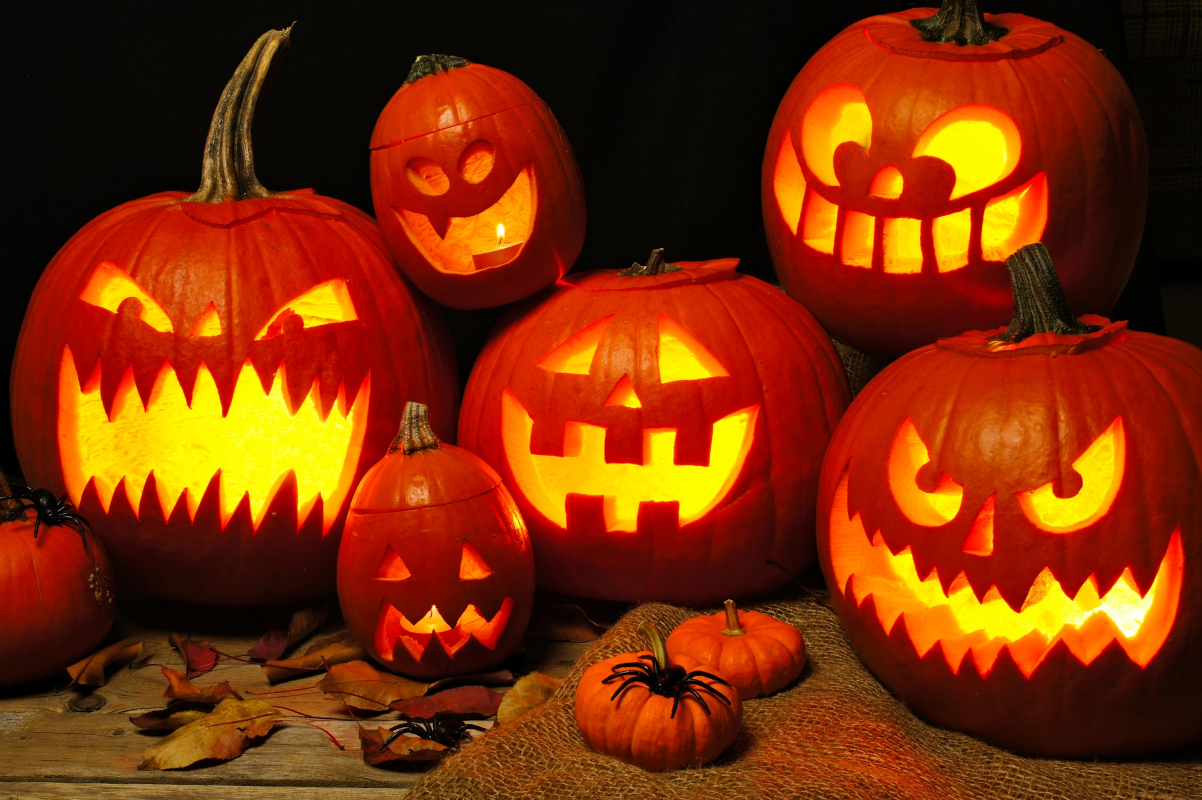
The customs in these Halloween traditions trivia questions range from porch lights and door-to-door treats to regional prank nights and party games. The National Museum of Ireland preserves many older practices, while UK trivia questions provide a wider look at the countries where several customs developed.
For hosts searching for trick-or-treating trivia questions, this round includes practical modern signals as well as the history behind familiar activities.
41. What modern signal commonly tells trick-or-treaters that a home is participating?
Answer: A porch or exterior light left on.
42. What does “trunk-or-treat” usually involve?
Answer: Families decorate parked vehicles and distribute treats from their trunks in a central location.
43. What does a teal pumpkin outside a home signal during Halloween?
Answer: That non-food treats may be available for children with food allergies or other dietary needs. The Teal Pumpkin Project uses the color as a visible signal.
44. What did children originally use to collect donations during early Trick-or-Treat for UNICEF campaigns?
Answer: Small decorated milk cartons.
45. In the phrase “trick or treat,” what does the “trick” refer to?
Answer: A threatened prank if no treat is given.
46. What is suspended from a string in the Irish Halloween game called snap-apple?
Answer: An apple, which players try to bite without using their hands.
47. What food is hung from a string for another hands-free Halloween party race?
Answer: A doughnut.
48. What phrase did children traditionally call at doors on the Canadian Prairies instead of “trick or treat”?
Answer: “Halloween apples!” The expression is documented as a Prairie regionalism in Alberta, Saskatchewan, and Manitoba.
49. Which company became famous for inexpensive boxed Halloween costumes with plastic masks and vinyl outfits?
Answer: Ben Cooper, Inc. Its mass-market costumes helped make recognizable characters available in five-and-dime and department stores.
50. What is October 30 commonly called in parts of New Jersey?
Answer: Mischief Night.
Score Check After 50 Questions
Forty or more correct answers is an excellent start. A score from 30 to 39 shows strong general Halloween knowledge, while 20 to 29 means the more specialized rounds can still change your result.
Regional names such as Mischief Night make U.S. state trivia more interesting because the same date can carry different customs from one place to another.
51. What regional name for the night before Halloween is associated with parts of Cincinnati?
Answer: Cabbage Night.
52. What name has long been used for October 30 in Detroit?
Answer: Devil’s Night.
53. What vegetable was sometimes thrown or left near doors during old Irish Halloween pranks?
Answer: Cabbage.
54. What name is given to a public procession in which participants display Halloween costumes?
Answer: A costume parade.
55. Which Pennsylvania company created paper black cats, pumpkins, and other decorations that helped shape twentieth-century Halloween imagery?
Answer: The Beistle Company.
56. What does a Halloween costume swap allow people to do?
Answer: Exchange previously worn costumes instead of buying new ones.
57. What type of vehicle carries guests through a staged outdoor scare attraction?
Answer: A wagon or trailer on a haunted hayride.
58. What do hosts usually hide inside a Halloween mystery-feel box?
Answer: Everyday objects chosen to resemble something creepy when touched.
59. What name is given to a maze cut through a field of tall corn and often given an autumn or Halloween theme?
Answer: A corn maze.
60. What large wooden farm vehicle was sometimes dismantled and reassembled as an Irish Halloween prank?
Answer: A cart.
Many of these customs are tied to the same season that transforms villages, gardens, and historic towns. An autumn trip through England shows the landscape behind some of the imagery that now appears in Halloween decorations around the world.
Pumpkin, Jack-o’-Lantern, Symbol, and Decoration Trivia
Pumpkins deserve more than one predictable question. This Halloween pumpkin trivia round covers carved root vegetables, plant science, folklore, colors, animals, and cemetery imagery, with several jack-o’-lantern trivia questions that go beyond the familiar orange face.
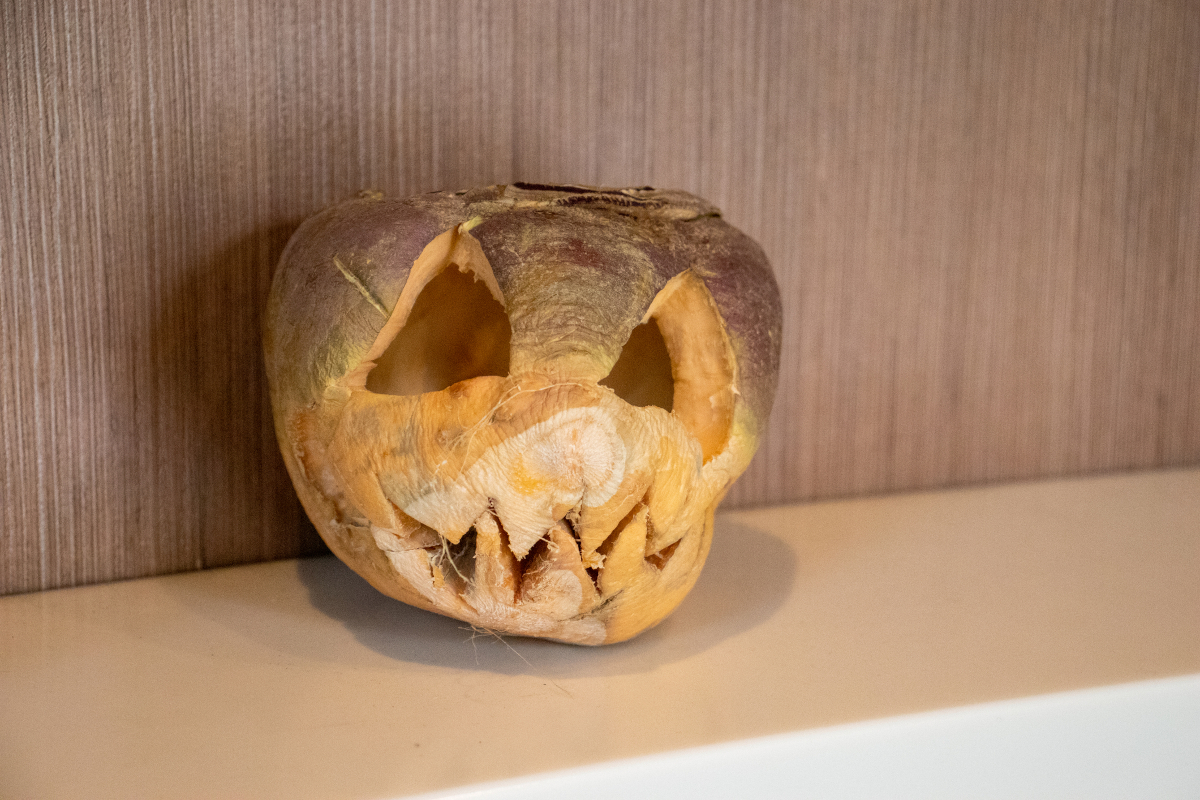
61. Which root vegetable was most commonly hollowed out for Halloween lanterns in Ireland before pumpkins became standard in North America?
Answer: Turnips.
ID 261553340 ©Londonaddict | Dreamstime.com
62. Which other root crops were sometimes carved into lanterns in parts of Britain and Ireland?
Answer: Potatoes and beets were also used in some communities.
63. Why did pumpkins become a practical choice for lantern carving in North America?
Answer: They were abundant, larger, and easier to hollow out than many traditional root vegetables.
64. In botanical terms, is a pumpkin a fruit or a vegetable?
Answer: A fruit, because it develops from a flower and contains seeds.
65. To which plant family do pumpkins, squash, cucumbers, and melons belong?
Answer: The gourd family, Cucurbitaceae.
66. According to Irish-American folklore, who was condemned to wander with a light inside a carved turnip?
Answer: Stingy Jack.
67. What does the orange in modern Halloween color schemes commonly represent?
Answer: The autumn harvest.
68. What does black commonly suggest in Halloween decorations?
Answer: Night, darkness, or death.
69. Why did bats become a natural sight near old bonfire celebrations?
Answer: The flames attracted insects, giving insect-eating bats an easy feeding area.
70. What happens when a flat honeycomb tissue-paper pumpkin is opened?
Answer: It expands into a three-dimensional decoration.
71. Why are owls an effective symbol for a nighttime holiday?
Answer: Most owl species are active at night or around dusk and dawn.
72. What does a skull traditionally represent in art and seasonal symbolism?
Answer: Human mortality and death.
73. Why are scarecrows used in fields?
Answer: To discourage birds from feeding on crops.
74. Which inexpensive materials were often used for early commercial Halloween lanterns?
Answer: Papier-mâché, paper, and cardboard.
75. What glowing organism shares the name “jack-o’-lantern”?
Answer: Several orange Omphalotus mushrooms, which can glow faintly and are poisonous.
Halloween Candy, Food, and Sweet Treat Trivia
ID 43375583 ©Eugene Bochkarev | Dreamstime.com
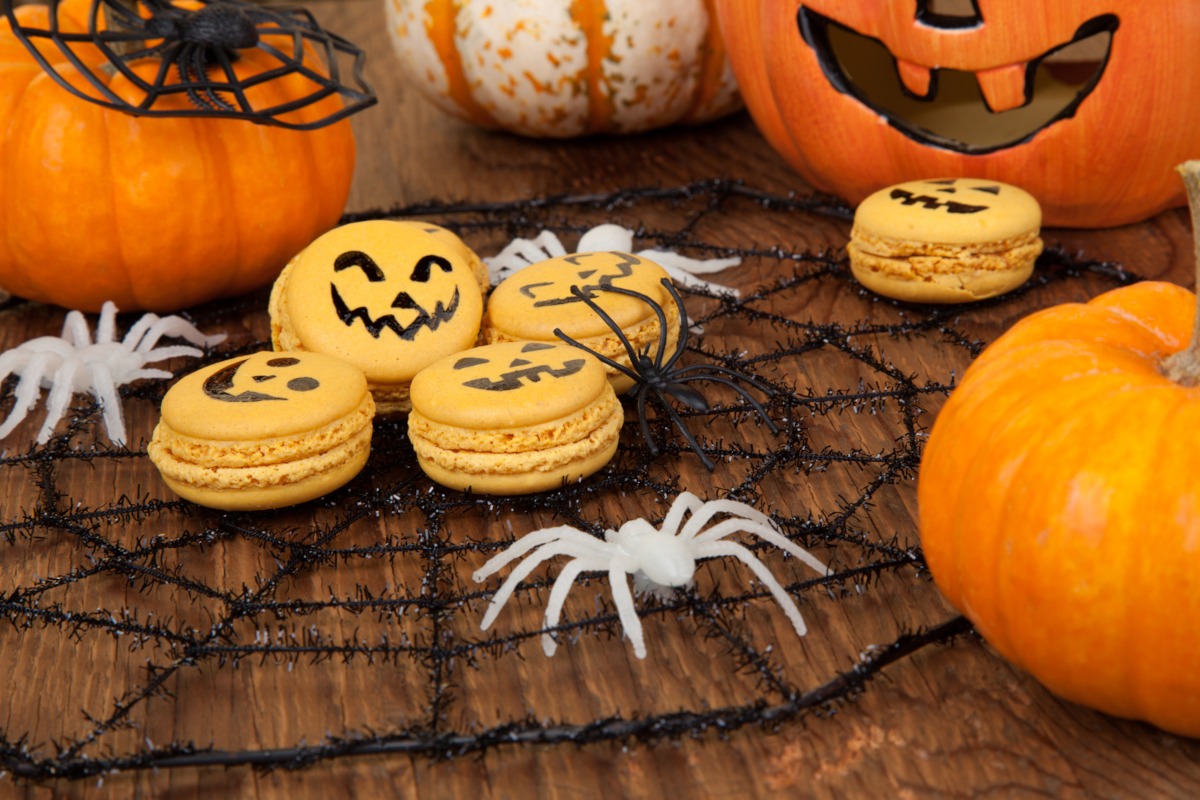
The next 20 Halloween candy trivia questions and answers combine brand history with older seasonal foods. The Smithsonian’s Halloween candy history, candy corn research, and history of Halloween sweets helped separate documented details from statistics copied without a year or source.
Good Halloween food trivia should include more than packaged candy, so this round also reaches Ireland and Britain for breads, potato dishes, and bonfire treats.
76. During which decade was candy corn created?
Answer: The 1880s.
77. What is unusual about the Dum Dums Mystery Flavor?
Answer: It changes continuously and isn’t limited to the brand’s current named flavors.
78. Which crunchy candy is sold in a box divided into two flavor chambers?
Answer: Nerds. The split box lets people pour one flavor or combine both.
79. Which cherry-flavored wax candy can be worn briefly before it is chewed?
Answer: Wack-O-Wax Fangs. The brand describes them as a “play now, chew later” treat.
80. Under what farm-themed name was candy corn once sold?
Answer: Chicken Feed.
81. What is the paper strip extending from a Hershey’s Kiss wrapper called?
Answer: A plume.
82. Which ring-shaped mint brand launched with Pep-O-Mint in 1912?
Answer: Life Savers.
83. In what year were Reese’s Peanut Butter Cups introduced?
Answer: 1928.
84. Which Newark candy maker is credited with creating the red candy apple in 1908?
Answer: William W. Kolb. He reportedly dipped apples into red cinnamon candy while developing a shop-window display.
85. What was the Snickers bar named after?
Answer: A favorite horse owned by the Mars family.
86. What do the two M’s in M&M’s represent?
Answer: Mars and Murrie, the surnames of Forrest Mars and business partner Bruce Murrie.
87. Which flavoring is often used in American black licorice when real licorice root isn’t used?
Answer: Anise oil. It has a similar aroma and flavor, but anise and licorice come from different plants.
88. What was Kit Kat originally called when Rowntree’s launched it in 1935?
Answer: Rowntree’s Chocolate Crisp.
89. Whose nickname inspired the name Tootsie Roll?
Answer: The nickname of inventor Leo Hirshfield’s daughter, Clara.
90. Which comic character first appeared in Bazooka Bubble Gum wrappers in 1953?
Answer: Bazooka Joe.
91. Which candy bar was introduced in 1923 and named after a malted milk drink?
Answer: The Milky Way bar.
92. What coating distinguishes a traditional candy apple from a caramel apple?
Answer: A hard, glossy sugar-candy shell.
93. Which Irish fruit bread is closely associated with Halloween?
Answer: Barmbrack, a sweet bread containing dried fruit.
94. What Irish potato dish commonly combines mashed potatoes with cabbage or kale?
Answer: Colcannon.
95. What dark, brittle British treat is made with treacle or molasses and is often eaten around autumn bonfires?
Answer: Bonfire toffee.
Halloween Superstitions and Fortune-Telling Trivia
Old party games give these Halloween superstitions trivia questions some of the article’s most surprising answers. I’m especially fascinated by the way a peel, a chestnut, a bowl, or a hidden object could become part of a prediction about marriage, travel, or money.
The customs are presented as beliefs rather than facts, using records such as the Smithsonian’s account of early Halloween fortune-telling and Irish folklore collections.
96. In an old Halloween fortune-telling game, what was an unbroken apple peel said to reveal when thrown over the shoulder?
Answer: The initial of a future spouse, based on the shape the peel appeared to form.
97. What did party guests do with chestnuts named after possible romantic partners?
Answer: They roasted the chestnuts and watched which one popped first.
98. What was the shape of a pulled cabbage or kale stalk supposed to predict?
Answer: The appearance or build of a future spouse.
99. What was soil clinging to a pulled stalk said to indicate?
Answer: Future wealth or property.
100. What gloomy fate did a bowl containing clay represent in an old blindfolded game?
Answer: Death, according to the historical superstition.
Score Check After 100 Questions
Eighty or more correct answers is a very strong halfway score. Sixty to 79 shows broad knowledge across several categories, while 40 to 59 means the folklore and international rounds can still improve your final result considerably.
101. What did choosing a bowl of water suggest in the same game?
Answer: Travel, emigration, or crossing water.
102. Why did some unmarried Halloween partygoers place symbolic objects under their pillows?
Answer: They hoped to dream about a future spouse.
103. What did a fasting dreamer hope a future partner would offer during the night?
Answer: Water or a towel.
104. In one mirror-gazing custom, what figure did a participant hope to see reflected over a shoulder?
Answer: A future husband or wife.
105. What did a ring baked into an Irish Halloween loaf traditionally predict?
Answer: Marriage within the coming year.
106. What did a thimble traditionally suggest to the person who found it?
Answer: Spinsterhood, according to the old custom.
107. What did a coin hidden in a traditional Halloween loaf predict?
Answer: Wealth or good fortune.
108. Which places did some people avoid on Halloween night because they were associated with fairies?
Answer: Fairy forts, mounds, and certain old trees.
109. What did a small piece of cloth or rag in the loaf traditionally predict?
Answer: Poverty or financial difficulty.
110. What was holy water used for in some Halloween protection customs?
Answer: It was sprinkled on people, homes, and animals as a religious form of protection.
111. What was a black-handled knife or steel object sometimes carried for in Irish Halloween belief?
Answer: Protection from harmful supernatural forces while traveling.
112. What was the purpose of placing a cross made from straw or wood above a door?
Answer: To protect the household and bring good fortune.
113. According to one Irish belief, why should wild fruit be avoided after Halloween?
Answer: The Púca was said to have spoiled or spat on it.
114. Why did some families place candles in windows during the season?
Answer: The light could welcome or guide the souls of the dead and signal remembrance.
115. Why did some people avoid traveling alone on Halloween night?
Answer: Folklore warned that supernatural beings could mislead or carry away solitary travelers.
Ghosts, Witches, Vampires, and Halloween Folklore Trivia
ID 33778355 ©Nadezda Kurnosova | Dreamstime.com
The next Halloween folklore trivia questions focus on traditional terms, supernatural beings, and classic literature. They avoid film casts and franchise plots, leaving room for witches, revenants, banshees, werewolves, and books that shaped modern spooky imagery.
116. What is a coven?
Answer: A group or gathering of witches.
117. What is a familiar in witch folklore?
Answer: A supernatural attendant or spirit, often represented in animal form.
118. What is a cauldron?
Answer: A large metal pot or kettle used for cooking over a fire.
119. What is a banshee in Irish folklore?
Answer: A female supernatural being whose cry or wail foretells a death.
120. What does the Irish expression behind the English word “banshee” mean?
Answer: Woman of the fairy mound, or woman of the Otherworld.
121. What is a revenant in folklore?
Answer: A dead person believed to have returned from the grave.
122. What does the German word “poltergeist” literally mean?
Answer: Noisy ghost or noisy spirit.
123. Which figure from Slavic folklore is often said to live in a hut that stands on chicken legs?
Answer: Baba Yaga.
124. What is a ghoul in the folklore from which the word developed?
Answer: A malevolent being associated with graveyards and consuming the dead.
125. Why does garlic appear in vampire folklore?
Answer: It was believed to repel or protect against vampires and other harmful forces.
126. What unusual compulsive behavior is attributed to vampires in some folk traditions?
Answer: Counting scattered seeds, grains, or knots.
127. Why do vampires lack reflections in some later folklore?
Answer: The story connects mirrors with the soul and describes vampires as soulless beings. This is a folkloric explanation, not a scientific one.
128. What is the term for the supposed transformation of a person into a wolf?
Answer: Lycanthropy.
129. Which metal is traditionally associated with killing or injuring a werewolf in later folklore?
Answer: Silver.
130. Which supernatural rider pursues Ichabod Crane in Washington Irving’s famous story?
Answer: The Headless Horseman.
131. Who wrote “The Legend of Sleepy Hollow”?
Answer: Washington Irving.
132. What is a changeling in European fairy folklore?
Answer: A fairy or substitute being believed to have been left in place of a human child.
133. Who wrote the novel Frankenstein?
Answer: Mary Shelley.
134. What is Dr. Frankenstein’s first name in Mary Shelley’s novel?
Answer: Victor.
135. Who wrote the novel Dracula?
Answer: Bram Stoker.
Halloween Around the World Trivia Questions
I also love seeing how customs travel and change, but separate religious and cultural observances shouldn’t be renamed simply because they occur near October 31. These Halloween around the world trivia questions distinguish Halloween customs from related remembrance traditions.
The round expands on global festivals connected with the season and adds international Halloween traditions from Wales, the Isle of Man, Northern Ireland, Japan, Mexico, the Philippines, Poland, Guatemala, Galicia, and Romania. A wider Europe travel trivia quiz continues the cultural and geographic challenge.
136. What is a traditional Scottish word for a turnip?
Answer: A neep.
137. What is the Welsh name for the night before the first day of winter, observed on October 31?
Answer: Noson Calan Gaeaf.
138. What does “Calan Gaeaf” mark in the traditional Welsh calendar?
Answer: The first day of winter.
139. Which witch appears in a traditional song sung by children on the Isle of Man at the end of October?
Answer: Jinny the Witch.
140. What type of lantern do Manx children traditionally carry during their October 31 celebration?
Answer: A carved turnip lantern.
141. What Catalan celebration around All Saints’ Day centers on roasted chestnuts, sweet potatoes, and panellets?
Answer: La Castanyada. It is distinct from Halloween even though it falls at the same time of year.
142. What is the traditional October 31 celebration on the Isle of Man called?
Answer: Hop-tu-Naa.
143. During which decade did the modern Derry Halloween festival begin?
Answer: The 1980s. The official Derry Halloween history explains how the festival began as a one-night event.
144. What Portuguese All Saints’ Day custom sends children from door to door asking for bread, cakes, nuts, sweets, or small gifts?
Answer: Pão por Deus, also known in some regions as the Day of the Little Cake or Dia do Bolinho.
145. Which Tokyo district became internationally known for large informal Halloween costume gatherings?
Answer: Shibuya.
Modern Japanese Halloween is only one part of the region’s cultural mix. These Asia trivia questions continue with history, food, geography, landmarks, and traditions from across the continent.
146. What bread shaped like a small child is eaten with colada morada during Ecuador’s Day of the Deceased traditions?
Answer: Guagua de pan. The word guagua means baby or child in this context.
147. Is Día de los Muertos another Spanish name for Halloween?
Answer: No. It is a distinct Mexican observance honoring deceased relatives, recognized by UNESCO as an Indigenous festivity dedicated to the dead.
148. What thick purple drink traditionally accompanies guaguas de pan in Ecuador?
Answer: Colada morada, a spiced fruit drink prepared for the Day of the Deceased.
149. What is an ofrenda in Día de los Muertos traditions?
Answer: An altar or offering space prepared for deceased loved ones.
150. Which orange flower is commonly placed on Día de los Muertos altars and paths?
Answer: Marigolds, especially cempasúchil.
Score Check After 150 Questions
A score above 115 at this point puts you on course for one of the highest final categories. Between 90 and 114 is still impressive, especially because the international questions require knowledge beyond the most familiar U.S. customs.
151. Which elegant skeleton image created by José Guadalupe Posada became closely associated with Día de los Muertos?
Answer: La Catrina.
152. What Filipino door-to-door tradition involves singing for gifts while representing souls?
Answer: Pangangaluluwa.
153. What type of food is traditionally offered to participants in that Filipino custom?
Answer: Kakanin, or sticky rice cakes, along with other foods or alms.
154. What is the Polish name commonly used for the November 2 remembrance observance?
Answer: Zaduszki.
155. What fills many Polish cemeteries with light during the early-November remembrance period?
Answer: Candles and grave lanterns.
156. What large handmade objects are flown in Santiago Sacatepéquez and Sumpango, Guatemala, during All Saints’ and All Souls’ commemorations?
Answer: Giant kites.
157. What does the Galician phrase “Noite dos Calacús” mean?
Answer: Night of the Pumpkins.
Galicia adds an autumn tradition that many international quiz players won’t recognize. The wider Spain trivia quiz includes more regional language, culture, festivals, food, and history.
158. Which animals are central to many Romanian folk beliefs connected with Saint Andrew’s Eve?
Answer: Wolves. Traditional sources also call the observance “Ziua Lupului,” or the Day of the Wolf.
159. When is Saint Andrew’s Day observed in Romania?
Answer: November 30.
160. Which Japanese Buddhist observance honors ancestors and is usually held at a different time of year from October 31?
Answer: Obon.
These examples show why careful wording is necessary: a remembrance festival, an ancestor observance, and Halloween may share dates or imagery without being the same holiday. Broader geography trivia questions can extend the world round without blurring those distinctions. The travel side of the season also appears in these places to visit in Europe in autumn, where fall color, seasonal events, and Halloween decorations create very different experiences from one destination to another.
Halloween Nature, Harvest, and Seasonal Science Trivia
A complete quiz can include the real science behind familiar October images. These Halloween nature trivia questions cover bats, owls, spiders, crops, daylight, and lunar cycles without drifting into unrelated biology.
Players who enjoy wildlife and landscapes can continue with National Parks trivia after the Halloween seasonal science round.
161. Which vertebrate class includes bats?
Answer: Mammalia.
162. What ability makes bats unique among mammals?
Answer: They are the only mammals capable of sustained powered flight.
163. What method do many bat species use to navigate and find prey in darkness?
Answer: Echolocation.
164. What feature on many owl flight feathers helps reduce noise?
Answer: Soft fringed or comb-like edges that break up air turbulence.
165. Are spiders insects or arachnids?
Answer: Arachnids.
166. Why do yellow and orange pigments become more visible in many autumn leaves?
Answer: The leaves produce less chlorophyll, allowing pigments such as carotenoids to become visible.
167. What process makes a cut apple turn brown after it is exposed to air?
Answer: Enzymatic browning, driven largely by the enzyme polyphenol oxidase.
168. What is the natural production of light by organisms such as fireflies and some fungi called?
Answer: Bioluminescence.
169. Do pumpkin plants usually produce separate male and female flowers?
Answer: Yes. Both flower types commonly grow on the same vine.
170. Which insects are especially important for pollinating pumpkin and squash flowers?
Answer: Bees.
171. Why do daylight hours become shorter during Northern Hemisphere autumn?
Answer: Earth’s tilted axis causes the Northern Hemisphere to receive fewer hours of sunlight as the season advances.
172. What astronomical event marks the beginning of astronomical autumn?
Answer: The autumnal equinox.
173. Approximately how long is one complete cycle of lunar phases?
Answer: About 29.5 days.
174. About how often does a full moon occur on Halloween?
Answer: Roughly once every 19 years, according to NASA’s explanation of the Halloween full moon.
175. Why can a full moon on October 31 also be called a Blue Moon under the monthly definition?
Answer: It is the second full moon within the calendar month of October.
The next round changes the format. Don’t rush the true-or-false statements – several use familiar claims that sound more convincing than they are.
Halloween True or False Questions
The pace changes with 10 Halloween true or false questions about animals, pumpkins, lighting effects, dry ice, and the human skeleton. Every answer includes a short correction or explanation, so a lucky guess still teaches you something.
176. True or false: Ravens and crows are the same species.
Answer: False. They belong to the same bird family, Corvidae, but the names refer to different species.
177. True or false: All bats are blind.
Answer: False. Bats can see, although many species also use echolocation.
178. True or false: Every spider builds an orb-shaped web.
Answer: False. Some build different types of webs, and others hunt without using a capture web.
179. True or false: White pumpkins can have orange flesh inside.
Answer: True. Skin color doesn’t necessarily determine the color of the flesh.
180. True or false: Some pumpkins develop naturally bumpy or warty skin.
Answer: True. Genetics and selective breeding can produce heavily textured fruit.
181. True or false: Glow sticks produce light through combustion.
Answer: False. Their light comes from a chemical reaction called chemiluminescence.
182. True or false: Dry ice is frozen carbon dioxide.
Answer: True.
183. True or false: The visible fog around dry ice is carbon dioxide smoke.
Answer: False. The visible cloud consists mainly of tiny water droplets formed as the cold gas chills moist air.
184. True or false: A black light uses ultraviolet radiation to make some materials fluoresce.
Answer: True.
185. True or false: Pumpkins originated in Europe.
Answer: False. Pumpkins and other squashes originated in the Americas.
Hard Halloween Trivia Questions and Answers
The final knowledge round contains hard Halloween trivia questions and answers based on language, literature, and older terminology. These hard Halloween history questions are specific, but each answer has a clear documentary basis rather than an obscure claim repeated from another quiz.
186. What subtitle appears with the novel Frankenstein?
Answer: The Modern Prometheus.
187. What does the apostrophe in the spelling “Hallowe’en” indicate?
Answer: The omitted “v” in “even,” an older form of “evening.”
188. In what year is the first known English use of “jack-o’-lantern” recorded by Merriam-Webster?
Answer: 1667.
189. What Scottish expression names the traditional fruit-bobbing game played from a basin of water?
Answer: Dookin’ for apples.
190. What does the Irish name “báirín breac” literally mean?
Answer: Speckled loaf.
191. In what year was Horace Walpole’s The Castle of Otranto first published?
Answer: 1764.
192. Which Irish author wrote the vampire novella Carmilla?
Answer: Sheridan Le Fanu.
193. In what year was Dracula first published?
Answer: 1897.
194. In what year was Edgar Allan Poe’s “The Raven” first published?
Answer: 1845.
195. Which Scottish poet wrote the 1785 poem “Halloween”?
Answer: Robert Burns.
Halloween Trivia Tie-Breaker Questions
Hosts can use these Halloween trivia tie-breaker questions one at a time when two players or teams finish with the same score. Each is numerical, dated, and linked to Guinness World Records; anyone who enjoys record questions can also try the travel superlatives trivia.
196. In 2013, how many lit jack-o’-lanterns did Keene, New Hampshire, display to set the Guinness World Record?
Answer: 30,581.
197. On October 31, 2013, how many seconds did Stephen Clarke need to carve a qualifying pumpkin?
Answer: 16.47 seconds.
198. How many pounds did the record-setting pumpkin pie made in New Bremen, Ohio, weigh in 2010?
Answer: 3,699 pounds.
199. How many pumpkins formed the Guinness-record line created in Blaine, Minnesota, in 2016?
Answer: 8,672 pumpkins.
200. How much did the pumpkin used for the heaviest jack-o’-lantern confirmed in 2023 weigh before carving?
Answer: 2,749 pounds.
How Did You Score?
Use one point for every question you answered correctly. The five record questions can remain part of the 200-point score, or a host can reserve them only for ties.
| Correct answers | Result |
|---|---|
| 0-40 | Halloween newcomer |
| 41-80 | Candy-bowl contender |
| 81-120 | Strong Halloween knowledge |
| 121-155 | Jack-o’-lantern expert |
| 156-180 | Master of Halloween lore |
| 181-195 | Exceptional |
| 196-200 | Almost impossible to beat |
A high score requires more than knowing the date, the colors, and a few candy brands. The later rounds reward knowledge of history, language, regional customs, old party games, literature, science, and culturally distinct observances.
Fact-Checking Notes Behind the Quiz
Halloween history is full of neat explanations that become less convincing once the sources are checked. The article describes Samhain as one influence on Halloween rather than claiming the two celebrations are identical. It also separates Día de los Muertos, Obon, Saint Andrew’s Day, and other observances from Halloween instead of presenting each one as a local version of the same holiday.
Folklore answers are introduced as legends, beliefs, or superstitions. Historical practices come from museum, library, heritage, and archival material. Changing records are dated, and the record answers link directly to Guinness World Records. Current candy rankings, annual spending estimates, costume popularity, and unsupported local laws were excluded.
Conclusion
Halloween can begin with a carved lantern or a bowl of candy and lead into centuries of customs, regional words, party games, books, beliefs, and community celebrations. That range is one reason I find the holiday so enjoyable. There’s always another detail hiding behind something familiar.
After 200 questions, you’ve moved from the easiest symbols to old fortune-telling games, international traditions, lunar science, literary dates, and record-breaking pumpkins. You can use the same rounds for a family evening, a classroom activity, an office game, or a full trivia night without forcing everyone to know horror films.
For another decade-based challenge, continue with 80s trivia, 90s trivia, or 2000s trivia. The holiday series also includes Valentine’s Day trivia, while the complete trivia collection gathers geography, history, destination, landmark, and general knowledge quizzes.
FAQ About Halloween Trivia Questions
How many questions should a Halloween trivia game include?
Ten to 15 questions work for a quick icebreaker. A family, classroom, or office game can use 30 to 40 questions. A full trivia event can include 50 to 80 questions divided into several rounds, with one numerical question saved for a tie.
Which questions are best for children?
Start with Questions 1-15, 61-85, and selected questions from the nature round. Older children may also enjoy the history and world sections, although some folklore and old fortune-telling beliefs need a short explanation from the host.
Which Halloween trivia questions are best for adults?
The history, traditions, candy, superstitions, folklore, international, hard, and tie-breaker rounds provide the widest mix for adults. A host can choose five to 10 questions from each category so one person’s specialist knowledge doesn’t dominate the whole game.
How can these questions be used for an office Halloween game?
Divide participants into small teams, use four rounds of 10 questions, and give everyone the same time to write each answer. The quick, traditions, candy, and true-or-false rounds work well for mixed groups because they don’t depend on horror-film knowledge.
Why are there so few movie questions?
Movie trivia has a separate search and playing intent. Keeping film casts, directors, characters, plots, and release dates for a dedicated quiz gives this article more room for Halloween history, customs, candy, folklore, superstitions, science, and international traditions.
How were the questions fact-checked?
Historical and cultural claims were checked against museums, libraries, heritage organizations, official event histories, scientific sources, nonprofit campaign records, dictionaries, publishers, and Guinness World Records. A question was removed when dependable sources disagreed about the definition, origin, or correct answer.
Second pin created with ChatGPT.
More amazing articles for you:
65 British Sayings That Confuse Travelers - And What They Actually Mean
7 Days in Jordan Itinerary
Australian food: the 12 best Australian dishes you should try
Best free things to do in Valencia
She Reclined Her Seat on a Plane. What Happened Next Went Viral - Justified or Not?
Is Hotel Breakfast Worth It? When Paying Extra Makes Sense - And When It Doesn’t (Hint: It’s NOT Jus...
His Son Booked a First Class Seat for His 83-Year-Old Dad. At the Gate, His Boarding Pass Was Flagge...
Pumpkin Trivia Quiz: Can You Get All 23 Questions Right?

Violeta-Loredana Pascal is a communications expert, business mentor, and the founder of Earth’s Attractions and PRwave INTERNATIONAL. A pioneer in the Romanian digital PR landscape since 2005, she holds a degree in Communication and Social Sciences from SNSPA Bucharest. Violeta is a senior trainer at AcademiadeAfaceri.ro, where she leverages over 20 years of experience to teach professional courses in PR strategy and workplace productivity. By blending high-level business consulting with a passion for holistic travel and wellness, she empowers solopreneurs to overcome procrastination, build profitable brands, and design a life of purposeful adventure.