A flight can leave you with several hours to fill, and everyone handles that time differently.
On daytime flights, I often look through the window at the clouds, mountains, cities, and immense green fields below. From 35,000 feet, the world can look enormous and strangely small at the same time. On night flights, when there is nothing to see outside and the cabin finally becomes quiet enough to focus, I usually read.
Other passengers watch movies, listen to music, work, eat, sleep, or spend most of the journey trying to find a position that does not make their neck hurt. Hopefully, anyone watching videos or listening to music uses headphones, because that has already become its own airplane etiquette problem.
None of that would make me look twice.
Turning the cramped space around an airplane seat into a place for personal grooming is another story.
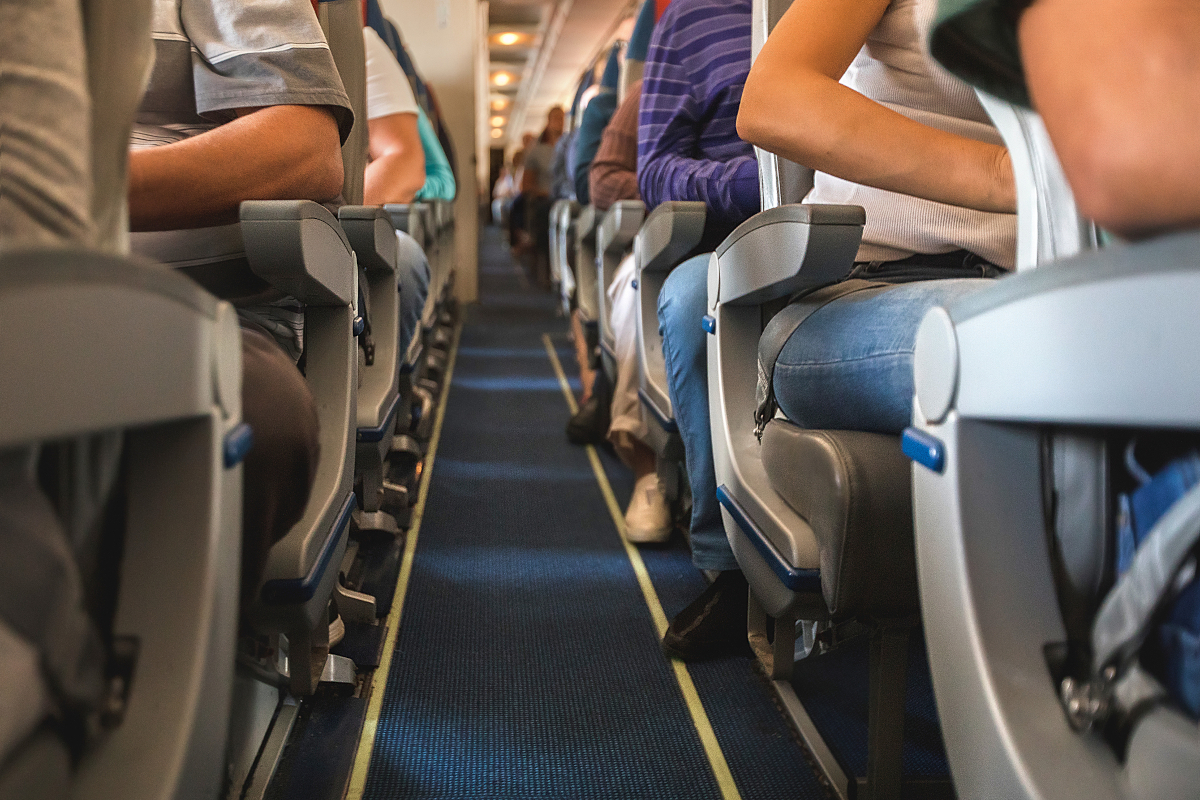
ID 110818802 | Airplane Cabin People ©Ekaterina Demidova | Dreamstime.com
I am not talking about applying lip balm, or putting on a little hand cream because airplane air can make your skin feel like paper. I mean the kind of personal grooming that makes other passengers look twice: clipping nails, trimming eyebrows, using face masks over tray tables and armrests that have seen far too much, or taking out a heated styling tool in the middle of a shared cabin.
Clipping nails on planes is already one of those habits that many passengers find disgusting. For me, it has an extra layer because I have misophonia, so the sound alone would make me cringe. And yes, while I have mostly seen videos of people clipping fingernails, I do not even want to imagine someone deciding that a flight is the right moment for toenails.
Then there are the beauty routines. Some passengers apply face masks or skincare treatments during flights, and I know there is a whole debate around that. I am not getting into all of it here, although the dirtiest places on a plane, according to flight attendants, don’t make me want to turn a seat area into a spa corner.
But the latest airplane-behavior video that caught my attention was not about nail clipping, bare feet, or face masks.
It was about hair curling.
A recent Instagram video shows a woman seated on a plane. The overlay text reads “Comfort Plus Air Curling.” Then she turns the camera toward the passenger beside her, who appears to be curling her hair during the flight (seems like a cordless curling iron). The poster’s caption says: “Imagine having to deal with a curling iron the entire flight.”
At first, this looks like another airplane etiquette debate. Is it rude? Is it harmless? Is it really anyone else’s business if someone wants to fix their hair while sitting in their own seat?
But the more I looked at the reaction, the more the real issue became clear. Many people were treating this as if it were only about personal preference.
That is where I say that there is more to it.
A curling iron is not just another beauty item. It is a hot device, used in a tight space, beside other passengers, in a cabin where turbulence can happen, where people are seated shoulder to shoulder, and where airline crews already have enough behavior problems to manage.
And that is before we even get to the bigger question: just because you are allowed to pack something in your carry-on, does that mean you should actually use it during the flight?
Can You Bring a Curling Iron on a Plane?
This is where the debate becomes more complicated.
Curling irons are not automatically banned from air travel. The rules depend on the type of device.
The Federal Aviation Administration says cordless curling irons containing a gas cartridge or powered by butane are limited to one per person, must be carried in carry-on baggage only, must have a safety cover securely fitted over the heating element, and must be protected from accidental activation. Spare gas refills are not permitted. The FAA also says electric curling irons and hair straighteners with a cord are “not restricted.”
The TSA also lists cordless butane curling irons as allowed in carry-on bags only, not checked bags. A separate TSA listing says cordless curling irons containing lithium metal, lithium-ion batteries, gas, or butane are allowed only in carry-on bags.
Canada’s air transport security authority says electric hair blow-dryers, curling irons, and flat irons are permitted in both carry-on and checked baggage.
So yes, in many cases, you can pack a curling iron for travel.
But packing it and using it during the flight are two very different things.
Delta, for example, says: “One butane curling iron per passenger is permitted in carry-on baggage only. Refills are not allowed, and the safety cover must be on the curling iron. It is not permissible to be used on the aircraft at any time. Butane curling irons are not permitted when traveling to Switzerland.”
Delta’s restriction quoted here applies specifically to butane curling irons. The FAA says corded electric curling irons are not restricted for transport, although being permitted in baggage does not automatically mean an airline will allow the device to be operated during the flight.
New Zealand’s aviation authority gives another important reason to be careful with heated styling devices. It says battery-powered heat-producing devices may overheat and catch fire if the battery and heating element have not been isolated or flight mode has not been activated.
That is the point many people seem to miss.
A curling iron may be allowed in your bag. That does not automatically make it safe, considerate, or acceptable to pull it out and use it beside another passenger in the air.
The Problem Is Not Only Etiquette
If someone applies lipstick before landing, most people probably will not care.
If someone brushes their hair quickly, fine. (Though some may argue about hair loss – ending up on other people’s clothes or in drinks/food during the flight…)
If someone puts on hand cream because the cabin air is dry, that is not the problem either.
The issue changes when the object is heated, used near another person, and handled in a space where passengers do not have much room to move away.
A hot curling iron is different from a makeup compact. It can burn skin. It can touch clothing. It can fall. It can be dropped during turbulence. It can make another passenger feel trapped beside something they did not agree to be near for the duration of a flight.
And if it is a cordless model powered by butane, gas, or a lithium battery, the safety conversation becomes even more serious.
True, in the video, nothing appears to happen, and no one gets hurt.
But that is not the standard we should use on airplanes.
“Nothing happened” is not the same as “this was a good idea.”
A lot of cabin safety depends on prevention. Seat belts are about prevention – remember the sleep hack that sparked the safety discussion? Stowing bags properly is about prevention. Keeping aisles clear is about prevention. Listening to the crew is about prevention. The entire logic of air travel safety is that you do not wait for something to go wrong before deciding whether something was risky.
That is why I found the reaction to the video more worrying than the video itself.
Many People Immediately Said This Was Not Okay
A lot of commenters reacted the way I expected. They saw the heated styling tool, the tight seating, and the possibility of turbulence, and they immediately questioned whether this should be happening on a plane.
One person asked:
“Is that allowed? Bc the heat? Lmao”
Another person wrote:
“The thought of a hot curling iron with turbulance is a big YIKES…”
That was my first reaction too.
Even if someone is careful, they are not controlling the aircraft. They are not controlling turbulence. They are not controlling whether the person beside them suddenly moves, reaches for something, spills a drink, or shifts in their seat.
A plane seat is not a bathroom counter. It is not a hotel vanity. It is not a backstage dressing room.
It is a shared space with strangers sitting inches away.
Flight Attendants and Crew Were Even More Direct
The most important comments, in my opinion, came from people who said they were flight attendants or crew.
In reply to the question about whether this was allowed, one person wrote:
“Flight attendant here 🙋🏼♀️ and no it’s absolutely not. This is a huge no.”
Another said:
“Absolutely tf not. I’m crew.”
A former flight attendant added:
“Massive no. Former flight attendant.”
Flight attendants are not there only to serve drinks and hand out snacks. Their job is safety. Their advice on what not to do on a plane reflects risks passengers may overlook in a crowded cabin.
And this is exactly why I do not think the conversation should stay at the level of “mind your business” or “she is not hurting anyone.”
Cabin crew doesn’t look at a heated device in a crowded aircraft cabin the same way a random Instagram commenter does. They have to think about what happens if the aircraft hits turbulence, if another passenger complains, if someone gets burned, if the device overheats, if there is smoke, if the person refuses to stop, or if the item itself is not allowed to be used on board.
Passengers often see only the moment.
The crew has to think about everything that moment could turn into.
But Many People Defended It
This is the part that surprised me more.
There were many comments supporting the passenger or treating the whole thing as clever, funny, or harmless.
One person wrote:
“Elite time management. Throw some curls in my hair too, sis.”
Another said:
“Honestly I woulda asked her to hook me up after 👏”
A similar comment said:
“Honestly, this is good time management and I’m here for it.”
That one received several replies from people who agreed:
“I’d hold her drink 🤷🏻♀️”
“Yeah same thank you”
Others took the joke even further:
“I’d ask her if she wanted me to get the back of her head 🤷🏼♀️”
“If I was sitting next to her I might offer to help with a few curls hahaha”
“Same girl. Same.”
Another person wrote:
“I would’ve been like, ‘throw some curls in my hair too, will ya!’ 😂”
And another defended the passenger this way:
“She probably has somewhere to be right after the flight! If she isn’t bumping you, let her be lol”
Someone else added:
“Honestly. I’m not mad at it, can I do mine next?”
I understand why some people reacted that way. Compared with other airplane behavior stories, this may not look like the worst thing a passenger can do. It is not loud music without headphones. It is not bare feet on someone else’s armrest. It is not clipping toenails. It is not a passenger crawling into an overhead bin for attention.
But that comparison is exactly the problem.
We have seen so many strange airplane behavior stories that some people now seem to judge everything by the lowest possible standard. If it is not the most disgusting, disruptive, or dangerous thing they have ever seen on a plane, then they treat it as harmless. That is not a good standard for shared spaces.
Some People Pushed Back Against the “Good Time Management” Argument
Thankfully, not everyone accepted the “good time management” defense.
One reply put it bluntly:
“Lol, good time management is waking up earlier if I know I have to curl my hair before I get on a plane surrounded by other people hoping my hair doesn’t land in their drinks.”
Another person used a more extreme comparison:
“Of course you do dear, of course you do. I hope the woman sitting next to you on your next trip decides to shave her pits. Because you know anyone with hair knows those pits can grow and she might be doing something when she lands.”
Another comment made the personal-boundary point more directly:
“Yuh. She’s ok. She just has no f*%ks left to give. I appreciate the time management but personal hygiene/tending to one’s hair and nails does not belong in a public space. That’s just my opinion obviously.”
That last comment gets close to the bigger issue.
There are things people do privately because they involve hygiene, body care, loose hair, nails, heat, odor, skin products, or other things that affect the people around them. A plane is public, but it is also more intense than most public spaces because passengers cannot simply walk away.
If someone does something uncomfortable in a park, you can move. If someone does something annoying in a café, you can leave. (Still unpleasant, but a solution nonetheless.)
If someone beside you on a plane starts using a hot styling tool, your options are limited. You can say something. You can call a flight attendant. You can sit there and hope it ends quickly.
The Bigger Problem: People Keep Confusing “I Can” With “I Should”
And the list of comments to the Instagram post goes on, but I do not want to make this article only about the comments. I wanted to point out the idea behind them.
The real issue is the growing confusion between what someone can physically do in a plane seat and what belongs in a shared aircraft cabin.
Can someone technically take out a curling iron? In some cases, yes, they may have one in their carry-on.
Can someone decide that a flight is the right time to style their hair with a heated device beside another passenger? That is a very different question.
These are the airplane incident stories I am tired of reading. Someone does something unusual, annoying, risky, or attention-seeking on a flight. Some people object. Others defend it as funny, harmless, efficient, personal freedom, or “not that serious.”
That reaction worries me because airplane cabins depend on basic cooperation. The experience is already stressful enough. People are tired, squeezed into narrow seats, dealing with delays, dry air, crowded boarding areas, overhead-bin tension, and the constant gamble of who will sit beside them.
The answer cannot be that every passenger turns their seat into whatever personal space they wish they had. A plane seat is not a salon chair and a tray table is not a vanity.
A shared cabin is not the place to test how much other people are willing to tolerate.
The Overhead-Bin Passenger Story Shows the Same Pattern
This is also why the curling iron debate reminded me of another recent airplane-behavior incident: the passenger who climbed into the overhead bin.
Again, some people treated it as funny. Some praised it. Some acted as if other passengers were too serious for objecting.
But that is what makes these stories more than isolated viral moments. The worrying part is not only that people do strange things on planes. Strange behavior is not new. The worrying part is how quickly public reaction turns obvious safety and courtesy issues into entertainment. If something creates a viral clip, a laugh, or a “let people live” comment thread, the practical question gets pushed aside.
What if the plane hits turbulence?
What if someone gets burned?
What if another passenger feels trapped or uncomfortable?
What if the crew has to stop dealing with actual service or safety tasks to handle something that should never have happened in the first place?
That is where the “it is not hurting anyone” argument becomes weak. On a plane, you do not always know whether something is hurting anyone until it creates a problem.
Pack It If It Is Allowed. Use It After Landing
I do not think every airplane etiquette issue needs outrage.
I also do not think every passenger mistake deserves public shaming.
But I do think we need to bring back a basic rule for flying: if an item involves heat, hygiene, loose body clippings, strong smells, or anything that can affect the person sitting beside you, do it before the flight or after landing.
Even food can create the same argument, as the recent debate over garlic chicken on a plane showed. Something may feel like a personal choice to one passenger while affecting an entire row that cannot move away.
That should not be controversial.
The issue is not whether someone wants to look good after a flight. Many people do. The issue is whether one person’s beauty routine should become another passenger’s in-flight problem.
Frequently Asked Questions About Curling Irons on Planes
Can you bring a curling iron on a plane?
In many cases, yes. Corded electric curling irons are generally permitted in carry-on and checked baggage. Restrictions are stricter for cordless models powered by butane, gas, or lithium batteries, so travelers should check the applicable aviation authority and airline rules before flying.
Can you use a curling iron during a flight?
Being allowed to pack a curling iron does not automatically mean passengers may use it onboard. Airlines may prohibit the use of heated styling devices during a flight, particularly butane-powered or battery-powered models. Cabin crew instructions must always be followed.
Are cordless curling irons allowed in carry-on luggage?
Some cordless curling irons are allowed only in carry-on baggage and must be protected against accidental activation. Butane models generally require a secure safety cover, and spare gas cartridges may be prohibited.
Why could using a curling iron on a plane be dangerous?
A curling iron produces heat in a cramped space where sudden turbulence may cause it to fall or touch another passenger, clothing, or cabin materials. Battery-powered devices may also overheat if they are not properly switched off or protected from accidental activation.
More amazing articles for you:
65 British Sayings That Confuse Travelers - And What They Actually Mean
15 Once-in-a-Lifetime U.S. Cities You Need on Your Bucket List
5 Tips for Planning a Manila Vacation
Carnival Cruise Passenger Uses a Dining Fork to Scratch Her Foot in Viral Video - What Happened Next
If you love to travel, you are most likely tired of hearing these 7 things about traveling
4 Ways to Get the Most Out of Your Travels
How to travel with an electric car: Ultimate EV travel guide
Louvre vs Musée d’Orsay: Which Paris Museum Should You Visit?

Violeta-Loredana Pascal is a communications expert, business mentor, and the founder of Earth’s Attractions and PRwave INTERNATIONAL. A pioneer in the Romanian digital PR landscape since 2005, she holds a degree in Communication and Social Sciences from SNSPA Bucharest. Violeta is a senior trainer at AcademiadeAfaceri.ro, where she leverages over 20 years of experience to teach professional courses in PR strategy and workplace productivity. By blending high-level business consulting with a passion for holistic travel and wellness, she empowers solopreneurs to overcome procrastination, build profitable brands, and design a life of purposeful adventure.