
You might think – like I did for a long time -, that decluttering requires a full week off, industrial-strength motivation, and a complete meltdown of willpower. It doesn’t. In fact, you can reset your entire home in just one weekend – without turning it into a miserable boot camp.
I would hazard to say that this situation is all too familiar: you look around on a Friday evening, and instead of seeing a sanctuary, you see a mounting “to-do” list. The mail is piling up on the entryway table, the “chair” in the bedroom is buried under clothes, and your kitchen counters have disappeared under gadgets you haven’t used in months.
The common response is to plan a massive, grueling “spring cleaning” that never happens because it feels too daunting. But what if you didn’t need a week? What if you only needed 48 hours and a shift in perspective?
This isn’t about a deep scrub of your baseboards. This is about visual and mental clarity. By implementing seven tiny habits over a single weekend, you can transform your home into a space that breathes. Here is your roadmap to an “Anti-Clutter” weekend.
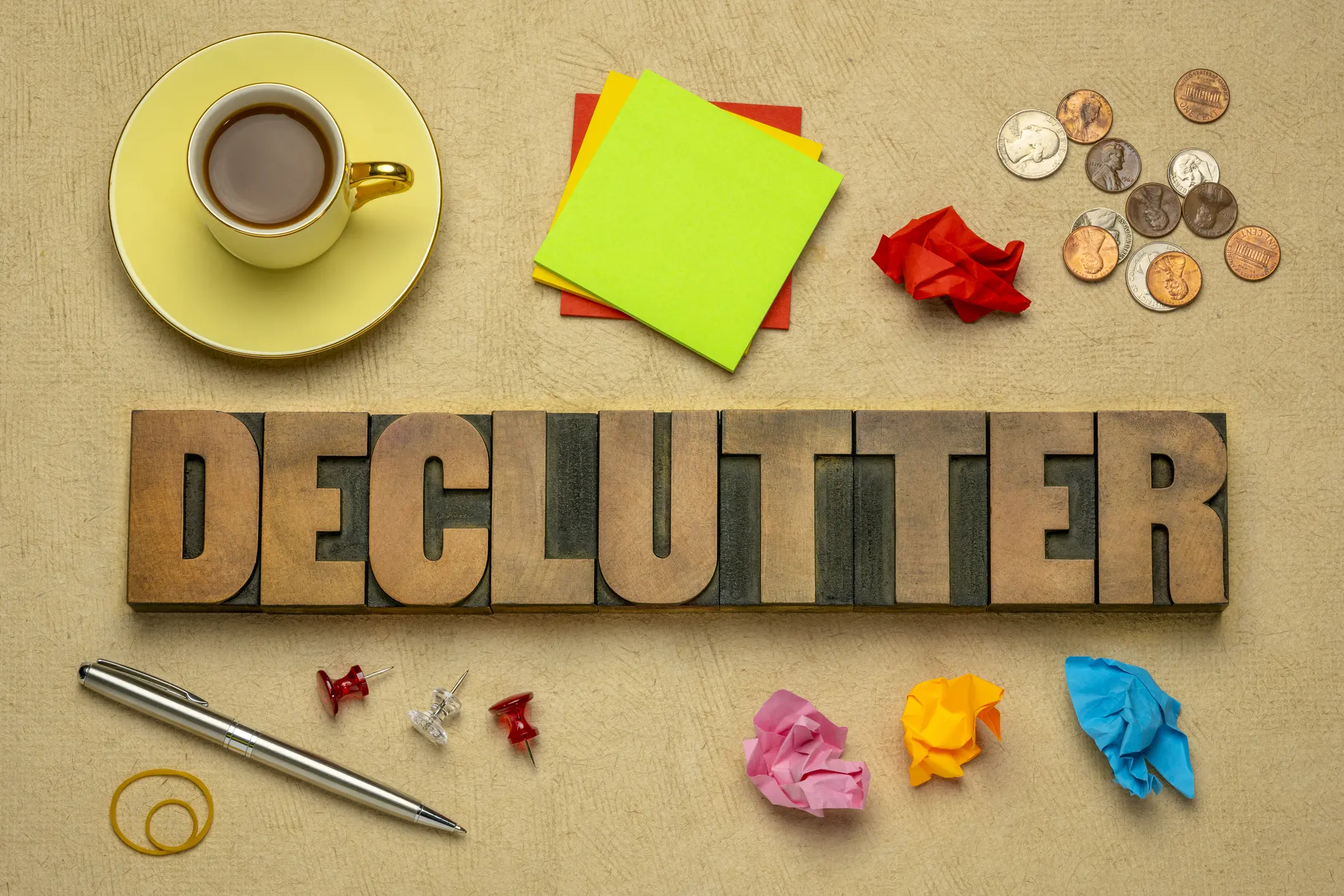
ID 165754722 ©Marek Uliasz | Dreamstime.com
The Science of Why We Feel Overwhelmed
Before diving into the habits, it is essential to understand that clutter isn’t just an aesthetic problem; it’s a biological stressor. I read a landmark study that found a direct correlation between the density of household objects and cortisol levels (the stress hormone) in mothers. When our visual field is crowded, our brains are forced to work harder to filter out irrelevant information, leading to what psychologists call “cognitive overload.”
Furthermore, research suggests that physical order in our environment influences our choices, making us more likely to choose healthy habits and experience better focus. By clearing your space, you aren’t just tidying a room; you are literally lowering your physiological stress levels.
Habit 1: The “Surface-First” Sweep (Saturday Morning)
The first habit of the weekend is designed for immediate visual relief. Our brains prioritize the “foreground” of our environment – the flat surfaces like dining tables, kitchen islands, and coffee tables.
- The Technique: Take a large laundry basket and move through your main living areas. Remove every single item that does not permanently belong on a flat surface.
- The Rule: Do not stop to organize these items yet. The goal is to create “white space” for your eyes.
- The Logic: According to the Princeton University Neuroscience Institute, multiple visual stimuli compete for neural representation in the brain. By clearing surfaces first, you reduce the “visual noise” that prevents you from focusing on the deeper decluttering tasks ahead.
The first time I did this, I filled an entire laundry basket from just my coffee table and entry console – and the room instantly felt twice as large.
Habit 2: The “One-In, Two-Out” Closet Audit (Saturday Midday)
Clothing is often the most emotionally charged category of clutter. We hold onto clothes for the “future self” we hope to be or the “past self” we miss.
- The Process: Spend 60 minutes in your primary closet. For every item you haven’t worn in the last six months that you decide to keep, you must find two items to donate or recycle.
- Why “Two-Out”? Standard “one-in, one-out” rules maintain the status quo. To reclaim space in a single weekend, you need to reduce the total volume.
- The Psychological Benefit: This habit fights Decision Fatigue. By setting a strict numerical rule, you bypass the emotional bargaining that often leads to “clutter paralysis.” Reducing the physical chaos in your kitchen is a vital step in learning how to declutter your mind and improve your daily focus.
Habit 3: The “Digital Dusting” (Saturday Afternoon)
In 2026, our digital environment is just as impactful on our mental health as our physical one. Digital hoarding – the excessive accumulation of files, emails, and apps – is now recognized as a significant predictor of stress and academic or professional burnout.
- The Habit: Spend 30 minutes doing a “digital audit.” Unsubscribe from five retail newsletters, delete ten unused apps, and clear your desktop of all stray icons.
- The Source: A 2024 study published in MDPI Public Health found that digital hoarding behaviors are linked to higher anxiety levels, particularly because digital clutter represents “unfinished business” that we carry with us everywhere via our smartphones.
For a more comprehensive deep-dive, check out this guide on 10 things to declutter for a fresh start, which includes a specific checklist for your devices.
Habit 4: The 10-Minute “Reset” Ritual (Saturday Night)
The biggest mistake people make during a decluttering weekend is working until they collapse. This leads to the “rebound effect,” where the mess returns by Monday morning because no system was put in place to maintain the new order.
- The Habit: Set a timer for 10 minutes before bed. Your only goal is to return the items from your “Surface-First” basket (Habit 1) to their proper homes.
- Substance Over Style: If an item doesn’t have a designated home, it is a “decision delayed.” Make the decision now: give it a shelf, donate it, or discard it.
- The Science: This builds Momentum. Completing a small, manageable task triggers a dopamine release in the brain’s reward system, making you more likely to stick to the plan on Sunday.
Cultivating an organized personality not only lowers daily friction but has actually been linked by scientists to increased longevity.
Habit 5: The “Kitchen Minimalism” Audit (Sunday Morning)
The kitchen is the “high-traffic” zone that most often contributes to daily frustration. We often lose time searching for matching lids or digging past unused appliances to find the one pan we actually use.
- The Habit: Open your Tupperware cabinet and your “junk drawer.” Match every lid to a container. If a container is missing a lid (or vice versa), recycle it immediately.
- The Appliance Check: Use the “One-Year Rule.” If you haven’t used that specialized gadget (the bread maker, the spiralizer, etc.) in 12 months, it is taking up “prime real estate.”
- The Logic: Research indicates that a disorganized kitchen is associated with poorer eating choices. A study in Environment and Behavior found that people in “chaotic” kitchens consumed twice as many calories from snacks as those in organized kitchens.
When I tried this, my dining table cleared in 7 minutes – and I instantly felt lighter walking past it.
Habit 6: The “Entryway Protocol” (Sunday Afternoon)
Your entryway is the “decompression chamber” of your home. If the first thing you see when you walk in is a pile of shoes and mail, your nervous system never fully shifts from “work mode” to “rest mode.”
- The Habit: Establish a “Landing Strip.” This must include a designated spot for keys, a small basket for incoming mail, and a clear limit on how many pairs of shoes can be by the door.
- The Protocol: Never put mail down on a table. Shred it, file it, or act on it immediately. This is known as the “OHIO” Rule (Only Handle It Once).
Habit 7: The “Empty Space” Appreciation (Sunday Evening)
The final habit is a psychological shift. As you finish your weekend, you will likely find yourself with empty shelves or clear corners. The natural human instinct is to “fill” the void with something new.
- The Habit: Consciously choose to leave the space empty.
- The Philosophy: In architecture and design, “negative space” is what gives a room its character and allows the important objects to shine. In a lifestyle context, negative space provides your mind with a “visual rest.”
- The Science: The study included in habit #1 found that our brains’ ability to process information is significantly improved when there is less “competition” in our peripheral vision.
Why This 48-Hour Plan Works
Your Weekend Quick-Start Checklist
- Gather one laundry basket
- Set three timers (60 / 30 / 10 minutes)
- Keep a donation bag nearby
- Put recycling box next to you
- Start Saturday morning, not Friday night
This Anti-Clutter Weekend works because it relies on Micro-Habits. By breaking the massive task of “cleaning the house” into seven tiny, time-capped behaviors, you bypass the brain’s resistance to change.
Summary Table: Your 48-Hour Timeline
| Time | Habit | Scientific Focus |
| Sat AM | Surface Sweep | Reduce visual competition & cognitive load. |
| Sat Noon | Closet 1-in-2-out | Combats “Decision Fatigue” & emotional hoarding. |
| Sat PM | Digital Dusting | Lowers “technology-related anxiety” & burnout. |
| Sat Night | The 10-Min Reset | Triggers dopamine through “Micro-Wins.” |
| Sun AM | Kitchen Audit | Influences healthier eating & habit formation. |
| Sun PM | Entryway Protocol | Regulates the nervous system upon arrival. |
| Sun Night | Negative Space | Improves information processing & mental rest. |
By managing the “stuff” in our lives, we make room for the experiences that truly matter. Reclaiming your space is the first step toward reclaiming your time and mental clarity. A home that breathes allows its inhabitants to do the same.
Creating a home that breathes is just one of many science-backed habits that can instantly improve your quality of life and overall well-being.
Can You Really Declutter Your Home in One Weekend?
Yes, you can declutter your home in one weekend, but only if you stop trying to fix every drawer, closet, shelf, and forgotten storage box at once. A weekend decluttering plan works best when you focus on the areas that create the most daily stress: visible surfaces, clothes you keep avoiding, kitchen items that waste space, mail, shoes, entryway clutter, and the small piles you walk past every day.
This is not a full-home renovation or a deep cleaning marathon. The goal is to make your home easier to live in by Sunday night. You want clearer counters, fewer items sitting in the wrong places, easier decisions in the closet, a more functional kitchen, and a simple reset system that keeps the mess from coming back immediately.
If you feel overwhelmed by clutter, the best place to start is not the most difficult room. Start with the most visible mess. Clear one surface, one basket, one drawer, or one category at a time. That gives you a quick result, and quick results make it easier to continue instead of giving up after the first hour.
Weekend Decluttering: Frequently Asked Questions
How can I declutter my home in one weekend without getting overwhelmed?
The easiest way to declutter your home in one weekend is to stop treating it like a full-house cleanout. Focus on the areas you see and use every day: counters, tables, the entryway, your main closet, the kitchen junk drawer, and the piles that keep moving from one place to another.
Set short time limits instead of trying to work for hours. Start with a surface-first sweep, use one laundry basket to collect items that don’t belong, and give yourself one clear task at a time. A weekend decluttering plan works better when it gives you quick visible progress early, because that makes the rest of the process easier to continue.
Where should I start when my house feels too messy?
Start with the most visible mess, not the hardest room. Kitchen counters, coffee tables, dining tables, bedroom chairs, and entryway surfaces usually create the fastest visual relief because you see them constantly.
Don’t begin with sentimental boxes, old photos, paperwork, or an entire storage closet. Those areas take more decisions and can slow you down fast. For a weekend declutter, the better first step is to clear one surface, put misplaced items in a basket, and decide later where each item should go.
What should I declutter first in a weekend plan?
The best things to declutter first are flat surfaces, clothes you no longer wear, mismatched food containers, unused kitchen gadgets, old mail, extra shoes near the door, and digital clutter such as unused apps or overflowing inboxes.
These categories work well because they affect daily life immediately. You notice them when you cook, get dressed, leave the house, work, or try to relax. Clearing them won’t fix every storage problem in your home, but it can make your home feel more manageable by Sunday night.
How long should I spend decluttering each area?
For a weekend decluttering plan, use short sessions. Spend 20 to 30 minutes on surfaces, 60 minutes on your main closet, 30 minutes on digital clutter, 30 to 45 minutes on the kitchen, and 10 minutes at night putting items back where they belong.
Time limits are important because clutter creates too many small decisions. Without a limit, one drawer can take an entire afternoon. The goal is not perfect organization. The goal is visible progress, fewer piles, and a simple system you can keep using after the weekend ends.
What is the one-in, two-out rule for decluttering clothes?
The one-in, two-out rule means that when you decide to keep an item you haven’t worn in a long time, you remove two other clothing items from your closet. Those items can be donated, recycled, repaired, or discarded, depending on their condition.
This rule works because it stops your closet from staying exactly as crowded as before. A one-in, one-out rule is useful for maintenance, but if your closet is already too full, you need to reduce the total amount of clothing, not just rearrange it.
Can decluttering help reduce stress?
Decluttering can help reduce stress because visible mess often adds to mental load. When counters are covered, mail is piling up, clothes are on chairs, and every surface has something waiting for a decision, the home starts to feel like a list of unfinished tasks.
You don’t need a perfect minimalist home to feel a difference. Even clearing the areas you use most often can make the space easier to move through, easier to clean, and less frustrating at the beginning and end of the day.
What should I do if I don’t finish decluttering everything in one weekend?
If you don’t finish everything in one weekend, that doesn’t mean the plan failed. A good weekend declutter should leave you with fewer visible piles, clearer surfaces, a better entryway, a more usable kitchen, and at least one system that keeps the clutter from coming back immediately.
Leave the harder categories for another day: sentimental items, paperwork, old electronics, children’s keepsakes, and storage boxes. The weekend plan is meant to break the overwhelm and give you a usable starting point, not solve every clutter problem in one push.
More amazing articles for you:
17 Travel Expenses People Forget to Budget For - Check These Before You Book
They Remember Your Name. You Have Absolutely No Idea What Theirs Is - Here’s What to Say
The lowdown on traveling in style
Stop Ignoring That “Bad Vibe”: Why You Instantly Dislike Certain People (And When You Should Trust I...
The Louvre Jewels I May Never See Again - And Why Visiting Museums Matters More Than Ever
A Major Review Analyzing Data from 98,299 People Found a Pattern in Short-Video Use - The Findings A...
These Places Don’t Feel Like December at All
Don’t Go In There! 15 Hilariously Dumb Things Horror Movie Characters Always Do (That We Secretly Lo...

Violeta-Loredana Pascal is a communications expert, business mentor, and the founder of Earth’s Attractions and PRwave INTERNATIONAL. A pioneer in the Romanian digital PR landscape since 2005, she holds a degree in Communication and Social Sciences from SNSPA Bucharest. Violeta is a senior trainer at AcademiadeAfaceri.ro, where she leverages over 20 years of experience to teach professional courses in PR strategy and workplace productivity. By blending high-level business consulting with a passion for holistic travel and wellness, she empowers solopreneurs to overcome procrastination, build profitable brands, and design a life of purposeful adventure.