
An airport announced it was banning pajamas.
The message was dramatic. Decisive. Almost campaign-like.
“The madness stops today.”
Within hours, the backlash began.
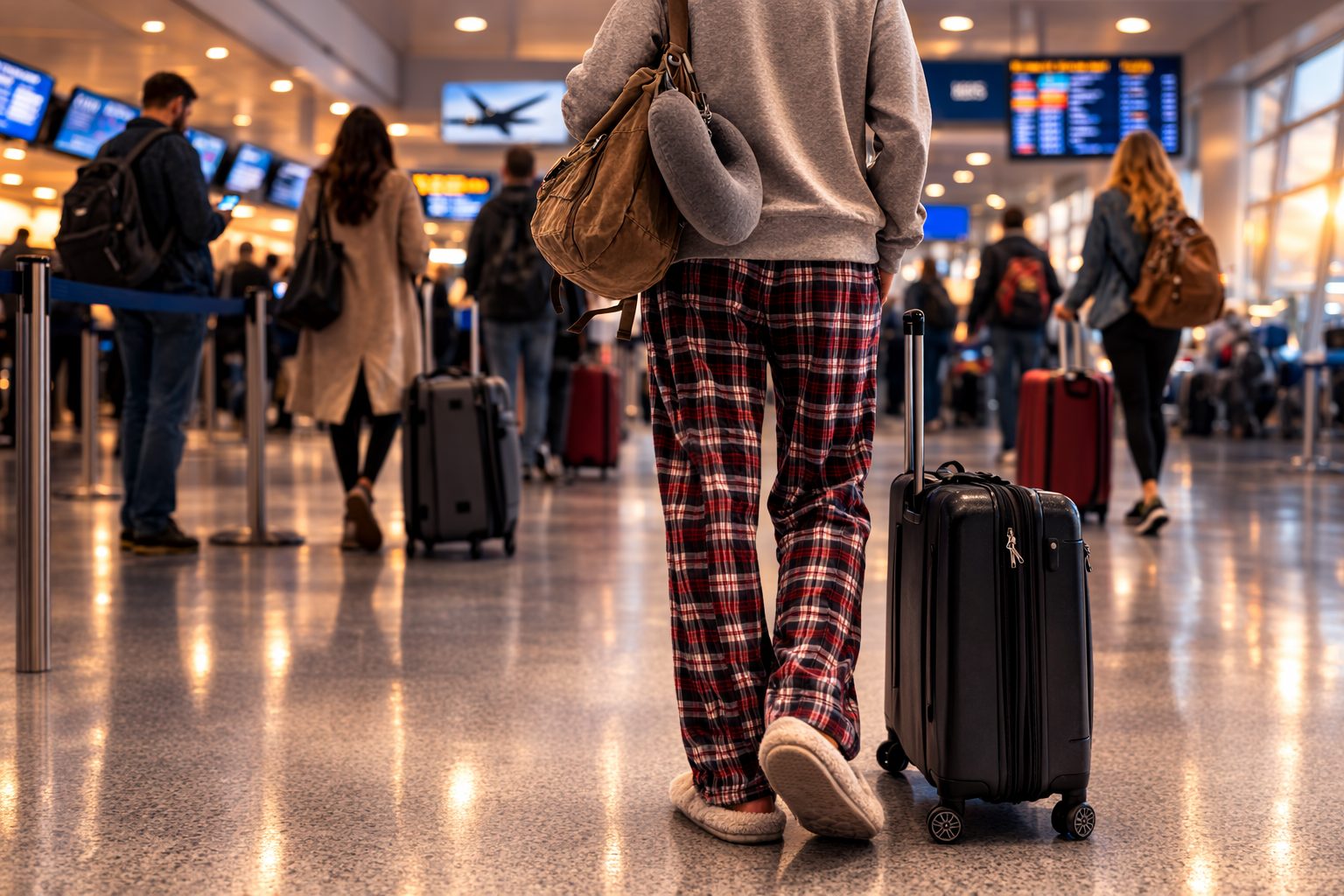
Recently, Tampa International Airport (TPA) posted an announcement declaring it was time to “ban pajamas at Tampa International Airport,” following its previous tongue-in-cheek “Crocs ban”:
“We’ve seen enough. We’ve had enough. It’s time to ban pajamas at Tampa International Airport.”
“We know this decision could be disruptive to someone in your life. It’s time to have a difficult conversation with them. You can do this.”
“The madness stops today. The movement starts now.”
The Internet Immediately Split Into Camps
The reactions were not mild.
They were philosophical. They were angry. They were oddly existential.
Here’s how the debate broke down.
Camp 1: “Yes. Ban Them.”
For some, this was long overdue.
“I can’t decide if people who wear pajamas in public have given up on life or are living it to the fullest.”
“WTF goes out in public in pajamas?”
“This is great, I am completely for this. Just dress decently.”
“I love this action. It’s about time! As a world traveler, I HATE having to sit next to someone that looks and smells like they were just pulled out of bed or a trash can. Looking forward to the more dignified look at the airports.”
“I love this! Lets go back to the way it was in the 50’s, 60’s and 70’s!”
But even supporters quickly pivoted beyond pajamas – toward a larger grievance:
“But I think we shouldn’t stop here, I think the airlines should start bringing the pleasure of traveling back to what it used to be. Like bring back actually feeding your travelers. Not even peanuts are given nowadays.”
This wasn’t really about sleepwear. It was about nostalgia. About standards. About a perceived decline in travel culture.
Camp 2: “Are You Serious Right Now?”
Then came the pushback – and it was loud.
“What kind of authoritarian bullshit is this?”
“How are you even classifying clothing as pajamas to begin with? Are sweatpants, yoga pants, children wearing soft clothes pajamas?”
“Fuck this rule. Never flying to Tampa ever again — and I’ve never flown wearing pajamas.”
“I’ll dress nice again when we’re not treated like cattle at the airport and on the plane.”
“Make air travel less miserable before you ask people to be less comfortable.”
“You get the dress your service deserves. Flying is the most uncomfortable and miserable experience for transport we have in this country.”
“If they don’t smell bad and aren’t bothering anyone why do yall care so much? Can yall focus on actually cleaning your bathrooms for once and speeding up TSA lines instead?”
“Policing pajamas and Crocs doesn’t make an airport classy or clean, it makes it insecure.”
“Let people travel in peace, comfort is not disrespect. Run the airport better and stop playing wardrobe police.”
Notice the pattern.
Very few people argued the policy itself.
They argued priorities.
Delays. Prices. Lost luggage. TSA lines. Customer service. Shrinking legroom.
The pajama post became a lightning rod for accumulated frustration.
And the comments went on and on – and many of them were a lot harsher!
Camp 3: The “Calm Down, It’s a Joke” Group
And then there were the observers – exhausted by outrage itself.
“All the comments!! How exhausting it must be to be offended so easily. Just laugh & go about your day.”
“I mean…as a joke, this is kinda funny.”
“This is funny. People wear what’s comfortable because they have to sit for over an hour and want to feel relaxed. You just boycotted a business for yourself, and we know you don’t actually care about it.”
But even here, the tone reveals something important.
When a joke requires clarification, it has crossed from satire into ambiguity.
An Official Statement Was Issued
Within hours, the backlash was strong enough that the airport issued a clarification. According to the Associated Press, the airport stated: “Today’s post about ‘banning’ pajamas was another playful nod to day-of-travel fashion debates. We encourage our passengers to travel comfortably and appreciate our loyal followers who enjoy the online humor.”
MarketWatch reported a similar statement: “Tampa International Airport regularly shares lighthearted, satirical social-media content as part of our ongoing effort to engage with our followers… Today’s post about ‘banning’ pajamas was another playful nod to day-of-travel fashion debates. We encourage our passengers to travel comfortably and appreciate our loyal followers who enjoy the online humor.”
The AP article also notes that TPA’s playful online persona isn’t new. For more than a decade, its social presence has leaned into humor. In the early days of what was then Twitter, a young intern began posting jokes – teasing rival sports teams and fans – and the tone caught on. The airport built a following around being witty, slightly sarcastic, and self-aware.
This time, though, the joke hit a nerve.
Why This Matters (And Why It’s Not About Pajamas)
After more than 20 years running a public relations agency, I can tell you something very simple:
If you have to issue a press statement explaining that your joke was a joke, the joke failed strategically.
Why? Because it wasn’t clear. Or it wasn’t clear that it is a joke. What you thought was funny hit a nerve instead.
Institutions – especially public-facing ones like airports – operate under a different humor threshold than individuals. When a brand jokes about banning clothing, it touches on autonomy, control, and power – whether intended or not.
People don’t respond to the literal meaning.
They respond to what it implies.
In this case, the satire collided with a sensitive moment in travel culture:
- Airfare is expensive.
- Service levels feel reduced.
- Comfort has declined.
- Passengers feel squeezed.
Against that backdrop, a joke about regulating comfort reads differently.
Even if it’s meant to be playful.
Even if it fits the brand’s established online voice.
The Deeper Debate: Comfort vs. Civility
Strip away the sarcasm, and you’re left with a real cultural question:
What does public space require of us?
Are airports neutral transit zones where comfort is king?
Or are they shared civic environments where presentation signals respect?
One comment captured the philosophical split perfectly:
“Airports are not a fashion show, a brunch spot or a LinkedIn networking event. They’re stressful, exhausting transit zones where people are sleep-deprived, jet-lagged, delayed, broke, sick, chasing connections or traveling overnight. Pajamas are about comfort not standards.”
Another countered with equal conviction:
“As a world traveler, I HATE having to sit next to someone that looks and smells like they were just pulled out of bed.”
It’s not about flannel pants.
It’s about expectations.
But, as mentioned above, there were also people who said that they have nothing against others wearing PJs at the airport, as long as they do not smell.
The Real Lesson for Brands
Humor works online – until it intersects with stress.
Airports are already high-tension environments.
When a public institution jokes about restrictions, even in parody form, people instinctively test it against reality.
Could they ban it?
Would they?
Should they?
That’s where the spark ignites.
The irony?
The post was designed to increase engagement.
It succeeded.
Just not entirely in the way intended.
And no, do not tell me the famous line with all publicity is good publicity because, even if I work in the field (though I do more business strategising now, not PR), I do not agree with it.
Yes, this was a communication crisis. And it required PR crisis management. Such incidents may be costly, so be very careful!
It was supposed to be a joke, but it got into a serious airport attire debate: is wearing pajamas on a flight OK or not?
So… Should You Wear Pajamas to the Airport?
That’s not really the point.
The point is this:
When public trust is fragile, tone becomes strategy.
And sometimes, the smallest fabric can unravel a much bigger conversation.
What do you think – is airport attire about comfort, standards, or something else entirely?
And here are the sources for this article:
- the original tweet
- the AP News article
- The MarketWatch article
— Tampa International Airport ✈️ (@FlyTPA) February 26, 2026
Photo made with ChatGPT