I am sharing with you another story that seems impossible. Yes, I’ve said this before, but this one is indeed mind-blowing – and every new detail I found made it even harder to believe.
Imagine you’re planning a trip to Italy (yes, I know, I wrote about an incredible story from Italy just yesterday). You’ll be staying in or near Vicenza, and while searching for interesting places to visit, you discover an ancient Roman attraction in the nearby hills.
How could you miss it? Italy is famous for its ancient monuments, archaeological sites, theaters and amphitheaters. You may never visit this part of the country again, and the attraction has an extraordinary history. The ticket costs up to $46 / €40. It isn’t exactly cheap, but it’s still an amount many people would pay for a special historical experience.
You look for more information before making your decision. The attraction appears in official tourism material. It has a website, photographs, guided tours and stories connecting it to some of the most famous names in history.
Everything seems legitimate. And the history is almost impossible to resist (I will share it all with you!)
You visit the site. You walk among the supposed ancient structures. You listen to the stories and perhaps take dozens of photographs.
Then, years later, you discover what you actually paid to see.
But that isn’t the end of the story.
The reactions people had after learning what happened surprised me almost as much as the attraction itself. And then I found the published biography of the man behind it.
I read it once. Then I read parts of it again because I thought I must have misunderstood something. I hadn’t.
I’ve worked in marketing for more than 20 years, and this story left me with so many questions – I will share them all with you too
Let’s start with what tourists were told they had discovered.
ID 16168512 ©Nicoleta Raluca Tudor | Dreamstime.com
An Ancient Attraction in the Hills Near Vicenza
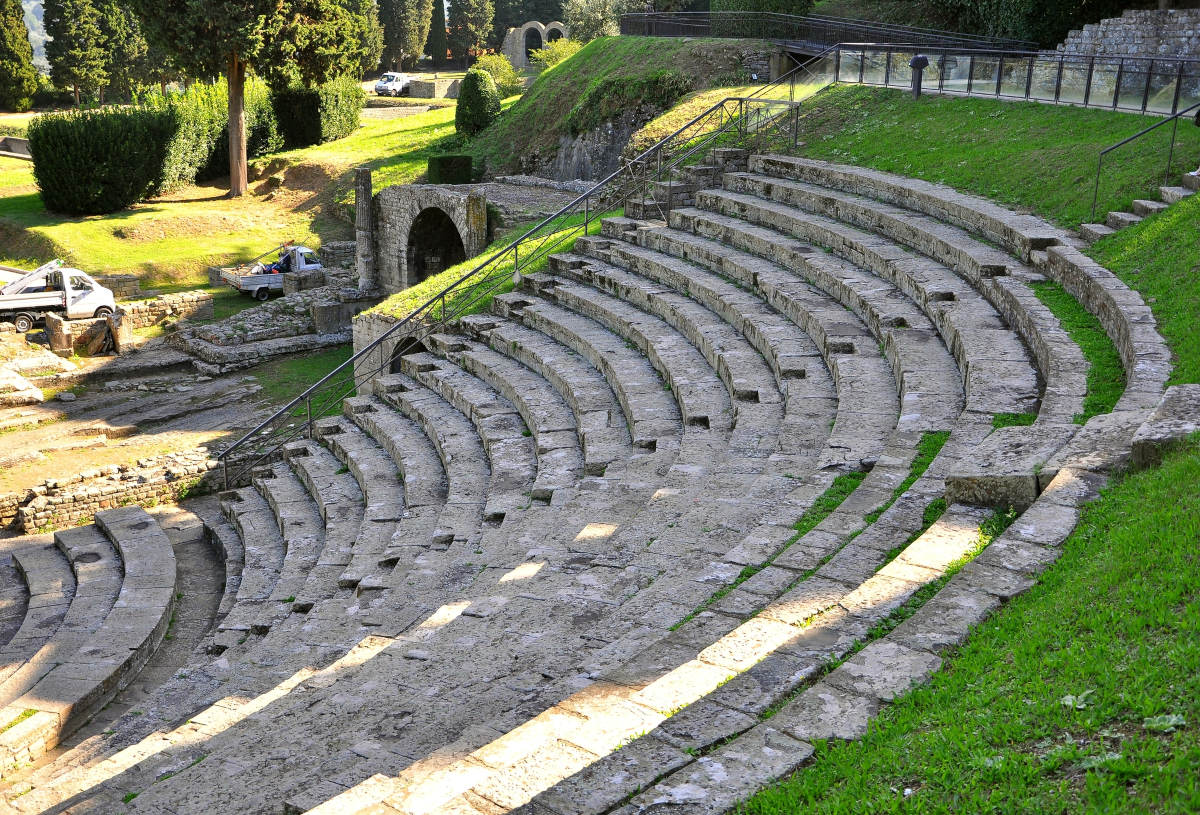
The attraction is known as the Anfiteatro Marittimo Berico, or Berico Maritime Amphitheater. It is located on a hillside in Arcugnano, a municipality in the province of Vicenza in northeastern Italy.
The complex covered approximately 5,000 square meters. It included tiered seating, columns, statues, an arena-like area and a pool below the seating.
Despite its name, the semicircular structure was actually closer in design to a Roman theater than a true amphitheater.
But that small technical detail was nothing compared with the history presented to visitors. According to the story used to promote the site, the amphitheater had been discovered following a landslide in 2005.
It was said to date back to AD 393 and was promoted as one of the oldest and largest amphitheaters in the world.
That alone would be enough to make many people curious. But there was more – yes, I know, it sounds like those teleshopping shows.
Visitors were told that Julius Caesar had passed through the site when returning to Rome from Egypt with Cleopatra.
And then there was a connection to another name tourists immediately recognize.
Juliet Capulet.
Yes, that Juliet.
The story associated an old church at the location with the heroine of Shakespeare’s Romeo and Juliet. The attraction was also presented as containing remains from several periods, including Ancient Greece, Ancient Rome and even the Neolithic era.
Caesar. Cleopatra. Juliet. Ancient Rome. Ancient Greece. Prehistoric remains.
From a marketing point of view, it was an extraordinary combination and I can totally understand why people would want to visit it.
Each new story added another reason to visit. Someone who wasn’t particularly interested in Roman engineering might be interested in Caesar and Cleopatra. Someone who didn’t care about them might be attracted by the Romeo and Juliet connection.
And people could do more than look at the structures. Guided tours and historical reenactments were reportedly organized at the site, with admission reaching €40 / $46 per visitor.
The attraction didn’t appear to be a random collection of stones someone had advertised on an obscure website. It had photographs, events, tours and an extensive history.
It also had something that would have reassured many tourists.
It Appeared in Official Tourism Material
According to Euronews, Franco Malosso von Rosenfranz managed to persuade local authorities to include the site in Vicenza’s EU-funded tourism guide and online app. EL PAÍS also reported that the attraction appeared in an official tourist guide.
Think about this from a tourist’s perspective. You hear about an unusual ancient site. You search for information. You find it included in official tourism material. Why would you assume that the story hadn’t been verified?
When people read about tourist scams in Europe, they usually learn to distrust unofficial sellers, vague offers and people applying pressure. This situation looked completely different: the attraction had guided tours, a detailed history and a place in official tourism material.
Most people aren’t archaeologists. They don’t know how ancient stone should look, which construction methods Roman builders used or where an amphitheater would normally have been built. They rely on museums, tourism offices, guides and local authorities to check those things.
Its inclusion in official material gave the attraction something that private advertising alone couldn’t provide: credibility.
You could visit its website. A Facebook page carrying the attraction’s name also published photographs and material about the site.
For someone planning a trip, there appeared to be plenty of evidence that this was a real attraction with a remarkable past.
But in 2016, authorities began looking much more closely.
The Investigation Began With a Complaint in 2016
The City of Arcugnano filed a complaint in 2016, beginning an investigation that would eventually lead to years of court proceedings and appeals.
Archaeologists were called in during an investigation by Italy’s Carabinieri. What they found was very different from the history tourists had been hearing: the supposed ancient complex contained modern materials. Reports mention fiberglass, papier-mâché, rendered blocks, cement columns and plaster statues dating from the early 2000s.
The tiered seating had been created using worked and stacked modern stone blocks that were made to look old and the pool was artificial. Satellite images reportedly showed that the hill had first been levelled. The monument was then constructed on the cleared area.
This wasn’t a Roman amphitheater rediscovered after almost two millennia – it was modern, and it had been built without the required urban-planning and landscape permits, according to EL PAÍS.
What Was the Attraction Supposed to Be?
As I looked closely at the articles and the story, it seems that here is where the story becomes more complicated.
According to EL PAÍS, a review of older reports doesn’t make Malosso’s original intention completely clear. The story changed over time. Initially, the site was presented as a genuine archaeological discovery containing remains from several historical periods. Later, after the investigation began, Malosso said it was a reconstruction of an ancient theater that had supposedly existed beneath the hill.
Italy’s Cultural Heritage Superintendency rejected that explanation. It determined that there were no archaeological remains at the site and that the structures were modern.
His defense also argued that the imitation was so obvious, or “clumsy,” that nobody could reasonably have believed it was genuine. The courts rejected that argument too.
Judges found that the site had been presented as containing authentic archaeological remains and that money had been generated through visits and activities held there.
The Historical Stories Had Problems Too
The construction materials weren’t the only issue. The dates didn’t work either.
The amphitheater was supposedly built around AD 393. Julius Caesar died in 44 BC. He couldn’t have visited a theater built more than 400 years after his death.
There was also the Juliet story.
Shakespeare’s Romeo and Juliet is associated with Verona, not Vicenza. And while Verona has created several attractions connected to the story, Juliet Capulet is a literary character. Still, I can understand why the combination was appealing to tourists.
People visit Verona to see Juliet’s House and balcony despite knowing that Shakespeare’s Juliet wasn’t a documented woman who lived there exactly as described in the play.
A reconstructed or fictional experience can be a successful attraction. It simply needs to be presented honestly. That distinction would become very important in this case as I am sharing below.
The Court Case Continued for Years
The legal proceedings lasted approximately a decade.
In December 2021, Italy’s Supreme Court declared Malosso’s appeal inadmissible. He had been found responsible for illegal construction, counterfeiting works of art and creating structures without authorization.
He was sentenced to two years and four months in prison and fined €3,000. The international stories published in July 2026 made it sound as though he had just been convicted. The sentence itself was already final.
Corriere del Veneto reported on July 22, 2026, that the 69-year-old had already been held in Ventimiglia prison for several months. A request that could have allowed him to avoid prison through an alternative arrangement was rejected. The Municipality of Arcugnano has also pursued a reported €560,000 damages claim.
EL PAÍS reported that the ruling required Malosso to compensate the municipality, demolish the theater and the other unauthorized structures, and restore the hill to its previous condition. As of late July 2026, that work had not been completed.
You would expect the public reaction to be almost entirely angry.
Some people were angry.
Others had a very different response.
Many People Saw a Wasted Business Opportunity
I found some of the most surprising reactions under a The Mirror Facebook post about the story.
One person wrote:
“The greatest tragedy wasn’t the fake ruins. It was the real genius behind them. A mind capable of building a legacy devoted itself to building an illusion. 😔”
Another commenter didn’t know whether to condemn the idea or admire the creativity:
“I don’t know whether to be shocked or congratulate the man for thinking outside the box I know it’s dishonest, but you have to it to him for being creative. If he had actually built a really good fake one, he could have made an honest business out of it. The Mummy rides again. Guys dressed up as mummies, some fake sarcophagi.🤣🤣😉”
Someone else gave a much shorter verdict:
“Man’s a genius”
These are individual social-media comments, of course. They don’t represent everyone who read the story.
I had already seen a similarly divided response when I wrote about a tourist diving into the Trevi Fountain. Even when an incident appears straightforward, some commenters focus on the audacity or creativity involved rather than the rule that was broken.
But the same idea repeatedly appeared in a Reddit discussion.
One person wrote:
“He could have advertised it as a realistic replica and turn it into a venue for shows or events and cashed in. Instead he’s in jail and will forever be known as a fraud.”
Another commenter asked the question I had been thinking about too:
“Why in the world wouldn’t he just pay some actors to play romans and make this the historic play it clearly is? Tourists would have still loved this, it is basically how all amusement parks work, disney castle is also not historic.”
And they’re right about one thing.
People pay to visit modern reconstructions, fictional buildings, film sets, historical villages and theme parks all over the world. They know Disney castles aren’t medieval royal residences. They know actors in historical shows aren’t actual Romans.
That doesn’t make the experience less enjoyable. A Roman-inspired theater with actors, performances and events could have been a real tourism business, it could have been a great movie set, events set…
That was already enough to make this one of the strangest stories I had read in a long time.
Then I found Malosso’s published biography.
The Biography Is Almost as Incredible as the Amphitheater Story
The Anfiteatro Berico website is still online.
It doesn’t present the court’s interpretation of what happened. It defends Malosso and gives an entirely different version of the amphitheater, his life and the legal proceedings.
The website contains both a short biographical CV and a much longer page titled “Biografia Franco Molosso von Rosenfranz.”
International news reports generally refer to him as Franco Malosso von Rosenfranz. The biography gives his name as Franco Molosso Alessandro di Macedonia Maltarello von Rosenfranz.
And that is only the beginning.
The website describes him as an academic musician, conductor, artistic director, composer, arranger, journalist, writer, historical researcher and reviewer.
It says he worked in satellite telecommunications and collaborated with NASA technicians on facial, posture and voice-recognition projects. It presents him as a philanthropist and peace activist. It says he became the 29th Margrave at the age of 14.
The biography connects his family with an ancient line descending from Alexander I of Epirus, the uncle of Alexander the Great. Elsewhere, the website refers to Malosso as the last Molossian king or Macedonian heir.
There is also an alleged intelligence career.
The biography identifies him as “Agent K-626” and describes secret operations connected with military intelligence, organized crime, kidnappings and gold. Another page on the website lists 37 publications attributed to him.
I’m giving you only a shortened version. The complete biography is extremely long and contains many more stories, connections and accomplishments.
I need to make something very clear here.
These are statements published on the website connected with Malosso and the amphitheater. I couldn’t independently verify many of them, and I’m not presenting them as established facts.
I’m sharing them because they show how extensive the story surrounding both the man and the attraction became. The amphitheater wasn’t supported by one invented paragraph. It was part of a much larger narrative involving ancient history, royal ancestry, music, intelligence work, politics and international events.
The Website Also Gives a Very Different Explanation for the Case
The Anfiteatro Berico website argues that Malosso was unfairly targeted.
It contains extensive allegations involving authorities, politicians, judges and organized crime. One page alleges that he and people connected with the amphitheater faced a demand for €5 million in protection money.
You can read the page containing that allegation here.
The website makes many serious accusations against named people. I couldn’t find reliable independent confirmation for those allegations, so I won’t repeat the names or present the accusations as facts.
They are Malosso’s side of the story, as published on a website that defends him. They are not the findings reported from the criminal proceedings. Still, their existence adds another strange layer to an already unbelievable case.
Why Didn’t He Sell the Experience Honestly?
This is the question I can’t get past.
Creating a large Roman-inspired theater isn’t, by itself, a bad business idea. It could have been promoted as a realistic reconstruction; it could have hosted Roman-themed shows, concerts, reenactments, dinners, educational experiences or private events.
Actors could have played Roman citizens, soldiers, politicians or gladiators. The Caesar and Cleopatra story could have become a theatrical performance rather than a historical statement. The site could have been used for films and photography. It could even have leaned into the fun of being an intentionally modern Roman attraction.
People might still have paid €40, particularly if the ticket included a guided experience or performance.
The online reactions show that some people would be interested in visiting it now, precisely because of its strange history. But presenting the construction as genuine archaeology created a problem that marketing couldn’t solve.
Sooner or later, an archaeologist was going to visit. Sooner or later, someone was going to check the construction materials, the permits, the satellite images and the impossible chronology.
But, in marketing you learn that a great image + a lie (as the base) will never lead to success. Maybe a short-term one, yes, but in the long run, you will always pay a steep price – money, damaged reputation, etc.
A persuasive story can encourage people to buy a ticket. Confidence can make a presentation sound convincing. Official inclusion can give an attraction credibility.
But how could anyone believe that modern construction presented as ancient history could remain undiscovered forever?
I also wonder about the numbers.
Even at €40 per visitor, the full ticket price wasn’t profit. There were construction costs, maintenance, staff, events, taxes and other expenses.
How many visitors would have been needed to recover everything invested in a 5,000-square-meter complex?
Was the attraction bringing in enough money to justify the work?
And how could that income ever justify the risk of demolition, enormous damages and prison?
Perhaps the biggest missed opportunity is that Malosso appears to have created something people might genuinely have wanted to visit.
The construction didn’t have to be ancient to be interesting. The story didn’t have to be presented as fact to entertain tourists. He could have sold the experience.
Instead, according to the court findings, he sold authenticity that wasn’t there. And that decision transformed a potentially creative tourism business into one of the most unbelievable archaeological hoaxes Italy has seen.
As I promised in the beginning of this article, here are the most important questions:
- How much money and work went into creating this place?
- How many visitors paying €40 would be needed to recover the investment and make a profit?
- How long could anyone expect the story to continue?
- And why take such an enormous risk when the same creativity and confidence could have been used to create a legitimate attraction?
More about Italy: Before your next trip, check the tourist rules and fines in Italy. For something lighter, discover these Italian proverbs and meanings.
He is convicted now – according to the reports – but the construction is still standing. What will happen to it?
More amazing articles for you:
Thinking of Visiting the U.S.? You May Soon Be Asked for 5 Years of Your Social Media History
Five Unusual Museums in London
A Beautiful Christmas Decoration with Lights from Bucharest
Your Funchal guide: discover what to do in Funchal, Madeira, Portugal
15 Once-in-a-Lifetime U.S. Cities You Need on Your Bucket List
3-day itinerary in London exploring the City, the West End, and the Royals
Heroes' Cross on the Caraiman Peak, Romania is the Largest Cross in the World at High Altitude
Exclusive vacations to relax and unwind

Violeta-Loredana Pascal is a communications expert, business mentor, and the founder of Earth’s Attractions and PRwave INTERNATIONAL. A pioneer in the Romanian digital PR landscape since 2005, she holds a degree in Communication and Social Sciences from SNSPA Bucharest. Violeta is a senior trainer at AcademiadeAfaceri.ro, where she leverages over 20 years of experience to teach professional courses in PR strategy and workplace productivity. By blending high-level business consulting with a passion for holistic travel and wellness, she empowers solopreneurs to overcome procrastination, build profitable brands, and design a life of purposeful adventure.