
Most people return home with photographs. Many return with stories. But across cultures, continents, and travel styles, one object appears again and again in luggage and gift bags: the fridge magnet. It is inexpensive, small, and seemingly trivial. Yet it has become the most widespread travel souvenir in the world, collected obsessively by some, casually by others, and gifted almost universally.
I realized this only after my own refrigerator quietly transformed into a map of journeys and relationships. At first, I saw the magnets as simple keepsakes. Over time, I noticed how often my eyes paused on them, how easily they summoned forgotten details, how reliably they sparked conversations with guests. That observation led to a deeper question. Why do people buy fridge magnets when they travel? What psychological, social, and cultural forces turned this tiny object into a global ritual of remembrance?

This article explores those questions in depth, combining personal experience with research from tourism studies, consumer psychology, and behavioral science to uncover why this unassuming souvenir holds such persistent emotional power.
Fridge magnets as memory anchors: the cognitive reason we keep buying them
The most consistent explanation for why people buy fridge magnets lies in how our memory functions. Cognitive psychology has long established that memory recall strengthens when information is linked to sensory or physical cues. This is known as cue-dependent memory. Physical objects associated with emotional events become retrieval triggers for stored experiences.
Travel is emotionally intense by nature. New environments, novelty, and heightened attention make memories stronger. When you buy a magnet during a trip, the object becomes encoded together with that experience. Recent research indicates that fridge magnets can actively stimulate post-holiday memory recall through repeated everyday exposure. Later, repeated exposure to the magnet reinforces the memory. Because refrigerators are accessed multiple times a day, the magnet benefits from constant visual reinforcement.
Multiple tourism researchers have explored the motivations behind souvenir buying, showing that souvenirs function not only as aids to memory but also as evidence of travel and as gifts to others. A foundational study by Wilkins (2011) identifies these core roles – memory, evidence, and gift – demonstrating that tourists often purchase souvenirs to tangibilize their travel experiences and share them socially.
This explains why many travelers feel mild discomfort if they forget to buy a magnet. It is not about missing an object. It is about missing the anchor that stabilizes the memory of the trip.
Practicality and design efficiency: why magnets outcompete other souvenirs
There is also a purely functional explanation for the dominance of travel fridge magnets. They solve multiple logistical problems simultaneously. They are small, light, inexpensive, and durable. They do not take up valuable luggage space. They rarely break. They are rarely restricted by airline regulations. They suit any budget.
Yet practicality alone does not explain success. Many practical souvenirs exist. What sets fridge magnet souvenirs apart is display efficiency. They do not require shelves, frames, or dedicated storage. They attach to a surface already present in almost every household. The refrigerator becomes a ready-made exhibition space.
From a design perspective, this is significant. A souvenir that can be displayed instantly, without additional cost or space, has a clear behavioral advantage. Research examining consumer satisfaction in product and service contexts consistently finds that when features are easy to use and immediately functional, they contribute strongly to overall satisfaction. A 2025 study applying the Kano model to consumer behavior highlights how usability and convenience are critical determinants of post-purchase satisfaction.
This explains why even minimalist travelers who avoid clutter often allow themselves a magnet. It does not feel like accumulation. It feels like functional decoration.
Identity construction through souvenir magnet collecting

Another layer behind why people collect magnets is identity formation. Sociological studies on travel behavior show that people use travel experiences to construct narratives about who they are. Visiting places becomes part of personal identity. Souvenirs serve as symbolic evidence of that narrative.
A fridge magnet collection tells a story without requiring explanation. Guests see it. Children ask questions. Friends recognize familiar destinations. Conversations emerge organically. The magnet collection functions as a low-effort storytelling device.
Importantly, this is not necessarily about status signaling. For many travelers, it is about personal coherence. The magnets represent continuity across life stages. Trips taken as a young adult, journeys with a partner, family vacations, solo adventures, work-related travel – all coexist on the same surface.
This is why magnet collections often remain even when people redecorate homes or change furniture. The fridge magnets are not décor. They are autobiographical artifacts.
Emotional reinforcement and the reward mechanism
Behavioral neuroscience offers another explanation for why people repeatedly buy fridge magnets. Small purchases made in emotionally charged contexts activate reward pathways in the brain. The act of selecting and buying a souvenir triggers a mild dopamine response. That response becomes associated with the travel experience itself.
Over time, buying a magnet becomes part of the travel ritual. Arrival, exploration, souvenir shop, magnet purchase, return home, placement on fridge. This sequence forms a habit loop reinforced by emotional reward.
So you can easily see why souvenir magnet collecting often persists for years without conscious decision. It becomes part of how a person completes the travel experience psychologically.
Social bonding: magnets as interpersonal tokens
Another important reason people buy fridge magnets is social. Souvenir gifting plays a recognized role in maintaining relationships during travel. Bringing back small gifts signals care, thoughtfulness, and inclusion. Fridge magnets work particularly well for this function.
They are neutral objects. They suit any household. They do not require knowledge of someone’s tastes or lifestyle. They are inexpensive, so they do not create social obligation. They carry the symbolic message: “I was away and I remembered you.”
Anthropological studies of gift exchange show that symbolic gifts reinforce social bonds more effectively than practical gifts. A magnet from a place someone has never visited carries emotional meaning beyond its material value.
This is why many magnet collections contain not only personal travel souvenirs but also gifts from others – my collection included! The fridge becomes a map of relationships as much as destinations.
Cultural standardization of the fridge magnet souvenir
Walk into souvenir markets anywhere in the world, from Iceland to Indonesia, and fridge magnets appear almost without exception. This global standardization is unusual. Few consumer products achieve such cross-cultural penetration.
The reason lies in universal household infrastructure. Refrigerators exist almost everywhere. Magnetic surfaces provide universal display compatibility. No language barrier exists. No cultural restrictions apply. A magnet is universally acceptable.
For tourism businesses, this creates a perfect low-cost product with high emotional appeal and global demand. That is why entire micro-industries exist solely to design, manufacture, and distribute fridge magnet souvenirs for tourist destinations.
This standardization reinforces the behavior further. Travelers expect magnets to exist. They seek them out. Souvenir shops position them prominently. A feedback loop forms between supply and demand.
Physical souvenirs in a digital memory era
It is reasonable to ask why fridge magnets remain popular when travelers now document trips through photos, videos, and social media. The answer lies in visibility and cognitive load. Digital photos are abundant but invisible in daily life. They require deliberate retrieval. Physical objects remain present without effort.
Cognitive science distinguishes between stored memory and accessible memory. Accessibility depends on cues. A magnet sitting on a refrigerator creates effortless access to stored travel memories.
So you see, even highly digital-native travelers continue to buy magnets. They fulfill a function digital media cannot replace: ambient memory reinforcement.
Personal experience: when magnets become a personal archive
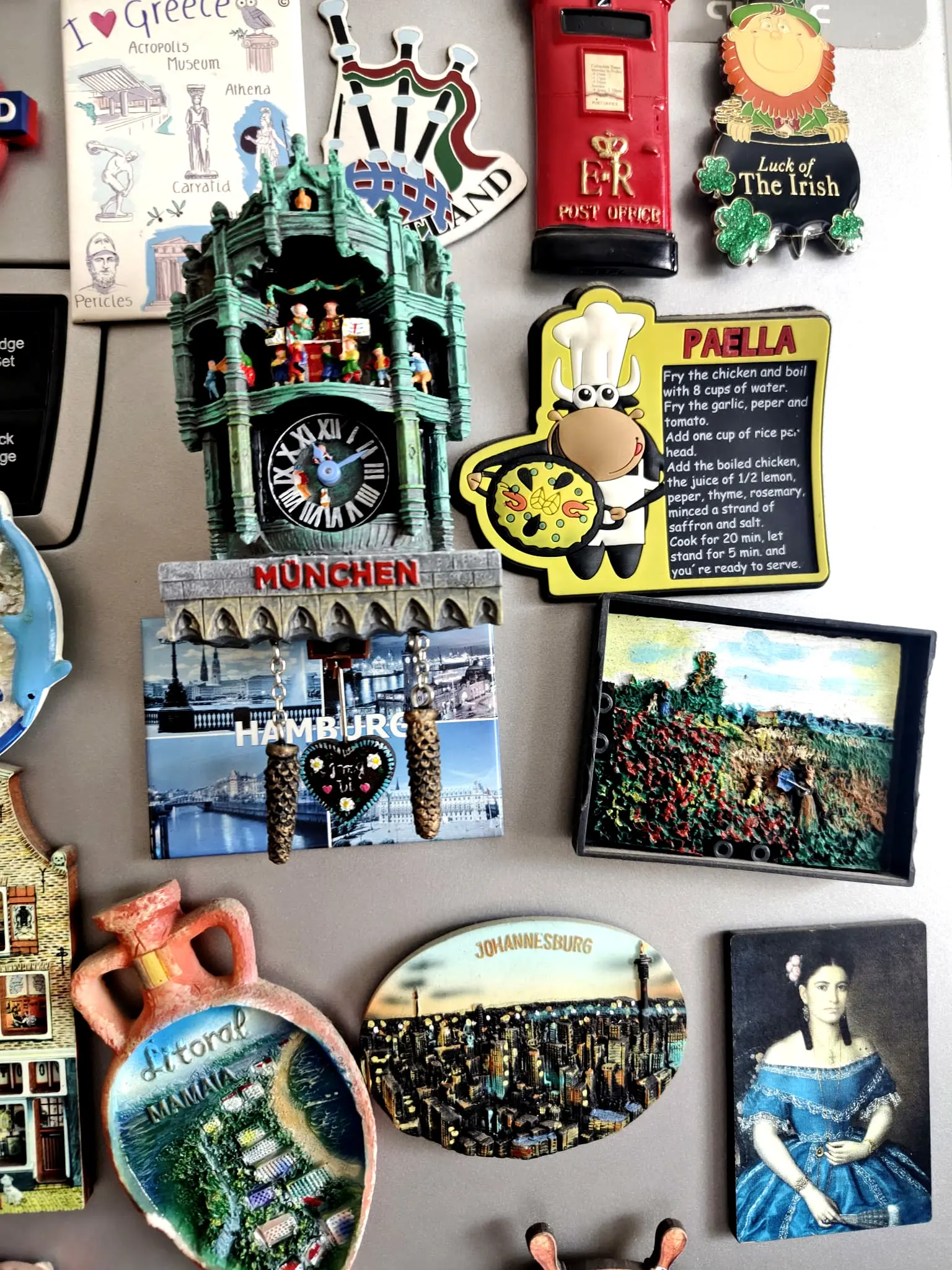
Returning to personal experience, my magnet collection now reflects far more than places visited. It reflects phases of life. Some magnets mark periods of exploration. Others represent family trips. A few represent destinations that changed my perspective entirely.
Over time, I noticed that when recalling travel memories, I often glance at the fridge unconsciously. The magnets became a spatial memory map. Certain corners of the fridge correspond to certain years or travel phases.
This unintentional organization reflects how we externalize memory. We build physical systems to store narrative structure. Fridge magnet collections often become personal archives without deliberate planning. Collecting behavior itself has long been studied in psychology as a mechanism for identity continuity and emotional meaning.
Why do people search for answers about magnet collecting
You might be surprised to learn that when I searched “Why do people collect fridge magnets?” I got soooo many answers and I noticed that the search trends show increasing curiosity around questions like “why do people buy fridge magnets,” “why do people collect magnets,” and “travel souvenirs psychology.” This reflects a broader cultural shift. People increasingly question consumption habits. They want to understand the meaning behind behavior.
This article exists precisely because of that shift. My initial curiosity mirrors a larger pattern. Travelers want souvenirs that feel meaningful, not wasteful. They want to understand emotional motivations.
Fridge magnets survive this scrutiny because their emotional, practical, and social value aligns with modern preferences for small but meaningful objects.
The deeper conclusion: a magnet is a contract with memory
At its core, the reason people buy fridge magnets is simple but profound. Travel experiences are fleeting. Memory fades. Physical anchors resist that fading. A magnet says: “This happened. This mattered. This stays.”
It is an inexpensive object performing an expensive emotional function.
That is why it endures. That is why souvenir shops keep producing them. That is why travelers keep buying them. And that is why refrigerator doors across the world have quietly become museums of our movement.
A Magnet Is More Than A Magnet
Understanding why people buy fridge magnets reveals much more than souvenir behavior. It reveals how we preserve identity, construct memory, and maintain relationships across distance and time. A small magnet is never just a magnet. It is a cognitive anchor, a social gesture, a narrative artifact, and a personal archive.