
We all have our check-in rituals. For some, it’s dropping the heavy bags and looking out the window to check the view. For others, it’s testing how comfortable the mattress is, or immediately logging onto the Wi-Fi to catch up on unread emails.
But there is a specific routine you should add to the very top of your list the moment you open your door. It has nothing to do with saving money, and it isn’t about scoring a free room upgrade.
Instead, it’s a modern travel strategy that addresses serious safety and privacy vulnerabilities that most of us completely ignore until it’s too late (as I recently realised).
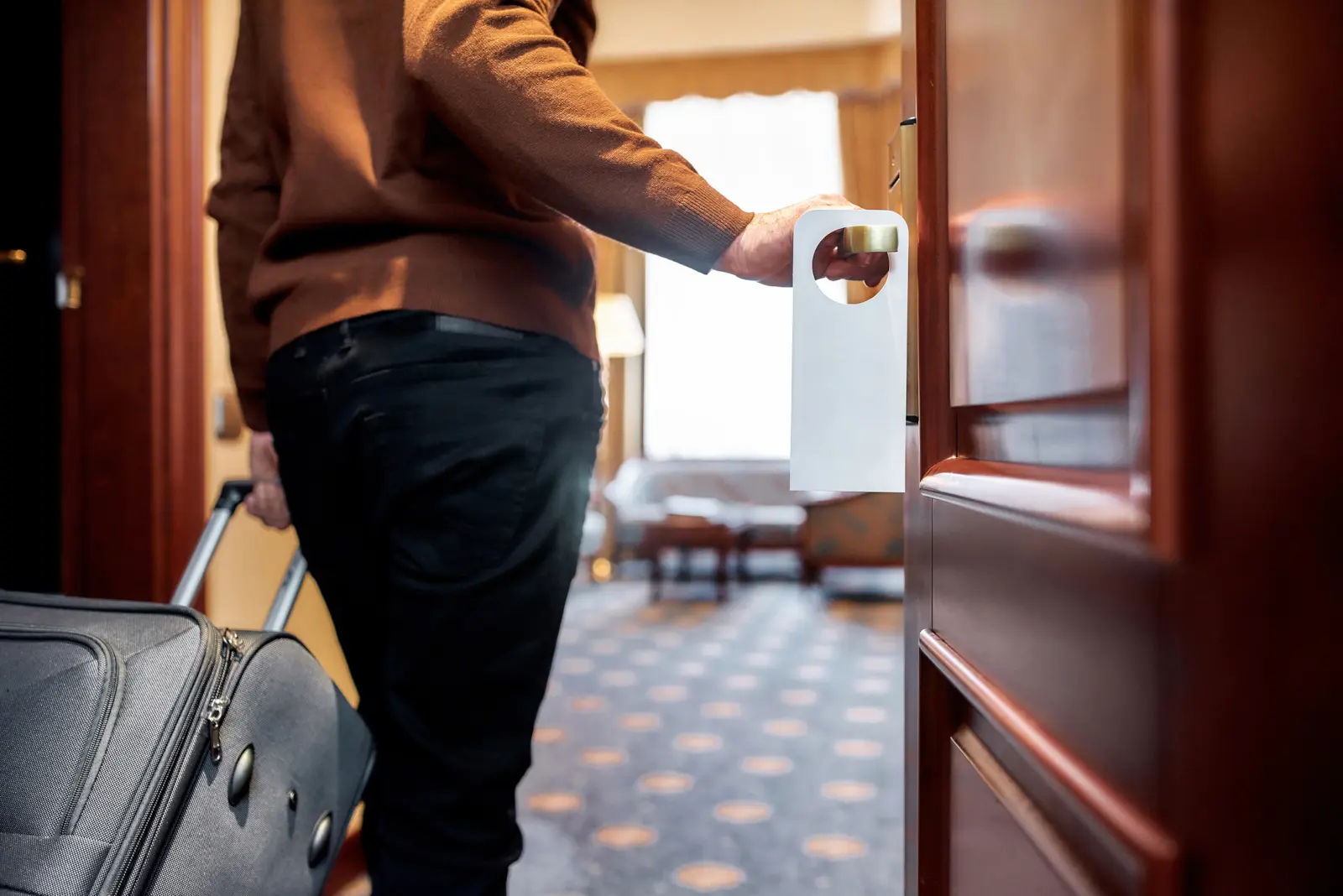
ID 176589363 ©Svitlana Ponurkina | Dreamstime.com
Before you open a single suitcase or sit down on the bed, you should pull out your smartphone. You’re going to use it to do two things immediately: take one specific, seemingly boring photo that serves as a midnight insurance policy (or a 3AM alarm), and use the camera sensor to expose things in the room that shouldn’t be there.
It requires almost zero effort, but if you ever find yourself facing a midnight crisis – or an invasive privacy breach – these few seconds will be the most important part of your entire trip.
What Happens at 3 AM When the Alarm Goes Off
To see why you need to prioritize this the moment you cross the threshold, you have to picture what happens when things go sideways.
Imagine being jolted awake at three in the morning in a pitch-black, unfamiliar room. A piercing fire alarm is echoing down the hallway. Your heart is pounding in your throat, your eyes are blurry, and you are completely disoriented. In that exact moment, your internal radar drops to zero. You don’t know which way the stairs are, you don’t remember how many doors are between you and safety, and you literally can’t think straight.
This isn’t just a hypothetical scary story. A close friend of mine, a lawyer, was recently on a family vacation in Dubai when the Iran-Israel conflict escalated. In the middle of the night, they were abruptly woken by emergency alarms. It was their first time in Dubai, and in that moment, the hotel was no longer just an unfamiliar building in a new city. It was a place they suddenly needed to understand fast: where the stairs were, where the exits were, and how to get their family moving without wasting time.
But think about what you actually do the moment you wake up in a panic. What is the very first thing your hand reaches for instinctively?
Your phone. It’s sitting right there on your nightstand. It’s the one object you and your family will grab without even thinking before you move toward the door.
And that is exactly why the smartest thing you can do before you even unzip your luggage is to walk over to the inside of your hotel room door, turn around, and take a quick, sharp photo of that little emergency exit map.
Why I Can’t Ignore the Exit Routes Anymore
For most people, that little plastic map on the door is just part of the room’s background decoration. We walk past it a dozen times a day without ever glancing at it.
But my own perspective on this changed forever because of a tragedy close to home. Years ago, here in Bucharest, a horrific fire broke out at the Colectiv nightclub. Because evacuation routes were dangerously inadequate and access to exits became a fatal problem: 64 young people died, some in a matter of minutes, and over a hundred more had their lives altered forever. It was a massive national tragedy that shook our entire country to its core.
Ever since that day, I look at public spaces completely differently. Whether I’m walking into a crowded shopping mall, a concert, or a new hotel room, my eyes instantly hunt for the exit signs. It takes two seconds, but it builds a quick mental map that protects you when everyone else starts to panic.
When you have that hotel door map saved directly in your phone’s camera roll, you don’t have to turn on the lights or stumble around in the dark trying to read tiny text on a door while smoke is rolling in. You have your exact escape route right in the palm of your hand on your way out. It completely eliminates that terrifying, frozen hesitation that causes people to make mistakes in a real emergency.
Of course, securing your physical safety is just the first step in protecting yourself while abroad. If you want to make sure your digital life and identity are just as safe while you’re away, make sure you also look over our guide on how to avoid pickpockets while traveling, which covers exactly how to protect your essential data, cash, and backup digital files from disappearing.
The 60-Second Hotel Safety Inspection
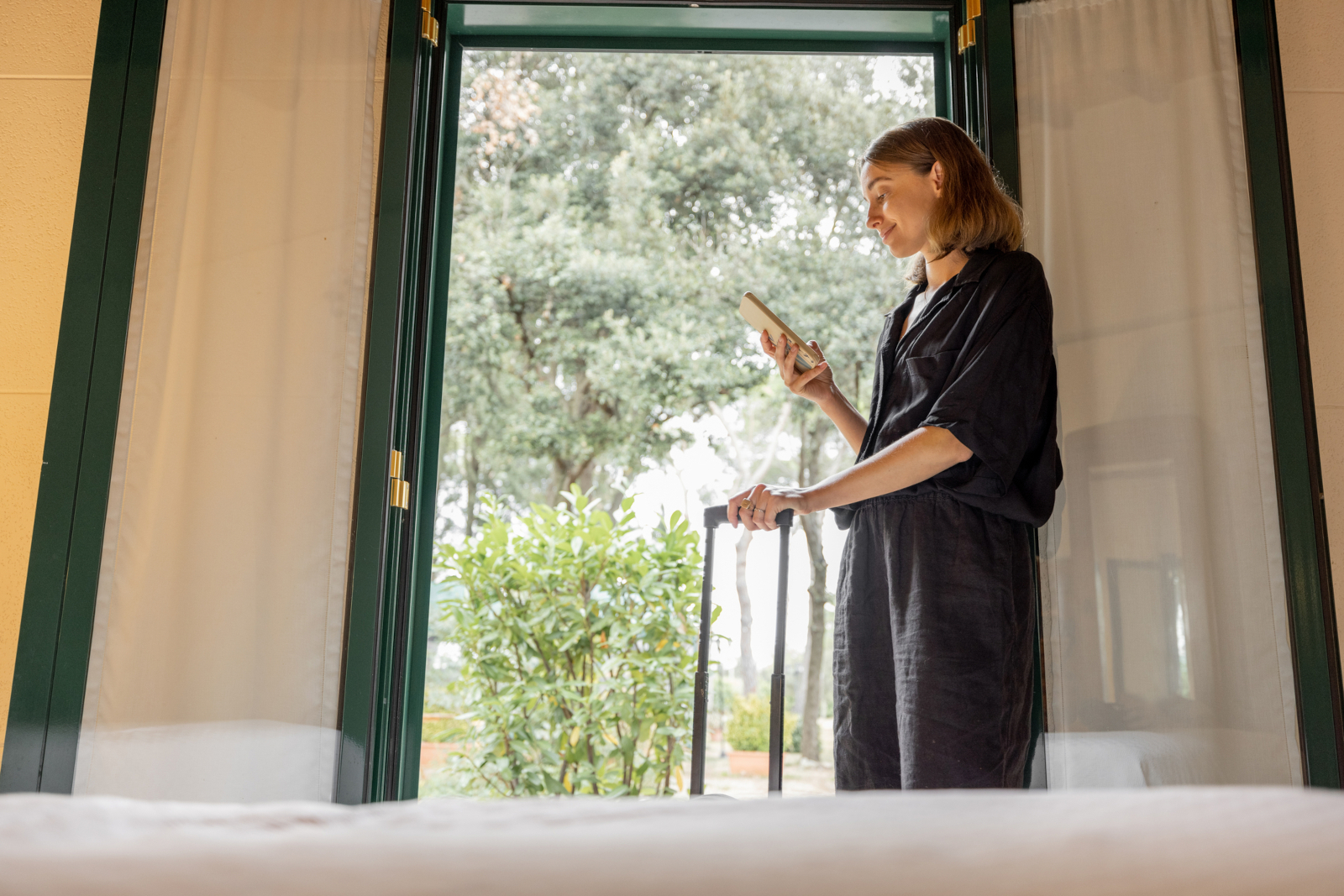
ID 248771482 ©Rosshelen | Dreamstime.com
This is where the phone becomes more than a place for boarding passes, hotel confirmations, and photos. I already treat my phone as a vault, but in a hotel room, it also becomes a quick safety tool. While taking that door photo is your baseline digital backup, you should combine it with a lightning-fast physical check of the space. It takes less than a minute, but it ensures your environment is actually secure and private before you lock up for the night.
How to Scan for Hidden Cameras with Your Phone
Turn off all the lights in the room so it’s completely dark. Turn on your smartphone’s flashlight and slowly pan it around the room, focusing on items facing the bed or bathroom – like smoke detectors, alarm clocks, or wall chargers. If there is a small camera lens, the glass may reflect a sharp glint when the flashlight hits it. It won’t always be blue or red (like many people say it is), and this method isn’t foolproof, but it can help you notice suspicious objects that deserve a closer look.
Alternatively, you can switch on your phone’s front-facing selfie camera. Some front-facing phone cameras can detect infrared light better than the rear camera. A quick way to test yours is to point a TV remote at the camera and press a button; if you see a flashing light on-screen, your phone may help you spot active infrared LEDs in a dark room.
Test the Door Lock and Deadbolt
Don’t just assume the door closed fully behind you when the bellhop left. Heavy carpet or handheld luggage can sometimes block the bottom of the frame. Physically close the door, ensure it latches completely on its own without you pushing it, and test both the deadbolt and the security latch from the inside.
Inspect the Peephole
Look through the peephole to make sure it’s clear and functional. More importantly, verify that it hasn’t been tampered with or accidentally installed backwards, which actually allows people in the hallway to see inside your room. If it doesn’t have a built-in privacy cover, simply cover it with a small piece of paper, a piece of tape, or a sticky note.
Secure the Adjoining Door
If your room has an interior door connecting to the neighboring suite, check it immediately. Ensure it is fully locked from your side. For extra peace of mind, especially if you are traveling solo, you can place a heavy piece of luggage or a chair right in front of it.
Look Under the Bed and in the Wardrobe
It sounds like a cliché from a Hollywood thriller movie, but simply walking around the room to check the bathroom stalls, the deep closets, and under the bed ensures you are completely alone in the space (see the stories mentioned below, in the section about the reality of hotel rooms) before you drop your guard and unpack.
Verify the Landline Phone
Look to see if the room phone actually works and has a clear dial tone. Check if it has a direct button for the front desk or local emergency services. If cellular service happens to be weak inside the hotel building, this old-school landline is your only quick connection to the outside world.
The Other Everyday Things You Need to Photograph
Once you realize how powerful a simple photo can be for managing hotel chaos, you start seeing other major blind spots in your room. While you have your smartphone out, there are a few other quick snapshots you should take to save yourself from massive, hidden headaches later in the trip.
1. The Room Thermostat
Hotel climate control systems can be notoriously baffling. Some have hidden motion sensors, others use cryptic symbols instead of temperatures, and almost all of them go completely dark at night. Take a photo of the control panel while the lights are still on. That way, when you wake up freezing at midnight, you can look at the image on your phone to see exactly which buttons control the temperature and fan speed without having to crawl out from under the blankets to hunt for a light switch.
2. The In-Room Safe Instructions
If you’ve already read through my night before a flight checklist, you know how critical it is to lock away your electronics, emergency cash, and backup documents before you head out the door for a day of sightseeing.
But every hotel safe seems to use a slightly different digital layout or locking sequence. Snap a photo of the printed instructions on the safe door before you lock it. If the mechanism glitches or you temporarily forget your code, having the exact model and instructions visual on your phone makes troubleshooting with the front desk staff ten times faster.
3. The Wi-Fi Password Slip
Front desks love to hand you a tiny, easily misplaced piece of paper containing a complicated 16-character network password. Instead of leaving it on the desk where it can easily get lost under local maps and tour brochures, take a picture of it immediately. When your connection randomly drops in the middle of a movie or an important work call, you won’t have to search through your pockets or call down to the lobby.
This was really useful to me in Paris – because my husband left with the password (he had a business meeting) and I was in the hotel room. Sure, I could have gotten the password from the front desk, but having it saved as a photo on my phone was a lot faster. Speaking of Paris, you might want to read my guide on how to save $50-$100 more daily without giving up on amazing experiences while traveling.
The Grimmer Reality of Hotel Rooms
Taking control of your environment isn’t just about emergency plans; it’s also about understanding what happens behind the scenes when you leave your room for the day.
We assume that our room is a pristine sanctuary once the housekeeping staff rolls through. However, there is a shocking, less-talked-about side to what some hotel staff actually do in your room when you are away. From cross-contaminating surfaces to people dipping into spaces they shouldn’t, there’s a reason seasoned travelers inspect their surroundings with a critical eye.
And if you think a dusty remote control or an unwashed glass is bad, it pales in comparison to the bizarre habits of your fellow guests. Recently, a seasoned traveler went viral for admitting to an absolutely disgusting travel hack you will not believe!
Taking a few seconds to photograph the exit map, check the lock, scan the room, and save the practical details you may need later isn’t paranoia. It’s a smart hotel check-in habit.
Before you unpack your bags on your next trip, take a moment to look at your door. Those five seconds might turn out to be the most valuable part of your entire vacation.
More amazing articles for you:
A ‘Once-in-a-Lifetime’ Experience Took a Terrifying Turn - You Won’t Believe What Stopped Them Cold
20 Travel Things We’re Supposed to Hate - But Plenty of Us Secretly Love
Chernobyl today: the ultimate travel guide to visiting Chernobyl, Ukraine
Ultimate Copenhagen Travel Guide: Top Things to Do, Where to Eat & Stay, and Local Tips
My Guide to Prater Vienna: Our Experience, Wiener Riesenrad, Rides, Prices and Tips
Best Time of Year to Visit Paris for Good Weather, Sightseeing, and Deals
Local's guide to Ljubljana, Slovenia with the things to do in Ljubljana
My Guide To Ceaușescu Mansion Bucharest: Tickets, Tour & What to See

Violeta-Loredana Pascal is a communications expert, business mentor, and the founder of Earth’s Attractions and PRwave INTERNATIONAL. A pioneer in the Romanian digital PR landscape since 2005, she holds a degree in Communication and Social Sciences from SNSPA Bucharest. Violeta is a senior trainer at AcademiadeAfaceri.ro, where she leverages over 20 years of experience to teach professional courses in PR strategy and workplace productivity. By blending high-level business consulting with a passion for holistic travel and wellness, she empowers solopreneurs to overcome procrastination, build profitable brands, and design a life of purposeful adventure.