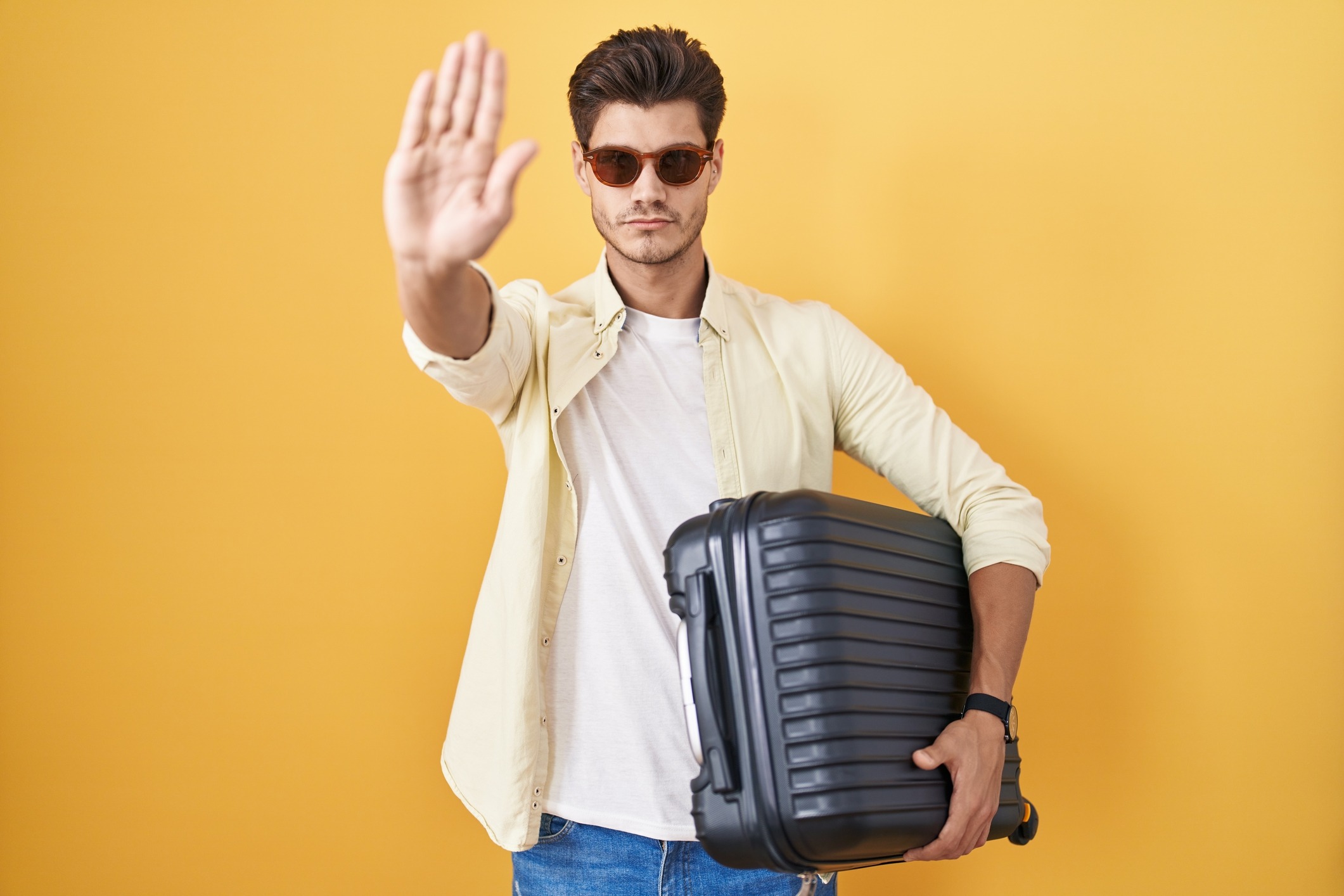
We’ve all seen the dramatic airport security shows where officers uncover suitcases stuffed with illicit substances or exotic reptiles. We watch from the comfort of our couches, thinking, “I’d never be that person.” But here is the scary reality: there are some common items that trigger a similar reaction and can get you fined or even arrested.
International borders are not just looking for contraband; they are looking for prohibited or restricted items in your luggage that could disrupt their local economy, health, or culture. To help you stay on the right side of the law, I’ve put together the ultimate guide to the surprising things you can’t have in your luggage that most people never see coming. The goal is to let you know what are these prohibitted luggage items so that you can prevent costly travel mistakes.
ID 303161352 ©Aaron Amat | Dreamstime.com
Prohibited Items in Luggage: What You Can’t Bring on a Plane
1. Medications You Can’t Bring on a Plane (Hidden Restrictions)
Medication is easily the most stressful category because it involves your personal health. Most of us assume that if a doctor prescribed it, or if it’s sold on a supermarket shelf, it’s safe to travel with. This is a dangerous assumption. Many restricted items in international travel are common cold remedies.
For example, I personally struggle with sinus issues, and for me, a trip to Japan requires an incredible amount of research. Japan has strict rules on certain cold, allergy, stimulant, and narcotic medications. Products containing pseudoephedrine can be prohibited, and medicines containing codeine or other narcotic ingredients may require advance permission, so travelers need to verify the exact product before departure.
Other countries have similar “hidden” rules; codeine is a major issue in the UAE (add this to this list of things that can get you fined in Dubai) and in Greece codeine is subject to special rules, so travelers should carry the original prescription and supporting medical documentation. ADHD medications are often treated as controlled stimulants in many parts of Asia.
2. Why You Can’t Bring Food or Seeds Abroad
We often think of food as the ultimate “useful” souvenir, but customs officers view it through the lens of biosecurity. Bringing organic material across a border is one of the most common ways to “mess with the natural environment.” When you bring in a foreign fruit or meat, you might be carrying a microscopic pest that could wipe out a local industry. Customs officers are not evaluating whether something is “safe to eat” – they are evaluating whether it could introduce pests, diseases, or biological risks into the country.
My husband experienced this firsthand during his trip to South Africa. He became fond of Biltong, a local cured meat, and he wanted to bring me some too, but meat products are exactly the kind of item that often triggers biosecurity restrictions, so whether it is allowed depends on the destination country’s rules. So… I have to get to South Africa too!
Kinder Surprise Eggs (The USA Trap) – This sounds like an urban legend, but it’s real. The classic Kinder Surprise Egg (the one with the toy inside the chocolate) is banned in the US because it’s a choking hazard. US Customs can seize them.
It isn’t just exotic meats, either. I read about this case of a woman traveling from Paris to the US who was facing a $500+ fine for an apple provided by the airline and found in her carry-on (she was keeping it for a later meal in the day). The larger lesson is that fruit, meat, and other agricultural products should always be declared.
What makes this even more surprising is that it doesn’t matter where the food came from. Even items handed to you on the plane – like fruit, sandwiches, or packaged snacks – can become a customs issue if you carry them into the country without declaring them. From a border control perspective, it is still an undeclared agricultural product.
The same applies to seeds for flowers or plants. You might think a packet of seeds is a harmless gift, but most countries require a phytosanitary certificate to ensure you aren’t introducing invasive species. In Australia and New Zealand, even a small undeclared biosecurity item such as seeds, food, or plant material can trigger an on-the-spot penalty.
There are also very specific “high-risk” food categories that trigger stricter enforcement. Pork products are one of them. In destinations like Taiwan, bringing in pork – even something as small as a sandwich or snack – can lead to extremely high fines due to strict biosecurity rules linked to animal disease control.
3. Clothing, Counterfeit Goods, and Other Restricted Travel Items
It sounds absurd, but your choice of clothing can lead to customs fines for travelers. In several Caribbean nations, including Barbados, Jamaica, and St. Lucia, it is actually a crime for civilians to wear camouflage patterns. These prints are reserved exclusively for military personnel. If you land wearing camo cargo shorts, you may have them confiscated or be forced to pay a fine.
Similarly, “faking it until you make it” can backfire in France and Italy (I recently published an article with mistakes that can get you fined in Italy). These countries have a zero-tolerance policy for counterfeit luxury goods. If you arrive with counterfeit luxury goods in places like France or Italy, customs officers can seize them, and the penalties can be severe.
Beyond fashion, vaping is another lifestyle trap. In Thailand, vaping devices are illegal. Tourists can face confiscation, heavy fines, detention, and court proceedings for carrying or using them.
4. Natural Items You Can’t Take in Your Luggage (Sand, Shells, and More)
Taking a “piece of the trip” home with you can be a legal nightmare if that piece belongs to the earth. In Sardinia, Italy, the sand is considered a protected mineral. In Sardinia, taking protected beach sand can lead to fines that reportedly range from hundreds to several thousand euros. On La Pelosa Beach, you cannot use a towel (the scientific reason makes sense!.
Speaking of Italy (and other countries), beware of two more important rules: there are areas in some cities where you cannot roll your carry-on (or you will be fined), and there are cities where you will be fined for wearing swimwear outside of the beach. You could even get a fine for building a big sandcastle here.
This also applies to the CITES agreement, an international treaty that protects wildlife. Many people do not realize that some shells, coral, and wildlife souvenirs may require CITES permits, and in places like Iceland, removing rocks or natural materials from protected areas can also be illegal. Taking these home without a permit is technically considered resource trafficking. Some of the most commonly confiscated items include coral jewelry, large seashells such as queen conch, and products made from protected species. Many travelers buy these as souvenirs without realizing they fall under international wildlife protection rules.
Even honey can be a border issue in places like Australia and New Zealand. It often has to be declared and inspected, and if it fails biosecurity rules, it may be seized.
5. Electronics and Items That Can Be Confiscated at the Airport
There are high-tech prohibited items in checked bags or carry-ons. “In Morocco and Egypt, drones are a serious customs risk and may be confiscated on arrival. In India, carrying a satellite phone without a specific government license is a serious offense that can lead to arrest.
Another common oversight is portable power. Power banks and spare lithium batteries are not allowed in checked luggage on most airlines. They must be carried in your cabin bag. If they are discovered in checked baggage, they may be removed for safety reasons, and in some cases, your luggage can be delayed or held for inspection.
Even innocent-looking gear can be reclassified. Camping and hiking gear can be trickier than it looks. Sharp tent stakes and some pointed trekking gear may need to go in checked baggage, while some blunt-tipped hiking poles are allowed in carry-on bags, depending on the security rules.
Traveling with multiple brand-new, boxed iPhones or MacBooks can raise red flags at customs. If the quantity, value, or packaging suggests they are not for personal use, officers may treat them as undeclared commercial goods – triggering import taxes (VAT) and, in some cases, additional penalties.
6. Everyday Items That Are Prohibited in Luggage
Finally, some household items are classified as hazardous materials:
- Smart Bags: If your luggage has a non-removable lithium battery, many airlines will refuse to let you board.
- Strike-Anywhere Matches: These are banned on almost all flights, even if a single regular lighter is allowed.
- Perm Solutions & Bleach: Bleach is prohibited on flights, and some beauty or salon products – including certain peroxides, dyes, and aerosol treatments — may be treated as hazardous materials depending on their composition.
Pro-Tip: The “Amnesty” Solution
If you realize you are carrying a biosecurity-risk item, use the marked amnesty bins where available or declare it immediately. In countries that use these systems, it is far safer than trying to walk through with an undeclared item.
Many travelers are surprised to learn that some of the most common prohibited items in luggage are everyday products—medications, food, souvenirs, or electronics. Knowing what you can’t bring on a plane is essential to avoid fines, confiscation, or delays at customs and airport security.
How to Avoid Fines and Problems at the Airport
Check destination-specific rules – not just airline rules
Airport security and customs operate under different regulations. What passes security may still be illegal at your destination.
Look beyond “obvious” prohibited items
Everyday products – medication, food, souvenirs, even electronics – are the most common reasons travelers get stopped.
Keep medications in original packaging with documentation
Carry prescriptions or a doctor’s note, especially for anything that could be classified as a controlled substance.
Always declare food, plants, or animal products
Declaring an item usually protects you from fines. Failing to declare it is what creates the problem.
Avoid carrying multiple new or boxed items
If it looks like you are transporting goods for resale, customs may treat them as undeclared imports.
Check electronics and battery rules before you pack
Items like power banks, drones, or smart luggage often have airline-specific restrictions.
Research “unusual” local laws before traveling
Things like vaping, camouflage clothing, or natural souvenirs can be restricted depending on the country.
Use the amnesty bin or declare items if unsure
When in doubt, it’s always safer to dispose of or declare something than risk fines or delays.
Conclusion
Most travel problems don’t come from obvious mistakes – they come from assumptions. The idea that something is “normal,” “harmless,” or “allowed everywhere” is exactly what gets people stopped at airports around the world.
The reality is that prohibited items in luggage are often the most ordinary things: medication you use at home, food you didn’t think twice about, or souvenirs that seemed completely harmless at the time.
A few minutes of checking before you pack can prevent fines, delays, or uncomfortable situations at the border. And in many cases, it’s the difference between starting your trip smoothly and dealing with a problem you didn’t even know existed.
More amazing articles for you:
How to see the Northern Lights in Iceland: tips, destinations, and more
Man Receives 30-Year Ban from Airline: His Actions Forced an Entire Plane to Empty - And It Wasn’t H...
Unconventional Christmas Celebrations: Quirky Traditions Across Continents
The perfect 10-day Sikkim Itinerary: Places to visit in Sikkim, India
Marrakech travel: discover the amazing Marrakech attractions you can't afford to miss
Do You Really Need Cash in Europe in 2026? Most Advice Gets This Wrong
Holiday Window Shopping
Wildlife Photography Equipment Guide

Violeta-Loredana Pascal is a communications expert, business mentor, and the founder of Earth’s Attractions and PRwave INTERNATIONAL. A pioneer in the Romanian digital PR landscape since 2005, she holds a degree in Communication and Social Sciences from SNSPA Bucharest. Violeta is a senior trainer at AcademiadeAfaceri.ro, where she leverages over 20 years of experience to teach professional courses in PR strategy and workplace productivity. By blending high-level business consulting with a passion for holistic travel and wellness, she empowers solopreneurs to overcome procrastination, build profitable brands, and design a life of purposeful adventure.