How much of what you know about Dracula and Transylvania comes from history – and how much comes from novels, movies, tourism, and more than a century of vampire pop culture?
Most people recognize the names Dracula, Vlad the Impaler, Transylvania, and Bran Castle. The harder part is separating the real places and historical figures from Bram Stoker’s novel, later movie rules, and Romanian folklore.
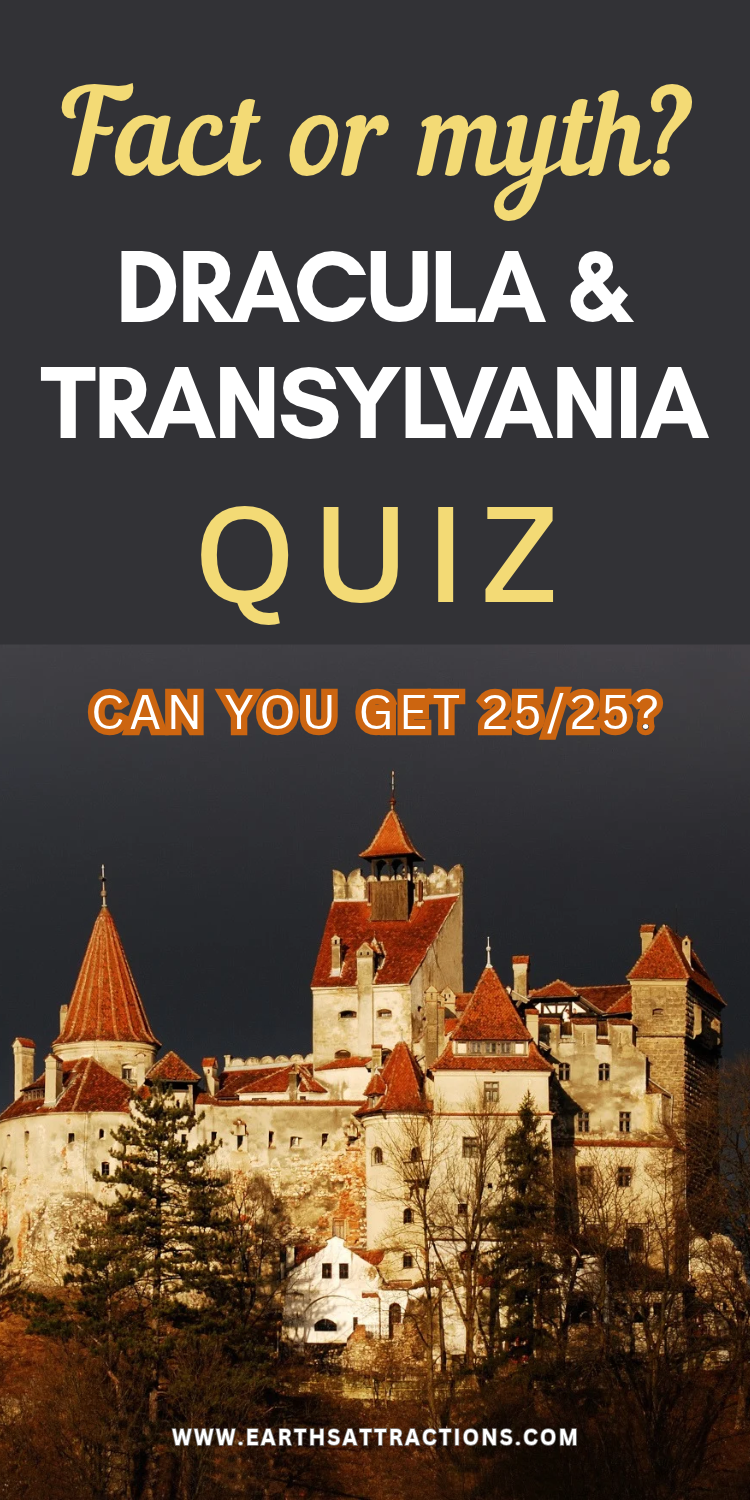
This 25-question Dracula & Transylvania Quiz: Fact or Myth? starts with questions a general reader can answer, then gets harder.
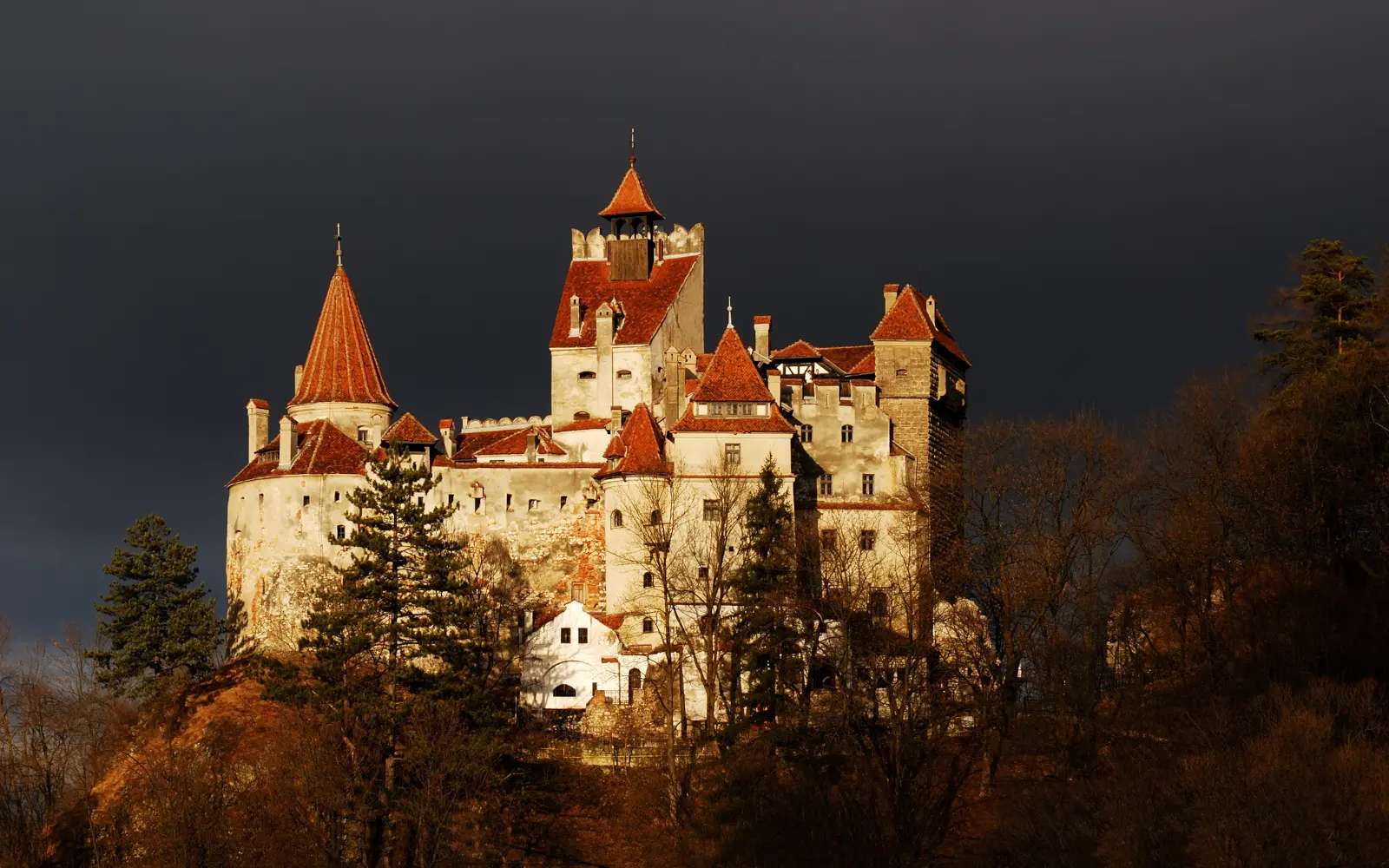
ID 17857514 ©Emicristea | Dreamstime.com
If this quiz makes you want to see more of the real places behind the legends, my guide to Romanian castles includes Bran, Peleș, and Corvin Castle. There is even a Vlad Țepeș castle in Bucharest, with a story of its own. And if Romania is on your travel list, these are some of the things that surprise Americans when they visit.
Ready? See how many Dracula facts you can separate from the myths.
Question 1 of 25
Is Transylvania a real place, or was it invented for Bram Stoker’s Dracula?
Transylvania is a real historical region in present-day Romania. Its international association with vampires became much stronger after Dracula and its many adaptations.
Question 2 of 25
Did Bram Stoker ever visit Transylvania before writing Dracula?
Stoker never visited Transylvania. He built his setting from books, maps, travel accounts and other research sources.
Question 3 of 25
Which territory did the real Vlad the Impaler actually rule?
Vlad III was voivode, or prince, of Wallachia. He had important connections with Transylvania, but he was not its ruler.
Question 4 of 25
Bran Castle is famous worldwide as “Dracula’s Castle.” What is true about its connection to Vlad the Impaler?
Bran’s association with Dracula is far stronger in tourism and popular culture than in Vlad III’s documented history. Vlad did not own Bran Castle or make it his home.
Question 5 of 25
Where did Vlad III’s name “Dracula” or “Drăculea” come from?
Vlad II became known as Dracul after his association with the Order of the Dragon. His son was known as Drăculea, commonly understood as “son of Dracul.”
Question 6 of 25
Is there reliable historical evidence that Vlad the Impaler actually drank his enemies’ blood?
Vlad III became notorious for brutal executions, especially impalement, and hostile stories about his cruelty circulated widely. Reliable evidence that he literally drank his victims’ blood is lacking.
Question 7 of 25
Did Bram Stoker invent vampires when Dracula was published in 1897?
Vampire traditions were centuries older, and vampire stories appeared in literature before Stoker’s novel. Sheridan Le Fanu’s Carmilla, for example, was published decades before Dracula.
Question 8 of 25
What does the name “Transylvania” roughly mean?
The name comes from Medieval Latin and refers to land “beyond the forest” or “beyond the woods.”
Question 9 of 25
Which famous vampire rule does NOT work that way in Bram Stoker’s original Dracula?
Dracula is limited by daylight in Stoker’s novel, but sunlight does not instantly burn him to ashes. That familiar rule became much stronger in later vampire movies.
Question 10 of 25
While shaving at Castle Dracula, what does Jonathan Harker notice about the Count?
Harker sees the room reflected behind him but no reflection of Dracula, even though the Count is standing close by.
Question 11 of 25
What does Van Helsing use around Lucy’s room in Dracula to help protect her?
Van Helsing brings garlic flowers and places them around Lucy’s room, including at the windows and around her neck.
Question 12 of 25
Long before Bran Castle became associated with Dracula tourism, what was one of its real historical purposes?
Bran Fortress had strategic and economic roles. It helped defend an important mountain route and functioned as a customs point controlling trade through the area.
Question 13 of 25
Which Romanian queen made Bran Castle one of her royal residences in the 20th century?
Bran Castle was given to Queen Marie of Romania in 1920. She restored it and transformed the old fortress into a much-loved royal residence.
Question 14 of 25
When Bram Stoker published Dracula in 1897, was Transylvania already part of Romania?
When Dracula appeared in 1897, Transylvania was part of the Kingdom of Hungary within Austria-Hungary. It became part of Romania after World War I.
Question 15 of 25
Jonathan Harker begins his Transylvanian journey in a city Stoker calls “Bistritz.” What is that city called today?
Bistritz is the German name used in the novel for present-day Bistrița in northern Transylvania.
Question 16 of 25
In Stoker’s novel, which place is closely associated with the route to Count Dracula’s fictional castle?
Dracula tells Jonathan Harker that his carriage will meet him at the Borgo Pass. Bran Castle is not named as Count Dracula’s castle in the novel.
Question 17 of 25
Besides garlic, which less famous plant is said in Dracula to help keep a vampire confined?
Van Helsing says that a branch of wild rose placed on a vampire’s coffin can prevent the vampire from leaving it. It is one of the novel’s less famous vampire rules.
Question 18 of 25
Which Transylvanian city is traditionally identified as the birthplace of Vlad the Impaler?
Sighișoara is traditionally identified as Vlad III’s birthplace, and his father was living there around the period of Vlad’s birth. Claims about one exact birthplace house should be treated with more caution.
Question 19 of 25
What was packed inside the wooden boxes Count Dracula had transported from Transylvania?
The boxes contain earth, which is tied to the supernatural conditions governing where Dracula can rest.
Question 20 of 25
When the mysterious ship Demeter reaches Whitby, what suddenly leaps from the ship and runs away?
The account describes an immense dog springing from the ship, jumping ashore and disappearing into the darkness.
Question 21 of 25
How is Count Dracula actually destroyed at the end of Bram Stoker’s novel?
Harker cuts Dracula’s throat with a kukri while Morris drives a Bowie knife into his heart. The famous stake-through-the-heart ending is not how Stoker finishes Dracula.
Question 22 of 25
Which fortress has a much stronger historical connection to Vlad the Impaler than Bran Castle?
Poenari Fortress is closely associated with Vlad III and served as an important stronghold. It is far less famous internationally than Bran Castle.
Question 23 of 25
In Romanian folklore, what are strigoi?
Romanian beliefs about strigoi vary by place and period, but they include dangerous or restless supernatural beings associated with both the living and the dead. They are often compared with vampires, although the folklore is more complex.
Question 24 of 25
During which traditional Romanian night was garlic used around doors and windows to help protect households from strigoi and other harmful forces?
Folk traditions surrounding the night before St. Andrew’s Day included beliefs about strigoi, wolves and dangerous supernatural forces. Garlic could be used around doors, windows and gates for protection.
Question 25 of 25
FINAL QUESTION: You’ll often hear that Vlad the Impaler is buried at Snagov Monastery. What is actually known?
Snagov has long been associated with Vlad’s grave, but archaeological investigation did not conclusively establish that he was buried there. Other locations have been proposed, and his final resting place remains uncertain.
Your result
You got 0 out of 25
How Many Dracula Myths Fooled You?
Dracula is difficult trivia for a simple reason: several different stories have been blended together for generations.
There was a real Vlad III, a 15th-century ruler whose reputation became surrounded by brutal stories. Real Transylvania exists, with medieval towns, castles, fortresses, villages, and traditions that existed long before Bram Stoker published Dracula in 1897. Then there is Stoker’s fictional Count Dracula – and another layer of vampire rules added later by movies and popular culture.
Bran Castle sits right where those worlds meet. Its documented history is interesting without the vampire story, from its strategic and commercial role to its years as a royal residence. If you want a glimpse from inside, here is one of my favorite Bran Castle views.
And Transylvania has far more to explore than Dracula. Cities such as Brașov, Sibiu, Sighișoara, Bistrița, and Cluj-Napoca each have their own history and character. If you are considering a trip through the region, this Cluj-Napoca guide is another place to start.
The final questions in this quiz are intentionally the hardest. They move away from the Dracula facts most people have encountered in movies and toward Romanian history and folklore – the part of the story that international audiences are less likely to know.
If you enjoyed the spooky side of the quiz, you may also like these Halloween facts, with strange traditions, history, candy, superstitions, and other surprises.
Conclusion
Whether you got 25 out of 25 or discovered that Hollywood had taught you a few things that Bram Stoker never wrote, Dracula is more interesting when the history and the fiction are pulled apart.
And some questions still do not have a neat ending. More than a century after Dracula became one of the world’s most famous fictional characters – and centuries after Vlad III lived – Romania still has legends, disputed stories, and unanswered questions mixed in with the documented history.
What was your score? Share it and see whether your friends can beat you.
More amazing articles for you:
Things To Keep In Mind When Planning A Destination Wedding
What airline passengers want - interesting airline passenger survey results
Amazing vacation destinations in the USA during the winter season
Pick Your Fall Favorites and Find Out Which of These 5 October Vibes Is Most Like You
An Airport Banned Pajamas — And People Absolutely Lost It
The Most Famous Travel Stereotypes (And Why You Shouldn’t Fall for Them)
Grown Men Were Jumping Walls Just to Get a Sunbed. Then People Shared What They’ve Seen at Other Res...
130 Latin Phrases Still Used Today - You Use More of Them Than You Think

Violeta-Loredana Pascal is a communications expert, business mentor, and the founder of Earth’s Attractions and PRwave INTERNATIONAL. A pioneer in the Romanian digital PR landscape since 2005, she holds a degree in Communication and Social Sciences from SNSPA Bucharest. Violeta is a senior trainer at AcademiadeAfaceri.ro, where she leverages over 20 years of experience to teach professional courses in PR strategy and workplace productivity. By blending high-level business consulting with a passion for holistic travel and wellness, she empowers solopreneurs to overcome procrastination, build profitable brands, and design a life of purposeful adventure.