
The first guests arrive; someone still checks what’s in the oven; the children get restless; and half the family seems perfectly happy to sit around talking. Finding a Thanksgiving game that everyone actually wants to play can be surprisingly difficult, especially when you have several generations together.
You might be looking for something funny to play after dinner, an activity to keep the children entertained, or a few quick challenges for adults who enjoy a little competition. And if you’re hosting at the last minute, you probably don’t have time to spend hours preparing games or buying supplies.
I’ve gathered 28 fun Thanksgiving games for family gatherings, including games without supplies, easy Thanksgiving dinner table games, funny party challenges for adults, Friendsgiving activities, and games for large groups with children, teens, and grandparents.
Most use things you already have around the house, and several require absolutely no preparation. You’ll find the rules, suggested playing times, scoring systems, and ready-to-use questions or challenges, so you can choose a game and start playing without searching elsewhere for instructions.
If your family enjoys testing its knowledge, the Thanksgiving trivia quiz is another option, with 22 interactive questions, immediate feedback, and a final score. I also have for you these 150 Thanksgiving conversation starters to help you when conversations stall 🙂

ID 159882420 ©Vasyl Chipiha | Dreamstime.com
Best Thanksgiving Games at a Glance
You don’t need to organize an entire afternoon of games to entertain guests. If you’re choosing activities at the last minute, start with how many people are playing, how much space you have, and whether everyone wants to get involved or would prefer something they can join casually.
Best Thanksgiving game without supplies: The Five-Second Dinner Debate, a quick game for three or more people that takes around ten minutes.
Best funny Thanksgiving game for adults: Thanksgiving Alibi, where guests invent explanations for a fictional holiday mystery.
Best Thanksgiving game for kids and adults: Guess the Thanksgiving Sound, which can be adapted for different ages without needing supplies.
Best Thanksgiving dinner table game: Predict the Table, where everyone tries to guess how many guests will agree with an opinion.
Best Thanksgiving game for large groups: The Mystery Menu Auction, a team game involving imaginary money, mystery dishes, and unexpected results.
Best last-minute Thanksgiving game: The Impossible Thanksgiving Choice, which requires no preparation and can be played while everyone is seated.
Best Thanksgiving minute-to-win-it challenge: Cranberry Chopstick Dash, a quick coordination game using two bowls and a handful of cranberries.
Best game that lasts throughout the gathering: The Secret Guest Missions, where guests complete harmless challenges during conversations.
Best Thanksgiving family competition: The Thanksgiving Grand Finale, with five rounds covering memory, food, words, estimation, and creativity.
Easy Thanksgiving Games Without Supplies (No-Prep Ideas)
These no-prep Thanksgiving games are useful when you haven’t planned any activities or want to entertain people without sending anyone to look for cards, paper, or other supplies. Most work while guests sit at the table or relax in the living room, and you can usually start with only three or four people.
1. The Five-Second Dinner Debate
Players: 3 or more. Time: 10–15 minutes. Supplies: None.
Some Thanksgiving food preferences can inspire surprisingly passionate arguments, especially when somebody believes their favorite dessert or side dish deserves a permanent place on every holiday menu.
One person announces a question with two possible answers, and each player has five seconds to choose a side and defend it with one reason. A valid argument that hasn’t already been used during the round earns one point.
For example, the host asks whether Thanksgiving dinner should begin at noon or in the evening. Someone argues that an early meal leaves more time for movies and games, while another player prefers dinner later because everyone can spend the afternoon cooking and talking. Both arguments qualify for points.
Try these ten Thanksgiving debate questions:
Round 1: Which deserves the final slice: pumpkin pie or apple pie?
Round 2: Is stuffing better with crispy edges or a softer texture?
Round 3: Would you rather have perfectly prepared mashed potatoes or freshly baked dinner rolls?
Round 4: Should Thanksgiving dinner begin before 3 p.m. or later in the evening?
Round 5: Which is better after dinner: watching a movie or playing a family game?
Round 6: Are Thanksgiving leftovers better reheated or transformed into something completely different?
Round 7: Would you rather prepare dessert or handle every side dish?
Round 8: Is a small family gathering better than a large Thanksgiving party?
Round 9: Should guests choose their own seats or follow a seating plan?
Round 10: Would you rather wash every dish after dinner or do all the grocery shopping beforehand?
After ten rounds, the player with the highest score wins. If there’s a tie, ask the finalists to defend an absurd idea such as “All Thanksgiving food should be served in dessert bowls.” Give each person 20 seconds, then let the other guests vote for the more convincing argument.
Continue the debates with 150 Thanksgiving Would You Rather questions covering food, funny situations, family traditions, Friendsgiving, and some genuinely difficult choices.
2. The One-Word Thanksgiving Story
Players: 4–12. Time: 5–10 minutes. Supplies: None.
Everyone takes turns adding one word to an imaginary Thanksgiving story. The first player begins with a word such as “Yesterday,” the second adds another, and the story continues around the group.
You might end up with a sentence beginning “Yesterday Grandma discovered…” followed by an increasingly ridiculous explanation involving a missing dessert, an unexpected guest, or a mysterious package arriving at the door.
Each person has five seconds to contribute a word, and the group should try to keep the sentence grammatically coherent. No one can change words already spoken, even if the story heads in a direction they never expected.
For a harder version, introduce a condition after every complete sentence. The next sentence must include a kitchen disaster, a secret ingredient, a surprise visitor, or something that has mysteriously disappeared.
You can also begin with these unfinished sentences: “Nobody expected Grandma to…”, “The doorbell rang just as…”, or “We thought the dessert was…”
There’s no need to keep score, although you can award a point whenever somebody introduces a plot twist that makes the group laugh. If more than 12 people want to play, split them into smaller circles and have each group tell its completed story afterward.
3. Guess the Thanksgiving Sound
Players: 3 or more. Time: 10 minutes. Supplies: None.
One player makes a sound associated with Thanksgiving preparations, a family gathering, or something that happens around the dinner table. Everyone else tries to identify it.
The person performing the sound can’t use recognizable words, point at objects, or give clues through gestures. They have to communicate through sound alone.
For the first few rounds, try imitating a kitchen timer, an electric mixer, a microwave finishing, water boiling, or someone chopping vegetables.
Other possibilities include a refrigerator door opening, a cork popping, a frying pan sizzling, somebody knocking on the front door, a football crowd cheering, a camera taking pictures, or someone snoring after dinner.
The first person to guess correctly earns one point and gets to perform the next sound. If nobody identifies it within 30 seconds, the performer can give one short verbal clue, but a correct answer after the clue is worth only half a point.
For younger children, allow gestures too. Adults and teenagers can increase the difficulty by choosing less recognizable sounds or performing two related sounds in sequence, such as opening a refrigerator and pouring a drink.
4. The Thanksgiving Memory Switch
Players: 2 or more. Time: 10–15 minutes. Supplies: None.
The host describes a fictional Thanksgiving scene containing several specific details. After everyone hears the description, the host repeats it, changing one detail.
Players must identify what changed and earn an extra point if they can repeat the original information correctly.
Here’s a complete opening round.
Original scene: “Grandpa arrived at four o’clock carrying a chocolate cake, wearing a green sweater, and looking for his glasses, which were inside his coat pocket.”
Changed scene: “Grandpa arrived at four o’clock carrying a chocolate cake, wearing a blue sweater, and looking for his glasses, which were inside his coat pocket.”
Answer: The sweater changed from green to blue.
For another round, read: “The family dog was sleeping under the dining table beside three wrapped presents while Aunt Susan prepared apple pie in the kitchen.”
Repeat the sentence but replace the three wrapped presents with two shopping bags. Anyone who spots the change gets one point, and anyone who remembers both the original objects and their number gets two points.
Begin with five details and only one change per round. Once everyone understands the game, introduce longer descriptions or change two details, requiring players to find both differences.
You can make this an easy seated Thanksgiving game for mixed ages by reducing the number of details or allowing a little more thinking time, especially when children and grandparents play together.
5. The Impossible Thanksgiving Choice
Players: 3 or more. Time: 10–20 minutes. Supplies: None.
Present guests with an unusual Thanksgiving situation and ask them to choose between two difficult or ridiculous options. Each player must explain what they would do, even when neither alternative sounds especially appealing.
Keep the game casual: everyone can vote and discuss their choices, or award one point for an original solution and another for the answer with the most votes.
Here are ten situations to get started:
1. Would you rather prepare Thanksgiving dinner without an oven or without a refrigerator?
2. Would you rather have 20 unexpected guests arrive or discover that your dining table is missing an hour before dinner?
3. Would you rather eat every Thanksgiving dish cold or serve every dessert warm?
4. Would you rather describe everything you eat like a television chef or announce every guest’s arrival like a sports commentator?
5. Would you rather wear an enormous pumpkin costume throughout dinner or speak only in rhymes for an hour?
6. Would you rather wash every dish by hand or peel 100 potatoes?
7. Would you rather celebrate Thanksgiving on a train or on a boat?
8. Would you rather let a different person choose every course or let one person choose the entire Thanksgiving menu?
9. Would you rather host Thanksgiving in a tiny apartment with a perfect kitchen or in an enormous house with no working stove?
10. Would you rather eat Thanksgiving leftovers for breakfast for a week or have pumpkin-flavored desserts every day for a month?
For a large group, have everyone vote at the same time by holding up one finger for the first option and two fingers for the second. People can explain their decisions if they want to, but nobody has to defend a choice in front of the entire gathering.
6. Two Truths and a Turkey
Players: 3–15. Time: 10–20 minutes. Supplies: None.
This Thanksgiving variation of Two Truths and a Lie is an easy icebreaker, especially when you have relatives who haven’t seen each other for a long time or friends meeting for the first time.
Each player tells the group three things about themselves, their food preferences, or their holiday experiences. Two statements must be true, while the third is invented.
The other players discuss what they’ve heard and vote for the statement they believe is false. After everyone votes, the storyteller reveals the answer.
For example, somebody might say, “I’ve eaten pumpkin pie for breakfast,” “I once attended Thanksgiving dinner in another country,” and “I’ve never tasted cranberry sauce.”
All three statements sound plausible, so the other guests must decide which one doesn’t belong.
Players earn one point for correctly identifying the invented statement. The storyteller receives one point if at least half the other players guess incorrectly.
For a Thanksgiving gratitude variation, ask each person to make one of their two true statements about something small they appreciated during the year. It might be a helpful neighbor, an unexpected phone call, a favorite weekend, or a meal somebody prepared for them. Everyone still has to identify the invented statement, but the game can lead to some lovely stories without turning the evening into a series of formal speeches.
If someone would rather avoid personal questions, let them use statements about food, hobbies, movies, or places they’ve visited. Plenty of light topics are available, and nobody should need to reveal private information to participate.
You can also use some Thanksgiving conversation starters when guests want to keep talking without keeping score.
Funny Thanksgiving Party Games for Adults and Teens

ID 117315993 ©Lacheev | Dreamstime.com
Thanksgiving games for adults don’t need to involve alcohol, embarrassing challenges, or questions that make people uncomfortable. A fictional mystery, a deliberately ridiculous argument, or a creative team challenge can be entertaining even when guests don’t all know each other.
These games work for family gatherings and Friendsgiving parties, and you can adapt most for teenagers by choosing age-appropriate situations and keeping the humor friendly.
7. Thanksgiving Alibi
Players: 5–12. Time: 15–25 minutes. Supplies: Small pieces of paper, optional.
Something terrible has happened to Thanksgiving dinner, and somebody in the room is responsible. Fortunately, the disaster is completely fictional, and everyone gets to invent an explanation for where they were when it happened.
Choose one person to act as the investigator. The investigator secretly selects a culprit and announces the imaginary incident. Everyone else becomes a suspect, including people who are completely innocent.
Start with The Case of the Vanishing Pumpkin Pie.
A freshly baked pumpkin pie disappeared from the kitchen at 3:15 p.m. Fifteen minutes later, somebody discovered an empty pie dish behind the sofa. One guest knows exactly what happened, but nobody will admit it.
Give each suspect 30 seconds to invent an alibi. Somebody might claim they were looking for the television remote, while another insists they were arranging napkins in the dining room.
Allow two rounds of questioning. Players can ask things such as “Who saw you?”, “Why were you near the kitchen?”, or “What were you carrying?”
The culprit must try to maintain a believable story without revealing their role. After the questions, every innocent suspect secretly votes for the person they believe is responsible. The investigator doesn’t vote because they already know the answer.
The culprit earns two points if fewer than half the innocent suspects identify them. Otherwise, each innocent player who voted correctly receives one point.
Here are three more fictional mysteries:
The Great Roll Replacement: Someone replaced the freshly baked dinner rolls with an identical basket containing only crumpled paper napkins.
The Missing Place Cards: Every carefully arranged place card disappeared just before dinner, leaving the host to guess where everyone should sit.
The Cranberry Sauce Mystery: A bowl of cranberry sauce vanished from the refrigerator and reappeared in the laundry room, with nobody admitting to moving it.
Choose a new culprit each round and rotate the investigator role. The most entertaining part is often hearing someone’s carefully invented story fall apart after the second question.
8. The Worst Thanksgiving Advice Wins
Players: 4 or more. Time: 10–15 minutes. Supplies: None.
Imagine having a Thanksgiving problem and asking everyone to suggest the worst possible solution. Players compete to invent deliberately terrible advice, with points awarded for the funniest responses.
The host reads a fictional situation, and everyone has 20 seconds to come up with something ridiculous. After hearing all the suggestions, guests vote for the most entertaining one.
Suppose you’ve invited eight people for dinner, but 25 arrive. One player might suggest giving everyone a single pea and calling it an exclusive tasting menu. Another proposes organizing seven dinner shifts, with dessert reservations required.
Try these situations:
Problem 1: Your Thanksgiving centerpiece is so tall that nobody can see the person sitting opposite them.
Problem 2: Every guest arrives with exactly the same dessert.
Problem 3: Your family has spent 45 minutes arguing over which movie to watch.
Problem 4: Somebody insists on photographing every dish before anyone can begin eating.
Problem 5: The dining room has seven chairs, but 12 guests arrive.
Problem 6: Everyone agrees to play a game, but every guest wants to be the referee.
Problem 7: Nobody remembers who volunteered to bring the mashed potatoes.
Problem 8: Three different relatives insist that they invented the family’s famous pie recipe.
Each winning response earns one point, and the person with the most points after eight rounds wins.
Keep the suggestions imaginary and harmless. A ridiculous proposal about opening a restaurant that serves nothing but leftovers is far more entertaining than making a real guest the target of the joke.
9. The Secret Guest Missions
Players: 5 or more. Time: Throughout the gathering. Supplies: Paper and a pen, or private messages.
Give participating guests a secret mission when they arrive. Their challenge is to complete it naturally during the day without announcing what they’re trying to achieve.
Every completed mission earns one point. Guests who finish three different missions receive an additional bonus point, and everyone reveals their assignments before the gathering ends.
You can prepare folded pieces of paper beforehand or send individual missions to guests’ phones.
Here are 15 missions you can use:
Mission 1: Get somebody to recommend a movie you’ve never watched.
Mission 2: Convince another guest to describe their ideal Thanksgiving dessert using exactly three words.
Mission 3: Get two people to agree on which Thanksgiving dish deserves its own restaurant.
Mission 4: Persuade somebody to tell a funny story involving a kitchen mistake.
Mission 5: Convince another person to invent a name for a fictional Thanksgiving restaurant.
Mission 6: Get a guest to explain which board game they enjoyed most as a child.
Mission 7: Encourage somebody to describe their dream holiday destination.
Mission 8: Ask another guest to choose between hosting dinner in a mountain cabin and hosting it at the beach.
Mission 9: Convince somebody to invent an advertising slogan for mashed potatoes.
Mission 10: Get a guest to name three things they regularly forget to buy at the grocery store.
Mission 11: Persuade somebody to suggest a song for the Thanksgiving playlist.
Mission 12: Get another player to describe their favorite dessert without mentioning its main ingredient.
Mission 13: Convince a guest to invent a silly name for a new holiday.
Mission 14: Get somebody to propose an unusual but enjoyable Thanksgiving tradition.
Mission 15: Ask a guest to describe the world’s most inconvenient place to host a family dinner.
For a harder version, give players two unrelated missions and ask them to complete both during the same conversation.
Everyone should know that a harmless mission game is taking place, even if they don’t know the individual assignments. Participation should remain optional, and the missions shouldn’t involve unwanted photographs, physical contact, personal secrets, or practical jokes that interfere with dinner.
10. The Mystery Menu Auction
Players: 6–20, divided into teams. Time: 20 minutes. Supplies: Paper, a pen, and 15 folded menu cards.
Each team receives an imaginary budget of $100 and must compete to purchase mysterious Thanksgiving dishes. The problem is that nobody knows whether they’re buying something delicious or a culinary disaster.
Write the following 15 dishes on separate pieces of paper and assign each one the indicated score. Fold the papers so their contents can’t be seen, shuffle them, and number the outside from 1 to 15.
Excellent menu cards: Perfect mashed potatoes (+20 points), freshly baked dinner rolls (+15), an incredible homemade pie (+20), a beautifully prepared vegetable dish (+10), golden roasted potatoes (+15), and a delicious cranberry dessert (+10).
Average menu cards: A large bowl of salad (+5), a perfectly acceptable casserole (+5), slightly cold dinner rolls (+2), and an enormous bowl of plain rice (+2).
Disaster menu cards: Burnt dinner rolls (-10), a dessert nobody can identify (-10), mashed potatoes containing far too much salt (-15), an empty serving platter (-5), and a beautifully decorated cake made entirely from cardboard (-20).
The auctioneer announces the number on a mystery card and invites teams to bid, beginning at $5. Bids increase in $5 increments, and teams can’t spend more imaginary money than they have remaining.
The auctioneer can describe every item with an equally unhelpful sales pitch, such as “This could be exactly what your Thanksgiving dinner needs.”
Continue until all 15 cards have been offered. Any card that receives no bids remains unsold.
When the auction ends, reveal the purchased dishes and add their scores. Each team also earns one bonus point for every complete $10 it has left unspent.
For example, a team whose dishes are worth 35 points and that has $20 remaining finishes with 37 points.
The highest-scoring team wins. For another round, shuffle the cards again and allow each team to request one clue about a mystery dish before bidding.
11. Thanksgiving Caption Championship
Players: 4 or more. Time: 15–20 minutes. Supplies: Paper, pens, and five holiday photographs or scene descriptions.
Choose five funny or unusual Thanksgiving-related images and ask everybody to write a caption for each one. Players get 45 seconds per round, and their submissions remain anonymous until voting is finished.
If you don’t have suitable photographs, describe a fictional scene aloud instead. These five scenarios work well:
Scene 1: A dining table is covered with desserts, but there’s absolutely no room for dinner plates.
Scene 2: A person stands in front of an open refrigerator, looking confused by dozens of leftover containers.
Scene 3: A family dog is staring intensely at a plate of mashed potatoes.
Scene 4: Somebody has fallen asleep on the sofa while still holding the television remote.
Scene 5: A tiny pumpkin is positioned in the center of an enormous, extravagantly decorated dining table.
The host reads all submitted captions without saying who wrote them. Guests vote for their favorite, and the winning caption earns two points. Players can’t vote for their own submissions.
For a harder version, add a different restriction each round. One caption must contain exactly five words, another should sound like a newspaper headline, and a third must include an unexpected word such as “astronaut” or “elevator.”
At the end, add the scores and reveal who wrote each caption. You may discover that the quietest person in the room has been responsible for the funniest answers all evening.
Friendsgiving Games for Adults and Small Groups
Friendsgiving can bring together people who don’t all know one another well, so choosing games is a little different from planning activities for relatives who’ve celebrated together for years. You want something people can join without needing to know family history, reveal embarrassing stories, or learn complicated rules.
For a group of six to ten adults, I’d start with two short games and keep a longer challenge available if everyone wants to continue after dinner.
A 15-Minute Friendsgiving Game Plan
Start with five minutes of the Five-Second Dinner Debate from Game 1, using questions designed for friends. Ask whether everyone would rather host Friendsgiving or always be responsible for dessert, which dish deserves its own holiday, and whether a gathering is better with a carefully planned menu or everyone bringing a surprise dish.
Give people a chance to defend their choices without requiring everyone to speak. Guests who enjoy debating food can contribute more, while others can simply vote.
For the next ten minutes, play Thanksgiving Caption Championship using two imaginary scenes: a table with eight identical pumpkin pies and a refrigerator overflowing with leftovers. Give everyone 30 seconds to write a caption, read the answers anonymously, and vote for the funniest one.
If the group wants another game, Thanksgiving Alibi is a good choice for people who enjoy improvising, while Secret Guest Missions can continue between dinner, conversations, and other activities without bringing everybody together for a separate competition.
For a smaller Friendsgiving dinner with four or five people, Predict the Table is another entertaining option because everyone can participate in every round, and you might discover some surprising differences in your friends’ food preferences and holiday traditions.
Easy Thanksgiving Games to Play at the Table
After a large meal, getting everyone to stand up for an active competition may be difficult. If you’re looking for Thanksgiving dinner games guests can play while seated, Predict the Table, Dessert Detective, and The Missing Ingredient are easy places to start.
These seated Thanksgiving games also work between courses, while you wait for dessert, or when some guests prefer to stay at the table. Several need no preparation, and the others use small items you probably already have.
I enjoy trivia and games that reveal unexpected things, especially when a question makes everyone wonder how they missed the answer or when two people discover they have completely different opinions about something familiar. But not every game needs a correct answer, and guessing what other people think can be even more entertaining than a knowledge competition.
12. Predict the Table
Players: 4 or more. Time: 10–20 minutes. Supplies: None.
The host reads a statement about Thanksgiving, food, or holiday traditions. Before everyone votes, players predict how many people in the group will agree.
Suppose eight people are playing, and the statement is “Pumpkin pie is better than apple pie.”
One player predicts that five people will agree, another predicts three, and somebody else predicts seven. Everyone records or announces their prediction before the host asks for a simultaneous show of hands.
If exactly five people agree, a prediction of five earns two points. A prediction of four or six earns one point, while all other predictions receive zero.
Here are ten statements you can use:
1. Thanksgiving leftovers taste better the next day.
2. Mashed potatoes are more important than dessert.
3. Thanksgiving dinner should begin before 3 p.m.
4. A family game is more entertaining than watching television after dinner.
5. Apple pie is better than pumpkin pie.
6. Dinner rolls deserve a permanent place on every holiday menu.
7. Decorating the table is just as enjoyable as planning the menu.
8. A small Thanksgiving gathering is better than a large one.
9. Thanksgiving leftovers should last at least two days.
10. Every Thanksgiving dessert selection should include something with chocolate.
Count only the people participating in the game, including the person whose prediction is being evaluated. After ten rounds, the player with the highest total wins.
You may discover that somebody who confidently expected everyone to agree with them is actually in the minority, which can lead to some very funny conversations.
13. The Missing Ingredient
Players: 2 or more. Time: 10 minutes. Supplies: None.
The host reads a fictional recipe containing six ingredients. Players listen carefully because the host will repeat the recipe with one ingredient missing.
Whoever identifies the missing ingredient first earns one point. If two people answer at the same time, each gets a point.
Here are five complete rounds, including the answers.
Round 1 – The Harvest Soup. Read: “Carrots, potatoes, onions, mushrooms, cream, and parsley.” After ten seconds, repeat: “Carrots, potatoes, mushrooms, cream, and parsley.” Missing ingredient: Onions.
Round 2 – The Thanksgiving Dessert. Read: “Apples, cinnamon, walnuts, brown sugar, butter, and oats.” Repeat: “Apples, cinnamon, walnuts, butter, and oats.” Missing ingredient: Brown sugar.
Round 3 – The Holiday Salad. Read: “Spinach, pears, cranberries, pecans, cheese, and olive oil.” Repeat: “Spinach, cranberries, pecans, cheese, and olive oil.” Missing ingredient: Pears.
Round 4 – The Autumn Casserole. Read: “Potatoes, broccoli, cheddar, garlic, cream, and breadcrumbs.” Repeat: “Potatoes, broccoli, cheddar, garlic, and breadcrumbs.” Missing ingredient: Cream.
Round 5 – The Mystery Cake. Read: “Flour, cocoa, eggs, vanilla, milk, and orange zest.” Repeat: “Flour, cocoa, eggs, vanilla, and orange zest.” Missing ingredient: Milk.
For a harder version, begin with eight ingredients or change the order during the second reading. If younger children are participating, start with only four ingredients and gradually increase the difficulty.
14. The Thanksgiving Price Is Almost Right
Players: 3 or more. Time: 15 minutes. Supplies: Paper, pens, and current grocery prices.
Most people have a general idea of what they spend on groceries, but estimating the cost of a complete Thanksgiving shopping basket isn’t always easy.
Before the party, choose ten products from one grocery store’s website or a recent shopping receipt. Record the exact prices and package sizes, since a large package and a small one can cost very different amounts.
Your shopping basket might include a five-pound bag of potatoes, one pound of butter, a dozen eggs, fresh cranberries, canned pumpkin, dinner rolls, a gallon of milk, green beans, apples, and stuffing mix.
Read the first item aloud, including its package size, and let everybody write down an estimate. Reveal the actual price before moving to the next product.
The closest estimate earns two points. If two people are equally close, award one point to each.
For the final round, ask everyone to estimate the combined cost of the entire basket before revealing the total. The closest answer earns five points.
Make this Thanksgiving guessing game harder by asking guests which of two products costs more per ounce or pound, or by giving them a fixed imaginary grocery budget and challenging them to choose the most items without exceeding it.
Use prices checked shortly before the gathering, because Thanksgiving grocery prices vary by store, location, package size, brand, and promotions.
15. Dessert Detective
Players: 3 or more. Time: 10–15 minutes. Supplies: None.
One person reads clues about a dessert, beginning with the least revealing information. Players can guess after every clue, but they’ll earn fewer points if they need more information.
A correct answer after the first clue earns three points, after the second earns two, and after the third earns one. Players may make one guess per dessert, so guessing too early carries a risk.
Here are five ready-to-play rounds:
Dessert 1: My filling is usually smooth and made from a seasonal ingredient. Cinnamon and other warm spices are often associated with me. I’m one of the best-known Thanksgiving pies. Answer: Pumpkin pie.
Dessert 2: I can be served warm or cold. My main ingredient is a familiar orchard fruit. I’m often served with vanilla ice cream. Answer: Apple pie.
Dessert 3: I’m rich and usually quite sweet. My filling contains nuts. My name comes from the nut traditionally used in my filling. Answer: Pecan pie.
Dessert 4: I don’t need a pastry crust. I have a crunchy topping and soft fruit underneath. I’m often made with apples and oats. Answer: Apple crisp.
Dessert 5: I usually need several hours to chill. I have a creamy filling and often a crumb crust. My name includes the dairy ingredient that gives me my texture. Answer: Cheesecake.
Read one clue at a time and pause for guesses before continuing. If a clue genuinely fits more than one dessert, accept reasonable answers or add another detail that distinguishes the intended answer.
You can also include desserts from your family’s traditions, especially if guests have favorite recipes tied to Thanksgiving or other holiday gatherings.
16. The Recipe Translator
Players: 4 or more. Time: 10–15 minutes. Supplies: Paper cards, optional.
One player must describe a Thanksgiving dish without using its name or any of the forbidden words listed on the challenge card. Their teammates have 30 seconds to identify the food.
Suppose someone needs to describe mashed potatoes but can’t say “potato,” “mashed,” “butter,” or “creamy.” They might say it’s a familiar holiday side dish people often serve with gravy.
Prepare these ten challenge cards:
1. Mashed potatoes: Forbidden words – potato, mashed, butter, creamy.
2. Pumpkin pie: Forbidden words – pumpkin, pie, orange, cinnamon.
3. Green bean casserole: Forbidden words – green, bean, casserole, mushroom.
4. Cranberry sauce: Forbidden words – cranberry, sauce, red, sweet.
5. Dinner rolls: Forbidden words – bread, roll, warm, butter.
6. Apple pie: Forbidden words – apple, pie, fruit, crust.
7. Stuffing: Forbidden words – stuffing, bread, herbs, inside.
8. Sweet potato casserole: Forbidden words – sweet, potato, marshmallow, casserole.
9. Cornbread: Forbidden words – corn, bread, yellow, bake.
10. Gravy: Forbidden words – gravy, sauce, brown, pour.
Teams earn one point for each correctly identified dish. If the person describing it uses a forbidden word or part of the answer, the team receives no point for that card.
For a harder version, also forbid gestures. For younger children, remove two forbidden words from each card so they have more ways to describe the dish.
17. The Spice Jar Smell Test
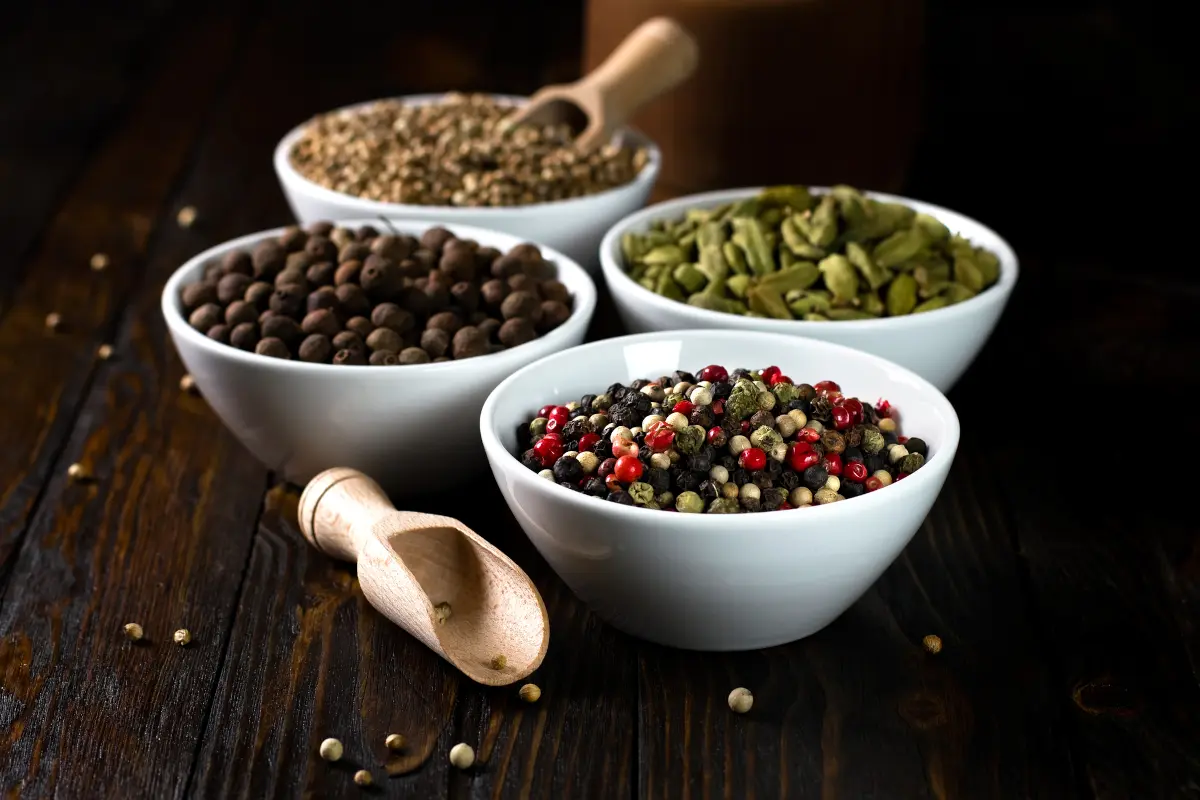
ID 27881959 ©Ivandzyuba | Dreamstime.com
Players: 2 or more. Time: 10–15 minutes. Supplies: Eight small opaque containers, kitchen spices, paper, and pens.
Many Thanksgiving dishes use familiar herbs and spices, but identifying them without seeing the packaging can be surprisingly difficult. Cinnamon might be easy, while nutmeg, allspice, and cloves can leave even enthusiastic home cooks guessing.
Prepare eight small, opaque containers, each with a different spice or aromatic ingredient inside. Number the containers and make sure nobody can see their contents.
For the first game, I recommend cinnamon, ground ginger, nutmeg, cloves, allspice, cardamom, rosemary, and vanilla. A vanilla bean works well if you have one, but you can also use vanilla extract in a tightly closed container with a scent opening.
Players smell each container and write down what they think it contains, without tasting anything or looking inside.
Every correct answer earns two points. To make the game harder, ask players to identify both the ingredient and a Thanksgiving dish where they could use it. Award one bonus point for a reasonable culinary example.
For younger children, use only three or four familiar scents, such as cinnamon, vanilla, orange peel, and rosemary.
Make sure guests can smell the ingredients without opening containers of loose powder near their faces, and check for allergies, asthma, or sensitivities to strong scents. Anyone who prefers not to participate can simply skip this game.
If everyone enjoys guessing things about Thanksgiving food and traditions, you can continue with a few of these surprising Thanksgiving facts, which include unusual food histories and traditions that many guests may not know.
Thanksgiving Minute-to-Win-It Games and Quick Challenges
Thanksgiving minute-to-win-it games are useful when you want something competitive without organizing a long tournament. Most rounds last about 60 seconds, although you’ll need a little extra time to explain the rules, prepare the materials, and compare scores.
These quick Thanksgiving party games use inexpensive household items and can be played individually or in teams. Choose a clear space away from hot dishes and fragile decorations, and adapt the activities for guests who prefer to remain seated.
18. The Pumpkin Landing Zone
Players: 2 or more. Time: 5–10 minutes. Supplies: A small foam pumpkin or soft ball, paper targets, and tape.
Create three scoring zones on the floor using large pieces of paper. Label the closest target 5 points, the middle one 10 points, and the farthest 20 points.
Players stand or sit behind a marked starting line and roll a small foam pumpkin toward the targets, trying to make it stop inside a scoring zone.
Each player gets three attempts. Add the scores from all three rolls, and the person with the highest total wins. If the pumpkin stops on the boundary between two zones, award the lower score.
For young children, move the targets closer to the starting line. Adults can compete from farther away or aim at smaller targets.
A soft ball works just as well if you don’t have a foam pumpkin. Avoid hard decorative pumpkins that could damage furniture or hurt someone if they roll unexpectedly.
For another pumpkin-themed activity without physical movement, try the pumpkin trivia quiz, with 23 interactive questions about food, gardening, art, history, pop culture, and unusual records.
19. Build the Impossible Thanksgiving Table
Players: 2–12. Time: 10 minutes. Supplies: Paper cups, disposable plates, napkins, and spoons.
Give each player or team four paper cups, two disposable plates, four napkins, and two spoons. They have 60 seconds to construct a miniature Thanksgiving table arrangement using only those materials.
The finished design must include two recognizable place settings, a centerpiece, and something representing food. Players can fold, roll, stack, or balance the materials, but they can’t use tape or glue.
When time runs out, award two points if both place settings are recognizable, two points if the centerpiece stands without support, two points for a creative representation of food, and two points if all materials remain within the designated table area.
The remaining two points go to the construction the other teams voted most creative, for a maximum of ten points.
For a harder round, remove two materials from each team’s collection or ask players to create a completely different design using the same supplies.
You can also make the challenge cooperative by having children and grandparents work together: one person plans the arrangement, and the other assembles it.
20. Thanksgiving Pattern Panic
Players: 2 or more. Time: 10 minutes. Supplies: Colored paper squares and a sheet of paper to cover the pattern.
Cut paper into small squares using four autumn colors: orange, red, yellow, and brown. The host arranges the squares in a sequence, shows it for ten seconds, and then covers the pattern.
Players must recreate the exact sequence from memory using their own collection of colored squares.
Start with these four patterns:
Easy: Red – Yellow – Orange – Brown.
Medium: Orange – Red – Brown – Yellow – Red – Orange.
Hard: Brown – Orange – Yellow – Red – Yellow – Brown – Orange – Red.
Very hard: Red – Brown – Orange – Orange – Yellow – Red – Brown – Yellow – Orange – Brown.
A completely correct sequence earns three points, while players who make only one mistake receive one point.
For a harder version, increase the number of squares or arrange them in two rows. For younger children, begin with three or four squares.
If somebody has difficulty distinguishing colors, add symbols or letters so the challenge doesn’t depend entirely on color recognition.
And if you’d rather include a few seasonal knowledge questions between rounds, the fall trivia questions cover history, nature, food, holidays, entertainment, and many other autumn topics.
21. The Napkin Tower Challenge
Players: 2 or more. Time: 10 minutes. Supplies: Paper napkins, lightweight paper cups, and a ruler.
Give each player five paper cups and ten napkins. Their challenge is to build the tallest freestanding tower possible in 60 seconds using only the provided materials.
Players can fold, roll, or twist napkins, but they can’t use tape, glue, or anything else to hold the tower together.
When time expires, each tower must stand unsupported for five seconds. Only eligible towers are measured, and the tallest wins.
If a tower collapses before the five seconds are over, it receives no height score for that round.
For a second challenge, place a lightweight paper decoration on top of each completed tower. Award one bonus point if the decoration stays in place for five seconds.
Children can work in pairs while adults compete individually, or you can organize mixed-age teams so everyone contributes to the design.
22. The Great Pie Slice Puzzle
Players: 2 or more. Time: 10 minutes. Supplies: Paper, scissors, and a pen.
Draw a large circle on a sheet of paper and divide it into eight irregular pieces, like a pie cut into unusual slices.
Number the pieces on the back and cut the circle along the lines. Before cutting, trace the same design onto additional sheets so every player or team receives an identical puzzle.
Mix the pieces and place them face up with the numbers hidden. Everyone has 60 seconds to reconstruct the original circle.
A correctly completed circle earns five points. Award three points if seven pieces are placed correctly and one point if five or six pieces are in their proper positions.
After the timer ends, check the completed shapes against the original drawing and use the numbers on the back to verify the arrangement.
For a harder round, use ten pieces or draw a simple pie decoration across the circle before cutting. Players then reconstruct both the circle and the image.
23. Cranberry Chopstick Dash
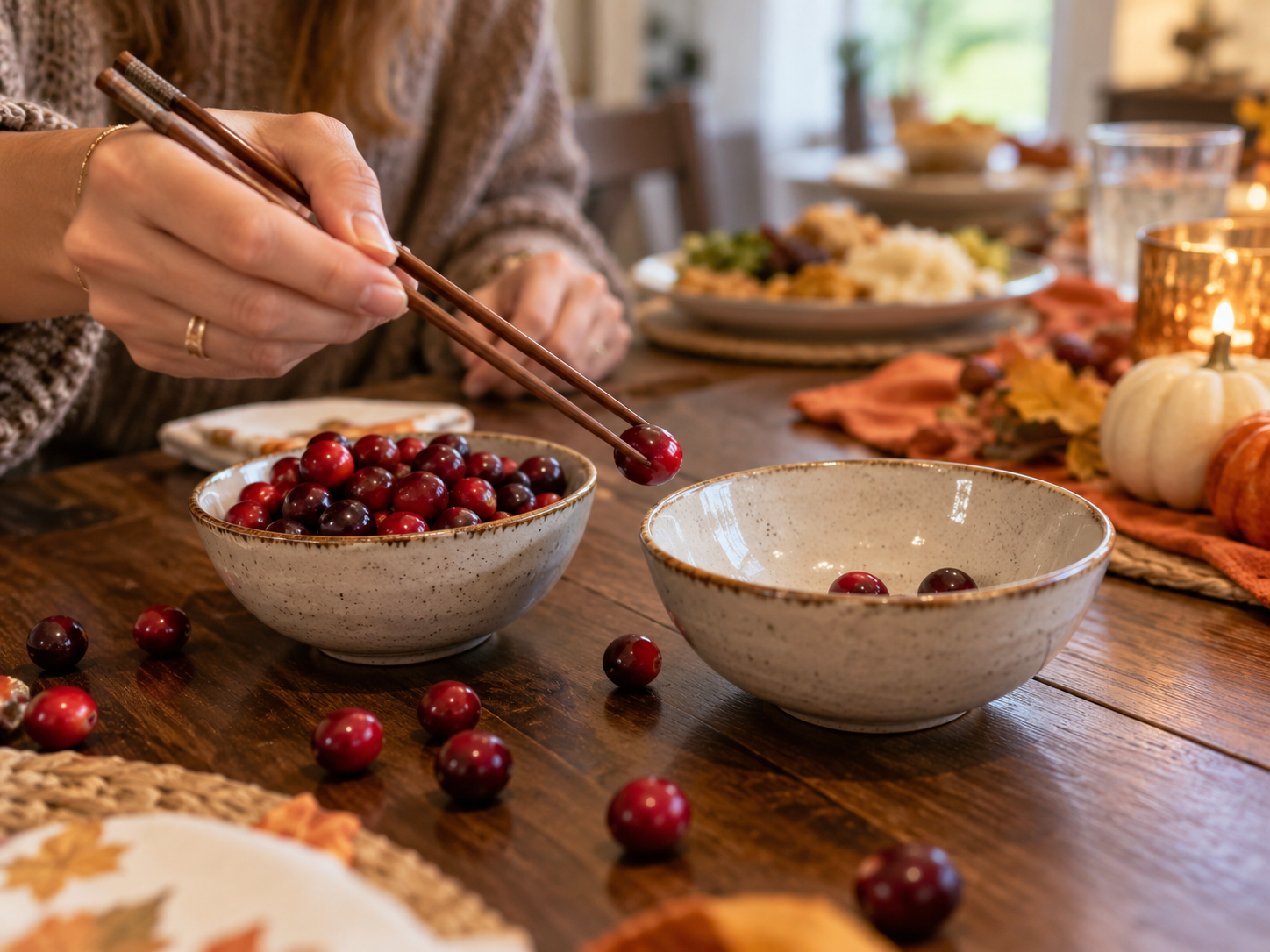
Players: 2–6 per round. Time: 5–10 minutes. Supplies: Fresh cranberries, chopsticks, two small bowls per player, and a timer.
This quick Thanksgiving challenge tests hand coordination and concentration and can be played on a dining table with minimal space.
Place 10 fresh cranberries in one bowl for each player, with an empty bowl beside it. Everyone receives a pair of chopsticks and has 60 seconds to move as many cranberries as possible into the empty bowl.
Players can pick up only one cranberry at a time and can’t use their hands to move the fruit directly. Any cranberry that falls onto the table must be picked up again using the chopsticks.
When the minute ends, count the cranberries successfully transferred. The player with the highest total wins, and you can organize a second round for the finalists.
For younger children or participants who find chopsticks difficult, use kitchen tongs or spoons. Keep separate categories for different utensils if you want to compare scores fairly.
Large reusable craft objects can replace the cranberries for a non-food version. Keep small berries or craft pieces away from toddlers, and don’t return cranberries used during the game to food preparation.
Thanksgiving Games for Large Groups and Mixed Ages
When you’re hosting 12, 15, or 20 people, individual games can take too long because everyone has to wait for their turn. Team challenges keep more guests involved, and pairing children with adults gives people with different skills a chance to contribute.
These Thanksgiving games for large groups also work for smaller families if you reduce the number of teams or let participants take on more than one role.
24. The Thanksgiving Family Challenge Board
Players: 6–24. Time: 20–30 minutes. Supplies: 12 folded challenge cards and a pen.
Prepare 12 challenge cards, numbered on the outside, and divide the guests into teams of roughly equal size. Each team takes turns choosing a card and attempting the challenge inside.
Some cards require knowledge, while others reward creativity, wordplay, or quick thinking. They’re worth 1 to 3 points.
Here are 12 challenges ready to use:
Card 1 – One point: Name three common Thanksgiving desserts in ten seconds. Accept any three recognizable desserts traditionally served for the holiday.
Card 2 – Two points: Unscramble the word “NIKPUMP.” Answer: PUMPKIN.
Card 3 – One point: Name four different ways to prepare potatoes. Valid examples include mashed, roasted, baked, and fried.
Card 4 – Three points: One team member must describe a refrigerator without saying “cold,” “food,” or “kitchen.” Their teammates have 20 seconds to guess the object.
Card 5 – Two points: Invent a new Thanksgiving dessert and give it a name. The team earns the points if it explains what the dessert contains and how it would be served.
Card 6 – One point: Name three objects commonly found on a dining table.
Card 7 – Three points: Arrange these words alphabetically in 15 seconds: cranberry, casserole, cinnamon, cornbread. Answer: Casserole, cinnamon, cornbread, cranberry.
Card 8 – Two points: Name four countries in North America within 15 seconds. Canada, the United States, Mexico, and Guatemala are four valid examples.
Card 9 – Two points: Create a five-word advertising slogan for a fictional pumpkin pie bakery.
Card 10 – One point: Name three nuts commonly used in baking.
Card 11 – Three points: Solve this riddle: “I can be folded, placed beside a plate, and used during a meal, but I’m not food. What am I?” Answer: A napkin.
Card 12 – Three points: Invent a new family-friendly Thanksgiving party game in 30 seconds and explain one rule. Award the points if the activity is safe and the rule makes sense.
Teams receive the points printed on each card when they complete the challenge correctly. If a team fails, another team can try the same challenge for one point, as long as the answer hasn’t already been revealed.
After all 12 cards have been played, the team with the highest score wins.
If your family enjoys longer trivia competitions, you can select questions from the 200 Thanksgiving trivia questions, which include history, food, traditions, presidents, the Macy’s parade, movies, television, and more, with difficulty increasing throughout the collection.
25. Pass the Secret Recipe
Players: 6 or more. Time: 10–15 minutes. Supplies: Recipe cards.
Divide guests into teams and ask everyone to form a line or arrange their chairs so they can whisper to the next person without being overheard.
The first player on each team reads a short fictional recipe, then whispers it to the next teammate. That person passes along what they remember, and the message continues until the final player announces the recipe aloud.
The results can be hilarious because ingredients, quantities, and preparation instructions tend to change as the message travels.
Here are five recipes you can use:
Recipe 1 – The Midnight Apple Cake: “Mix three apples, two spoons of honey, a handful of walnuts, and a pinch of cinnamon. Bake for 20 minutes, then decorate with five slices of pear.”
Recipe 2 – The Golden Harvest Soup: “Cook two carrots, three potatoes, one onion, and a cup of corn. Add parsley, stir five times, and serve with warm bread.”
Recipe 3 – The Mystery Thanksgiving Salad: “Combine spinach, orange slices, four walnuts, dried cranberries, and soft cheese. Add a little olive oil and serve in a blue bowl.”
Recipe 4 – The Impossible Pumpkin Dessert: “Mix pumpkin puree, vanilla, brown sugar, and cinnamon. Pour into six small cups and decorate each cup with two chocolate chips.”
Recipe 5 – The Holiday Potato Surprise: “Bake four potatoes, add grated cheese and chopped onions, and sprinkle with parsley. Serve on a large plate with three small tomatoes.”
Award one point for every correctly repeated ingredient, one additional point for each exact quantity, and one point for each preparation or serving instruction that survives the entire chain.
Use the same recipe for competing teams so the scoring is fair. After the final player has spoken, read the original aloud so everyone can compare the two versions.
For mixed-age gatherings, shorter recipes can be used for younger children, although separate difficulty categories are better if you’re comparing scores competitively.
26. The Thanksgiving Team Puzzle Race
Players: 4–16. Time: 10–20 minutes. Supplies: Paper and pens.
Every team receives the same logic puzzle and must solve it using a series of clues. A correct answer earns five points, and the fastest team receives one bonus point.
For the first puzzle, imagine four fictional Thanksgiving guests sitting in a straight row of chairs, numbered from left to right. Their names are Anna, Ben, Clara, and David.
Clue 1: Anna sits immediately to the left of Ben.
Clue 2: Clara isn’t sitting at either end.
Clue 3: David is sitting somewhere to the left of Clara.
Clue 4: Ben occupies the far-right chair.
Give teams two minutes to work out the seating order.
Answer: David, Clara, Anna, Ben.
For the second round, imagine five guests named Emma, Jack, Olivia, Noah, and Sophie sitting in a row of five chairs.
Clue 1: Olivia sits in the middle chair.
Clue 2: Noah sits immediately to Olivia’s right.
Clue 3: Jack sits at the far-right end.
Clue 4: Sophie sits immediately to Olivia’s left.
Clue 5: Emma sits somewhere to Sophie’s left.
Answer: Emma, Sophie, Olivia, Noah, Jack.
For another version, change the puzzle from seating arrangements to matching guests with fictional Thanksgiving dishes. Give players clues such as “The person who brought dessert arrived before the person who brought mashed potatoes,” then ask them to work out who brought each dish.
Check that any new logic puzzle has one unique solution before adding it to a timed game, so teams aren’t penalized for finding another arrangement that also fits the clues.
27. Harvest Hunt: The Clue Trail
Players: 2 or more. Time: 15–25 minutes. Supplies: Eight clue cards and an optional small prize.
A Thanksgiving scavenger hunt works indoors, with clues pointing to familiar places around the house. Children can play individually, while larger groups compete in teams.
Before guests arrive, place the first clue somewhere visible, and hide the remaining cards at the locations the previous clues indicate.
Here’s a complete eight-clue sequence you can adapt to your home.
Clue 1: “I keep your drinks cool and your leftovers fresh. Open my door to continue your quest.”
Answer: Refrigerator. Place Clue 2 on an accessible shelf or attach it to the outside.
Clue 2: “After dinner, you might sit here to relax, watch a movie, or take a nap.”
Answer: Sofa. Hide Clue 3 beneath a cushion.
Clue 3: “I have pages full of stories, but I never tell them aloud.”
Answer: Book. Place Clue 4 inside a book on an accessible shelf.
Clue 4: “You look at me when you want to see your reflection.”
Answer: Mirror. Place Clue 5 beside a mirror.
Clue 5: “I help keep your feet comfortable, and I often wait near the door.”
Answer: Shoes. Hide Clue 6 beside a shoe rack or inside an unused, clean shoe.
Clue 6: “I have a face and hands, but I can’t smile or hold anything.”
Answer: Clock. Place Clue 7 beside a clock.
Clue 7: “I brighten a room when the sun goes down.”
Answer: Lamp. Hide Clue 8 beside a lamp, away from its bulb and electrical parts.
Clue 8: “Your final surprise is waiting where guests gather to share a meal.”
Answer: Dining table. Leave a small prize or congratulatory message at the final location.
For a team competition, prepare duplicate clue sets in different colors so groups don’t have to wait for one another at every hiding place.
If guests prefer to remain seated, read the same clues aloud and award one point for each correct location. Everyone can enjoy the riddles without physically searching the house.
28. The Thanksgiving Grand Finale
Players: 4–24. Time: 20–30 minutes. Supplies: Paper, pens, a timer, and a few household objects.
For a longer family competition, combine five different challenges into one Thanksgiving game. Divide participants into teams and give everybody the same amount of time for each round.
The activities involve words, food knowledge, memory, estimation, and creativity, so everyone has a chance to contribute.
Round 1 – The Thanksgiving Word Race
Give teams one minute to create as many words as possible using the letters in “THANKSGIVING.”
Every word must contain at least three letters, and teams can’t use a letter more times than it appears in the original word. Proper names, abbreviations, and invented words don’t count.
For example, THINK, SING, NIGHT, KING, THING, GIANT, and THINKING are all valid answers.
Each distinct valid word earns one point, and the host can use a dictionary to settle disputed answers.
Round 2 – Three Food Riddles
Read these riddles one at a time, allowing teams 15 seconds to submit each answer.
“I’m often served in slices, my filling can be orange, and I’m associated with autumn spices.” Answer: Pumpkin pie.
“I’m a small red fruit that can be quite tart, and people often cook me into a sauce.” Answer: Cranberry.
“I can be mashed, baked, roasted, or fried, and I’m a familiar side dish at family dinners.” Answer: Potato.
Each correct answer earns two points, for a maximum of six points in this round.
Round 3 – The Ten-Second Memory Test
Place eight household objects on a table, such as a spoon, candle, pencil, apple, cup, key, napkin, and book.
Show them to everyone for ten seconds, then cover them. Teams have 30 seconds to write down everything they remember.
Award one point for each correctly named object, for a maximum of eight points.
Round 4 – Guess the Total
Before the game, fill a transparent container with a known number of large, safe objects, such as individually wrapped candies, and count them privately.
Every team submits one estimate. The closest team earns five points, while the second closest earns three.
If two teams are equally close, share the points available for those positions. For example, if two teams tie for first, they split the combined eight points and receive four each.
Round 5 – Invent a New Thanksgiving Tradition
Give teams two minutes to invent a family-friendly Thanksgiving tradition that could become an annual activity.
They must provide a name, explain what people would do, and describe any required materials or preparations.
Each team presents its idea in 30 seconds. Participants then vote anonymously for their favorite proposal without voting for their own team’s entry.
Award five points to the proposal with the most votes and three points to the runner-up. If two entries tie for first, split the combined eight points evenly, giving four points to each.
Add the scores from all five rounds to determine the winning team. If two teams finish tied, give them 30 seconds to write down as many different Thanksgiving-related foods as possible. The team with the most valid answers wins.
For mixed-age teams, ask two players from different generations to cooperate during the creative round: one describes the tradition, and the other explains how it would work. Keep this optional so people can contribute in whatever way they’re comfortable.
When to Play Thanksgiving Games Throughout the Day
You don’t need to organize a separate Thanksgiving game night to enjoy a few activities. Some games fit naturally into the hours before dinner, while others are better saved for when everyone has finished eating and wants to relax.
Before Thanksgiving Dinner
The time before dinner can be busy, especially when guests arrive while you’re still preparing food. Short games that don’t require constant supervision are usually easiest.
Secret Guest Missions can start as soon as people arrive, while Two Truths and a Turkey helps guests get acquainted. If children are waiting for the meal, Guess the Thanksgiving Sound or the Pumpkin Landing Zone can keep them entertained for a little while.
During Dinner or Between Courses
Predict the Table, Dessert Detective, and the Five-Second Dinner Debate work well once everyone is seated. You can also use the Spice Jar Smell Test if you’ve prepared the containers beforehand and guests are comfortable participating.
There’s no reason to interrupt a conversation that’s already going well just to begin another round. If everyone wants to keep talking, save the game for later.
After Thanksgiving Dinner
Once the plates have been cleared, the Mystery Menu Auction, Thanksgiving Alibi, or the Family Challenge Board can provide a longer activity for guests who enjoy competing.
For people who’d rather stay seated, The Missing Ingredient and the Thanksgiving Memory Switch are easier choices that require little movement or equipment.
At the End of the Evening
The Thanksgiving Grand Finale works well when a group wants one last competition before people leave. You can also finish with a few Impossible Thanksgiving Choice questions, especially if guests prefer talking and laughing to keeping score.
If you’re looking for more family activities beyond Thanksgiving Day, these November ideas include cozy indoor options, outdoor activities, family experiences, and ways to enjoy the final weeks of fall.
How to Choose Thanksgiving Games for Your Guests
For a small family gathering with four to six people, I’d start with Predict the Table, Dessert Detective, or the Recipe Translator. Everyone gets frequent turns, and you don’t need to organize several teams.
For a large Thanksgiving gathering with 12 or more guests, the Mystery Menu Auction and Thanksgiving Family Challenge Board are better options because they let people work together. Four teams of five are manageable for 20 people.
When children, teenagers, adults, and grandparents all play, choose activities that use different skills instead of relying entirely on speed or trivia knowledge. You can adjust The Missing Ingredient, Thanksgiving Memory Switch, Recipe Translator, and Grand Finale for different ages.
For adult-only Friendsgiving gatherings, Thanksgiving Alibi, Secret Guest Missions, Caption Championship, and Worst Thanksgiving Advice Wins are entertaining without requiring alcohol or uncomfortable personal questions.
And for guests who prefer seated activities, including older relatives or people with limited mobility, choose Predict the Table, Dessert Detective, the Spice Jar Smell Test, or one of the no-supplies games.
A Simple 30-Minute Thanksgiving Game Plan
If you have only half an hour available, try ten minutes of the Five-Second Dinner Debate, followed by 15 minutes of Predict the Table and five minutes of Dessert Detective.
For an adult gathering, replace the dinner debate with Thanksgiving Alibi and allow approximately 20 minutes for questioning and voting. Finish with ten minutes of ridiculous Thanksgiving dilemmas.
For a family with young children, begin with the Pumpkin Landing Zone, continue with Guess the Thanksgiving Sound, and finish with a short round of Harvest Hunt clues.
You can also spread the activities across several hours instead of asking everybody to participate continuously. A quick guessing game before dinner, another activity after dessert, and a longer team competition later in the evening may suit your gathering much better.
Easy Thanksgiving Game Prizes for Kids and Adults
If you’re organizing several Thanksgiving games as a family competition, small prizes can make the evening more entertaining, but you don’t need to spend much money or prepare a separate gift for every round.
For children, offer stickers, coloring supplies, small puzzles, or the chance to choose the next family activity. Adults might enjoy a small coffee gift card, a packet of favorite treats, or the right to select the movie everyone watches after dinner.
Another option is to award funny titles instead of physical prizes. You could name somebody the Thanksgiving Dessert Detective Champion, the Family Debate Winner, or the Mystery Menu Master, depending on which games you’ve played.
If guests compete in mixed-age teams, you can also recognize the funniest answer, the most creative idea, or excellent teamwork, giving people more chances to win.
Free Thanksgiving Quizzes and Other Games You Can Play Online
If you don’t have time to prepare cards or gather supplies, quizzes are another easy way to entertain Thanksgiving guests. People can play individually on their phones, or one person can read the questions aloud while small teams discuss their answers.
For a family quiz night, choose questions from several categories instead of making the entire competition depend on history or food knowledge. Mixing familiar holiday traditions with unusual facts and entertainment questions gives different people a chance to contribute.
Another option is a round of Thanksgiving fact-or-fiction questions using the Thanksgiving Myths Quiz. Its 19 interactive questions cover familiar stories about Thanksgiving history, traditional foods, the Macy’s Thanksgiving Day Parade, football, and several misconceptions. Players can answer individually or discuss each question as a team before revealing the explanation.
If your guests enjoy questions that go beyond Thanksgiving, the November trivia questions cover history, holidays, food, entertainment, science, nature, sports, and events from around the world.
You can also create a short true-or-false game using seasonal information. Read a statement aloud, ask everyone to vote, and reveal the answer afterward. These surprising facts about fall provide interesting material for a guessing round that isn’t limited to Thanksgiving traditions.
For online gatherings, you can play Guess the Thanksgiving Sound, the Five-Second Dinner Debate, Dessert Detective, and the Impossible Thanksgiving Choice over video calls. Participants can answer aloud, vote in the chat, or write down their guesses and reveal them at the same time.
Conclusion
With 28 Thanksgiving games to choose from, you can organize an entire family game night or simply keep two or three activities ready for moments when people want something different to do.
I’d choose a combination of guessing games, funny challenges, and something competitive, depending on who’s attending. A game that takes ten minutes can be just as enjoyable as a longer competition, especially when it gives people a reason to laugh together or share a story they haven’t told before.
I don’t live in the United States, but I’ve always loved the essence of Thanksgiving: spending time with family and friends, appreciating the good things in life, and making room for the people who matter to us. I can certainly appreciate a celebration filled with conversation, laughter, and games, even if preparing a huge holiday meal isn’t my favorite part.
Whichever activities you choose, there’s no need to finish every round or stick to a schedule once everyone is having fun. If a five-minute game turns into a much longer conversation, enjoy it.
Thanksgiving Games: Frequently Asked Questions
What are some fun Thanksgiving games for the whole family?
Fun Thanksgiving games for the whole family include Predict the Table, the Thanksgiving Memory Switch, Guess the Thanksgiving Sound, Dessert Detective, and the Thanksgiving Grand Finale. These games can be adapted for children, teenagers, adults, and grandparents, with team versions available for mixed-age gatherings.
What Thanksgiving games can you play without supplies?
Thanksgiving games without supplies include the Five-Second Dinner Debate, One-Word Thanksgiving Story, Guess the Thanksgiving Sound, Two Truths and a Turkey, and the Impossible Thanksgiving Choice. You can play all of them without printing cards, buying materials, or setting up a special activity area.
What are some funny Thanksgiving games for adults?
Funny Thanksgiving games for adults include Thanksgiving Alibi, Worst Thanksgiving Advice Wins, Secret Guest Missions, Mystery Menu Auction, and Thanksgiving Caption Championship. These games involve humor, creativity, fictional scenarios, or competition, and suit family parties and Friendsgiving gatherings.
What games can you play at the Thanksgiving dinner table?
Thanksgiving dinner table games include Predict the Table, Dessert Detective, the Missing Ingredient, Recipe Translator, and the Five-Second Dinner Debate. Guests can stay seated, and most of these activities require little or no prep, making them great for between courses or while you wait for dessert.
What are the best Thanksgiving games for large groups?
For large Thanksgiving groups, try the Mystery Menu Auction, the Thanksgiving Family Challenge Board, Pass the Secret Recipe, or the Grand Finale. Dividing 12–24 guests into smaller teams reduces wait times and gives more people chances to participate.
What Thanksgiving games are good for kids and adults together?
Good Thanksgiving games for kids and adults include Guess the Thanksgiving Sound, Harvest Hunt, the Pumpkin Landing Zone, Thanksgiving Memory Switch, and Pass the Secret Recipe. You can adjust the difficulty, time limits, or materials to accommodate different ages and abilities.
Are there Thanksgiving games for seniors or people who prefer seated activities?
Yes. Predict the Table, Dessert Detective, the Missing Ingredient, Two Truths and a Turkey, and the Impossible Thanksgiving Choice can all be played while seated. Choose activities with flexible time limits and accessible materials so guests can participate comfortably without standing or moving around.
What are easy Thanksgiving games for a small family?
For a small family of three to six people, try Dessert Detective, the Five-Second Dinner Debate, Thanksgiving Memory Switch, or the Price Is Almost Right. These games don’t require large teams, and most take about 10–15 minutes.
What are the best Friendsgiving games for adults and small groups?
For a Friendsgiving party with four to ten adults, try Two Truths and a Turkey, Thanksgiving Caption Championship, Predict the Table, or the Five-Second Dinner Debate. These games are easy to explain, don’t depend on family knowledge, and work well when some guests are meeting for the first time. For a longer evening, Secret Guest Missions can continue between dinner, conversations, and other activities.
What are some Thanksgiving minute-to-win-it games?
Thanksgiving minute-to-win-it games include Cranberry Chopstick Dash, the Napkin Tower Challenge, Thanksgiving Pattern Panic, the Pumpkin Landing Zone, and Build the Impossible Thanksgiving Table. Each involves a short, timed challenge using materials you can usually find around the house.
What are some easy Thanksgiving games with prizes?
Try a short family tournament using Dessert Detective, the Thanksgiving Family Challenge Board, or the Grand Finale. Winners can receive inexpensive gifts such as snacks, small gift cards, or coloring supplies, while funny titles and the chance to choose the next family activity work when you don’t want to buy prizes.
How many Thanksgiving games should you plan for a party?
Two or three planned games are usually enough for a typical Thanksgiving gathering, especially when guests also want time to eat, talk, and relax. A 30-minute session could include two short guessing games and one longer team challenge, while a larger party may benefit from an optional game that continues throughout the evening.
Can you play Thanksgiving games online or over video calls?
Yes. Thanksgiving trivia, Would You Rather, Dessert Detective, the Impossible Thanksgiving Choice, and Guess the Thanksgiving Sound can all be adapted for video calls. Participants can take turns answering aloud, send guesses in a group chat, or complete an interactive quiz individually and compare their scores afterward.
The Cranberry image and the pin were created by ChatGPT
More amazing articles for you:
Florence Travel Guide: What to See, Eat, Book, and Skip
5 Border-Crossing Walking Trails in Europe
Travel to Thailand: things to know and the best places in Thailand
Zurich off the beaten path: 21 unique things to do in Zurich
30 Free Virtual Museum Tours in Europe: Science, History, Cars, Dinosaurs & More
A Nurse Spent 90 Minutes Helping a Sick Passenger on an American Airlines Flight. What Happened Afte...
Ill on Vacation/Holiday - What to Do Next
100 October Quotes to Celebrate the Beauty of Fall

Violeta-Loredana Pascal is a communications expert, business mentor, and the founder of Earth’s Attractions and PRwave INTERNATIONAL. A pioneer in the Romanian digital PR landscape since 2005, she holds a degree in Communication and Social Sciences from SNSPA Bucharest. Violeta is a senior trainer at AcademiadeAfaceri.ro, where she leverages over 20 years of experience to teach professional courses in PR strategy and workplace productivity. By blending high-level business consulting with a passion for holistic travel and wellness, she empowers solopreneurs to overcome procrastination, build profitable brands, and design a life of purposeful adventure.