Last updated July 2026: attraction locations, ticket arrangements, and visitor information checked.
Budapest is one of those cities that invites you to walk – to take your time, soak in the views, and let history unfold at every corner. During our trip, we decided to spend one full day exploring Pest on foot without using public transport between the attractions.
It turned out to be one of the best decisions we made in Budapest. The central streets of Pest are largely flat, many of the main sights are close enough to connect on foot, and there are parks, cafés, benches, and food stops along the way. We were travelling with my son, so the playground, breaks, Budapest Eye, and Cat Café were as important to our day as the famous landmarks.
This is a one-day Pest itinerary, not an attempt to squeeze both sides of Budapest into a few rushed hours. Our route covered approximately 5 km/3 miles and took around 7–8 hours at a relaxed pace, including sightseeing, photographs, food, and breaks.
If you prefer Castle Hill, panoramic viewpoints, cobbled streets, and a hillier route, use this one-day Buda itinerary. If you have two full days, you can give each side the time it deserves with this two-day Budapest itinerary.
Should You Spend One Day in Buda or Pest?
Choose Pest if you prefer flatter walking, grand city architecture, Parliament, St. Stephen’s Basilica, lively squares, cafés, and easy opportunities to pause. Choose Buda if you prefer Castle Hill, historic terraces, elevated views, greener spaces, and a walk with more climbing.
Trying to cover the major sights of both sides in one relaxed day would have meant cutting several stops or moving much faster than we wanted. Giving Pest a full day allowed us to notice smaller details and enjoy the breaks that made the route memorable.
Stop 1: St. Stephen’s Basilica – The Start of Our One-Day Pest Walking Itinerary
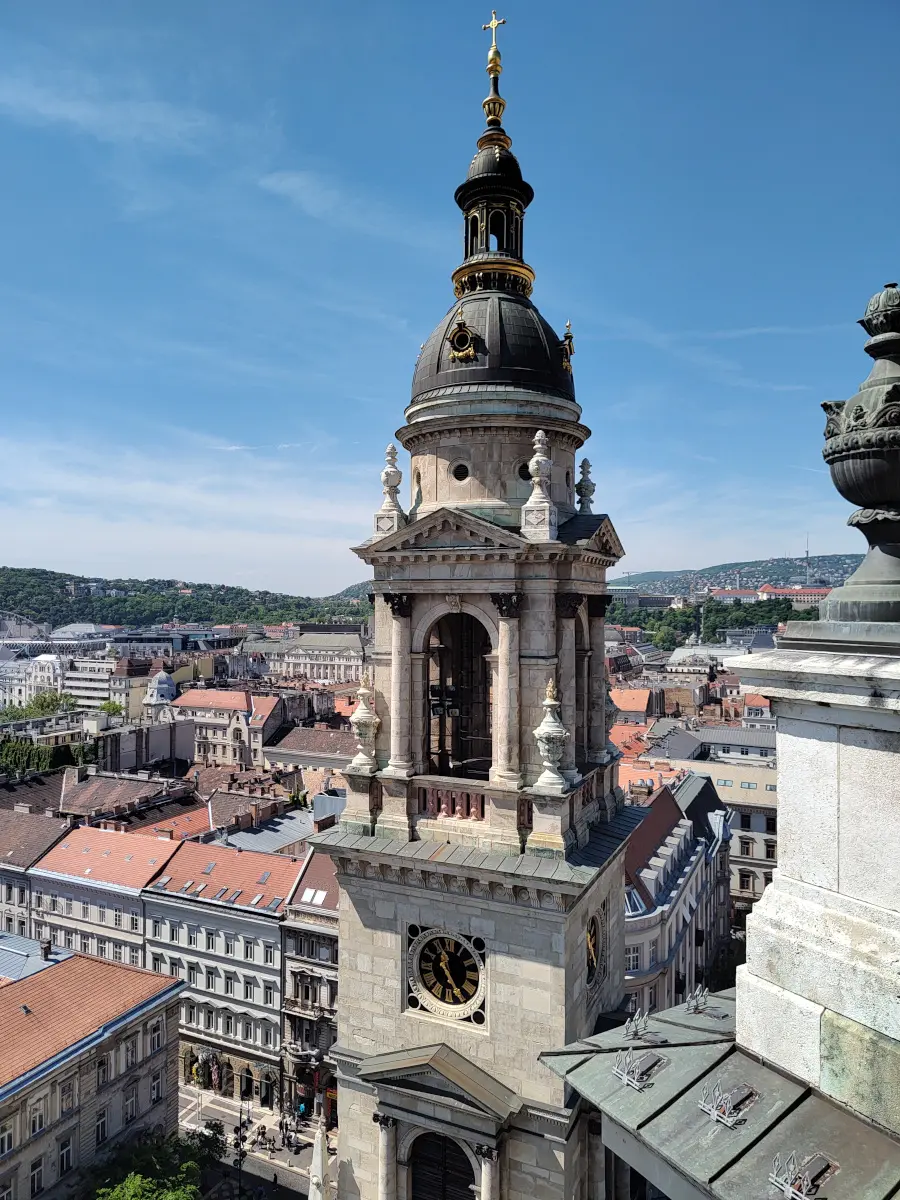
We started our day with one of Budapest’s most recognizable landmarks: St. Stephen’s Basilica, the Roman Catholic basilica dedicated to Hungary’s first king. It was within walking distance of our hotel and made an ideal first stop on our self-guided walking tour through Pest.
Instead of beginning with the interior, we went directly to the panoramic terrace. It was absolutely worth it. The elevated walkway gave us 360-degree views across Budapest, including Parliament, the Buda Hills, Buda Castle, the Danube, the rooftops of Pest, and the Budapest Eye.
We visited early, when the light was beautiful for photographs and the terrace wasn’t as busy as it can become later. The ascent uses elevators for much of the way, although there are still steps and narrow sections. The terrace itself is narrow, so it helps to take your time and leave room for people moving in the opposite direction.
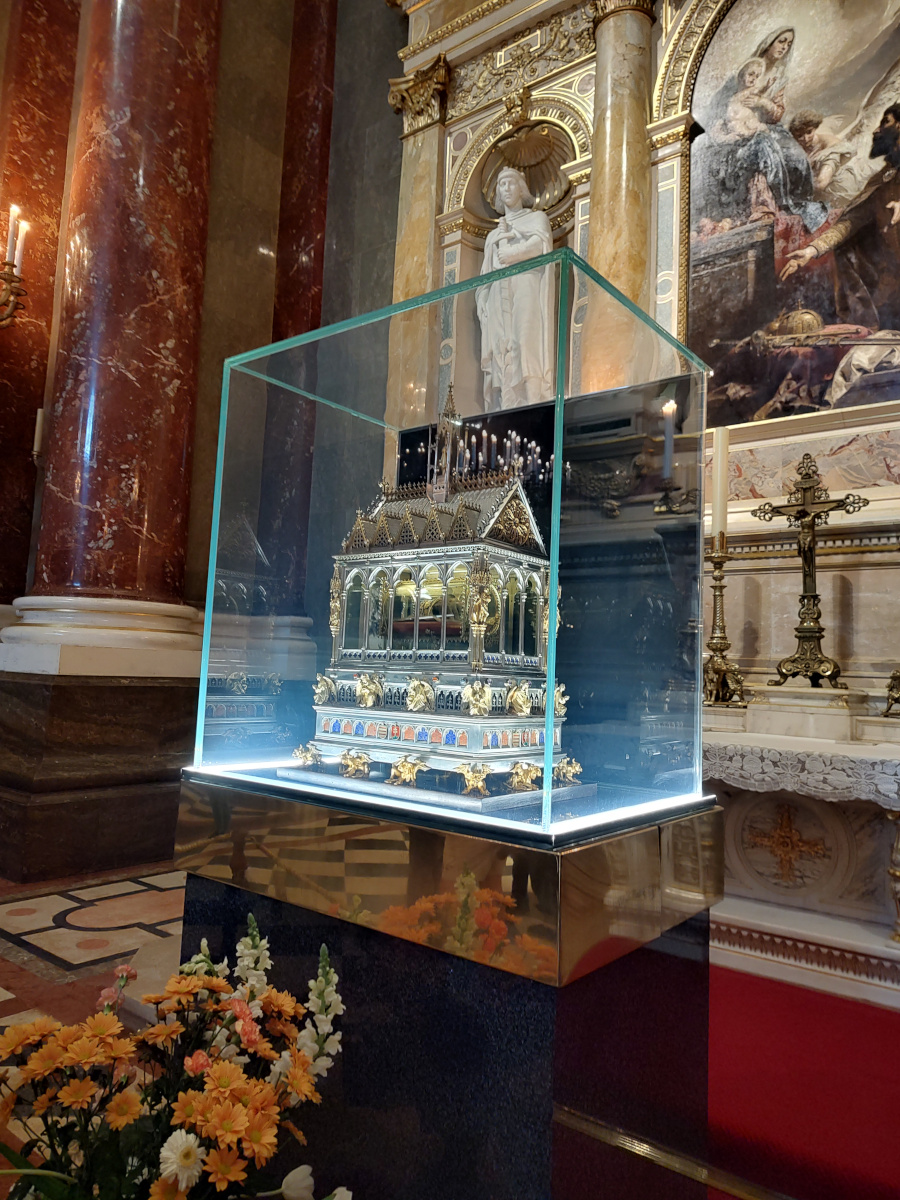
After taking in the views, we explored the Basilica interior, admiring its frescoes, marble columns, sculptures, and gold details. One of its most important religious objects is the Holy Right, the preserved hand traditionally associated with King St. Stephen, displayed in a side chapel.
Ticket note: Visitor entry to the Basilica is paid. The official ticket system currently offers separate tickets for the church hall and for the panoramic terrace with the treasury, as well as an all-in-one option. Weekend weddings can sometimes limit access to the church hall, and Sunday visiting hours differ from the rest of the week. Check the official Basilica ticket page before your visit.
Before going, read the St. Stephen’s Basilica visiting details for terrace access, the remaining stairs, photography tips, and the things I wish I had known in advance.
Sweet Stop: Gelarto Rosa Near St. Stephen’s Basilica

Just across from St. Stephen’s Basilica, we treated ourselves to a stop at Gelarto Rosa, known for serving gelato shaped into flower petals. The presentation is beautiful, but we enjoyed the gelato itself too.
The available flavours can change, so choosing was part of the fun. It was a refreshing stop before we continued toward Liberty Square.
Stop 2: Liberty Square – Interactive Fountains and Complicated History
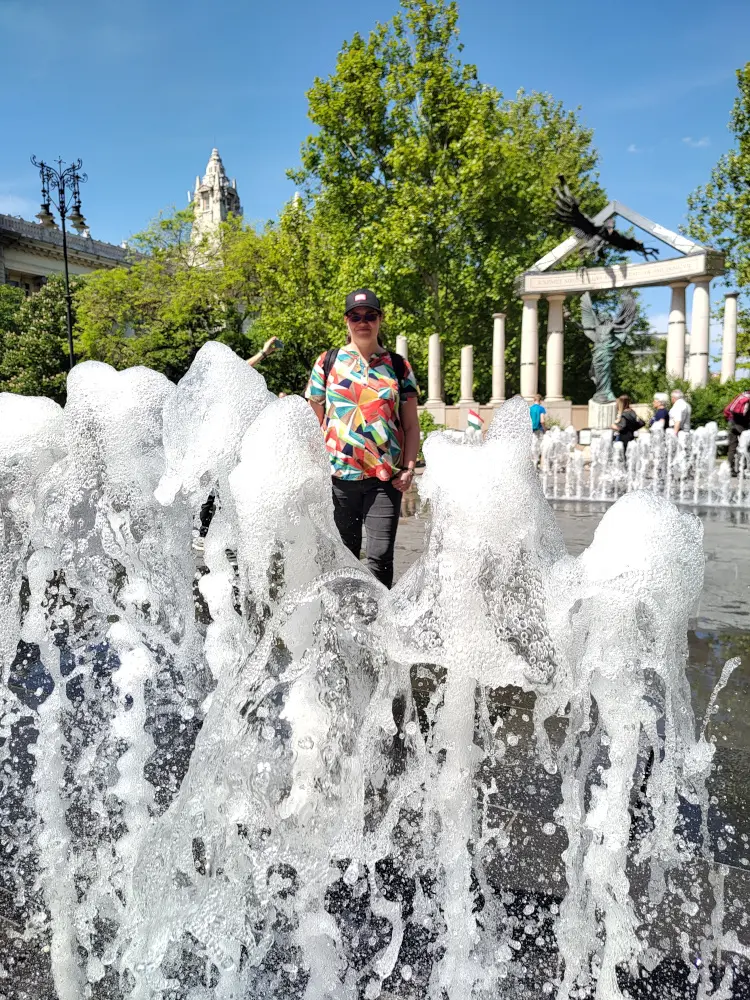
From St. Stephen’s Basilica, we continued toward Liberty Square (Szabadság tér). It is a pleasant green space surrounded by impressive buildings, but it is also one of the most historically and politically complex squares in central Budapest.
The first thing that caught our attention was the interactive fountain, where water jets rise and fall as people approach. It is playful, refreshing on a warm day, and particularly entertaining for children trying to move through without getting wet.
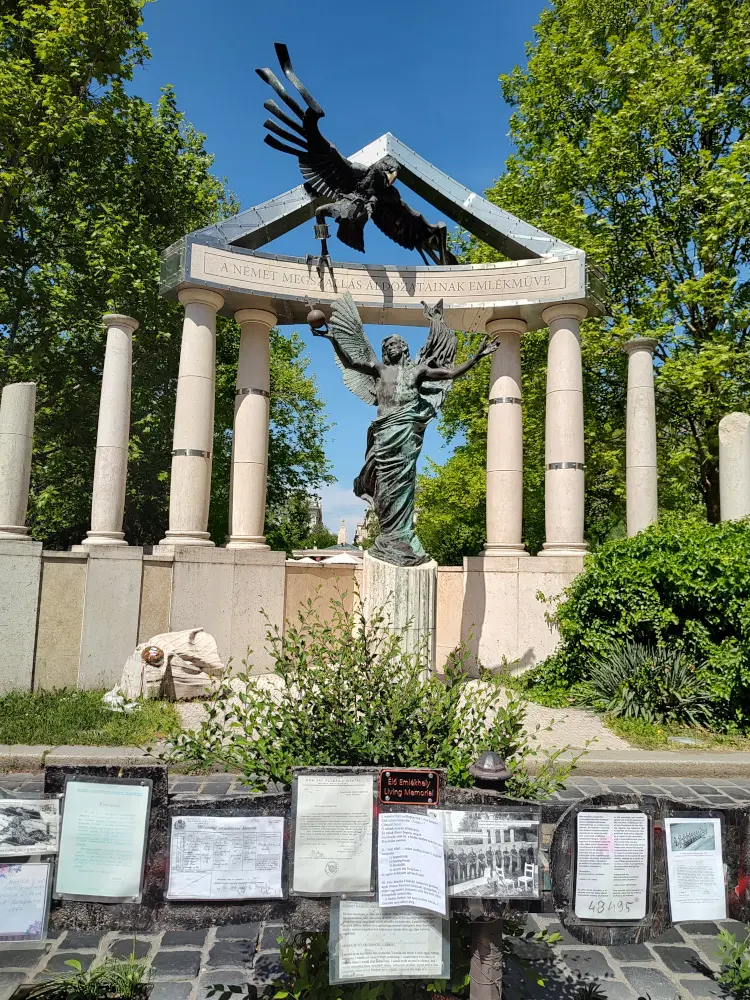
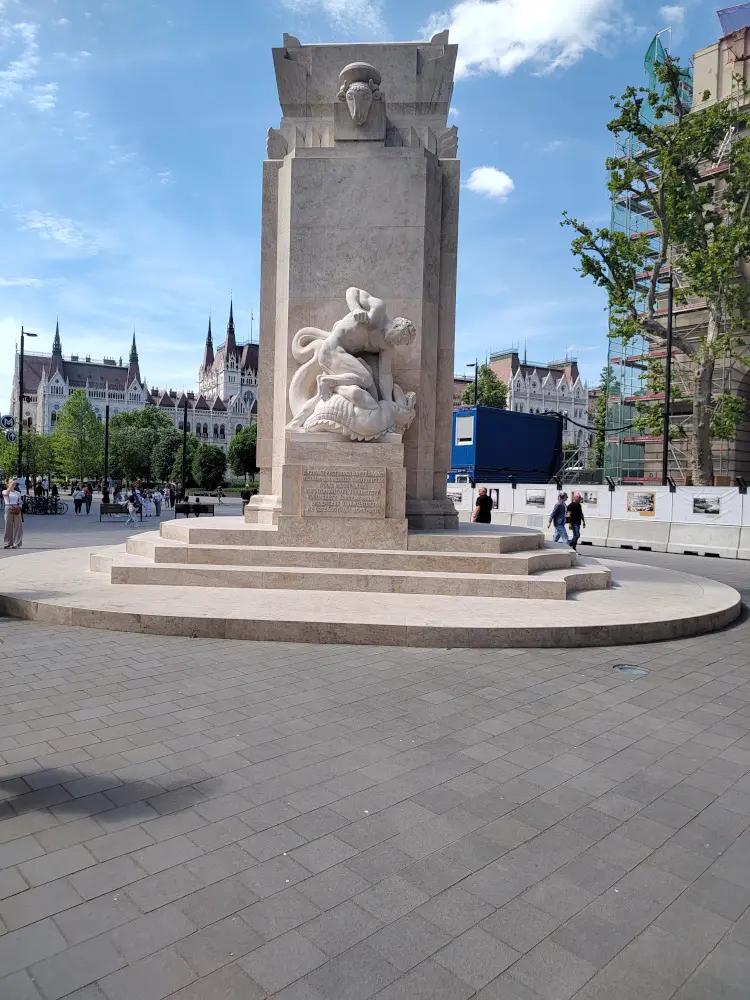
Nearby stands the Memorial to the Victims of the German Occupation. It depicts Hungary as the Archangel Gabriel beneath an attacking eagle representing Nazi Germany.
The monument has been controversial since it was installed in 2014. Critics argue that its symbolism presents Hungary primarily as an innocent victim and doesn’t sufficiently acknowledge the role of Hungarian authorities in the persecution and deportation of Jewish citizens during the Holocaust.
In front of it, relatives, activists, and members of the public created a counter-memorial using photographs, written testimonies, personal objects, stones, and candles. Seeing the official monument and the personal memorial together gives visitors a more complex picture than either one would provide alone.
Stop 3: Liberty Square Playground and the Ministry of Agriculture
The Liberty Square playground was one of the stops that made this walking route work so well for us as a family. Its red train, climbing structures, towers, and slides gave my son time to play while we drank water and rested our feet.
That pause wasn’t wasted sightseeing time. We had already walked and spent time at the Basilica, and the break helped us continue through the Parliament area without feeling that every minute had to be filled with another formal attraction.
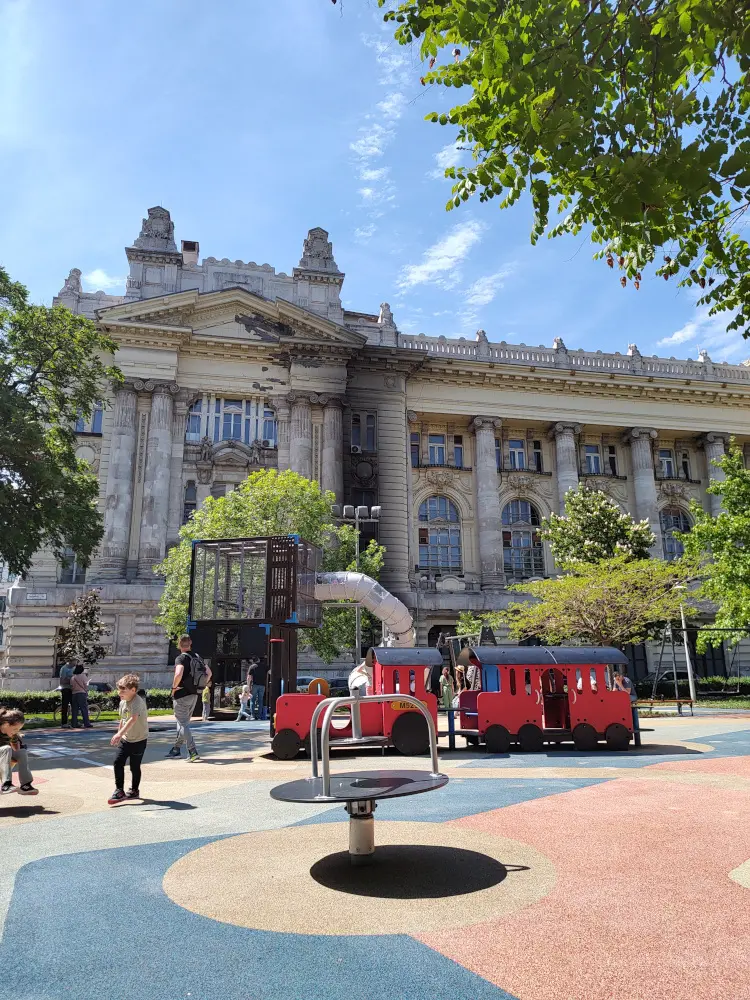
During this part of the walk, as we continued toward the Parliament area, the Hungarian Ministry of Agriculture came into view on Kossuth Lajos Square. Its monumental façade, columns, and sculpted details make it one of the prominent historic buildings framing the square.
The building isn’t located in Liberty Square itself, but it appeared at this point in our walk as we moved from the playground toward Parliament. I have kept it here to preserve the exact order in which we experienced the route.
Stop 4: The Soviet Memorial and Ronald Reagan Statue
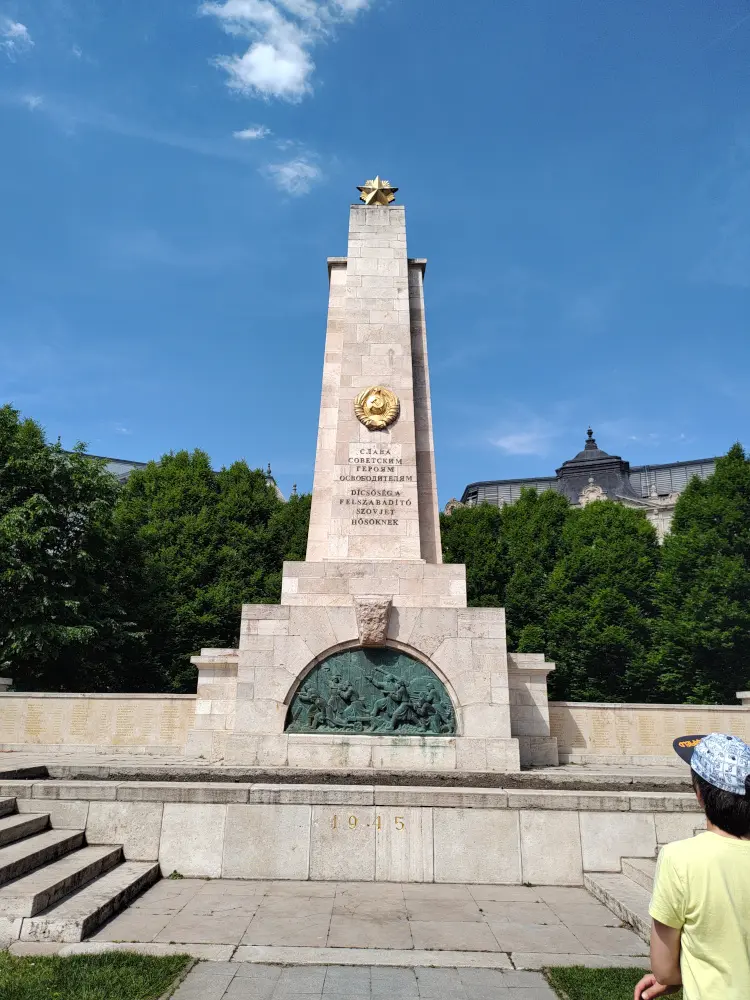
We then passed the Soviet War Memorial in Liberty Square. It commemorates Soviet soldiers who died during the fighting that drove Nazi German forces from Budapest.
Its meaning remains controversial because the end of Nazi occupation was followed by decades of Soviet domination and communist rule in Hungary. The memorial is one of the surviving Soviet monuments in central Budapest and forms part of the square’s unusual concentration of competing historical narratives.
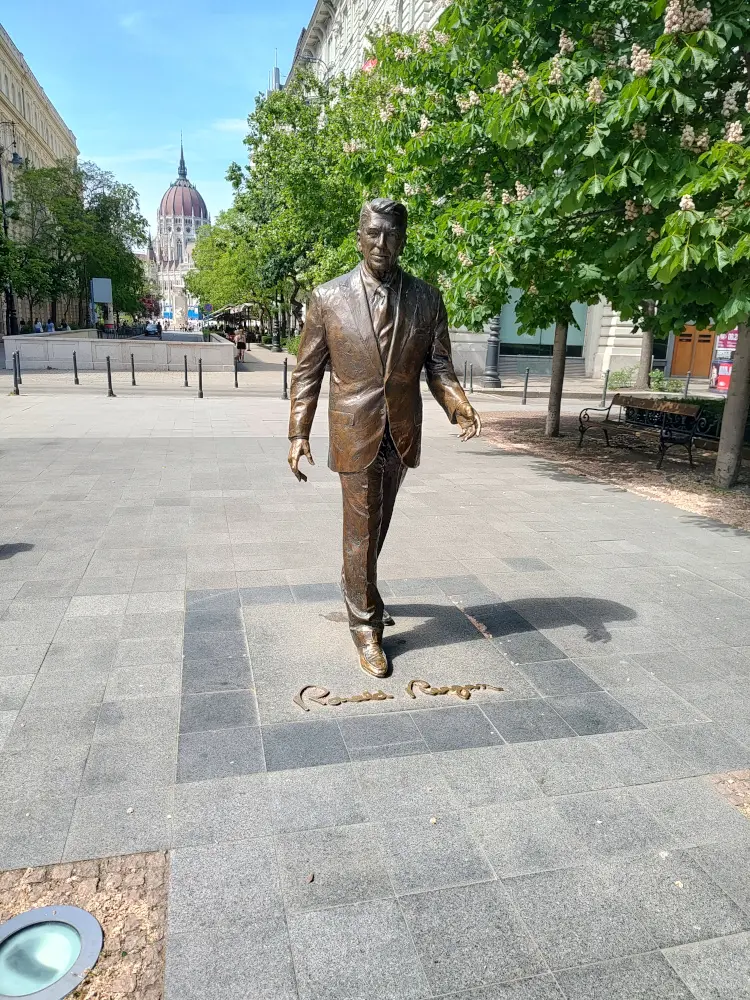
A short distance away stands the bronze statue of Ronald Reagan, commemorating his role during the final period of the Cold War. From certain angles, the Parliament dome rises behind the statue, making this a popular place for photographs.
The Soviet memorial, Reagan statue, German Occupation memorial, and counter-memorial present very different perspectives on occupation, liberation, responsibility, and freedom. That combination makes Liberty Square much more thought-provoking than its lawns and fountains initially suggest.
Stop 5: The Count Gyula Andrássy Statue
Before reaching the main Parliament façade, we stopped beside the equestrian statue of Count Gyula Andrássy. He served as Hungary’s first prime minister after the Austro-Hungarian Compromise of 1867 and later became foreign minister of Austria-Hungary.
The bronze statue stands close to Parliament and creates another strong composition for photographs of the building. It also introduces the political history represented throughout Kossuth Lajos Square.
Stop 6: The Hungarian Parliament Building
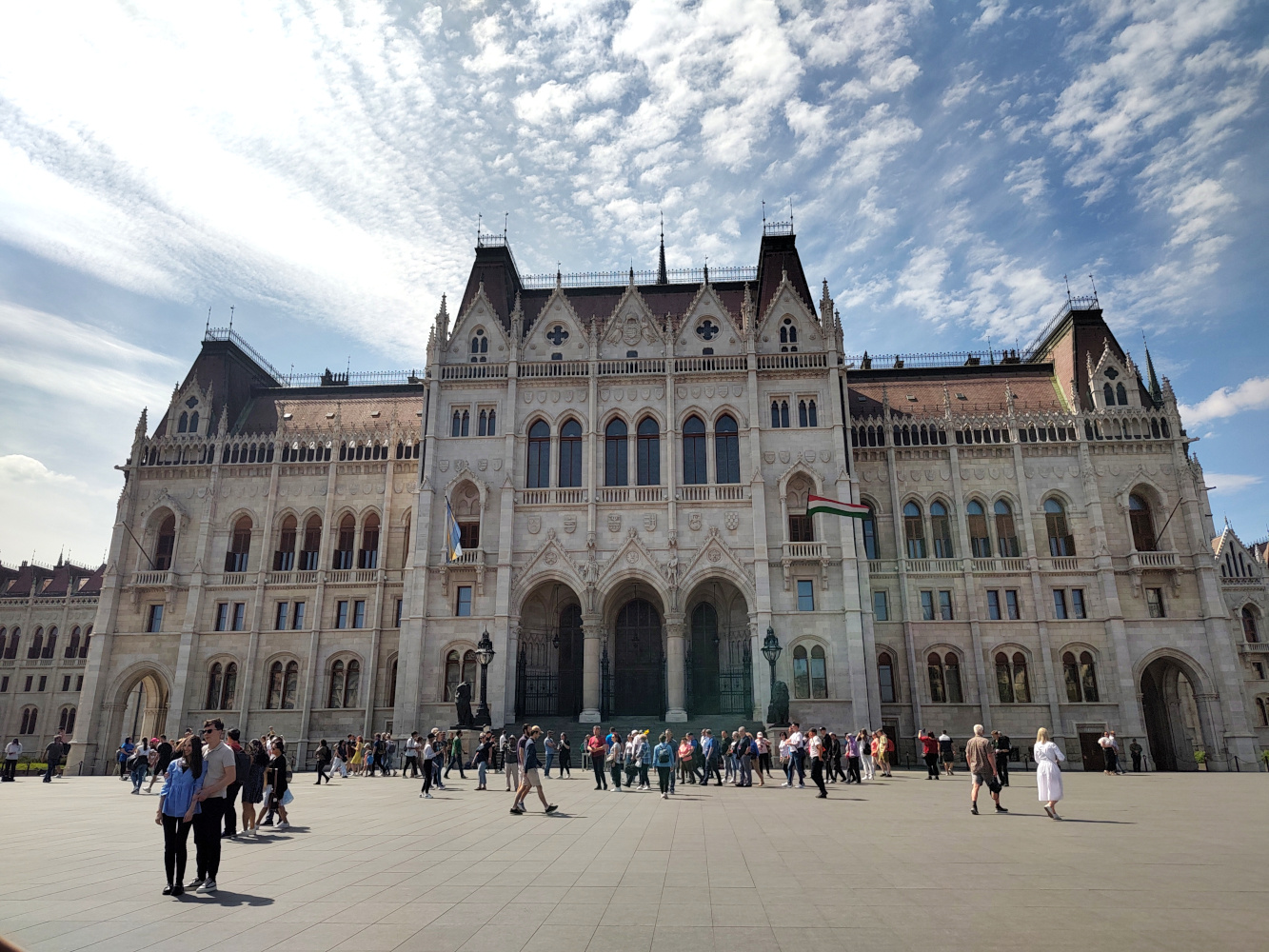
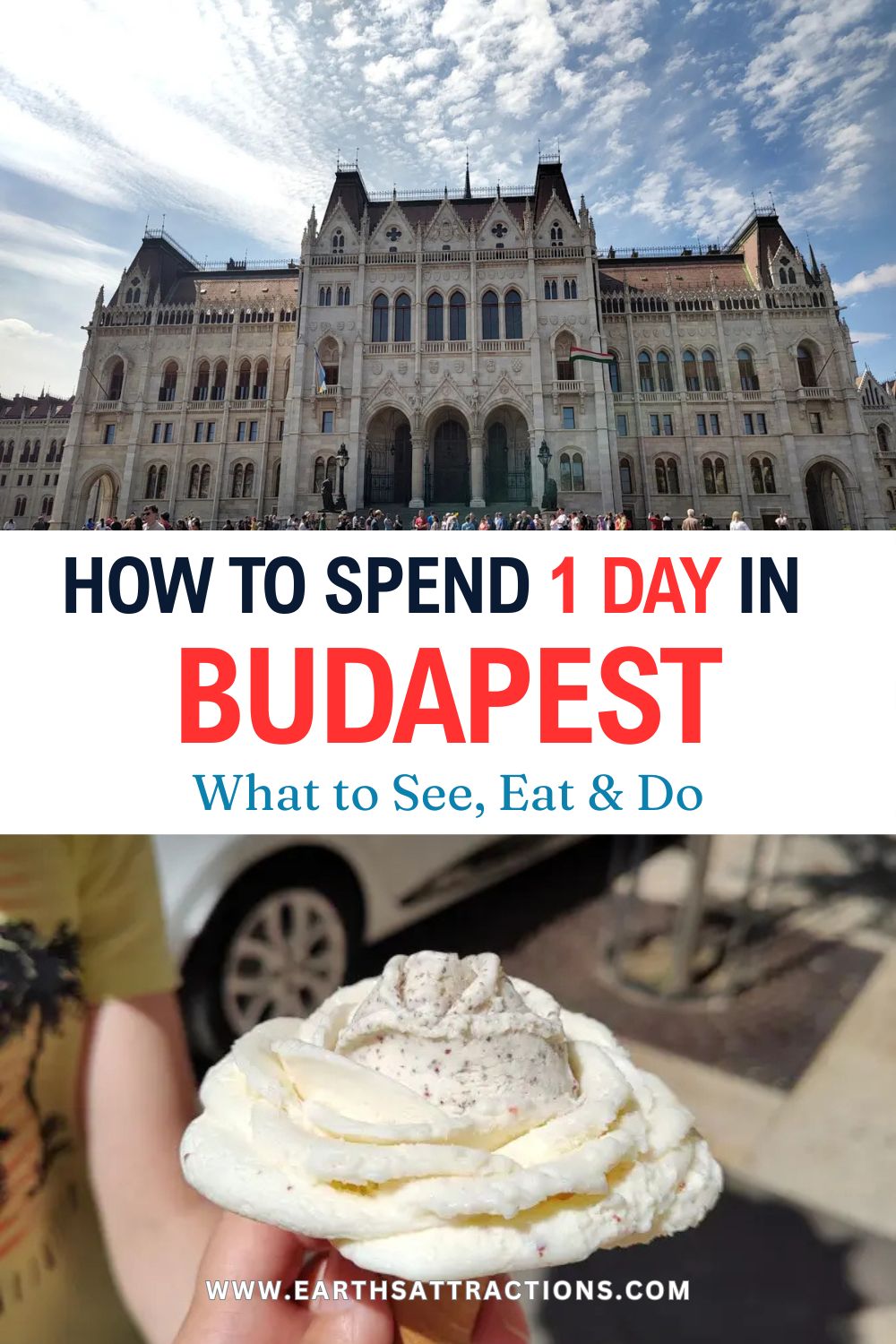
Our route then led us to the Hungarian Parliament Building, one of Budapest’s defining landmarks. The photograph above shows the main entrance and the Kossuth Lajos Square façade.
Many of the best-known photographs of Parliament are taken from across the Danube on the Buda side, but standing close to the building lets you see the Neo-Gothic stonework, statues, arches, windows, and decorative details much more clearly.
We spent time walking around the square and admiring the building from different angles. Even without an interior visit, this is one of the essential stops during a day in Pest.
We didn’t take the Parliament tour on this trip, but we plan to do it next time.
Parliament ticket warning: The official guided visit lasts approximately 45 minutes and includes a security check. Advance tickets aren’t sold at the Visitor Centre ticket office; they are sold online through the Parliament’s authorized Jegymester page. Popular dates and convenient time slots can become unavailable, so book as early as your plans allow and use the official Parliament visitor page rather than an expensive reseller. Add extra time to this itinerary if you reserve the interior tour.
Stop 7: The Former Palace of Justice Opposite Parliament
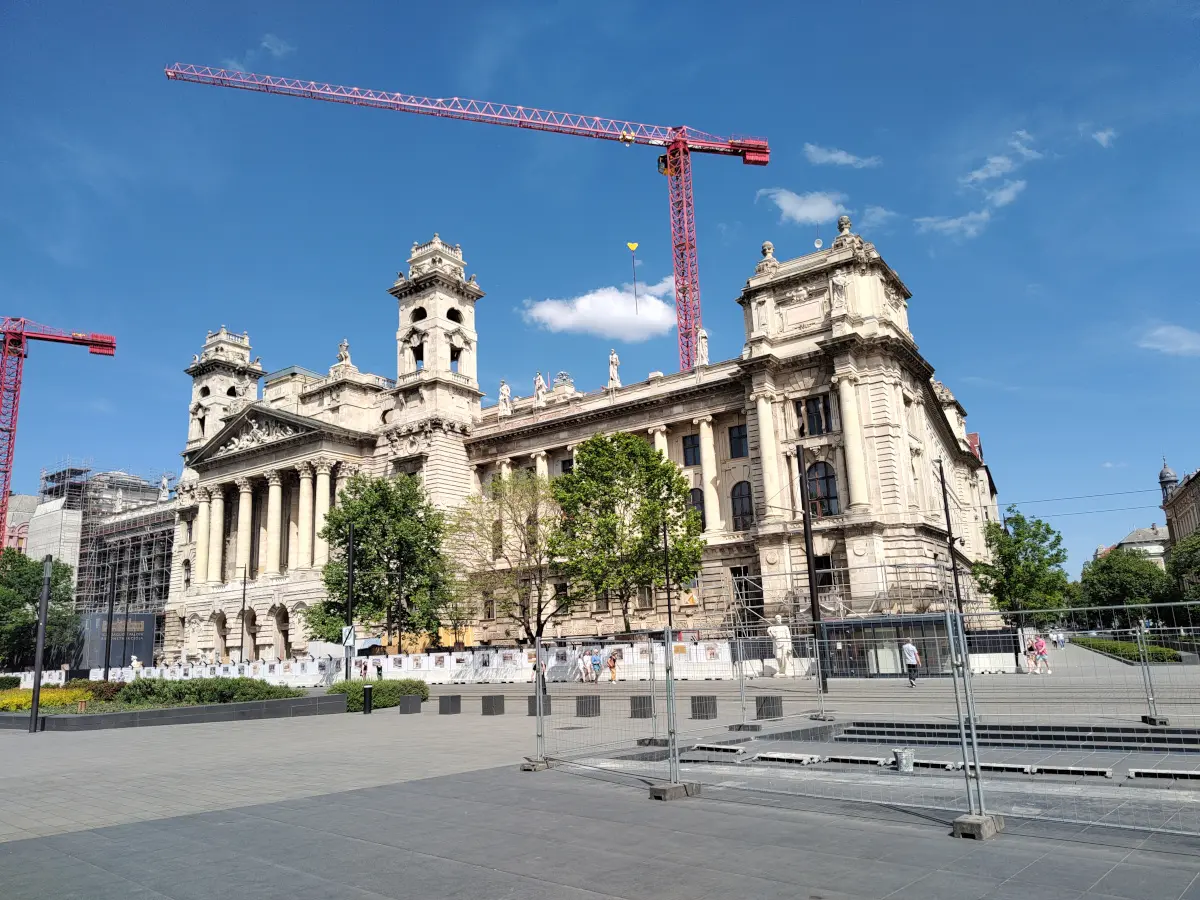
On the opposite side of Kossuth Lajos Square, we admired another monumental building that was under renovation during our visit. It was originally constructed as the Palace of Justice and later housed Budapest’s Museum of Ethnography for several decades.
The Museum of Ethnography is no longer located here. It moved to a purpose-built museum in City Park, which opened in 2022. The former Palace of Justice remains an impressive part of the architectural ensemble around Parliament, but visitors shouldn’t expect to find the museum inside this building.
Stop 8: The Lajos Kossuth and Attila József Memorials
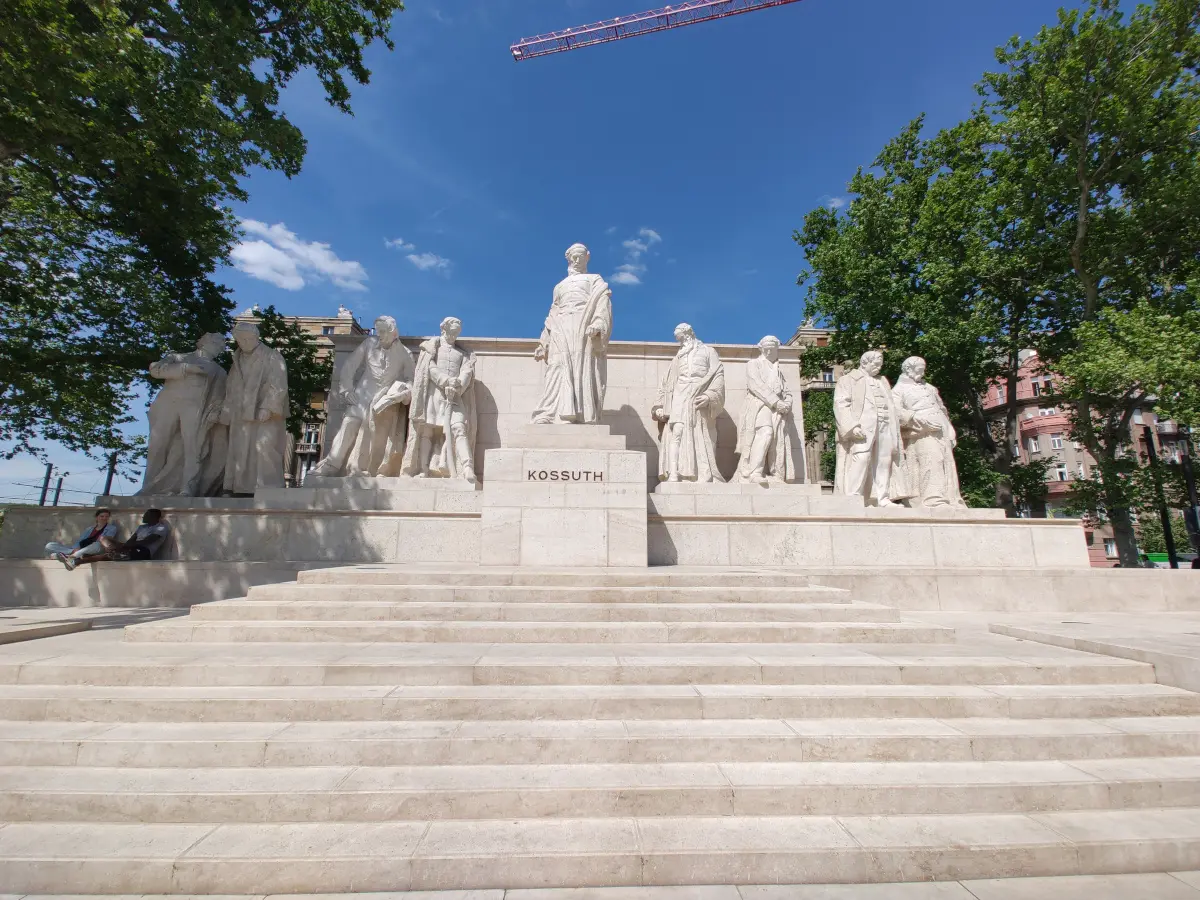
The Lajos Kossuth Memorial honours the statesman who became one of the central figures of the Hungarian Revolution of 1848 and the country’s struggle for independence from Habsburg rule. The large group of figures makes it one of the most prominent monuments in the square.
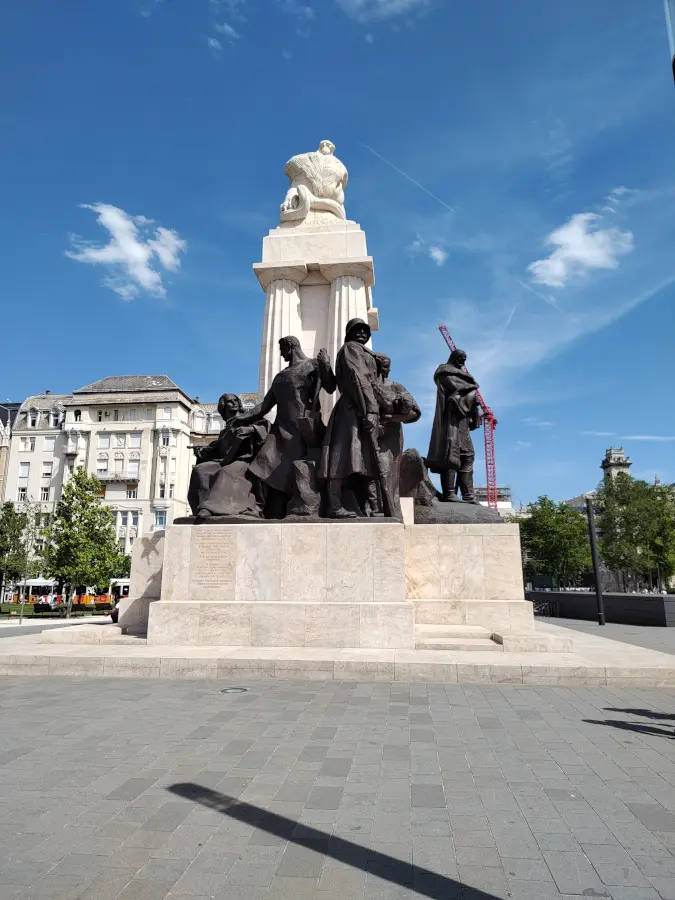
Nearby, the seated statue of Attila József honours one of Hungary’s most important 20th-century poets. Its position near the river is especially fitting because one of his best-known poems is “By the Danube.”
The political memorial and the poet’s more reflective figure reveal two different parts of Hungarian public memory within the same square.
Stop 9: A Peaceful Pause on the Danube Riverbank
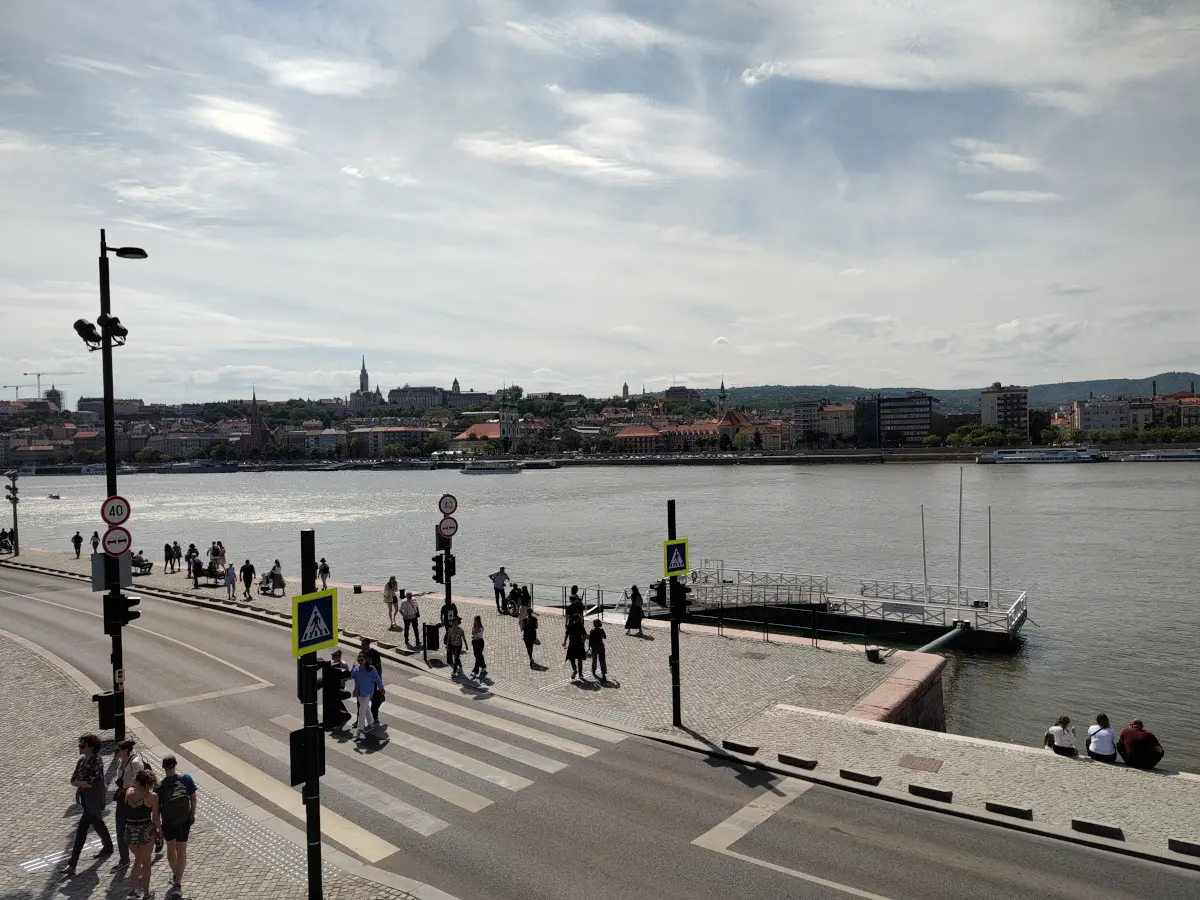
After exploring Kossuth Lajos Square, we walked toward the river for a well-deserved break. My son went down the steps all the way to the edge of the river, where we could see boats moving along the Danube and people walking beside the water.
We found a bench nearby, sat down, and enjoyed the view across to Buda. Fisherman’s Bastion and Matthias Church rose above the opposite bank, and the breeze from the river was welcome after walking through the city.
We stayed there as the light softened over Buda and watched the sunset colours reach the skyline before we continued. It was one of those grounding moments that make travelling on foot so rewarding.
Optional Detour: Shoes on the Danube Bank
We didn’t reach the Shoes on the Danube Bank memorial during this walk, so I haven’t presented it as one of the places we personally visited. It is, however, an important and geographically logical addition if you continue south from Parliament along the river.
The memorial consists of 60 pairs of cast-iron shoes in styles worn by men, women, and children in the 1940s. It commemorates people, many of them Jewish, who were forced to remove their shoes before being murdered on the riverbank by Arrow Cross militiamen in 1944–1945. The shoes represent what was left behind.
The memorial is only a few hundred metres south of Parliament, in the direction of the Chain Bridge. Allow extra time, approach it respectfully, and avoid standing inside the shoes for photographs. You can read more about the history through Yad Vashem’s account of the memorial.
Stop 10: The Ferenc Rákóczi II Statue
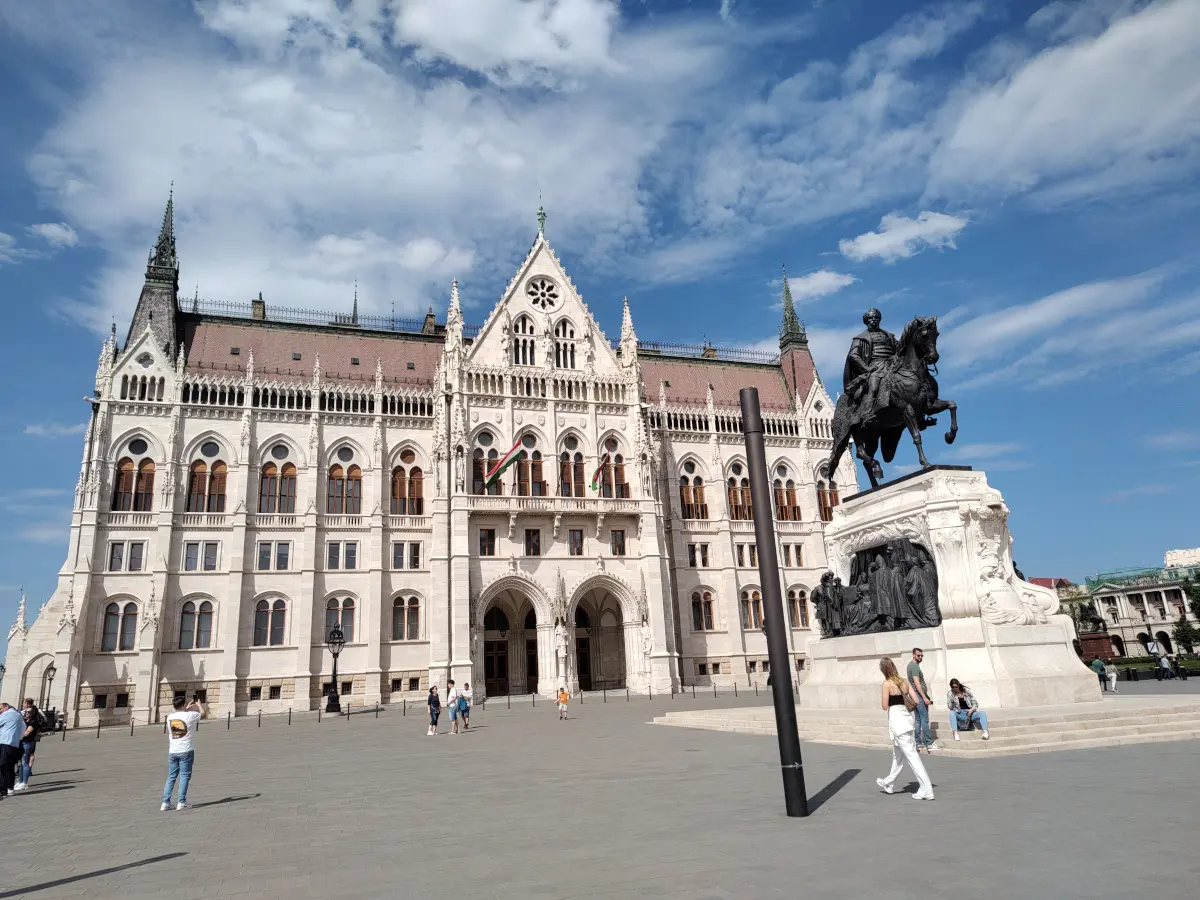
Before leaving the Parliament area, we stopped at the equestrian statue of Ferenc Rákóczi II. He led the early 18th-century uprising against Habsburg rule and remains one of Hungary’s national heroes.
The bronze horse and rider stand against the Parliament façade, creating another memorable view within the square. Kossuth Lajos Square rewards slow exploration: Parliament attracts most of the attention, but the surrounding statues help explain why this is also one of the country’s most important symbolic spaces.
Stop 11: Budapest’s Love Locks
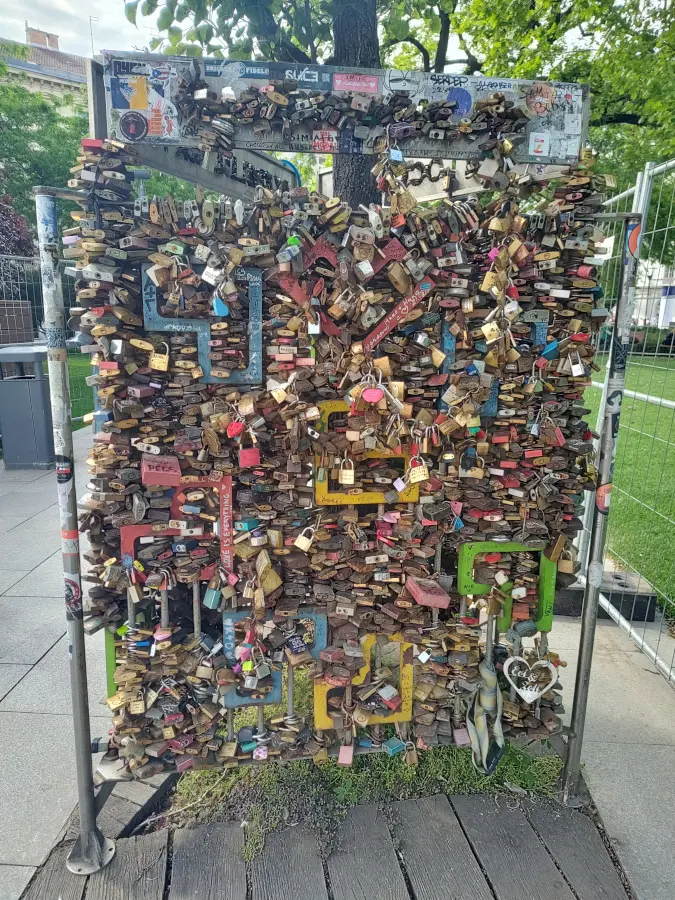
Later, in Erzsébet Square, we came across a colourful and unexpected sight: Budapest’s love locks. I had no idea this love-lock installation existed before we found it.
The locks have been left by couples, friends, and visitors from many places. Names, dates, initials, and short messages cover the metal structure, with old weathered locks mixed among newer ones.
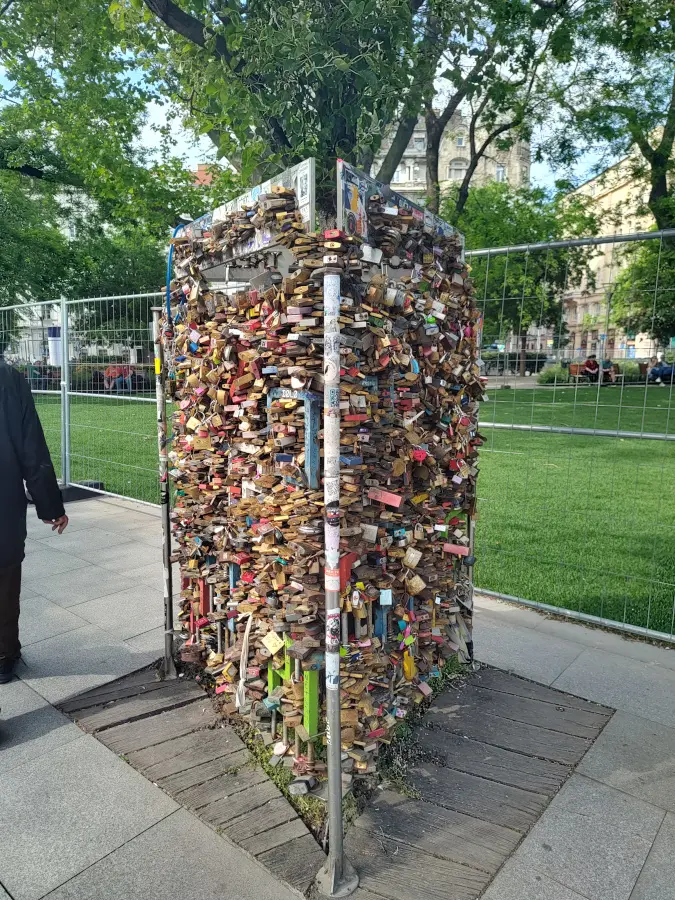
We stopped for a while to read the names and dates. It was a small, modern detail after a day filled with monuments, historic buildings, and political history.
The love locks are in Erzsébet Square near the Budapest Eye and Danubius Fountain. Their location makes the next stops easy to reach without using public transport.
Stop 12: The Budapest Eye
Right beside the love locks, we found one of our favourite attractions in any city: a Ferris wheel. The Budapest Eye stands in Erzsébet Square and reaches approximately 65 metres above the city.
Since we both love Ferris wheels, this was an unmissable stop for us. From the cabin, we could see the rooftops of Pest, St. Stephen’s Basilica, parts of the Danube, and landmarks across the city.
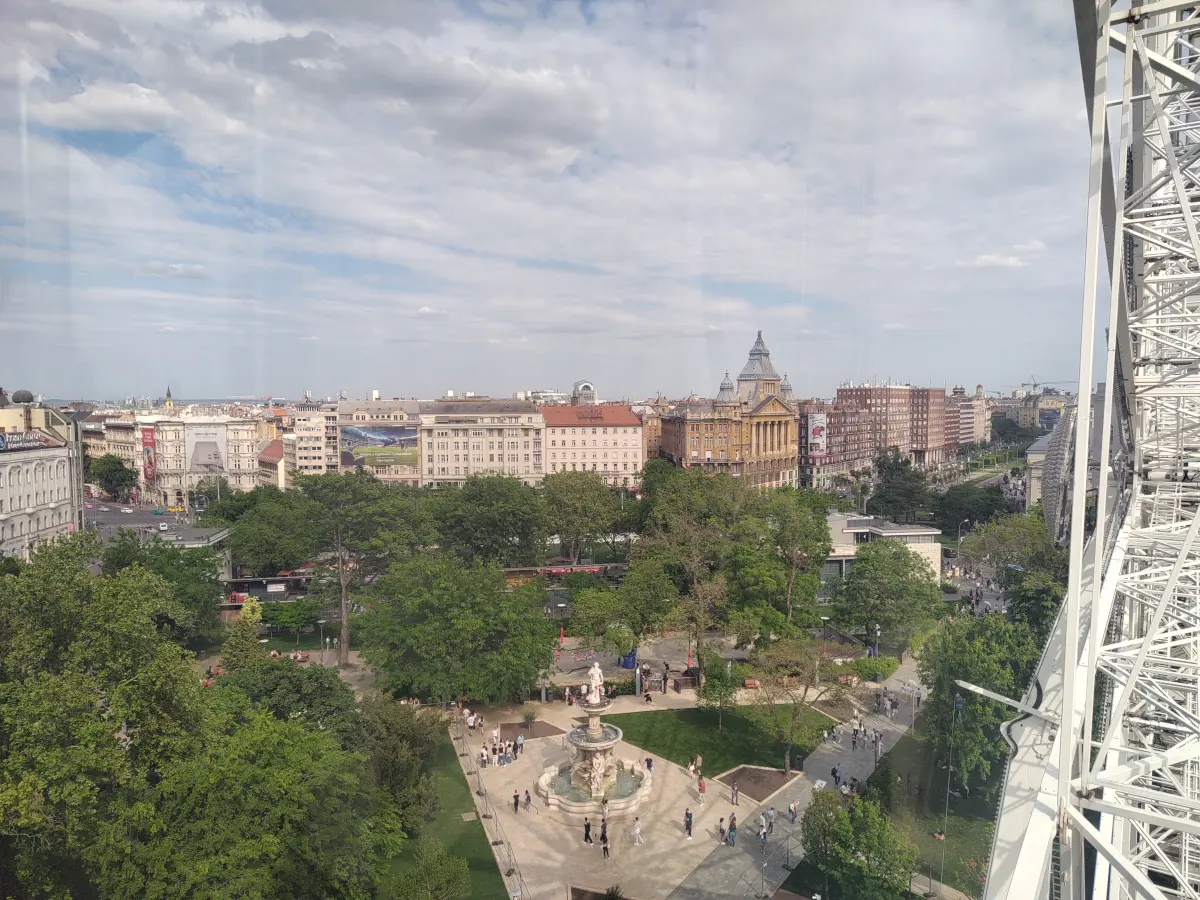
The ride was smooth and relaxing, which made it a fun change after hours of walking. On a clear day, it also gives you the chance to identify several places you have already visited from a completely different angle.
Stop 13: The Danubius Fountain
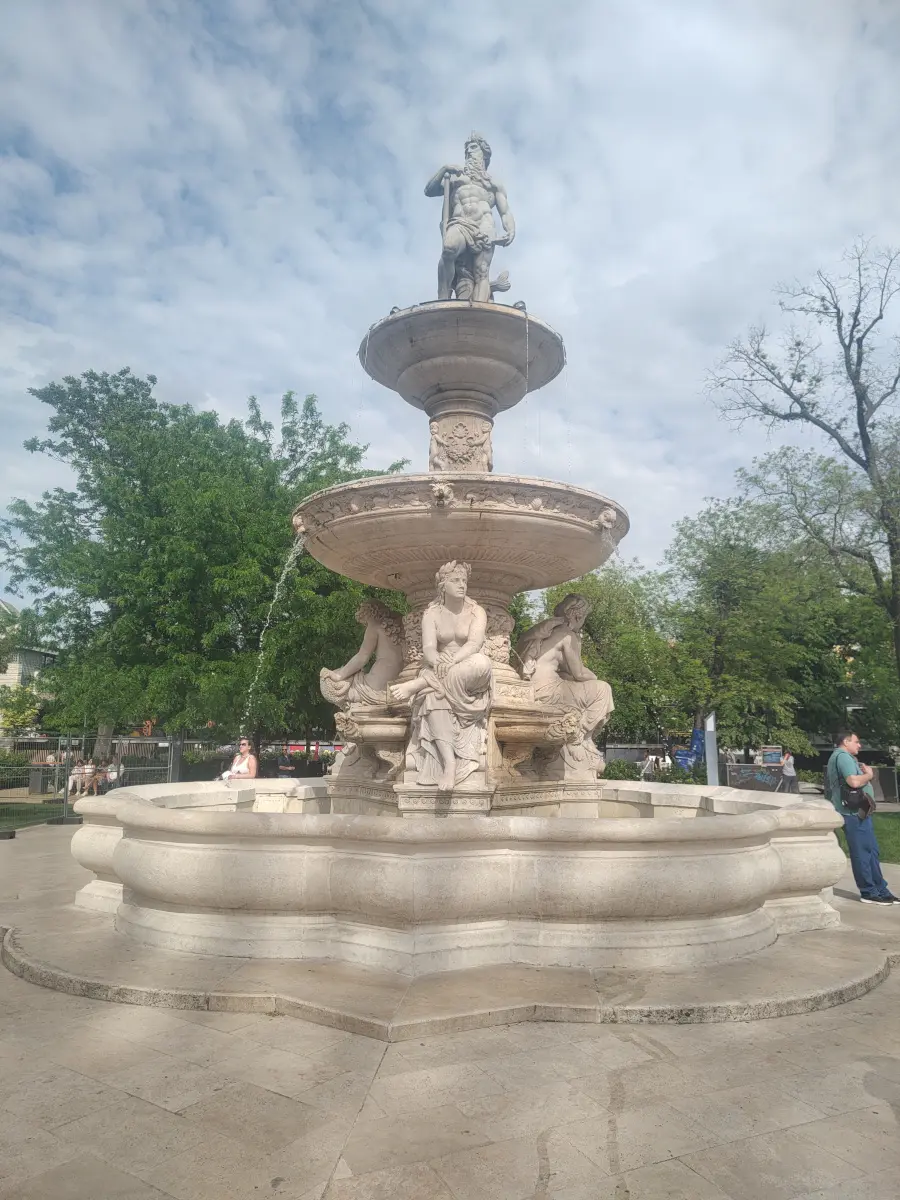
Just steps from the Budapest Eye, we stopped to admire the Danubius Fountain. Designed by Miklós Ybl, the fountain represents four major rivers of historic Hungary.
The male figure at the top personifies the Danube, while the three female figures below represent the Tisza, Drava, and Sava. The fountain was originally erected in another Budapest square in the 19th century; the version in Erzsébet Square was reconstructed after the original was badly damaged during World War II.
The water, sculptures, surrounding trees, and nearby benches make this another pleasant place to pause before continuing.
Stop 14: Trying Lángos in Budapest

After so much walking and sightseeing, it was time to eat. We chose lángos, Hungary’s deep-fried flatbread, commonly served with garlic, sour cream, and grated cheese.
The outside was crisp, the inside remained soft, and it was exactly the sort of filling food we wanted at that point in the day. We found a small stand nearby and ate while watching the movement of the city around us. It was simple, satisfying, and absolutely delicious.
For more ideas beyond lángos, look for some of the best Hungarian dishes during your Budapest trip.
Stop 15: Cat Café Budapest – Our Final Stop

We ended our one-day Pest itinerary at Cat Café Budapest, a stop we had planned before the trip. After a full day outside, the café gave us time to sit down, order drinks and desserts, and enjoy being surrounded by cats.
The cats move freely through the café, sleep in their favourite places, climb, play, or decide whether they want to approach visitors. We found a comfortable corner and spent time enjoying the calm atmosphere, the soft music, the drinks, the cakes, and the cats.
Cat Café Budapest is on Révay Street, near St. Stephen’s Basilica. Although that brought us back toward the starting area, it worked well as a final indoor stop. Animal lovers should read the house rules before visiting and allow the cats to decide whether they want contact.
These Cat Café Budapest tips include the location, visiting information, rules, what we ordered, and what the experience was like with my son.
Optional Evening Extension: Budapest’s Jewish Quarter
If you still have energy after the daytime route, you can continue toward Budapest’s Jewish Quarter in District VII for dinner or an evening drink. The area includes the Dohány Street Synagogue, Gozsdu Passage, restaurants, bars, and Budapest’s well-known ruin pubs.
This wasn’t part of our itinerary, so it isn’t included in the 5 km distance or 7–8 hour timing. It is an optional extension for people who want nightlife after the family-friendly daytime route.
Practical Information for This One-Day Pest Walking Itinerary
Starting point: St. Stephen’s Basilica. Deák Ferenc tér, served by metro lines M1, M2, and M3, is within walking distance. Bajcsy-Zsilinszky út on the M1 is also nearby.
Ending point: Cat Café Budapest on Révay Street, close to the Basilica area.
Core walking distance: Approximately 5 km/3 miles, depending on the streets you use and how much you walk around Liberty Square, Kossuth Lajos Square, and Erzsébet Square.
Total time: Around 7–8 hours at the relaxed pace we followed. A Parliament interior tour, the Shoes on the Danube detour, longer meal stops, or an evening in the Jewish Quarter will extend the day.
Terrain: The street route through central Pest is largely flat. Individual attractions can include steps, narrow spaces, and uneven surfaces.
Public transport: We didn’t use public transport between the stops. You may still use it to reach the Basilica in the morning or return to your accommodation at the end.
Paid attractions: The Basilica interior and panoramic terrace, Budapest Eye, Parliament interior tour, food, and Cat Café purchases. Liberty Square, Kossuth Lajos Square, the riverbank, monuments, love locks, and Danubius Fountain can be seen without an admission ticket.
Best time to start: An early start gives you more time and can make the Basilica panorama more comfortable. Check the current schedule before choosing a starting hour, especially on Sundays and days with services or weddings.
For families: Liberty Square playground provides a useful break. The Budapest Eye, gelato, lángos, and Cat Café also helped keep the day varied for my son.
In hot weather: Carry water, use shaded areas and benches when available, and allow time for breaks. Kossuth Lajos Square and the riverbank can feel exposed in strong sun.
In rain: Shorten the time spent at outdoor monuments and consider spending longer inside the Basilica or adding a pre-booked Parliament tour. Cat Café is a comfortable indoor ending.
For currency, public transport, safety, and other practical details, check these Budapest travel tips before your trip.
A Shorter Pest Walking Itinerary for 4–5 Hours
If you have only half a day, keep the main route and remove the less essential stops:
1. Visit St. Stephen’s Basilica and choose either the church interior or the panoramic terrace if time is limited.
2. Walk through Liberty Square and see the German Occupation memorial, counter-memorial, Soviet memorial, and Ronald Reagan statue.
3. Continue to Parliament and Kossuth Lajos Square.
4. Walk to the Danube riverbank. Add Shoes on the Danube only if your schedule allows.
5. Finish in Erzsébet Square with the Budapest Eye area and Danubius Fountain.
The detailed monument stops, a long meal, and Cat Café are the easiest elements to remove when time is short. Families may prefer to keep the playground and remove a monument or paid attraction instead.
What I Would Add Next Time
The main addition I would make on a future visit is the Parliament interior tour. We admired the building from outside, but seeing the ceremonial staircase, Dome Hall, and other interior spaces would add another dimension to the day.
I would also consider continuing from Parliament to the Shoes on the Danube Bank memorial before heading toward Erzsébet Square. It is close enough to fit naturally, although it needs its own time and respectful attention.
I wouldn’t remove the playground break, river pause, Budapest Eye, or Cat Café merely to fit in more famous sights. Those stops shaped our real day, gave my son things to enjoy, and kept the itinerary from becoming a race between monuments.
How to Spend One Day in Pest: Route Overview
Morning: Begin at St. Stephen’s Basilica for the panoramic terrace and church interior, followed by Gelarto Rosa.
Late morning: Continue to Liberty Square for the interactive fountain, German Occupation memorial, counter-memorial, and playground.
Next: See the Ministry of Agriculture as you approach Kossuth Lajos Square, then continue past the Soviet memorial and Ronald Reagan statue in the order we followed.
Midday: Visit the Count Gyula Andrássy statue, Parliament, the former Palace of Justice, and the Lajos Kossuth and Attila József memorials.
Afternoon: Rest on the Danube riverbank, then return to see the Ferenc Rákóczi II statue. Add Shoes on the Danube only as an optional extension.
Later afternoon: Continue to the love locks, Budapest Eye, and Danubius Fountain in Erzsébet Square.
Food and final stop: Try lángos, then finish at Cat Café Budapest.
Distance: Approximately 5 km/3 miles for the core route.
Duration: Approximately 7–8 hours at a relaxed pace, excluding optional extensions.
Conclusion: Is One Day Enough for Pest?
One day is enough to see many of central Pest’s best-known landmarks while still leaving room for food, photographs, a playground break, and time beside the Danube. The route worked well for us because we didn’t treat every pause as a delay.
From the views at St. Stephen’s Basilica and the political history of Liberty Square to Parliament, the river, the Budapest Eye, lángos, and Cat Café, each part of the day felt different. We saw grand architecture and important memorials, but we also noticed a melody from a street musician, fountains, locks covered in names, boats on the Danube, and the places where people simply sit and enjoy the city.
This was our first full day in the Hungarian capital. On another day, we explored the hills, viewpoints, monuments, and unexpected places on the Buda side. Giving each half of Budapest its own day allowed us to experience both without compressing everything into a rushed city checklist.
By the time we finished, we both agreed that Budapest is best discovered one step at a time.
Frequently Asked Questions About Spending One Day in Pest
Is this itinerary entirely on the Pest side of Budapest?
Yes. All the principal stops are on the Pest side of the Danube. Buda Castle, Fisherman’s Bastion, Matthias Church, and the Castle District are covered in the separate Buda itinerary.
How long does this Pest walking itinerary take?
Allow approximately 7–8 hours for the route at a relaxed pace, including the Basilica, breaks, photographs, food, Budapest Eye, and Cat Café. A Parliament tour or optional detours will add time.
How far will I walk?
The core route is approximately 5 km/3 miles. Your final distance will depend on how much you explore inside the squares and whether you add Shoes on the Danube or the Jewish Quarter.
Do I need public transport during the route?
No. We completed the route on foot. Public transport can still be useful for reaching the starting point or returning to your accommodation.
Do I need to book Parliament tickets in advance?
Book online in advance if you want to see the interior. Advance tickets are sold through the authorized Jegymester system rather than at the Visitor Centre ticket office, and popular time slots can become unavailable.
Is St. Stephen’s Basilica free to enter?
No. Visitor entry is ticketed. The church hall and the panorama with treasury have separate ticket options, and an all-in-one ticket is also available. Check the official site for current prices and hours.
Is this Budapest walking route suitable for children?
It worked well for us with my son. Liberty Square playground, gelato, the Budapest Eye, food stops, and Cat Café helped break up the historical and architectural sights.
Can I complete the route in four or five hours?
Yes, with cuts. Keep the Basilica, Liberty Square, Parliament, the riverbank, and Erzsébet Square. Remove the longer breaks, detailed monument stops, and one or more paid attractions.
Should I visit Buda or Pest if I have only one day?
Choose Pest for flatter walking, Parliament, St. Stephen’s Basilica, city squares, cafés, and a livelier urban route. Choose Buda for Castle Hill, historic viewpoints, greener spaces, and a hillier walk.
Can I see both Buda and Pest in one day?
You can see selected highlights from both sides, but you will need a shorter and faster itinerary. We preferred giving Pest one day and Buda another so we could explore without rushing.
More amazing articles for you:
Everyone Is “Touching Grass” Now - And It’s Completely Changing How We Travel
Atlanta City Guide: Tips for Spending a Weekend in Atlanta with the Kids
Where To Stay In France For First Time Visitors
Top travelling spots from famous classical books [#Infographic]
Trevi Fountain Tourist Dive Sparks Outrage - But Some of the Comments Surprised Me
200 2010s Trivia Questions and Answers - Easy to Hard. How Many Can You Get Right?
Goa travel: best places to visit in Goa, accommodation, restaurants, tips & more
City Break in Vienna: A Unique and Unforgettable Experience

Violeta-Loredana Pascal is a communications expert, business mentor, and the founder of Earth’s Attractions and PRwave INTERNATIONAL. A pioneer in the Romanian digital PR landscape since 2005, she holds a degree in Communication and Social Sciences from SNSPA Bucharest. Violeta is a senior trainer at AcademiadeAfaceri.ro, where she leverages over 20 years of experience to teach professional courses in PR strategy and workplace productivity. By blending high-level business consulting with a passion for holistic travel and wellness, she empowers solopreneurs to overcome procrastination, build profitable brands, and design a life of purposeful adventure.