Paris is a city I love. I knew many of its famous landmarks before my trip, but once I was there, I found plenty of details I had never heard about. A familiar bridge had an unexpected story. A museum had once served a completely different purpose. Even the arrangement of the streets and the numbers on the buildings followed rules I hadn’t noticed before.
I love discovering new and interesting things about the places I visit, and Paris has given me more than enough material. After gathering interesting facts about France, I wanted to look more closely at the capital: its famous monuments, older streets, art, food, underground spaces and details that can change what you notice during a visit.
These 70 interesting facts about Paris include well-known stories explained more accurately and lesser-known facts connected with places you can still find. I have left out the exaggerated claim that the Eiffel Tower becomes permanently 15 centimetres taller every summer. The official explanation separates small changes in height from the movement of the summit caused by uneven heating, and the copied version usually confuses the two.
In this article, Paris means the City of Paris unless I specifically mention Greater Paris or a nearby destination. If you are preparing a visit, these Paris travel tips for a first trip cover tickets, timing and several details I wish I had known before going.
ID 34120772 ©Scaliger | Dreamstime.com
How Paris Got Its Name, Shape and Identity
Many historical facts about Paris begin with the Seine, the islands in the river and the people who lived here long before the modern capital took shape. Its name, compact official boundary and numbered districts explain details that visitors encounter throughout a trip.
1. Paris takes its name from the Parisii
The name Paris comes from the Parisii, a Gallic people who lived in the region before the Roman conquest. The Romans referred to the settlement as Lutetia Parisiorum, or Lutetia of the Parisii. Over time, the name connected with the people replaced Lutetia.
This origin also explains why Paris has no connection with Paris, the prince from Greek mythology, despite the identical spelling. The city’s name grew from local history rather than legend.
2. Roman Paris was known as Lutetia
Lutetia is the name most people associate with Roman Paris, although the full form Lutetia Parisiorum was also used. Much of the Roman town developed on the Left Bank, where visitors can still find the remains of baths and an amphitheatre.
The modern city has expanded far beyond that early settlement, yet the old name survives in street names, businesses and cultural references. You will also encounter the word “Lutetian” in geology: the geological age was named after Lutetia because layers around Paris became an important reference for scientists.
3. Île de la Cité became the centre of early Paris
Île de la Cité sits in the Seine and has played a central role in Paris for centuries. The island was fortified in the late Roman period and later became a seat of royal, judicial and religious power. Notre-Dame, the Sainte-Chapelle and the former royal palace now represented by the Conciergerie all stand here.
It is easy to think of Île de la Cité as one picturesque stop among many. Historically, it was one of the places from which the city developed.
4. The 20 arrondissements form a clockwise spiral
Paris is divided into 20 arrondissements, numbered in a spiral that begins near the Louvre and moves clockwise. The pattern is often compared with a snail shell. The current arrangement dates from 1860, when the city expanded and incorporated surrounding communities.
Knowing the number gives you a rough idea of where a place is. The 1st arrondissement is central, the 7th includes the Eiffel Tower, and Montmartre is in the 18th. The first four arrondissements now share one administrative sector called Paris Centre, but their familiar numbers remain. This is useful when building a Paris bucket list and grouping nearby attractions together.
5. The Left Bank and Right Bank are named according to the river’s direction
To understand which side is which, imagine facing downstream as the Seine flows west through Paris. The Right Bank, or Rive Droite, is on your right and north of the river. The Left Bank, or Rive Gauche, is on your left and south of it.
The two banks developed different cultural associations over time. The Left Bank became closely linked with universities, writers and artists, while the Right Bank was associated with commerce, government and grand avenues. Modern Paris is less tidy than those old descriptions suggest, but the terms are still used constantly. A long stretch of the banks of the Seine is protected by UNESCO, including major monuments on both sides.
6. The City of Paris and Greater Paris are different areas
Population figures for Paris can look contradictory because they may describe different boundaries. The City of Paris refers to the 20 arrondissements. Greater Paris can include a much larger urban and metropolitan area beyond those limits.
This distinction also affects attraction lists. Versailles, Disneyland Paris and La Défense are regularly included in Paris travel planning, but they are not inside the City of Paris. They are easy to reach from the capital, which is why the geographical line often disappears in casual travel articles. Choosing where to stay in France on a first visit becomes easier once you separate central Paris from the wider region.
7. Paris proper covers about 105 square kilometres
The official City of Paris covers roughly 105 square kilometres. That figure includes the Bois de Boulogne and Bois de Vincennes, two large wooded areas attached administratively to the city. The densely built part most visitors picture is smaller.
Paris can therefore feel surprisingly compact on a map, especially when compared with London, New York or many metropolitan areas. The wider urban region extends far beyond the 20 arrondissements, which is why figures for “Paris” vary so much. A trip that begins in the capital can also connect easily with many of the best places to visit in France.
8. The Stade de France is in Saint-Denis, not the City of Paris
The Stade de France carries the country’s name and was one of the best-known venues associated with Paris 2024, but its address is in Saint-Denis, immediately north of the Paris boundary. It was built for the 1998 FIFA World Cup and opened that year.
The distinction is practical as well as geographical. A ticket for an event there requires a journey beyond central Paris, usually by RER or Métro, rather than a walk from the major sights. It is another example of a place described casually as “Paris” even though it lies outside the 20 arrondissements.
9. A ship appears on the coat of arms of Paris
The ship on the city’s coat of arms recalls the importance of the Seine and the powerful medieval guild of river merchants. It is accompanied by the Latin motto Fluctuat nec mergitur, commonly translated as “Tossed by the waves, but unsinkable” or “Tossed by the waves, but never sunk.”
The motto became especially visible across Paris after the attacks of November 2015, when it was used as an expression of resilience. Its history is much older: the phrase was officially associated with the city in the 19th century, while the ship itself had appeared in Parisian heraldry for centuries.
Famous Paris Landmarks and the Stories Behind Them
The best-known facts about Paris landmarks often stop before the story becomes interesting. The Eiffel Tower, Louvre, Notre-Dame and Sacré-Cœur all contain details that are easy to miss, even when the monument itself is impossible to overlook.
10. The Eiffel Tower was created for the 1889 Exposition Universelle
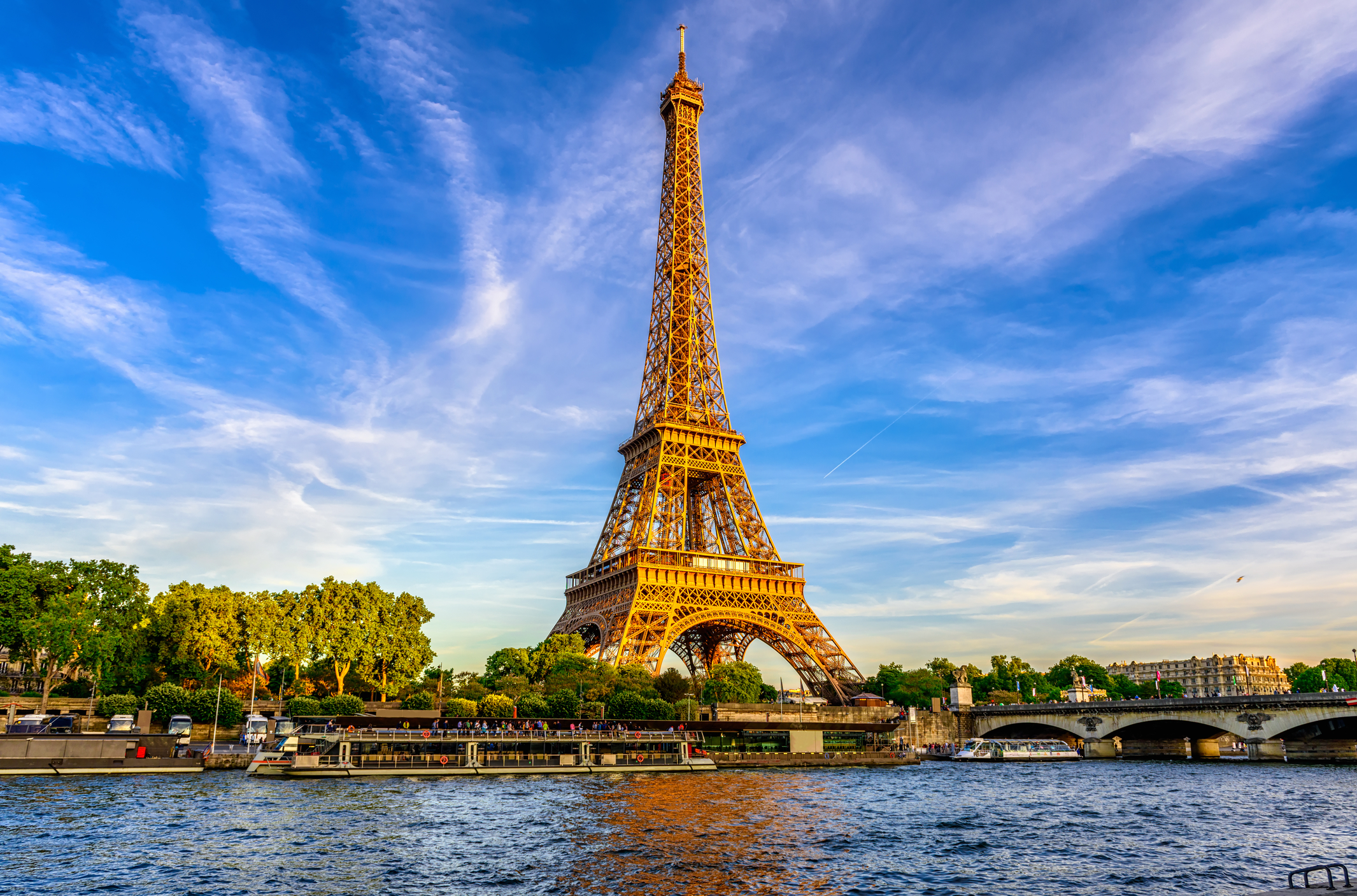
ID 107376702 © Ekaterinabelova | Dreamstime.com
The Eiffel Tower was constructed as the entrance monument for the 1889 Exposition Universelle, a world’s fair held during the centenary year of the French Revolution. Work began in 1887, and the Tower was completed in time for the exhibition.
Gustave Eiffel’s company built it, but the first structural concept came from engineers Maurice Koechlin and Émile Nouguier. Architect Stephen Sauvestre helped shape its appearance, while Eiffel developed, financed and promoted the project. That fuller story gives more people credit for one of the best-known landmarks in Paris.
11. The Eiffel Tower originally came with a 20-year concession
The Tower was allowed to stand on its site under a 20-year concession. Its future after 1909 depended on the City of Paris, so demolition was possible, although the monument didn’t come with one fixed appointment for destruction.
Gustave Eiffel encouraged meteorological, astronomical and physics experiments there. Wireless telegraphy later proved especially valuable. The Tower’s height made it an excellent antenna, and its scientific and military usefulness helped secure its survival.
12. The Eiffel Tower has been repainted about once every seven years on average
Paint protects the Eiffel Tower’s iron from corrosion. According to the monument’s official history, it has been repainted 20 times in 136 years, which works out at an average of approximately once every seven years.
A complete campaign uses around 60 tonnes of paint, and much of the work is still carried out with brushes. The Tower has worn several colours, including Venetian red, reddish brown and the bronze shade known as Eiffel Tower brown. Its latest major campaign returned it to the yellow-brown colour selected by Gustave Eiffel in 1907. The official painting history shows how much its appearance has changed.
13. The names of 72 scientists and engineers are engraved on the Eiffel Tower
Look around the border below the first floor and you can see names written in large gold letters. Gustave Eiffel selected 72 French scientists, engineers and mathematicians as a tribute to their work. Among them are Lavoisier, Ampère, Foucault, Fourier and Daguerre.
The inscriptions disappeared beneath paint in the early 20th century and were restored in 1986 and 1987. Something else that surprised me was how much there is to notice after you stop looking only at the Tower’s overall shape. The view is another reason to go up: these photos of Paris from the Eiffel Tower show how different the city looks from above.
14. The Louvre began as a medieval fortress
Before the Louvre was a palace or an art museum, it was a fortress built under King Philip II around the end of the 12th century. Its position protected the western side of Paris at a time when the city was considerably smaller.
Parts of the fortress survived beneath the later palace. Visitors can walk through the Medieval Louvre area on the lower level of the Sully wing and see the base of the keep and sections of the defensive walls. It gives an entirely different meaning to the familiar glass-pyramid view in a photo of the Louvre Museum.
15. The Louvre opened as a public museum in 1793
The fortress gradually became a royal residence, and successive rulers enlarged it. After the royal court moved to Versailles, the Louvre continued to house artists, collections and institutions. During the French Revolution, it was turned into a national museum and opened on August 10, 1793.
The building’s long history is one reason a Louvre visit can feel overwhelming. The palace itself deserves attention alongside the paintings and antiquities. If you need to choose where to spend your time, this comparison of the best museums in Paris helps separate the Louvre, Orsay, Orangerie and smaller collections.
16. The Mona Lisa was missing from the Louvre for more than two years
On August 21, 1911, the Mona Lisa was stolen by Vincenzo Peruggia, an Italian worker who had previously worked at the Louvre. The theft was discovered after an artist came to copy the painting and found an empty space on the wall.
Peruggia kept it hidden and was caught in Florence in 1913 when he tried to arrange its sale. The painting returned to the Louvre in January 1914. The case attracted international attention and added considerably to its fame.
The Mona Lisa dominates many conversations about the museum, yet the rooms nearby contain works that deserve time too. The Greek sculptures at the Louvre include the Venus de Milo and Winged Victory of Samothrace, while the historic royal jewellery offers a completely different reason to slow down.
17. The Louvre Pyramid caused considerable controversy
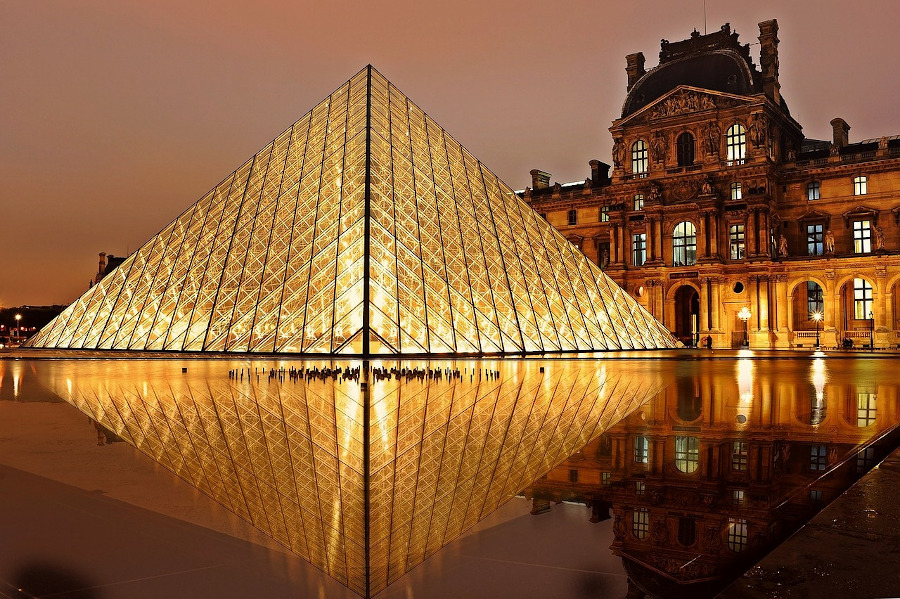
I. M. Pei’s glass Pyramid is now inseparable from the modern image of the Louvre, but its construction between 1985 and 1989 provoked intense criticism. Opponents believed its shape, scale and modern materials would damage the character of the historic palace.
The debate reached the press and the National Assembly. Pei’s design also solved a practical problem by creating a central entrance for a museum whose exhibition space and visitor routes were being transformed. The Pyramid was inaugurated in March 1989 and gradually became a Paris landmark in its own right.
18. Notre-Dame’s famous chimeras are largely 19th-century additions
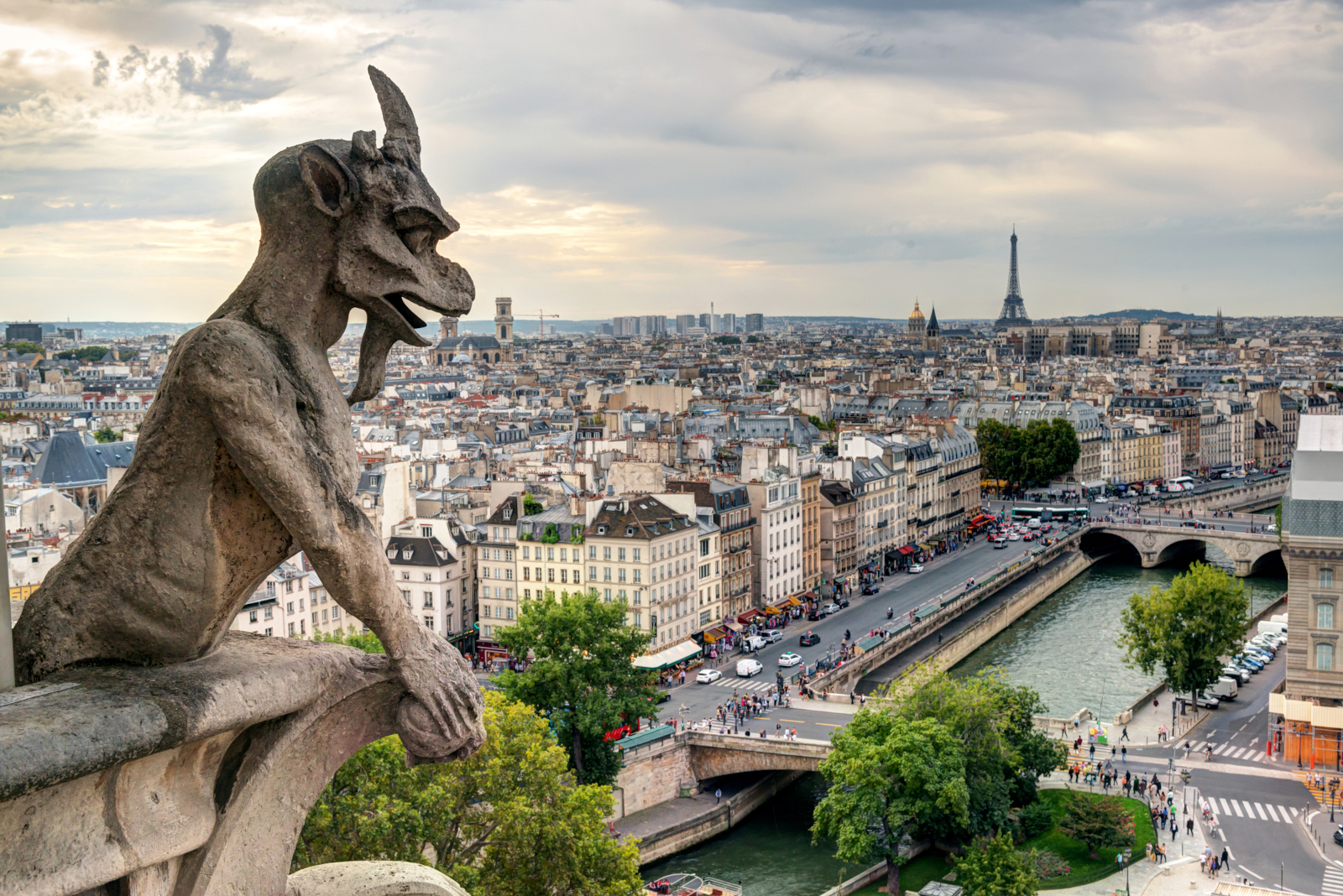
The creatures perched high on Notre-Dame are often described collectively as medieval gargoyles. There is an important difference. Gargoyles are projecting waterspouts that carry rain away from the building, while chimeras are decorative creatures.
Many of the best-known chimeras, including the brooding figure frequently photographed with the Paris skyline, were added during the 19th-century restoration led by Eugène Viollet-le-Duc. They look completely at home on the Gothic cathedral, which is probably why so many people believe they are medieval.
19. The spire of Notre-Dame is a 19th-century design
The spire that collapsed during the 2019 fire wasn’t an untouched medieval feature. Notre-Dame had an earlier spire, but it was dismantled in the late 18th century after centuries of deterioration.
Eugène Viollet-le-Duc designed the familiar replacement during the cathedral’s 19th-century restoration. It was completed in 1859 and included copper statues of the apostles around its base. After the fire, the spire was rebuilt to restore Viollet-le-Duc’s silhouette rather than replaced with a new contemporary design. Notre-Dame reopened in December 2024.
20. Point Zero stands in front of Notre-Dame
A small bronze marker set into the paving of the cathedral forecourt is known as Point Zero of the roads of France. It is the traditional reference point from which official road distances from Paris are measured.
Point Zero is sometimes described as the geographical centre of France, but that is incorrect. Its importance is administrative and symbolic. The marker is easy to miss when the square is busy, so look down as you cross the forecourt rather than searching for a large monument.
21. Pont Neuf is the oldest surviving bridge across the Seine in Paris
Its name means “New Bridge,” yet Pont Neuf is now the oldest surviving bridge over the Seine in Paris. Construction began in the 16th century and the bridge was completed under Henry IV in the early 17th century.
It was new in design as well as name. Pont Neuf had pavements for pedestrians and was built without houses lining both sides, giving people open views of the river. Those features seem ordinary now, but they made the bridge unusual at the time.
22. The Luxor Obelisk is an ancient Egyptian monument
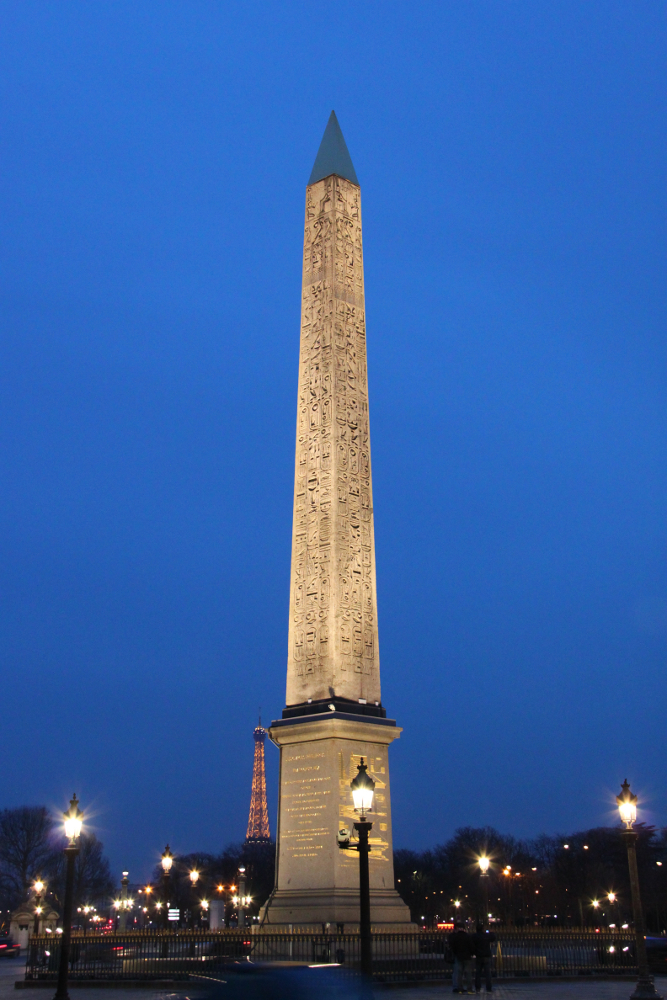
The obelisk in Place de la Concorde was not created as Egyptian-style decoration for Paris. It stood at the entrance of Luxor Temple and is approximately 3,000 years old. Egypt presented it to France in the 19th century, and it was raised in the square in 1836.
Hieroglyphs on the monument praise the reign of Ramesses II. The golden pyramidion at the top is modern; it was added in 1998. The contrast around the Luxor Obelisk in Paris is fascinating: an ancient Egyptian monument stands between Parisian façades, fountains and long views towards other famous landmarks.
23. Sacré-Cœur owes its pale appearance partly to its stone
Sacré-Cœur was built with pale travertine stone from Château-Landon. When rain reaches this stone, it releases calcite, which helps maintain the basilica’s bright surface.
This is often shortened online to the claim that Sacré-Cœur “cleans itself.” The real effect is less magical: the stone’s properties contribute to its whiteness, while weather, pollution, restoration and maintenance still affect the building. The material was a deliberate choice by architect Paul Abadie and has become one of the reasons the basilica looks so distinct on the Montmartre skyline.
24. About two-thirds of Sainte-Chapelle’s stained glass is original
Sainte-Chapelle was built in the 13th century for Louis IX and the sacred relics he had acquired. Its upper chapel contains 15 immense stained-glass windows filled with 1,113 biblical scenes.
Despite fires, the French Revolution, wartime danger and extensive restoration, the monument’s official history states that approximately two-thirds of the windows are original. The rose window belongs to a later period and dates from the 15th century. The survival of so much medieval glass is even more striking when you stand inside and see how little solid wall appears between the windows.
25. A smaller Statue of Liberty stands on an island in the Seine
A 16-metre version of the Statue of Liberty stands at the southern tip of Île aux Cygnes, a narrow artificial island in the Seine. It was given to Paris by the American community in France and inaugurated in 1889, the same year the Eiffel Tower opened.
The statue is far smaller than the one in New York Harbor, but it is large enough to be unmistakable from nearby bridges and riverboats. It also creates an unexpected view when photographed with the Eiffel Tower. Paris has other Liberty replicas and models, including one at the Musée d’Orsay, but this riverside version is the most prominent outdoors.
Paris can also make familiar landmark questions less obvious than they first appear. The Eiffel Tower is easy, but an Egyptian obelisk, a French Statue of Liberty and two different triumphal arches add better clues to a famous landmark quiz or a challenge to guess the country from its landmarks.
Pieces of Older Paris That Visitors Can Still Find
Several lesser-known historical facts about Paris are attached to places you can still see: Roman stonework, a medieval wall, flood markers and a clock on a busy street. The traces are often small compared with the modern city around them, which is exactly why they are rewarding to find.
26. Roman remains survive at the Arènes de Lutèce and Musée de Cluny
The Arènes de Lutèce was a Gallo-Roman arena used for performances and combat. Parts of it were rediscovered during 19th-century construction work, and the site is now a public space in the 5th arrondissement. Its seating and arena make the scale of Roman Lutetia much easier to imagine.
Nearby, the Musée de Cluny incorporates remains of Roman public baths. The great frigidarium, or cold room, still rises to an impressive height. The two sites show different sides of Roman urban life and can be visited without leaving the Latin Quarter.
27. Sections of the wall built by Philip Augustus still stand
King Philip II, also known as Philip Augustus, ordered a defensive wall around Paris before leaving on the Third Crusade. Construction took place around the turn of the 13th century and enclosed the city on both banks of the Seine.
Paris soon spread beyond it, and most of the wall disappeared into later buildings or was demolished. Long sections remain visible on Rue des Jardins-Saint-Paul in the Marais, while another well-known fragment stands on Rue Clovis in the 5th arrondissement. Towers, curves and stones that seem oddly placed beside modern homes may be parts of the old fortification.
28. The Bastille is gone, but its position is still marked
The Bastille fortress-prison was attacked on July 14, 1789 and later dismantled. There is no large ruined prison to visit at Place de la Bastille today. The July Column in the centre commemorates the Revolution of 1830, not the storming of the Bastille.
Look closely at the paving around the square and you can find lines marking part of the former fortress outline. Remains of one tower’s base were uncovered during Métro construction and can be seen on a platform in Bastille station. If your time is limited, a one-day Paris itinerary can connect the Bastille area with several better-known stops.
29. Paris’s first public clock can be seen at the Conciergerie
A public clock was installed on the tower of the royal palace in 1371. It gave Parisians a civic way to measure time instead of relying entirely on church bells. The clock visible today has been altered, decorated and restored over the centuries, so it should not be described as an unchanged mechanism ticking continuously since the Middle Ages.
Its blue face, golden details and sculpted figures are easy to spot from Quai de l’Horloge. The dial includes allegorical figures of Law and Justice, an appropriate choice for a building with a long judicial history.
30. Marie Antoinette’s memorial chapel partly occupies the site of her later cell
Marie Antoinette spent her final weeks at the Conciergerie before her execution in October 1793. Visitors sometimes hear that her original prison cell survives unchanged, but the present space needs a more precise explanation.
An expiatory chapel was created in 1816 partly on the site of the cell she occupied during the latter part of her imprisonment and partly on an adjoining room. The room commemorates her detention rather than preserving every detail exactly as she knew it. Elsewhere in the building, displays and reconstructed spaces help explain the prison’s role during the Revolution.
31. Place de la Concorde was an execution site during the French Revolution
Place de la Concorde had a very different name and purpose during the French Revolution. Known then as Place de la Révolution, it became one of the principal sites for public executions by guillotine.
Louis XVI was executed there on January 21, 1793, and Marie Antoinette followed on October 16. The square later received the name Place de la Concorde, while the Luxor Obelisk, fountains and long views created the elegant setting visitors see now. Knowing what happened there makes the contrast difficult to ignore.
32. Haussmann changed the way Paris functioned
Baron Georges-Eugène Haussmann is associated with broad boulevards and rows of pale stone apartment buildings, but the transformation carried out under Napoleon III went far beyond appearance. Paris gained new roads, parks, water supplies, sewers, markets and public buildings.
The work also demolished neighbourhoods and displaced residents. The familiar “Haussmannian” look came partly from regulations governing façades, balconies and building heights along the new avenues. A few steps from the Louvre, the smaller Arc de Triomphe du Carrousel is a reminder that monumental Paris was being reshaped before Haussmann’s boulevards appeared.
33. The Seine flood of 1910 left markers around Paris
In January 1910, the Seine reached 8.62 metres at the Pont d’Austerlitz gauge and flooded streets, cellars, transport tunnels and buildings across Paris. Boats replaced ordinary street transport in some areas, while water and sewage problems continued for weeks.
Flood markers on buildings preserve the height reached in particular locations. The Zouave statue on Pont de l’Alma also became an informal Parisian gauge: during the 1910 flood, the water rose to his shoulders. Changes to the bridge and the statue’s position mean he isn’t a scientific measuring instrument, but Parisians still watch him when the river climbs.
If dates, changing city boundaries and revolutions are the details you remember best, these European history trivia questions continue far beyond Paris.
Small Details and Everyday Life in Paris
Everyday Paris facts can be surprisingly useful during a visit. Street numbers, plaques, transport design, drinking fountains and newer mobility choices reveal how the city works as well as how it looks.
34. Paris street numbers generally begin at the end nearest the Seine
As a general rule, the numbering on streets that run towards or away from the Seine begins at the end closest to the river. On streets running roughly parallel with the Seine, the numbers usually follow the river’s direction from east to west.
Odd numbers are generally on the left and even numbers on the right when you face the direction in which the numbers increase. The city is too old and complicated for every street to fit the pattern perfectly, but the rule can still help when you are walking without constantly checking a map. It is one of several useful details in this guide to first-time Paris mistakes.
35. Traditional street signs tell you the arrondissement
The familiar blue-and-white Paris street plaques usually include the arrondissement number above the street name. Below it, a short explanation may identify the person or event commemorated by the name.
This makes the signs useful sources of information rather than simple labels. When you leave a Métro station and aren’t sure exactly where you are, the arrondissement number provides an immediate clue. It can also alert you that you have crossed into another district without noticing a formal boundary.
36. Hector Guimard turned Métro entrances into Art Nouveau landmarks
When the Paris Métro opened, architect Hector Guimard designed entrances using cast iron, glass and the flowing lines of Art Nouveau. Their lettering looks as if it grew with the metalwork, and the lamps resemble unusual flowers.
Many original entrances have disappeared, while surviving examples are protected. Porte Dauphine retains one of the more elaborate covered designs. The entrance at Abbesses was moved there from another station, a detail that surprises visitors who expect every historic feature to have been created for its current location.
37. Métro Line 1 opened during the 1900 Universal Exhibition
Paris’s first Métro line opened on July 19, 1900, connecting Porte de Vincennes with Porte Maillot. The Universal Exhibition had already brought large crowds to the city, so the new underground railway arrived at a moment when Paris urgently needed better transport.
Line 1 still crosses central Paris and serves places such as the Louvre, the Tuileries, the Champs-Élysées and the Arc de Triomphe. It has since been automated, which places one of the network’s oldest routes among its most technologically updated lines.
38. Métro Line 14 was fully automated from the day it opened
Line 14 opened on October 15, 1998 and was the first Paris Métro line designed to operate without drivers from the beginning. Its original name, Météor, came from an abbreviation of Métro Est-Ouest Rapide.
The line was built partly to relieve pressure on other central routes. It later expanded in both directions and reached Orly Airport in 2024. Line 1 and Line 4 were automated after years of conventional operation, which makes Line 14’s original design an important distinction.
39. Wallace fountains were donated by an English philanthropist
Sir Richard Wallace paid for public drinking fountains after the Franco-Prussian War and the Paris Commune, when access to clean water was a serious problem. The first Wallace fountains appeared in 1872.
The best-known model is dark green and has four female figures supporting a dome. Different versions exist, and new fountains have also appeared in other colours. They still provide drinking water during the warmer months, although seasonal operation and individual availability can vary.
40. Wallace fountains once had communal drinking cups
The original fountains included metal cups attached by chains. Anyone could fill one and drink, then leave it for the next person. The cups remained part of the fountains until 1952, when they were removed for hygiene reasons.
That detail changes the way the design looks: the small rings or fixtures were once part of a practical public drinking system. Today you will need your own bottle, which you can refill where the water is running.
41. Bronze medallions mark the former Paris meridian
Small bronze discs set into pavements and buildings trace the old Paris meridian. Dutch artist Jan Dibbets created the project in honour of François Arago, a 19th-century astronomer and scientist who directed the Paris Observatory.
There were 135 medallions placed along the meridian in 1994. Each bears the name ARAGO and the letters N and S. They cross very busy parts of Paris, including the Louvre area, yet most people walk over them without stopping. Once you recognise one, finding another becomes a small city game.
42. Paris’s covered passages offered shelter, shops and light
Before department stores transformed shopping, Paris had a network of covered passages lined with boutiques, cafés and entertainment venues. Glass roofs brought daylight inside, while gas lighting made some passages appealing after dark.
Only a portion of the original network survives. Galerie Vivienne is known for its elegant mosaic floor, Passage des Panoramas for shops and restaurants, and Passage Jouffroy for its 19th-century atmosphere. They are useful places to remember on a rainy day and add a different side of the city to a collection of Paris photos.
43. Vélib’ brought large-scale bike sharing to Paris in 2007
Paris introduced Vélib’ in July 2007, when public bicycle-sharing systems were still unusual on this scale. Docking stations spread across the city, making it possible to borrow a bicycle for one journey and return it elsewhere.
The system has changed operators, bicycles and technology since its launch, and electric models now form part of the fleet. Vélib’ also extends into neighbouring municipalities, another reminder that everyday movement across Paris rarely stops neatly at the administrative boundary.
44. Paris ended its rental e-scooter scheme after a public vote
Shared rental e-scooters arrived quickly in Paris and became equally well known for blocked pavements, careless parking and conflicts with pedestrians. In April 2023, the city asked residents whether the rental services should continue.
Nearly 90 percent of those who took part voted against keeping them, and the operators’ contracts ended in September 2023. The decision concerned app-based rental scooters. Privately owned e-scooters weren’t banned, although their riders remain subject to traffic, speed and parking rules.
What Lies Beneath Paris
The hidden history of Paris continues below opera seats, apartment blocks and roads. Several unusual Paris facts begin with practical problems involving groundwater, quarries, cemeteries, sewage and canals.
45. The “lake” beneath Palais Garnier is an engineered water reservoir
The story of a secret natural lake beneath the opera house sounds as though it came directly from The Phantom of the Opera. The reality began with a construction problem. Workers encountered groundwater while building Palais Garnier, and pumping could not remove it permanently.
A tank was created beneath the building to contain the water and help stabilise the foundations. It is inaccessible to visitors and resembles an enclosed reservoir rather than a vast romantic cavern. The water still needs to be monitored, which makes the engineering solution part of the building’s continuing life.
46. The Paris Catacombs occupy former limestone quarries
The tunnels existed before they held human remains. Limestone was quarried beneath and around Paris for centuries, supplying stone for buildings above ground. When extraction ended, large empty galleries remained.
The official Catacombs occupy only one part of the extensive quarry network. Calling every tunnel beneath Paris “the Catacombs” is inaccurate; the term properly refers to the section adapted as a municipal ossuary. The official site history explains how the former Tombe-Issoire quarries were selected.
47. Overcrowded cemeteries led to the transfer of bones underground
By the late 18th century, conditions around central Paris cemeteries had become dangerous. The Cimetière des Innocents was severely overcrowded, and concerns about collapsed walls, odours and contamination led authorities to close it.
Night-time transfers of bones to the former quarries began in the 1780s. Remains from other cemeteries followed over many years. The arrangement visitors see now was created later, when skulls and long bones were organised into walls and inscriptions were added.
48. The ossuary contains the remains of several million Parisians
The official Catacombs describe the ossuary as containing the remains of several million people. You may see a precise figure of six million repeated frequently, but records and estimates don’t make that an exact head count.
The public route covers a small section approximately 20 metres below ground. It was opened to visitors in 1809, though access and presentation have changed since then. The site is a cemetery as well as a historic attraction, and the bones must never be touched.
49. The sewer network follows much of the city above
Paris’s sewer system expanded greatly in the 19th century through the work of engineer Eugène Belgrand and the wider rebuilding of the capital. Tunnels were organised in relation to streets, and signs below ground help workers identify the roads above them.
A section can be visited at the Musée des Égouts de Paris. The museum explains water supply, waste removal and the enormous amount of work required to keep a dense city functioning. It is an unusual museum choice, although the subject is much more practical than mysterious.
50. Part of Canal Saint-Martin runs beneath the streets
Canal Saint-Martin is visible beside quays, footbridges and locks in northeastern Paris, then it seems to disappear. A long section is covered as it approaches the Bastille area, passing beneath Boulevard Richard-Lenoir and Boulevard Jules-Ferry.
The canal was created in the early 19th century to bring water into Paris and support transport. Today, a boat journey can take passengers through the underground stretch before the canal re-emerges into daylight. People walking above may have no idea that boats are moving beneath them.
Paris and the Development of Art, Books and Cinema
Paris culture facts go far beyond a list of famous paintings. The city gave a name to Impressionism, turned a railway station into a museum, placed a museum’s machinery outside and created rooms around the way Monet wanted his art to be experienced.
51. Impressionism received its name after a Paris exhibition
In 1874, a group of artists held an independent exhibition in the former studio of photographer Nadar. Claude Monet showed Impression, Sunrise, a painting of the harbour at Le Havre.
Critic Louis Leroy used the title to mock the loose, unfinished appearance he believed the works had. The word “Impressionists” remained and eventually lost its insulting intent. The exhibition included artists now considered central to the movement, including Renoir, Degas, Pissarro, Morisot and Cézanne.
The story is one reason Paris appears so often in Europe travel trivia: one address or event in the city can connect art, history and places far beyond France.
52. Musée d’Orsay was originally a railway station
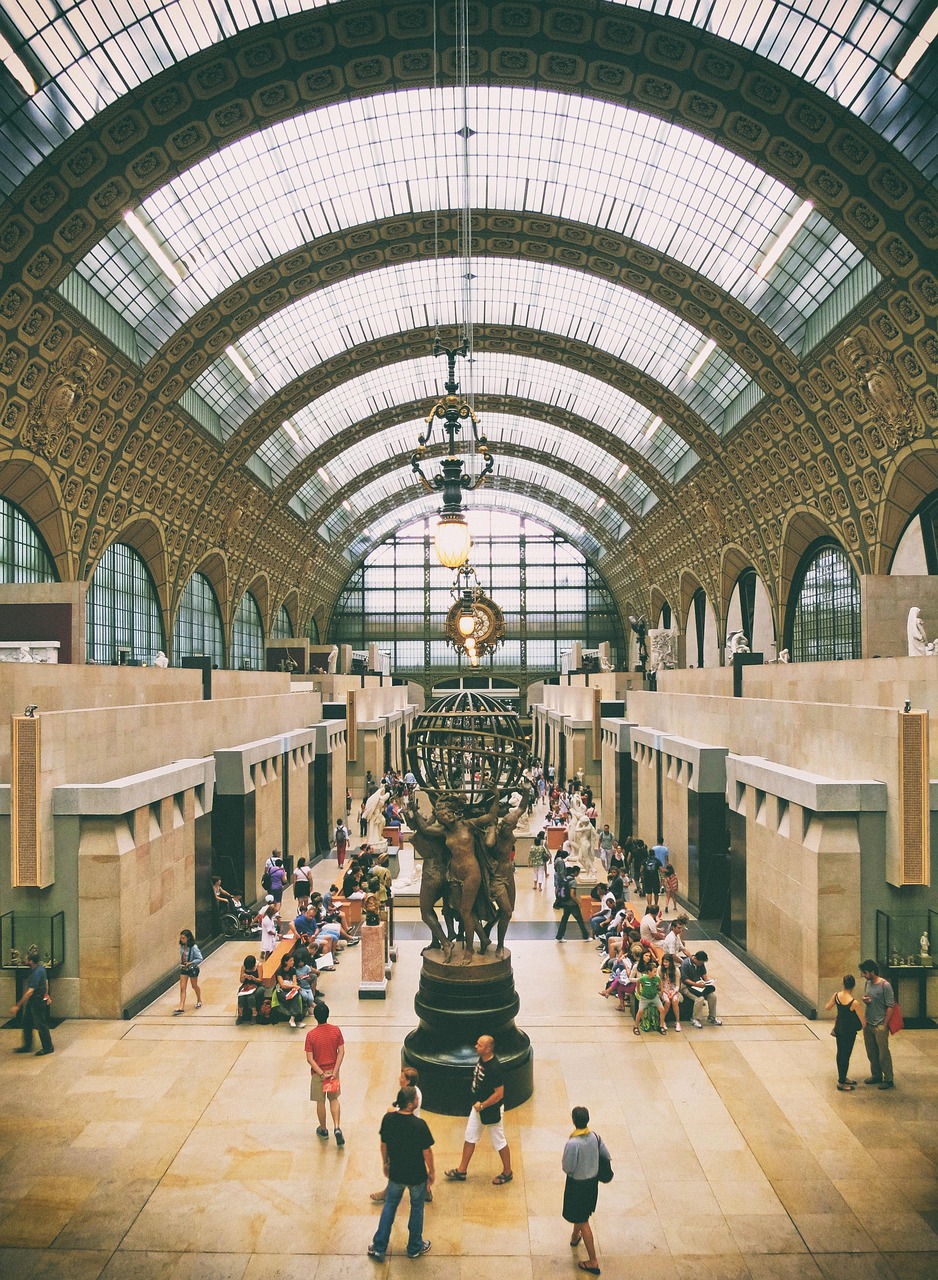
The Gare d’Orsay was built for the 1900 Universal Exhibition, bringing trains into central Paris near the Seine. Its platforms eventually became too short for newer trains, and the station lost its original long-distance role.
The building escaped demolition and was converted into an art museum, opening in 1986. The great hall, metal structure and monumental clocks still make its former purpose easy to recognise.
Musée d’Orsay was the first museum I visited in Paris, and I spent almost an entire day there. I would still return because I know I missed details. Anyone planning a visit should check the current practical information along with these tips for visiting Musée d’Orsay.
53. Monet helped shape the Water Lilies rooms at the Orangerie
The eight monumental Water Lilies compositions at the Musée de l’Orangerie weren’t placed in ordinary rectangular galleries after Monet’s death. The artist worked on an environment intended specifically for them.
Two elliptical rooms allow the paintings to surround the visitor, with daylight entering from above. Sunrise tones are positioned towards the east and sunset tones towards the west, extending the sense of time passing across the cycle. The works were installed according to Monet’s plan in 1927, several months after he died.
54. Centre Pompidou places much of its machinery on the outside
The coloured pipes, ducts, escalators and exposed structure of Centre Pompidou aren’t decorative additions placed over a conventional museum. Architects Renzo Piano and Richard Rogers moved many of the building’s services to the exterior so the interior floors could remain large, open and adaptable.
The colours help identify different functions, while the transparent external escalator creates a route up the façade. The design was radical when the centre opened in 1977 and drew plenty of criticism. Its current transformation may change how visitors enter and use the building, but the inside-out architectural idea remains its defining feature.
55. Victor Hugo’s novel renewed interest in Notre-Dame
Victor Hugo published Notre-Dame de Paris in 1831. The novel is widely known in English as The Hunchback of Notre-Dame, although the original title places the cathedral itself at the centre.
At the time, Notre-Dame had suffered neglect, damage and unsympathetic alterations. Hugo’s book drew attention to Gothic architecture and strengthened public concern for the cathedral. It contributed to the climate that led to a major restoration, but it would be an exaggeration to say the novel single-handedly saved the building.
56. A Paris screening became a landmark in cinema history
On December 28, 1895, the Lumière brothers presented a programme of short films to a paying audience in the Salon Indien of the Grand Café on Boulevard des Capucines. The event is commonly described as the first commercial public film screening.
Other inventors and earlier film demonstrations form part of cinema’s history, so “the invention of cinema” can’t be reduced to one night. Still, the Paris screening was decisive because it showed motion pictures to a paying public as a shared form of entertainment.
57. The bouquinistes have sold books beside the Seine for centuries
Bouquinistes operate from the dark green boxes fixed to the parapets along sections of the Seine. They sell second-hand and antiquarian books, prints, postcards and other paper items.
The trade developed over several centuries, and the boxes can be locked when the sellers leave. Their riverside position makes them part of the landscape rather than a separate market building. Browsing them also connects the city’s literary reputation with an everyday walk along the quays.
58. Foucault demonstrated the Earth’s rotation inside the Panthéon
In 1851, physicist Léon Foucault suspended a long pendulum from the dome of the Panthéon. The pendulum’s plane of swing appeared to turn over time, providing a direct and visible demonstration that the Earth rotates.
The experiment could be understood without watching the stars or making complex astronomical calculations. A pendulum has returned to the Panthéon in later installations, allowing visitors to see the principle in the same building associated with the original public demonstration.
59. The flame beneath the Arc de Triomphe is rekindled every evening
The Tomb of the Unknown Soldier lies beneath the Arc de Triomphe. It honours unidentified French soldiers who died during World War I. The memorial flame was first lit in 1923 and is rekindled in a ceremony every evening, traditionally at 6:30 p.m.
The ceremony has continued through war, occupation and political change. Visitors who arrive at the right time can watch, but the area is an active memorial and should be treated accordingly. The Arc de Triomphe also appears in this selection of favorite places in Paris, alongside Musée d’Orsay and several places with a very different atmosphere.
60. Père Lachaise is the largest cemetery in Paris
Père Lachaise covers approximately 44 hectares and contains around 70,000 burial plots, making it the largest cemetery in Paris. Its sloping paths, named avenues, trees, monuments and separate divisions can feel more like a walled district than one open burial ground.
Among the people buried there are Frédéric Chopin, Oscar Wilde, Édith Piaf, Colette, Marcel Proust and Jim Morrison. It remains an active cemetery, so the famous graves and funerary art should be explored with the same respect you would show at any burial place.
Paris appears frequently in world capitals quiz questions, but the stories in this section show why knowing the capital is only the beginning.
Paris Food Traditions With Histories of Their Own
A collection of Paris food facts would be incomplete without the changing meaning of “restaurant,” an official baguette competition and a market whose unusual name has survived for centuries.
61. The word “restaurant” was first connected with restorative food
The French word restaurant was used for food believed to restore strength, particularly concentrated broths. A popular story credits a Parisian named Boulanger with opening the first restaurant in 1765, but historians have questioned both the evidence and the claim that one person invented the modern restaurant.
Paris did play an important role in its development. In the late 18th century, establishments offered individual tables, menus and dishes chosen by the customer rather than one fixed communal meal. After the French Revolution, changing employment and a growing dining public helped the restaurant trade expand.
62. Paris holds an official competition for its best traditional baguette
The City of Paris has organised the Grand Prix de la Baguette de Tradition Française since 1994. Bakers submit loaves that must meet the competition’s size, weight and salt requirements. A jury evaluates appearance, baking, texture, aroma and taste.
The winner receives a prize and the opportunity to supply baguettes to the Élysée Palace for one year. The winning bakery changes annually, so anyone hoping to buy that year’s top baguette should check the latest official result rather than relying on an old travel article.
63. Marché des Enfants Rouges is Paris’s oldest covered market
The market in the Marais dates to 1615 and is generally described as the oldest covered market in Paris. Its name means “Market of the Red Children,” a reference to children from a nearby orphanage who wore red uniforms, the colour associated with Christian charity.
Today, the market combines food stalls, fresh products and small places to eat. Its age doesn’t mean the space has remained unchanged since the 17th century, but the name has preserved a local story that would otherwise be easy to lose.
Food, art and landmark comparisons also make the choice between France and Italy much harder than a simple preference for one cuisine.
Green and Unexpected Places in Paris
Several unusual facts about Paris lead towards vines, imitation ruins and abandoned railway tracks. These places also offer a change of pace between museums, churches and the busiest streets.
64. Montmartre still has a working vineyard
Clos Montmartre occupies a small slope near the Musée de Montmartre. Vines had grown in the area long before Montmartre became part of Paris, but urban development greatly reduced the vineyard land.
The present vineyard was planted in the early 1930s, and its first modern harvest took place in 1934. Wine is produced in limited quantities, and the annual Fête des Vendanges celebrates the harvest. The vineyard is fenced, so you can see it from the street but can’t normally wander among the vines.
Seasons can change the experience of this and many other outdoor places, which is worth considering when deciding on the best time of year to visit Paris.
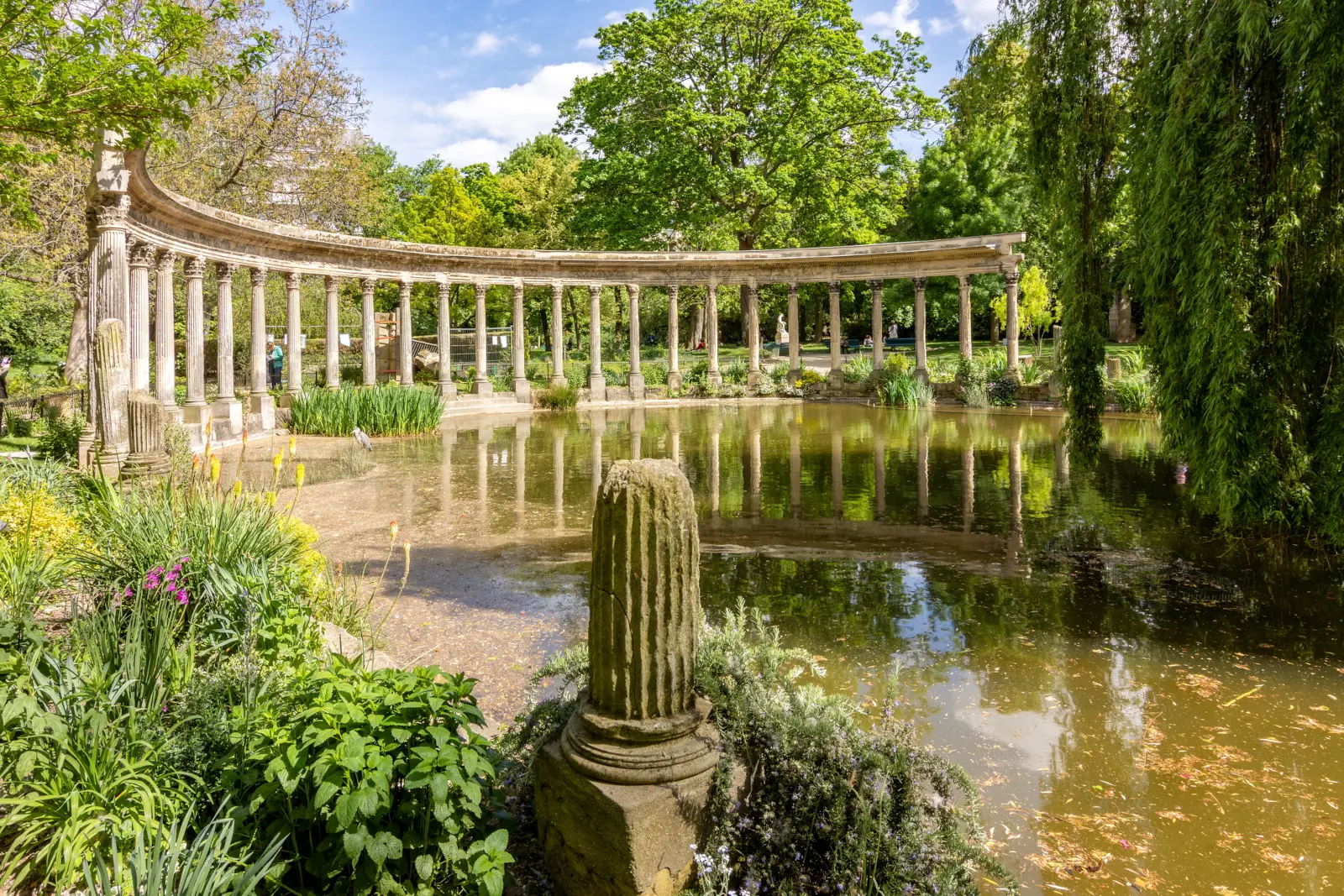
65. Parc Monceau’s Roman-looking ruins aren’t Roman
ID 457342208 ©Mistervlad | Dreamstime.com
The semicircular colonnade beside the water in Parc Monceau is known as the Naumachie. It looks like the remains of an ancient Roman structure, which was exactly the effect intended when the garden was developed in the late 18th century.
The feature is a garden folly rather than an archaeological ruin. Some of its columns came from an unfinished 16th-century monument associated with Catherine de’ Medici, then were reused to create this romantic setting. The park also contained other fanciful features representing different times and places.
Paris parks often reward a slower look. Even a familiar garden can offer an unexpected scene, including the ducks in the Tuileries Garden.
66. Parts of the Petite Ceinture have become green walking spaces
The Petite Ceinture was a circular railway built around Paris in the 19th century. It carried passengers and freight and linked the city’s major railway lines. Passenger service ended on most of the route in 1934, although parts continued to serve other railway purposes.
Several sections have since opened as walking areas and habitats for plants and wildlife. Old tracks remain in places, creating an unusual combination of railway history and urban nature. It isn’t one uninterrupted public trail: some sections are separated, inaccessible or still connected with railway operations, so check the entrance for the part you intend to visit.
Modern Paris and the Olympic Legacy
Modern Paris facts changed quickly around the 2024 Olympic and Paralympic Games. The city used the Seine and famous landmarks as stages, then kept one of the most discussed promises by opening supervised river-swimming areas.
67. Paris has hosted the Summer Olympics three times
Paris hosted the Summer Olympic Games in 1900, 1924 and 2024. It became only the second city, after London, to host the summer event three times.
The 1900 Games were held alongside the Exposition Universelle and stretched over several months. The 1924 edition introduced an Olympic Village, though it was far simpler than the large complexes built later. A century after that, the 2024 Games used Paris itself as part of the setting, with competitions and ceremonies near monuments and along the Seine.
68. The Paris 2024 opening ceremony was the first held outside a stadium
On July 26, 2024, the Olympic opening ceremony left the stadium for the first time in Summer Games history. Athletes travelled along a six-kilometre route on the Seine, with 85 boats forming the first Parade of Nations held on a river.
The route passed landmarks including Notre-Dame, the Louvre area and the Grand Palais before reaching the Trocadéro. Heavy rain became part of the evening, but it didn’t change the historical distinction: the host city itself served as the ceremony’s main stage.
69. Paris used famous landmarks as Olympic venues
Paris 2024 placed temporary and adapted competition spaces beside monuments rather than hiding the Games in a distant sports district. Beach volleyball took place beneath the Eiffel Tower, while fencing and taekwondo used the Grand Palais.
Archery was held at Les Invalides, urban sports filled Place de la Concorde, and equestrian events took place in the grounds of Versailles. Not every venue was inside the City of Paris, but the arrangement gave television viewers a constant visual connection between the competitions and the destination.
70. Public swimming returned to designated parts of the Seine
Swimming in the Seine had been prohibited for generations, but the water-quality and infrastructure work connected with Paris 2024 continued after the Games. Three supervised public swimming areas opened in summer 2025.
The sites at Bras Marie, Grenelle and Bercy returned for the 2026 season, scheduled from July 4 to August 30. Opening depends on daily water-quality tests, current, weather and safety conditions, and swimming elsewhere remains prohibited. Current hours and closures are published in the City of Paris guide to swimming in the Seine.
Conclusion
The postcard version of Paris is real and worth seeing, but the smaller details give you more reasons to stop. The names on the Eiffel Tower, a medieval wall beside modern homes, a bronze disc in the pavement and an old railway line turned green can all become part of the same day.
Learning these facts has also given me more reasons to return. Next time, I would like to look for more Arago medallions, see the surviving city walls and spend time in museums I couldn’t fit into my first trip. Paris has many places that deserve more than one hurried visit, even though this playful article offers several reasons you should never visit Paris.
Which of these Paris facts surprised you most, and which detail would you look for during your next visit?
Frequently Asked Questions About Paris Facts
These answers bring together several of the most common questions about Paris without repeating all 70 stories.
What are five interesting facts about Paris?
Paris takes its name from the Parisii; its 20 arrondissements form a clockwise spiral; the Louvre began as a medieval fortress; approximately two-thirds of Sainte-Chapelle’s stained glass is original; and bronze Arago medallions trace the former Paris meridian.
What was Paris called before it was known as Paris?
Roman Paris was known as Lutetia, or Lutetia Parisiorum. The later name Paris developed from the Parisii, the Gallic people associated with the area before the Roman conquest.
Why is Paris called the City of Light?
The nickname La Ville Lumière is commonly associated with two parts of the city’s history: Paris as an intellectual centre during the Enlightenment and its early use of organised urban lighting. Evidence doesn’t establish one explanation as the sole origin, so both associations are usually mentioned.
How many arrondissements does Paris have?
Paris has 20 numbered arrondissements arranged in a clockwise spiral. The first four remain separate numbered arrondissements but share one administrative sector called Paris Centre.
How large is the City of Paris?
The City of Paris covers approximately 105 square kilometres, including the Bois de Boulogne and Bois de Vincennes. Greater Paris and the wider metropolitan area are much larger.
What are some lesser-known facts about Paris?
The Palais Garnier has an engineered water reservoir beneath it; communal cups once hung from Wallace fountains; Marie Antoinette’s memorial chapel partly occupies the site of her later Conciergerie cell; Parc Monceau contains imitation ancient ruins; and part of Canal Saint-Martin passes beneath streets near the Bastille.
What small details should visitors notice in Paris?
Look for arrondissement numbers on street plaques, Guimard’s Art Nouveau Métro entrances, bronze ARAGO medallions, Wallace fountains, flood markers and fragments of the wall built by Philip Augustus.
Is Greater Paris the same as the City of Paris?
No. The City of Paris consists of the 20 arrondissements. Greater Paris refers to a wider territory extending into surrounding municipalities. Versailles, Disneyland Paris, La Défense and the Stade de France are all associated with Paris travel, but they are outside the City of Paris.
Can people swim in the Seine now?
Only in authorised, supervised areas when they are officially open. In summer 2026, the City of Paris scheduled swimming at Bras Marie, Grenelle and Bercy from July 4 to August 30, subject to daily water-quality, weather, current and safety checks. Swimming outside designated areas remains prohibited.
Are all popular Paris facts online accurate?
No. Several claims begin with a real detail and become misleading through repetition. Point Zero isn’t the geographical centre of France, the Eiffel Tower doesn’t permanently grow 15 centimetres each summer, the Palais Garnier reservoir isn’t a natural underground lake, and the present Marie Antoinette memorial space isn’t an untouched original cell.
More amazing articles for you:
Hungarian Goulash Recipe
Deutsches Museum Munich: Why You’ll Want to Spend the Whole Day Here
Technisches Museum Wien Guide: Exhibits, Tickets & Tips. My Guide to the Vienna Technical Museum
More Than 150 Tourists Arrived for Their Seaside Vacations in Italy. Then One Family Tried to Fix th...
Florence Travel Guide: What to See, Eat, Book, and Skip
Explore Oxford: Local's guide to Oxford with the best things to do, restaurants, hotels, and more
Zurich off the beaten path: 21 unique things to do in Zurich
Eiffel Tower Summit vs Second Floor: I Visited Both - Which Ticket Is Actually Worth It?

Violeta-Loredana Pascal is a communications expert, business mentor, and the founder of Earth’s Attractions and PRwave INTERNATIONAL. A pioneer in the Romanian digital PR landscape since 2005, she holds a degree in Communication and Social Sciences from SNSPA Bucharest. Violeta is a senior trainer at AcademiadeAfaceri.ro, where she leverages over 20 years of experience to teach professional courses in PR strategy and workplace productivity. By blending high-level business consulting with a passion for holistic travel and wellness, she empowers solopreneurs to overcome procrastination, build profitable brands, and design a life of purposeful adventure.