I love planning my family’s trips, and I’m usually the one who looks at all the pieces before we leave – from choosing where to travel next and deciding what we want to see to transport, accommodation and creating the itinerary.
I’ve booked hotels through online platforms and directly from the official websites of hotels and hotel chains. Of course I look at the price. But I’ve never chosen a hotel based on price alone, because there are too many other details that can affect the stay.
A cheaper room isn’t much of a bargain if you spend a lot of time getting to everything you want to visit. A beautiful room won’t help if it’s above a noisy bar and you’re a light sleeper. Free cancellation isn’t particularly useful if you don’t notice that it ends many days before your trip. And the room in the first photo you see may have very little to do with the room category you’re about to book.
There are things that move higher or lower on my list depending on the trip. When we travel by car, parking is high on my list. For short city trips, I usually want to be close to the attractions we’re planning to visit. As a woman, I also research the areas of a city before choosing where we’ll stay. I want a hotel in an area where I’ll feel comfortable returning later in the day too, not only one that looks convenient on a map.
So before I confirm a hotel reservation, these are the things I check.

ID 81772718 ©Fizkes | Dreamstime.com
1. Start With the Exact Location, Not With “Centrally Located”
Hotel descriptions tend to make locations sound appealing. “Central.” “Close to the main attractions.” “Convenient for sightseeing.” I want more than that.
I open Google Maps and compare the hotel with the places we actually plan to visit. I look at walking routes, public transport and how much time we’d spend going back and forth each day.
For a short trip, location can completely change how much you manage to see. During our one day in Pest, we stayed around 300 meters from St. Stephen’s Basilica and Cat Café Budapest. Apart from St. Stephen’s Basilica, which was almost next to us, the other attractions we wanted to see were within walking distance. That’s exactly what we needed when we had so little time in the city.
We used a similar approach on our first trip to Vienna. If I’m staying somewhere for only a day or two, I don’t want to lose a large part of that time commuting. Vienna has several areas that can work very well for visitors, depending on the trip, transport and what you want to see, so location is one of the first things I consider when deciding where to stay in Vienna.
Then there’s public transport. A hotel that looks a little farther away may have a direct connection to almost everything on your itinerary. Another one may appear closer on the map and require several changes or a lot of walking (I pay close attention to this as I have a knee issue and I avoid unnecessary walking). In Paris, knowing how the Metro and RER connect different parts of the city makes comparing hotel locations much easier.
And I have a special tip for you – this time based on something I read (that surprised me)! A recent Las Vegas case is a good reason to check the address separately. Traveler Ariana Patiño said she had ruled out OYO Hotel & Casino after reading its reviews and booked Palette Las Vegas instead. When she arrived, she discovered that Palette led her back to OYO. According to Patiño, a hotel employee told her the alternate listing was being used to see which name would gain more traction.
Before booking, copy the hotel’s exact street address and search it separately. Check which hotel appears at that address, look at Street View, and see whether the same address is being used under another hotel name.
Look at the area around the hotel too
I research the neighborhood as well.
As a woman, safety is something I pay attention to when choosing accommodation. I search for information about the areas of the city I’m visiting, read recent discussions and look at the streets around the hotel. I’m interested in the route back from a station or restaurant too, especially if we’re likely to return in the evening.
Street View helps. I look at the immediate streets, nearby businesses and transport stops rather than judging a large neighborhood from a single description.
Of course, looking at a street online isn’t the same as being there. I still want that extra information before choosing the hotel.
2. Compare the Cost of the Whole Stay
Let’s say one hotel costs $150 per night and another $175. I still wouldn’t pick the $150 room until I checked what each price actually covers.
Breakfast and parking alone can change the calculation quite a lot, especially for a family staying several nights.
I look at the amount for our full stay and then at the things we’re likely to pay for separately: breakfast, parking, local taxes, pet fees, extra beds, early check-in, late checkout or another service we know we’ll use.
Accommodation is also only one part of the travel expenses that are easy to forget when estimating how much a vacation will actually cost. A few smaller charges here and there can add a surprising amount to the final cost of a trip.
For hotel bookings in the United States, older articles about mandatory “hidden” hotel fees can now be outdated. The FTC’s Rule on Unfair or Deceptive Fees took effect on May 12, 2025. For covered short-term lodging, businesses displaying a price have to show the total price upfront including mandatory charges they know about and can calculate in advance. Government charges such as taxes and optional extras can be excluded from that first total, but they have to be disclosed before payment. The FTC guidance on lodging fees explains the rule in more detail.
I would still read what the rate includes. Breakfast, parking and the other extras you choose can make two similar-looking offers quite different.
3. Find Out About Deposits and Card Holds Before You Arrive
We had this happen recently at a hotel in Budapest. They placed a hold on the card, and the money became available again about two weeks later.
Hotels may place a temporary authorization or incidental hold on the card used at check-in. The amount varies by hotel and can be separate from the amount you’re paying for the room.
With a debit card, that can temporarily reduce the money available in your account. With a credit card, it reduces the available credit. Depending on your travel budget and card limit, you may care a lot about the amount being held.
When I can’t find the information in the booking conditions, I’d ask the hotel what it normally authorizes at check-in, whether that’s per night or for the whole stay and which payment methods it accepts for incidentals.
In our Budapest case, it took about two weeks for the held amount to become available again. That’s also why I wouldn’t assume that the money will reappear immediately after checkout. The hotel can release the authorization from its side, but your bank or card issuer handles what happens after that.
4. Read What Comes After “Free Cancellation”
I like flexible hotel bookings, but the words “free cancellation” are only the beginning of what I want to know.
The important part is the deadline.
It may be 24 hours before arrival, 48 hours, several days or another period stated in the conditions. After that, a rate may become fully non-refundable or the hotel may charge one night or another amount.
I check the exact date and hour. When the hotel is in another time zone, I also pay attention to which local time applies to the cancellation cutoff.
Changing the dates can have its own rules, so I look at that too. I check what happens with a no-show and whether the hotel charges the room immediately or later.
I’ve booked flexible rates and I’ve booked non-refundable rooms. I’ll choose a non-refundable rate if the price is really good and I know for sure I won’t cancel. I just want to make that choice myself rather than notice the restriction after I’ve paid.
I save the cancellation conditions with the reservation. A screenshot is enough. Months later, I don’t want to depend on remembering exactly what I read while booking.
5. Compare the Hotel’s Website With the Booking Platform
I’ve booked through online platforms many times. I’ve also booked directly from hotels and hotel chains.
Before confirming through an OTA, I often open the hotel’s own site as well.
The comparison has to be fair, though. I look at the same room category and dates. Does one price include breakfast? Are the cancellation conditions identical? Is one prepaid? Does one rate include an extra benefit?
Hotel websites may have member prices, loyalty points or benefits attached to a direct reservation. A booking platform can still have a better deal for your dates.
I also look at who I’ll need to deal with later if plans change. A direct reservation means dealing with the hotel. With a third-party reservation, the platform may be involved in changes, cancellations or refunds.
I’ve used third-party platforms myself and will use them again. I simply compare both options before deciding.
6. Make Sure You’re Looking at Photos of Your Room Category

ID 26001164 ©Tacettin Ulas | Dreamstime.com
Hotel galleries can be misleading without containing a single fake photo.
You may see a beautiful suite first, followed by a renovated superior room, a room with a balcony and eventually the standard room you’re actually about to book. After scrolling through dozens of pictures, it’s very easy to remember the best ones.
Once I choose a room category, I look specifically at the photos assigned to it.
I also check the room size in square meters or square feet. Wide-angle lenses can make a small hotel room look considerably bigger.
View descriptions deserve a closer look too. “City view,” “courtyard view,” “interior view,” “garden view” and “partial sea view” can describe very different rooms.
I wouldn’t dismiss a courtyard room. For me, a quieter room can be more valuable than a better view. But if natural light, an exterior-facing window or the view itself is important to you, check what you’re actually booking rather than relying on the general gallery.
Hotels with renovated and older sections need another look. I try to find out whether the room category I’m considering is in the renovated part of the property.
7. Check the Bed Setup, Especially When More Than Two People Are Staying
I’ve traveled only with my husband on some trips, while on many family vacations our son was with us too. The bed setup obviously becomes much more important when you’re booking for three people instead of two.
A double room may have one bed or two beds, depending on the property and booking option. Double, queen, king and twin can also be used a little differently from one country or hotel to another.
With children, I read the occupancy details carefully. Is the child included in the room price? Are they expected to share one of the existing beds? Is there a sofa bed? Can the hotel add another bed, and what does it cost?
I also look at whether the bed arrangement is guaranteed or shown only as a preference.
Connecting rooms are another example where the same feature can be great for one guest and annoying for another. We had connecting rooms in Timișoara, and for us they were great. A family booking two rooms may specifically want them.
If you’re a light sleeper and aren’t using both rooms, however, the connecting door can allow more sound through. You can ask for a non-connecting room as a preference.
8. Look Beyond the Main Room Description
I like quiet areas, so room position is one of the details I pay attention to.
A room beside the elevator wouldn’t be my first choice. The same goes for one above a busy bar or facing a very noisy road if I have another option.
Recent reviews can reveal a lot about this. I search for terms such as street, bar, elevator, walls, traffic, nightclub and connecting room.
There are other small details that can make a room comfortable or annoying depending on what you like. Curtains matter if you prefer a dark room at night. Windows matter if you want natural light or fresh air. Bathroom design can become relevant when a hotel uses glass walls, open bathrooms or a layout with less privacy than you expected.
When a particular feature is very important to me and the answer isn’t clear online, I’d contact the hotel. I’d rather ask one question before paying than arrive and hope they’ll have another room available.
Security is part of my hotel research too. There are issues guests often start thinking about only after they’ve checked in, so I also keep hotel room safety concerns in mind when choosing and using accommodation.
9. Don’t Stop at the Air-Conditioning Icon
ID 100394721 ©Grecu Mihail Alin | Dreamstime.com
Air conditioning is very important to me everywhere, but especially when we’re traveling somewhere hot.
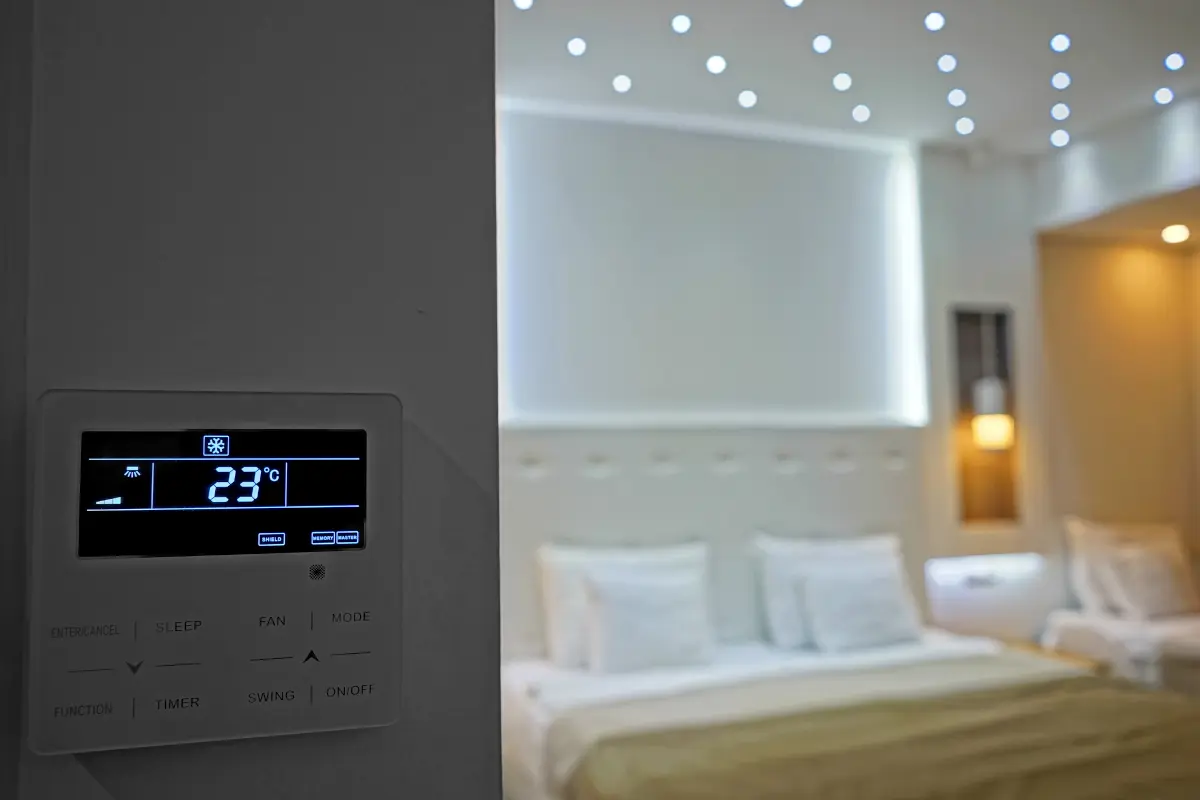
The small AC icon in a booking site’s amenities section isn’t enough for me if temperatures are going to be high. I want to know what kind of system the hotel has.
Some rooms have their own controls. In other hotels, heating and cooling are managed centrally. Seasonal systems can be particularly annoying during a hot spell in spring or autumn if cooling hasn’t been switched on yet.
I search recent reviews for “air conditioning,” “AC,” “heating,” “temperature” and “thermostat.” Guests tend to mention it when a room is uncomfortably hot or cold.
If I’m still unsure, I ask the hotel. Can guests adjust the temperature in the room? Will the cooling system be on during our dates?
I check the windows too. Being able to open one can make a difference to me.
10. I Read Recent Reviews Differently From Older Ones
The overall hotel rating is one of the first numbers everyone sees. I look at it too, but it isn’t enough for me.
I want to know what people who stayed there recently are saying.
A hotel may have thousands of reviews collected over many years. Meanwhile, something very relevant could have changed last month: construction started next door, breakfast became worse, the rooms were renovated or several guests began complaining about the air conditioning.
I usually start with newer reviews and then search for the subjects I care about. I also look at articles and online discussions, rather than limiting my research to reviews on a single booking site.
When we travel by car, I search for parking. If I’m looking forward to the hotel’s breakfast, I search for that. Other words I use include noise, clean, bed, bathroom, elevator, Wi-Fi, AC, heating, construction and check-in.
One bad review doesn’t scare me away from a hotel. People have different expectations, and even a good property can have an unhappy guest. Several recent reviews describing the same issue get my attention.
I find the middle ratings particularly useful. They tend to contain the trade-offs that help me make a decision: wonderful location but small rooms, good hotel but basic breakfast, very helpful staff but noticeable street noise.
I can live with plenty of hotel imperfections. I just prefer knowing about them before I book.
11. Search for Renovations, Building Work and Closed Facilities
A hotel website may have gorgeous photos of the pool, rooftop terrace and restaurant. Before getting excited about any of them, I check whether they’ll actually be available during our stay.
Recent reviews are often the fastest way to discover building work. If several people mention drilling, scaffolding or renovation noise, I search for more details.
Renovation work can affect the rooms, entrances, elevators, breakfast area, restaurants or swimming pool. Construction next door can create just as much noise.
Then there are facilities that open only during certain months. If I’m choosing a hotel mainly for its pool, rooftop bar or another seasonal facility, I check the opening dates. An outdoor pool can look fantastic in the photos and still be closed when you visit.
For anything that strongly influences my hotel choice, I’d rather confirm it before booking.
12. Pay Attention to the Amenities You Actually Use
I always look at amenities, especially the ones that interest me, and I pay attention to the exact wording.
“Breakfast available” and “breakfast included” are two different offers. That difference appears on the final bill. Breakfast hours can matter as well if you have an early tour, train or flight.
With Wi-Fi, what I need depends on the trip. For checking messages or maps, basic hotel Wi-Fi may be enough. Someone planning to work from the room or spend time on video calls will probably want to read recent reviews about the connection.
I also look for things such as a refrigerator or minibar, kettle, safe, hair dryer, luggage storage and 24-hour reception. A pool or gym may interest me on one trip and have no importance at all on another.
Check where the elevator actually takes you
Elevators have become particularly important to me because of my knee issues.
Older hotels and historic buildings can have unusual layouts. The elevator may serve only part of the building, stop between floors or leave you with another flight of stairs before you reach the room.
If you’re traveling with big suitcases, a stroller, older relatives or someone with reduced mobility, look beyond the elevator icon. Check how you actually get from reception to your room.
And even when there’s a perfectly good elevator, I usually prefer a room farther away from it. It’s generally quieter.
13. Match the Hotel’s Check-In Times to Your Travel Schedule
I don’t look at check-in and checkout after everything else is booked. I compare them with our flights, trains or driving schedule while planning the trip.
If your flight arrives at 7 a.m. and the room isn’t available until 3 p.m., you have a good part of the day between arrival and check-in. I’d want to know whether I can leave the luggage at the hotel and go out.
Departure day can create the reverse situation. An 11 a.m. checkout and an evening flight leave several hours in between, so luggage storage can be very useful again.
Late arrivals bring different questions. Is reception open all night? Does the hotel ask guests to notify them after a certain hour? Is there a self-check-in system? If a flight is delayed, will you still be able to get into the hotel?
I prefer dealing with those details while planning the whole trip, when I’m already looking at transportation and our daily schedule.
14. If You’re Driving, Read the Parking Details Carefully
When we travel by car, I look for parking before I book the hotel.
Free parking is always welcome, and I’ll choose it when the hotel itself is right for us. In a major city center, however, I know I may have to pay for parking. We checked this carefully for our stays in Vienna, Munich and Budapest.
The phrase “parking available” isn’t enough. I want to know what kind of parking they’re talking about.
Does the hotel have its own garage? Is it a public garage nearby? Can I reserve a space? What’s the daily price? Are there height restrictions?
If we’re planning to drive during the stay, I also check how entries and exits work. I don’t want to find out later that taking the car out of the garage several times changes what we’re paying.
There’s another part of the arrival that people can overlook: getting to the hotel itself. Older European city centers may have pedestrian streets, one-way systems, underground garages or environmental restrictions. It’s worth checking local driving rules in advance, as we did for driving in Germany.
Once parked, we don’t always use the car again. In Vienna, Munich and Budapest, we left it and used public transport or walked. We did use the car within places such as Brno, Veliko Tarnovo and Ruse. It depends very much on the city and on what we’re doing there.
15. Read the Final Booking Screen Before You Pay
By this point, you may already have spent a lot of time comparing hotels and reading all those details. It’s tempting to hurry through the last screen.
I check it anyway.
Dates come first. Overnight flights, late arrivals and time-zone changes make it surprisingly easy to confuse the night you need the hotel with the date shown on the booking.
Then I check the number of nights and guests, including our son when he’s traveling with us. I look at the room category, bed setup, breakfast or other inclusions, cancellation deadline and payment terms.
I also read the full hotel name and address. Chains can have several properties in one city with very similar names, and that’s a mistake I’d rather catch before paying.
Check the currency before paying for a hotel abroad
An international hotel payment may give you a choice between the local currency and your home currency. The second option may use Dynamic Currency Conversion, or DCC.
Visa explains that a DCC offer should show the amount in the local currency, the converted amount, the exchange rate and any additional fees or markup. You should also be able to accept or decline the conversion. The details are available in Visa’s Dynamic Currency Conversion guidance.
I don’t choose the converted amount simply because it’s easier to recognize my home currency. I look at the rate and fees being offered, and I know what my own card charges for foreign transactions.
After I book, I save the confirmation somewhere easy to find. Hotel details are among the things I keep on my phone when traveling, so I’m not searching through emails at reception.
I check them again when I go through my night-before-flight checklist. At that point I want the hotel address, booking confirmation and arrival details ready.
My 2-Minute Hotel Booking Check Before I Pay
Once I’ve done the research and decided on the hotel, I go through the booking one more time. These are the details I’d check before entering the card information.
Location: Is the hotel in the right part of the city for the things you want to do?
Neighborhood: Have you looked at the immediate surroundings and the route you’ll use when coming back later in the day?
Total cost: What will you actually spend after adding breakfast, parking or the other extras you’ll use?
Card hold: Does the hotel require a deposit or incidental authorization?
Cancellation: What is the exact cutoff date and hour?
Direct or third party: Have you compared the same room and conditions on both?
Room category: Are the photos and details really for the room you’re booking?
Beds: Does the setup work for everyone staying in the room?
Noise: What do recent guests say about street noise, elevators, connecting doors, bars or construction?
Heating and cooling: Will the room have the type of temperature control you want?
Reviews: Is the same complaint appearing again and again in recent reviews?
Facilities: Will the amenities that influenced your choice be open during your dates?
Access: If stairs are an issue, can you reach your room by elevator?
Arrival and departure: Will check-in, checkout, reception hours and luggage storage work with your transport?
Parking: If you’re driving, where will the car actually stay and what will it cost?
Final details: Hotel name, address, dates, guests, room, currency and payment terms – are they all correct?
I Don’t Expect a Hotel to Have Everything
I don’t expect every hotel to have everything I want and still fit my budget.
I’ll happily book a smaller room when the location is excellent. I’ll pay for parking if that hotel makes more sense than a cheaper one farther away. I’ve also chosen non-refundable rates when the savings were good enough and our plans were fixed.
What bothers me is discovering something important after the booking when I could easily have checked it before.
For each trip, I know which compromises I’m willing to make. Price may win one time, location another time, parking another. That’s fine. I just prefer knowing exactly what I’m choosing.
Once we arrive at the hotel, I do another quick check before we unpack. Locks, room condition and anything that needs to be reported are much easier to deal with at that point. These are the things I include in my hotel room check after entering.


Questions About What to Check Before Booking a Hotel
What should I check before booking a hotel?
Check the exact location and neighborhood, full cost of the stay, cancellation deadline, deposit or card-hold policy, room category, bed setup, recent reviews, heating and air conditioning, renovations, important amenities, check-in and checkout times, luggage storage and parking if you’re driving. Before paying, check the hotel name, dates, guests, room, currency and payment conditions again.
What should I look for in hotel reviews before booking?
Start with the newest reviews and search for the subjects that affect your own stay. I usually look for noise, cleanliness, beds, bathrooms, air conditioning, Wi-Fi, breakfast, parking, elevators, construction and check-in. Several recent guests mentioning the same issue gets my attention far more than one complaint.
Is it better to book a hotel directly or through Booking.com, Expedia or another booking site?
I compare both. Look at the same room, dates, cancellation terms, payment conditions and included extras. The hotel may offer a member rate or direct-booking benefit, while an OTA may have the better deal for your dates. Also check who you’ll need to contact later if you change or cancel the reservation.
What does free cancellation mean when booking a hotel?
Free cancellation applies until a specific deadline stated in the booking conditions. Depending on the rate, that may be hours or days before arrival. Check the date, exact time and the hotel’s time zone, plus the charge that applies after the deadline.
Can a hotel put a hold on my credit or debit card?
Yes. Hotels may place an authorization or incidental hold on the card used at check-in. The amount differs from one property to another. Ask the hotel about it in advance if the hold could affect the money or credit you have available during your trip.
How can I tell whether a hotel room will be quiet?
Search recent reviews for street noise, traffic, bars, elevators, thin walls, connecting doors, events and construction. If you know you’re a light sleeper, you can also ask the hotel to note a preference for a room farther from elevators, nightlife or other obvious sources of noise.
What does an interior view or courtyard view mean in a hotel?
It varies from hotel to hotel. A courtyard room usually faces an internal courtyard rather than the street. An interior view may face an atrium, lightwell or another part of the building. Look at photos for your exact room category and ask the hotel if the view or an exterior-facing window is important to you.
What should I check about hotel elevator access?
Find out whether the elevator reaches the floor and section of the building where your room is located. Older properties can still have stairs between the elevator and some rooms, which can be important when you’re carrying heavy luggage or have mobility problems.
How can I find out whether a hotel has individually controlled air conditioning?
Check the room description and recent reviews for references to individual thermostats or central air conditioning. If you can’t find a clear answer and room temperature is important to you, ask the hotel whether you can control it yourself and whether cooling will be operating during your stay.
What hotel fees should I check before booking?
Look at the full price and then at costs connected with the things you’ll actually use, such as parking, breakfast, pets, extra beds, early check-in or late checkout. For covered U.S. short-term lodging, mandatory calculable charges generally have to appear in the upfront total under the FTC’s current fee rule, while certain government charges and optional extras may be displayed separately before payment.
Should I pay for a hotel in the local currency when traveling abroad?
If Dynamic Currency Conversion is offered, look at the exchange rate and any fees or markup shown before choosing your home currency. Compare that with the foreign-transaction and currency-conversion terms of your own card. Visa’s rules require a DCC offer to show the relevant conversion information and allow the cardholder to accept or decline it.
More amazing articles for you:
5 Border-Crossing Walking Trails in Europe
10 Tips For Your First Trip To Japan
He Was Waiting for His Suitcase at Baggage Claim. Then a Sock Appeared - What Happened Next Had Peop...
How to Create Shade at the Beach?
300 Music Trivia Questions and Answers About Famous Songs - Easy to Hard (You'll Love This Trivia)
Unveiling the Top Travel Trends for 2024: A Journey into the Future of Wanderlust
The Best Places to Visit in Asia in January
A Local's Guide to Glasgow

Violeta-Loredana Pascal is a communications expert, business mentor, and the founder of Earth’s Attractions and PRwave INTERNATIONAL. A pioneer in the Romanian digital PR landscape since 2005, she holds a degree in Communication and Social Sciences from SNSPA Bucharest. Violeta is a senior trainer at AcademiadeAfaceri.ro, where she leverages over 20 years of experience to teach professional courses in PR strategy and workplace productivity. By blending high-level business consulting with a passion for holistic travel and wellness, she empowers solopreneurs to overcome procrastination, build profitable brands, and design a life of purposeful adventure.