
When we hand over a checked suitcase, we watch it disappear behind the baggage belt and usually don’t expect to see it again until we reach the carousel at our destination. We know it will be screened somewhere along the way, but passengers see very little of that process.
A new security procedure that took effect this week puts one part of that hidden journey into focus. If screening raises a concern about something inside a checked bag, the suitcase may be opened even if the passenger is not there for a closer inspection and an item can even be removed.
The rule may sound surprising, but it raises more questions: how common is this, what can cause a suitcase to be opened, and would you even know afterward? The new warning specifically mentions one small item many travelers pack almost automatically. Some suitcases have already been opened!

ID 81070887 ©Khunaspix | Dreamstime.com
A New Checked-Baggage Procedure Took Effect on September 8 – It Is Only The Newest, Read On To See Where in The World This Happens
The airport behind the new announcement is Athens International Airport. Beginning September 8, 2026, checked baggage that raises an indication or suspicion of a prohibited, dangerous, or other item requiring further examination may be opened and subjected to additional screening without the passenger being present.
If the closer examination confirms that something needs to come out of the suitcase, the relevant item may be removed as well. A passenger doesn’t have to be brought back to watch the bag being opened.
One Very Common Travel Item Is Specifically Mentioned
Athens Airport tells passengers to check their luggage carefully before handing it over, and one of the first things named in the warning is something millions of travelers carry: power banks and portable batteries.
They are easy to forget, true, but IATA’s 2026 guidance lists power banks as forbidden in checked baggage, including those rated at 100 Wh or below that can normally be carried in the cabin. The reason is the fire risk associated with lithium batteries if they are damaged, short-circuited or overheat.
Cabin crew can respond much more quickly to a battery problem they can see than to one developing inside baggage in the aircraft hold. Recent changes have brought even more attention to power-bank safety, with new international restrictions introduced in 2026 covering how many passengers can carry and how the devices may be used during a flight.
Important note: if a carry-on gets gate-checked, remove the power bank first.
In March 2018, a Boeing 787 flew from Melbourne to Bali with a power bank packed inside a passenger’s baggage in the cargo hold. After the aircraft landed and unloading began, ground workers noticed smoke coming from the hold and traced it to a burned suitcase. Australia’s Australian Transport Safety Bureau reported that the power bank inside the bag was the source. No one was injured.
Power Banks Aren’t the Only Items Athens Airport Is Warning About
The September notice names explosive or incendiary substances and devices, flammable materials, and other objects that can’t legally or safely travel in checked baggage. Fireworks are an obvious example, but dangerous-goods rules cover far more products than the items people usually picture when they hear the words “prohibited baggage.”
Aerosols, batteries, fuels, camping equipment, chemicals and battery-powered devices can all come with conditions that depend on the exact product, quantity or battery specification. Some can travel only in the cabin, some may be allowed in checked luggage under specific conditions, while others aren’t permitted on a passenger aircraft at all.
A Completely Legal Item Can Still Lead to More Screening
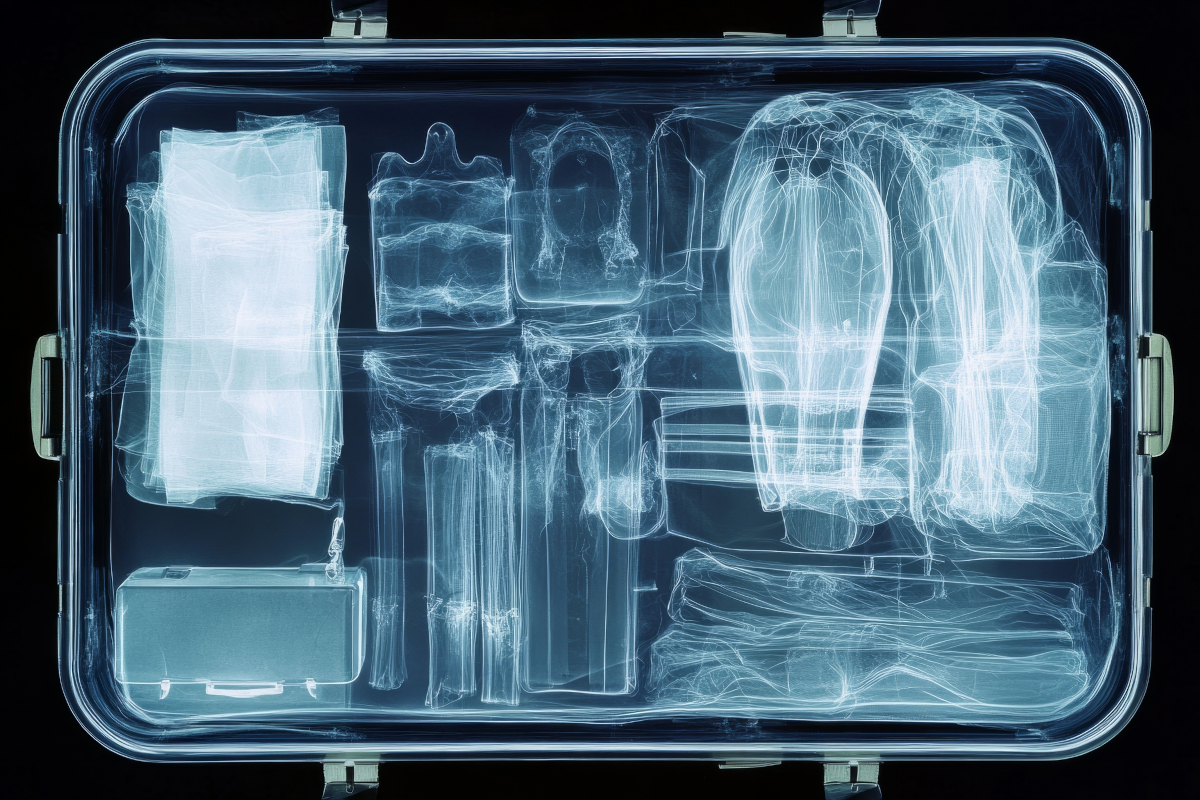
A suitcase doesn’t have to contain contraband for the screening process to stop temporarily. Security equipment still has to give the screener enough information to clear the bag.
Current EU aviation security rules allow checked baggage to be screened by several methods, including X-ray equipment, explosive-detection systems, explosive-trace detection, detection dogs and a physical hand search. A hand search involves a thorough manual check of the suitcase and its contents.
The same rules address another situation that travelers may never consider while packing. Dense objects, electronics grouped together or overlapping items can make an image harder to interpret. Security may need a closer look simply to identify what the scanner is showing.
A funny incident: One memorable example happened at New York’s JFK Airport, where a checked suitcase set off an alarm during TSA screening. When officers examined the X-ray more closely and opened the bag, the unexpected object inside wasn’t a prohibited travel item at all: it was a live orange cat. The animal had apparently climbed into the suitcase without the traveler realizing it before leaving for the airport.
So Is the Athens Rule Really New?
The procedure Athens International Airport announced for September 8, 2026 is new. The ability to physically inspect checked baggage is much older. European aviation-security regulations have allowed hand searches of hold baggage for years, along with X-rays and other screening methods. The current EU rules describe a hand search as a thorough manual inspection that includes the suitcase’s contents.
Brussels Airport, for example, tells travelers that staff may open a checked suitcase when screening finds something suspicious. Passengers are usually informed when additional screening is needed, but the airport also acknowledges that it sometimes opens bags without the owners present. In those cases, designated security personnel carry out the inspection and leave a numbered notice inside the luggage.
Thailand Is Moving in the Same Direction
Another comparison comes from Asia. Thailand’s Civil Aviation Authority has told passengers that checked baggage may be opened when screening detects a suspicious object, prohibited article or potentially dangerous item, and the inspection doesn’t require the traveler to be present.
Thailand’s procedure includes safeguards useful when comparing different systems: the bag opening is video recorded, and a notice is placed inside afterward. New checked-baggage screening provisions are due to take effect on October 16, 2026, further formalizing the process, weeks after the Athens change became effective.
Can TSA Open Your Checked Bag Without You?
ID 365652675 ©Michael Nesterov | Dreamstime.com
Yes. Travelers flying from the United States can have TSA physically inspect checked luggage without being beside the suitcase during the search.
TSA explains that technology lets officers screen many bags without opening them, but they occasionally need to conduct a physical inspection. If that happens, the agency says it places a Notice of Baggage Inspection inside the suitcase.
For an American traveler reading about the new Athens procedure and thinking, “Could this happen to my bag at home?”, the answer is already yes.
What Happens If Your Suitcase Is Locked?
Locking checked baggage doesn’t prevent a security search when one is required. In the United States, TSA-recognized locks are designed so officers can open them using the appropriate tools. If TSA needs to inspect a bag and can’t open the lock another way, the agency says it may have to cut the lock.
Canada follows a comparable approach. The Canadian Air Transport Security Authority says officers use special tools to open recognized travel locks when a physical search is necessary. If a lock can’t be opened, officers may break it so the inspection can continue.
Canadian officers then make reasonable efforts to secure the suitcase again and place a Notification of Checked Baggage Inspection card inside a bag that has been physically searched. Athens Airport’s new public notice explains when a suitcase may be opened without its owner, but it doesn’t spell out what happens if a particular lock prevents access.
Could Something Be Removed From Your Bag While You Aren’t There?
Yes. Athens Airport specifically states that it may remove the relevant item during additional screening when necessary.
Canada gives travelers another example of how this can work. CATSA says that if an item is removed from checked baggage during a security inspection, it is given to the airline and the passenger should follow the instructions on the inspection notice for information about what happens next.
National procedures aren’t identical, which becomes important if a traveler opens a suitcase at the destination and realizes something is missing. The airline, airport-security authority and baggage-handling process can all play different roles depending on the country and circumstances.
Would You Know If Your Suitcase Had Been Opened?
In the United States and Canada, official procedures provide travelers with a clear clue. TSA says it leaves a Notice of Baggage Inspection inside a suitcase it has opened, while CATSA uses its own Notification of Checked Baggage Inspection card.
Thailand provides an even more detailed comparison. In guidance published in June 2026, the Civil Aviation Authority of Thailand said it may open and inspect checked baggage without the passenger present when screening detects suspicious items, prohibited articles, or potentially dangerous goods. The inspection is video recorded and a notice is placed inside the bag.
The Athens announcement confirms that the suitcase may be opened and an item removed without its owner, but the public notice doesn’t describe a comparable written-notification system for every inspection.
Can Airport Security Open Checked Luggage in Other Countries Too?
Athens, the United States, Canada and Thailand already show why the broader answer is yes. Exact procedures vary, yet physical inspection of checked luggage forms part of aviation-security systems well beyond a single airport.
Airline conditions can include similar language. Carriers may state that they can search baggage in a passenger’s absence when the traveler isn’t available for inspection, particularly when security or legal requirements require access to the bag.
Smart Suitcases Add Another Battery Question
The battery problem isn’t limited to a portable charger tossed into a side pocket. Smart luggage may contain batteries that power tracking, charging, electronic locks, built-in scales or other features, and those batteries can affect whether the suitcase is accepted as checked baggage.
IATA’s current guidance distinguishes between small batteries installed in certain smart bags and larger removable lithium batteries. When the rules require a removable battery to come out before the suitcase is checked, the removed battery must stay in the cabin. Smart baggage with certain non-removable batteries can be prohibited altogether. Anyone using a suitcase with electronics should therefore check the bag itself before a flight, not only what’s packed inside.
Could an Extra Security Search Delay Your Suitcase?
Any bag selected for further examination must complete another security step before it can continue through the baggage system. The exact consequences depend on when the bag is flagged, how quickly the issue is resolved, and the airport’s procedures.
A traveler can’t control whether security decides a closer inspection is required, but many avoidable problems start before the suitcase ever reaches the screening equipment. Leaving a power bank in a checked bag, packing an item without checking whether it is permitted or forgetting about a lithium battery when a cabin suitcase is gate-checked can all create unnecessary complications.
What Should You Check Before Your Suitcase Disappears Down the Belt?
A quick final check before closing a suitcase can catch easy-to-miss items, especially if you’ve used the same bag as cabin luggage on another trip.
- Check every small pocket for power banks and spare lithium batteries.
- Move power banks and spare batteries into your cabin baggage before check-in.
- Look at the battery rules for electronic devices instead of treating every battery-powered product the same way.
- Check the airline’s rules for aerosols, tools, camping equipment, chemicals and other unusual items.
- Confirm whether a smart suitcase has a removable battery and what happens to it if the bag travels in the hold.
- If a cabin bag is unexpectedly taken at the gate, remove anything that can’t travel in checked baggage before handing it over.
- Check both airport and airline guidance when an item falls into a restricted category, since carrier policies can be stricter.
The airport’s banned-items list isn’t the only thing worth checking. A product may be permitted in one part of the aircraft and prohibited in another, and power banks are one of the clearest examples.
Conclusion
The checked-baggage procedure introduced at Athens International Airport on September 8, 2026 gives travelers a useful reminder about what happens after a suitcase disappears behind the check-in belt. If security detects or suspects a prohibited, dangerous or otherwise questionable item, the bag can be opened for additional screening without its owner present and the relevant item may be removed when necessary.
Athens isn’t alone. Checked bags can be physically searched in the United States, Canada, Thailand and other aviation systems, although notification procedures and the treatment of locks or removed belongings differ.
For travelers, one of the easiest mistakes to prevent involves the item Athens specifically put on its warning list: the power bank that ends up forgotten inside a checked suitcase. A few seconds spent checking pockets, batteries and unusual products before handing over the bag can save considerably more trouble once the suitcase has moved out of sight.
Frequently Asked Questions About Checked-Baggage Searches
Can airport security open checked luggage without you?
Yes. In several countries, airport security authorities can physically inspect checked luggage without the passenger standing beside the suitcase. Athens International Airport explicitly introduced a procedure allowing this from September 8, 2026, while TSA, CATSA and Thailand’s aviation authority document physical checked-baggage inspections as well.
Can Athens Airport open my checked suitcase without me?
Yes. From September 8, 2026, Athens International Airport says checked baggage may be opened for additional screening without the passenger present when a prohibited, dangerous or other item requiring further examination is detected or suspected.
Can airport security remove something from checked baggage?
Yes. Athens Airport says it may remove the relevant item when necessary. Other countries have their own procedures for handling removed belongings, so passengers may need to contact the airline or the responsible security authority for further information.
Can TSA open my checked bag without me?
Yes. TSA can physically inspect checked luggage during the security-screening process without the passenger present. TSA says it places a Notice of Baggage Inspection inside luggage that an officer has opened.
Can TSA open a locked suitcase?
Yes. Security officers can open TSA-recognized locks using appropriate tools. If TSA can’t complete a required inspection because it can’t open a lock another way, the agency says the lock may have to be cut.
Will I know if airport security opened my checked bag?
It depends on the country. TSA in the United States and CATSA in Canada place inspection notices inside bags they physically search, while Thailand says its inspections are video-recorded and a notice is left in the suitcase. Athens Airport’s September 2026 public announcement doesn’t specify an equivalent notification procedure for every search.
Can a power bank go in checked luggage?
No. Power banks containing lithium batteries must remain in cabin baggage, not checked luggage. Athens Airport specifically names power banks and portable batteries in its new checked-baggage warning.
What if my power bank is in a carry-on that gets checked at the gate?
Remove the power bank before handing the suitcase over. Once a cabin bag is transferred to the aircraft hold, power banks and spare lithium batteries can’t remain inside it.
Why would airport security search a checked suitcase?
Additional screening can be required when an item appears prohibited or dangerous, when screening equipment raises an alarm, or when the image doesn’t allow security staff to identify an object clearly enough to clear the bag. A physical search can therefore take place even when the contents ultimately prove to be permitted.
Can security search a suitcase just because something looks unclear on the X-ray?
Yes. EU aviation-security rules require another screening method when an item’s density prevents proper analysis of the contents of checked baggage. A manual inspection is one of the methods available for screening hold baggage.
More amazing articles for you:
My Guide To Ceaușescu Mansion Bucharest: Tickets, Tour & What to See
Don't go to Paris: here's why you shouldn't visit Paris, France
Insider's Guide to Toronto
A Couple Demanded a Passenger Give Up a Reserved Train Seat. Their Reason Was Infuriating - but Ther...
A guide to Poznan, Poland
4 Top Ways to Cut the Cost of Flying Long-Haul
Dracula & Transylvania Quiz: Fact or Myth?
Day trips from NYC - the best weekend getaways from New York City

Violeta-Loredana Pascal is a communications expert, business mentor, and the founder of Earth’s Attractions and PRwave INTERNATIONAL. A pioneer in the Romanian digital PR landscape since 2005, she holds a degree in Communication and Social Sciences from SNSPA Bucharest. Violeta is a senior trainer at AcademiadeAfaceri.ro, where she leverages over 20 years of experience to teach professional courses in PR strategy and workplace productivity. By blending high-level business consulting with a passion for holistic travel and wellness, she empowers solopreneurs to overcome procrastination, build profitable brands, and design a life of purposeful adventure.