
Updated July 2026
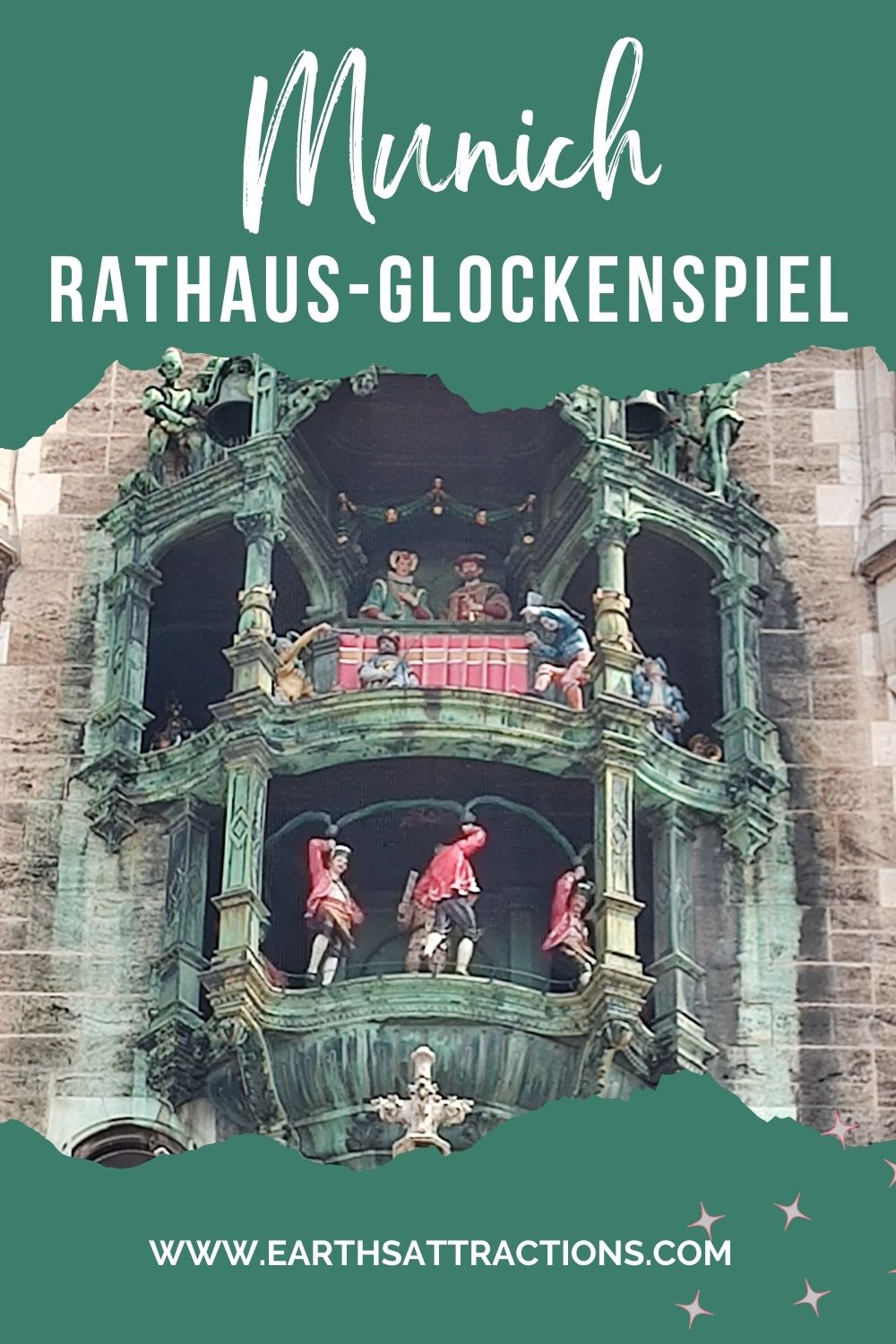
The Rathaus-Glockenspiel is one of Munich’s most famous landmarks. Located on the façade of the New Town Hall (Neues Rathaus) in Marienplatz, this large mechanical clock draws visitors who want to see its bells, moving figures, historical scenes, and unmistakably Bavarian performance.
Of course, we did not miss it! I created our Munich itinerary, and the Rathaus-Glockenspiel was on day one. In fact, it was the first attraction we visited in Munich.
We watched the 11:00 AM show and arrived at around 10:40, which gave us enough time to choose a good place in the square. In this guide, I am sharing the current Munich Glockenspiel times, where we stood, what the performance felt like, what the moving scenes represent, and useful tips for planning your own visit.

Munich Glockenspiel Times and Essential Visitor Information
Daytime performances: 11:00 AM and 12:00 noon every day
Additional performance: 5:00 PM from March through October
Night display: 9:00 PM daily, but this is a different and much shorter scene rather than the full daytime performance
How long to allow: Approximately 15 minutes for the daytime show, although the exact duration can vary with the musical programme
Cost: Free
Tickets or reservations: Not required
Location: Neues Rathaus, Marienplatz, central Munich
Recommended arrival: Around 10 to 15 minutes early, and a little earlier during particularly busy periods
Important: The noon performance takes place throughout the year. It is not limited to the warmer months. The 5:00 PM performance is the seasonal one, running from March through October.
The Glockenspiel is normally silent all day on Good Friday. Maintenance or exceptional circumstances may also affect a performance, so check the official Munich Glockenspiel schedule shortly before your visit if seeing it is one of your priorities.
Schedule last checked and article updated in July 2026.
Is the 9 PM Munich Glockenspiel show the same performance?
No. Every evening at 9:00 PM, the night watchman and guardian angel appear as the Münchner Kindl is put to bed to the sound of a lullaby. It is a lovely detail for visitors who are already in Marienplatz in the evening, but it is not a replacement for the complete daytime show with the jousting scene and the Schäfflertanz.
What It Was Like Watching the 11 AM Glockenspiel Show
We arrived at around 10:40 AM. Marienplatz was already busy, and there were several guided groups as well as people visiting independently, but we had no difficulty finding a place from which we could see the complete performance.
We stayed near the Mariensäule, or St. Mary’s Column, which stands in the centre of Marienplatz. Erected in 1638, the column is topped by a gleaming golden statue of the Virgin Mary holding the Christ Child. While facing the Rathaus-Glockenspiel, we stood on the left side of the column.
That position was very good for us. We were far enough from the façade to see both levels of figures clearly, without feeling as though we were standing at the back of the square. If a taller person moved in front of us, we only had to shift slightly to the left or right. We did not have any real visibility problems, and we saw everything perfectly.
The square does get crowded, but there is usually room to adjust your position. Arriving before the music began gave us the freedom to choose our observation point rather than trying to squeeze into the first available gap at the last second.
I liked every moment of the performance. I would happily see it again, but next time I would put away my camera and phone. I photographed and recorded so much of our first visit that I would now like to stand there and simply enjoy the music, the figures, and the atmosphere from beginning to end.
Where to Stand for the Best View of the Munich Glockenspiel
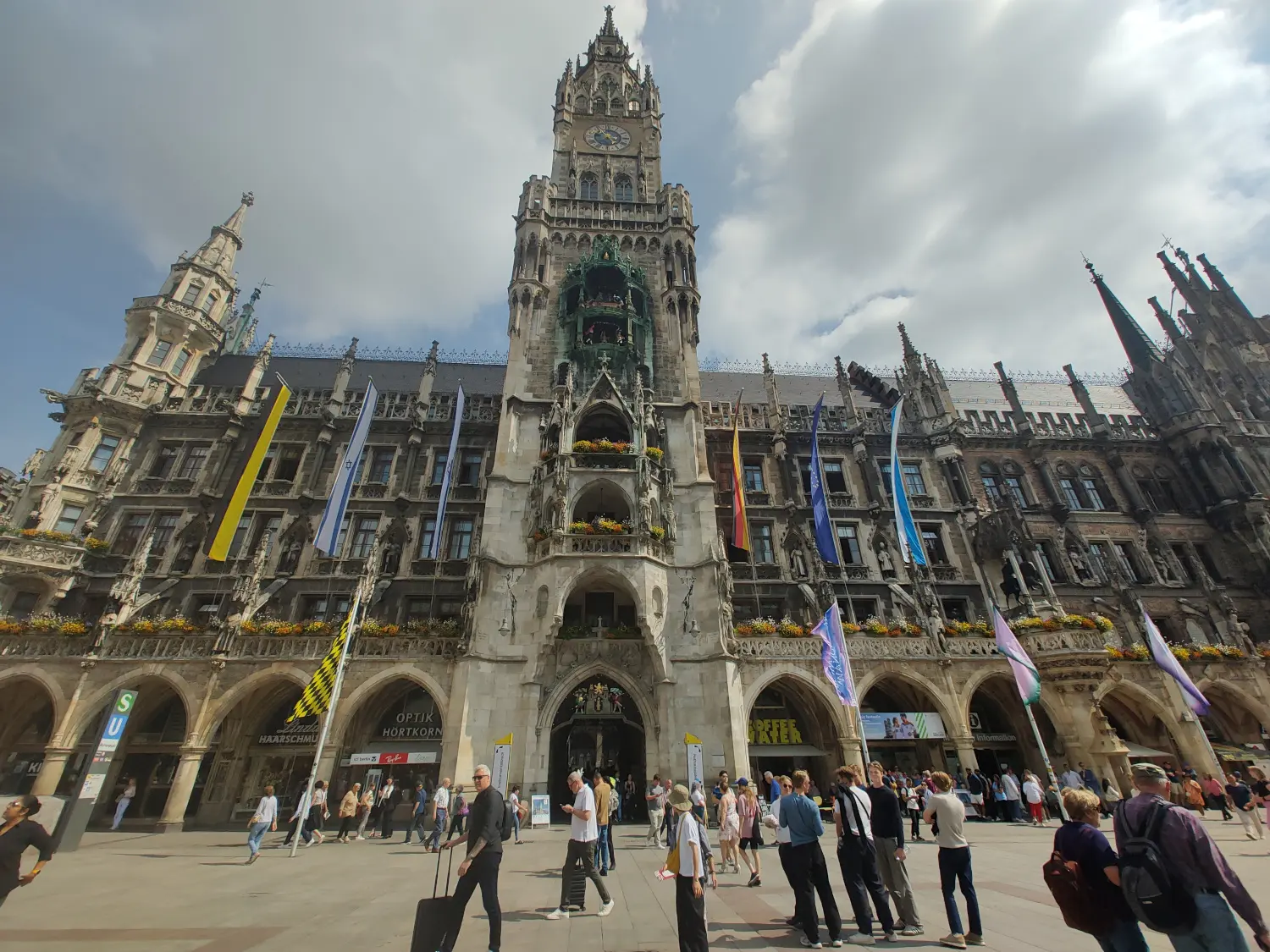
The best straightforward view is from the central part of Marienplatz, facing the New Town Hall. Do not stand directly below the façade. You need enough distance to see the upper jousting scene and the lower Schäfflertanz without repeatedly moving your head or missing part of the action.
Our position near the left side of the Mariensäule, while facing the tower, gave us a clear view of both levels. This is the location I would personally choose again.
Arrive at least 10 to 15 minutes before the advertised time. Summer weekends, Christmas-market days, school holidays, and major events can bring larger crowds, so allow more time then.
Café Glockenspiel, in the building opposite the New Town Hall, can provide an elevated perspective if you manage to get a suitable table. However, a table with an unobstructed view is not guaranteed, and watching from the square gives you the atmosphere of the crowd reacting to the performance.
The tower of St. Peter’s Church offers a panoramic perspective over Marienplatz, but I would not choose it if your main purpose is to follow the individual moving figures. The tower also involves 306 steps and has no lift.
Which Munich Glockenspiel Performance Should You Watch?
| 11:00 AM | A good choice for beginning a morning in Munich’s Old Town. This is the performance we watched. |
| 12:00 noon | Useful if you arrive in the centre later. This performance runs throughout the year. |
| 5:00 PM | Convenient for an afternoon Old Town visit, but available only from March through October. |
| 9:00 PM | A short night display with the night watchman, guardian angel, and Münchner Kindl. It is not the complete daytime show. |
I would choose the 11:00 AM performance again. It gave us time to enjoy the Glockenspiel and then continue exploring Marienplatz and the surrounding Old Town without rushing.
What Happens During the Munich Glockenspiel Show?
You know the performance is beginning when the music starts. Then the figures begin to move, but not all at once. Different tunes accompany different groups of figures, and the scenes unfold across more than one level of the tower.
I loved the music. It has that unmistakable Bavarian character—how can you not love it? The bells, the movement, and the elaborate façade turn what could have been a simple mechanical display into a small open-air performance.
I had already watched the figures of the Ankeruhr in Vienna, another clock show I enjoyed. Munich’s Glockenspiel felt more complex to me because the scenes take place on multiple levels and several groups of figures contribute to the story.
There is a clear sound when the performance finishes. I also remember a small feeling of sadness because it was over. You wait, look up, watch the historical figures come to life, and then suddenly the square returns to its normal movement.
How Long Does the Munich Glockenspiel Show Last?
Allow approximately 15 minutes for the daytime Rathaus-Glockenspiel performance. The precise duration can vary with the music being used, so do not plan an appointment immediately afterward.
The show is long enough to feel like a real performance, but short enough to add easily to an Old Town visit. Arriving 10 to 15 minutes early means the complete stop will normally take around half an hour.
We recorded the entire show. I had planned to post the video on YouTube and include it here, but the recording does not fully convey the sound, atmosphere, and details you notice while standing in Marienplatz. It is one of those attractions that is much better experienced in person.
What Is the Rathaus-Glockenspiel in Munich?
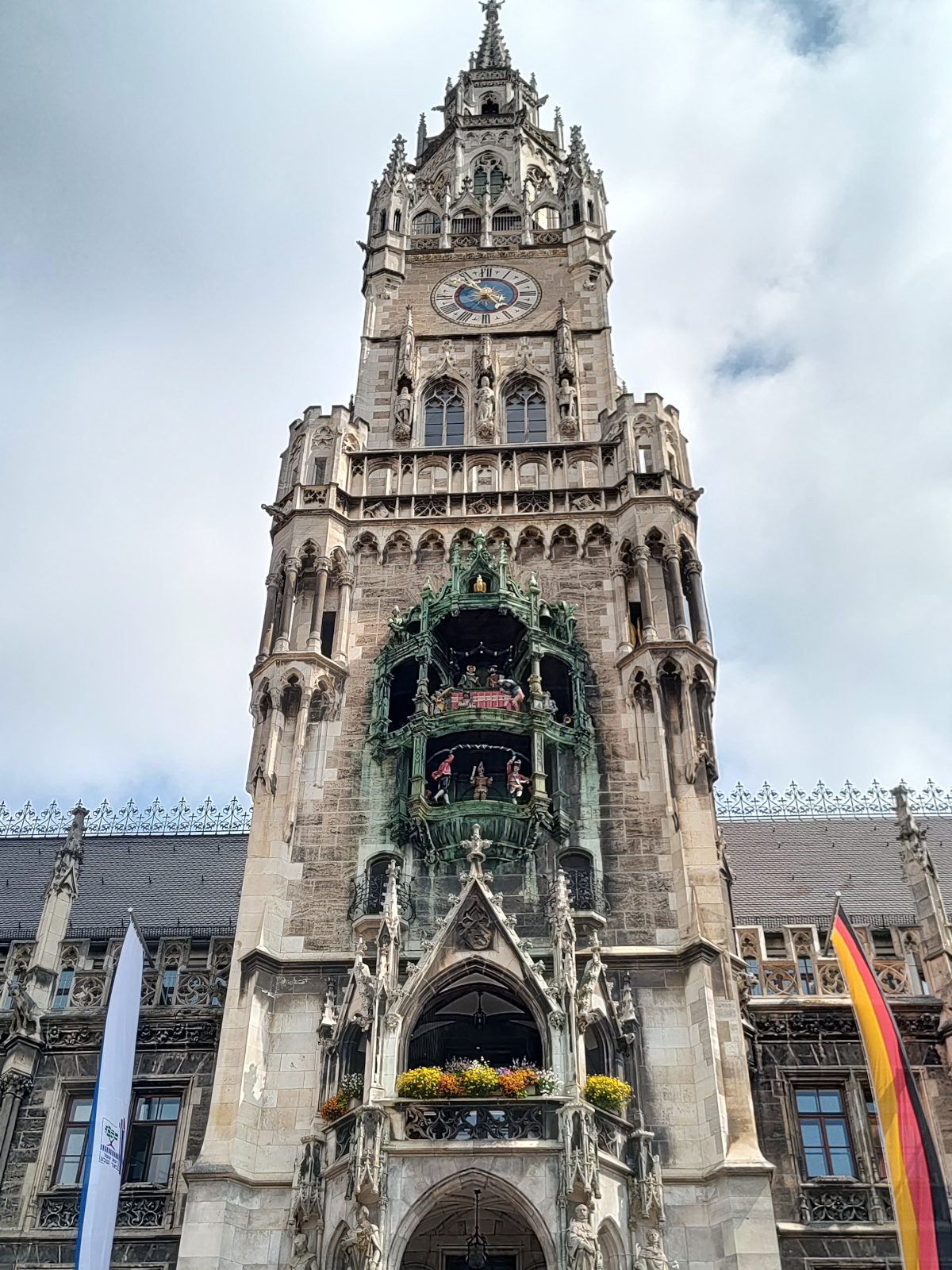
The Rathaus-Glockenspiel is a large electro-mechanical clock and carillon located in the tower of the New Town Hall in Marienplatz. It has 43 bells and 32 life-sized figures that re-enact two scenes connected to Munich and Bavarian history.
The Glockenspiel first sounded in 1908 and has since become one of the city’s most recognisable attractions. It combines bells, moving figures, music, a jousting tournament, dancers, and a golden rooster that signals the end of the performance.
The History of the Rathaus-Glockenspiel
The New Town Hall was constructed in three phases between 1867 and 1909. Designed in a neo-Gothic style, its façade is filled with statues, arches, balconies, and elaborate decorative details. You can read more about the building, its tower, interiors, and visitor options in my guide to the New Town Hall in Munich.
The Glockenspiel was created to commemorate episodes from local history. Although its figures are mechanical, the scenes are arranged almost like a small theatre production above Marienplatz.
The Historical Scenes Re-Enacted by the Glockenspiel
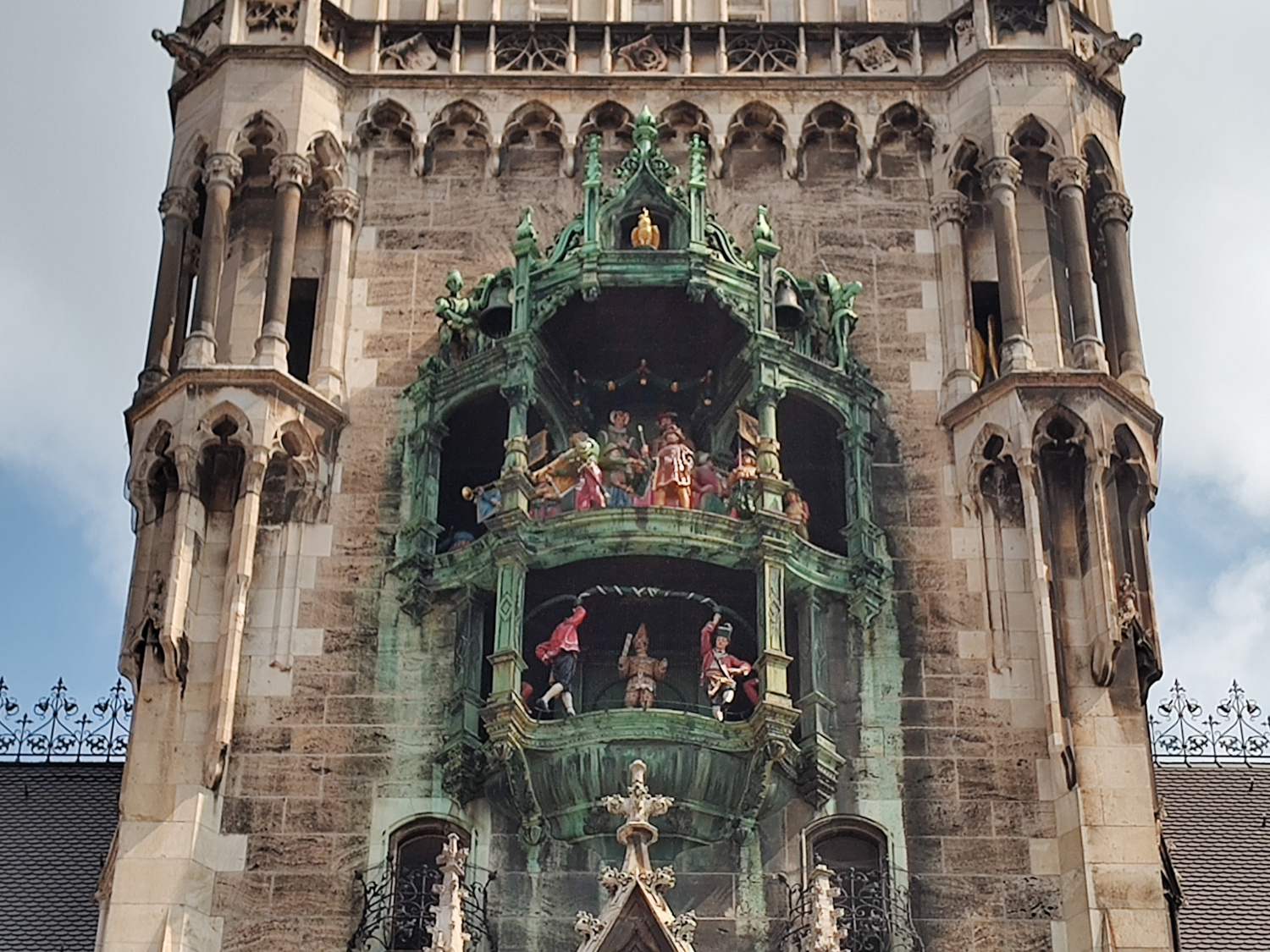
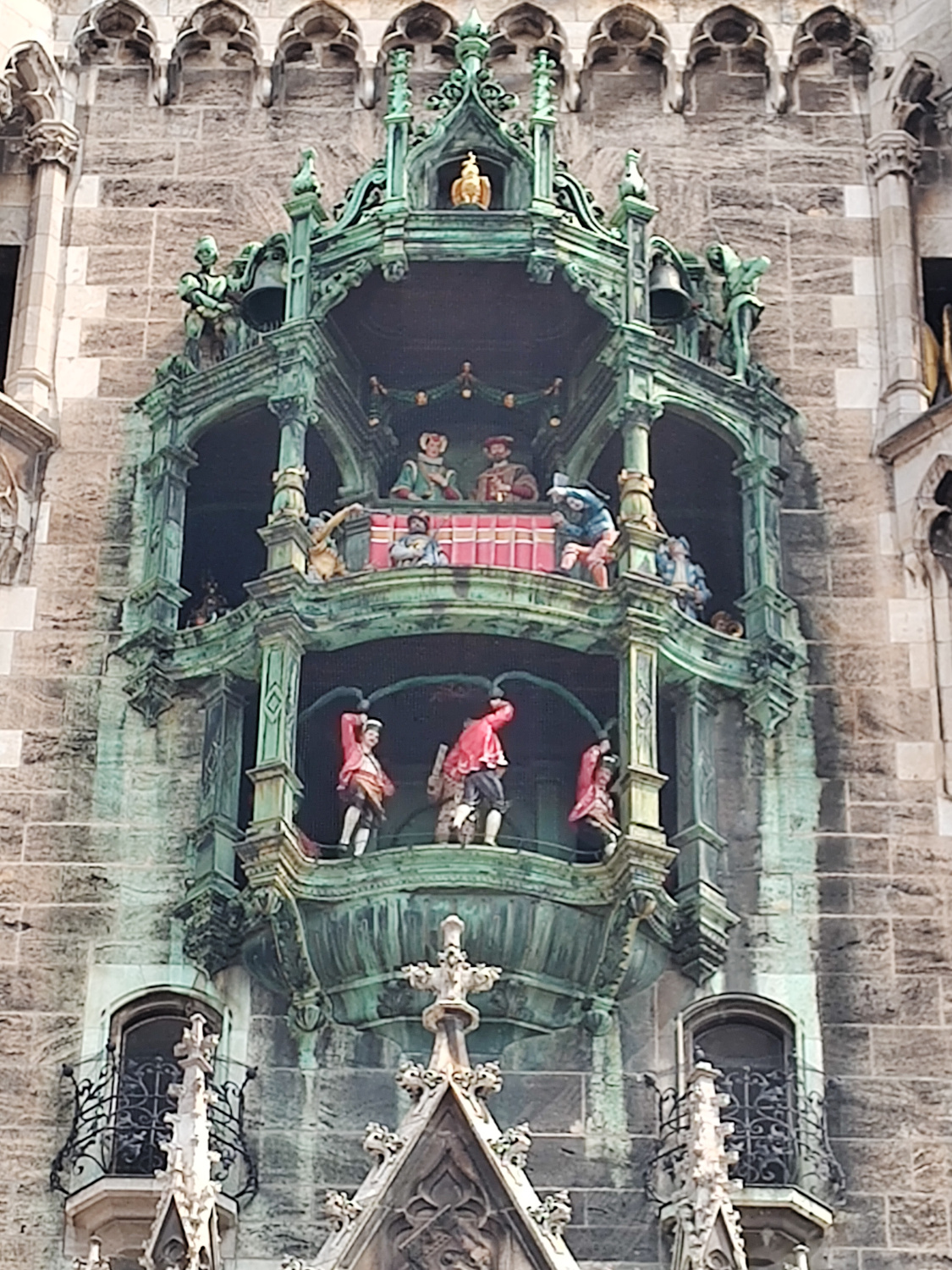
The figures are arranged on two main levels. The upper level presents the wedding celebration and jousting tournament, while the lower level shows the Schäfflertanz, or Coopers’ Dance.
The Wedding of Duke Wilhelm V and Renata of Lorraine
The upper half of the Glockenspiel re-enacts part of the celebration for the 1568 wedding of Duke Wilhelm V of Bavaria and Renata of Lorraine.
The festivities included a jousting tournament. On the Glockenspiel, mechanical knights representing Bavaria and Lorraine ride toward each other with their lances. The Bavarian knight ultimately knocks the Lorraine knight from his horse, representing Bavaria’s victory in the tournament.
The scene includes members of the court, musicians, standard bearers, and other figures connected to the wedding celebration. At the end of the complete performance, the golden rooster above the scenes crows to mark the conclusion.
The Schäfflertanz, or Coopers’ Dance
The lower half of the Glockenspiel features the Schäfflertanz, a dance associated with Munich’s coopers, or barrel makers.
According to local tradition, the dance dates to the time of a plague epidemic in 1517, when the coopers are said to have danced in the streets to encourage frightened residents to return to public life. The origin is presented as a legend, but the dance has become one of Munich’s best-known traditions.
The real Schäfflertanz is performed in Munich every seven years. The latest season took place from January 6 to February 17, 2026, and the next regular season is expected in 2033. The official Schäfflertanz guide provides more information about the tradition.
How Is the Munich Glockenspiel Operated?
The Rathaus-Glockenspiel is not simply left to run unattended. It uses an electro-mechanical system, but staff members are involved in starting and controlling the performance.
An employee presses the start button and then manually switches the melodies and groups of figures according to a defined sequence. The rooster and another figure known as the Hanswurst are also activated by hand. A specialist team maintains the bells, gears, contacts, wheels, and other parts of the century-old mechanism.
The system operates in much the same way as it did historically, although it is now powered by solar energy. I find this combination fascinating: an old mechanical attraction, modern energy, and people still making sure the performance unfolds correctly every day.
Practical Tips for Watching the Rathaus-Glockenspiel
Arrive before the advertised time
Do not plan to walk into Marienplatz exactly at 11:00 AM or noon. Give yourself at least 10 to 15 minutes to find the tower, understand where the figures are, and choose a comfortable position. We arrived at around 10:40 for the 11:00 AM show and were happy with that decision.
Remember that you will be standing outdoors
The audience watches from an open square, so prepare for sun, rain, wind, or cold. A light shower does not necessarily prevent you from seeing the performance, but an umbrella can obstruct other people’s view in a dense crowd. A hood or compact rain jacket can be more convenient. For a wet day, my guide to Munich in the rain includes indoor attractions you can add before or after Marienplatz.
Move back rather than closer
The figures are high on the tower. Standing immediately below them does not provide the clearest overall view. Step back until you can see both main levels without straining.
Use zoom for close-up photographs
A phone or camera zoom helps capture the individual figures. For the complete scene, landscape orientation is useful, while a vertical image can include more of the tower. I would still recommend spending at least part of the show looking directly at it rather than watching the complete performance through a screen.
Visiting with children
The show is free and short enough to include in a family day. Children may have difficulty seeing through a dense crowd, so arrive early and stand where you have some room to shift position. Staying farther back can also make it easier to see the complete display.
Accessibility
You do not need to climb a tower or enter a building to watch the Glockenspiel. The performance is visible from Marienplatz, although crowds and the paving may require more care for wheelchair users and visitors with limited mobility. Check current lift and escalator information for Marienplatz station before travelling if step-free access is essential.
How to Get to the Rathaus-Glockenspiel
The Glockenspiel is on the New Town Hall façade in Marienplatz, in the centre of Munich’s Old Town.
U-Bahn: U3 and U6 to Marienplatz
S-Bahn: Central S-Bahn services stop at Marienplatz. Check the current route in the MVV journey planner, especially when engineering work or service changes are announced.
We used the MVV app and Munich public transportation and reached Marienplatz using a combination of bus and U-Bahn.
As we climbed the stairs from the U-Bahn station, the impressive New Town Hall was there to welcome us. It was a special first view, particularly because this was the first attraction of our Munich trip.
What to Visit Near the Munich Glockenspiel
The Glockenspiel is easy to combine with several major Munich attractions because it is already in the centre of the Old Town.
If you have another 30 to 60 minutes
Look more closely at the New Town Hall façade, walk across Marienplatz, see the Old Town Hall, and visit the Munich Toy Museum inside the Old Town Hall.
If you have another one or two hours
Continue to Viktualienmarkt, visit St. Peter’s Church, or walk to the Frauenkirche. Hofbräuhaus is also within walking distance if you want to experience one of Munich’s most famous beer halls.
If you have several hours
Follow my tested one-day Munich walking itinerary through the historic centre, or continue toward the Munich Residenz.
Is the Munich Glockenspiel Worth Seeing?
Yes, I think the Rathaus-Glockenspiel is worth seeing, especially on a first visit to Munich. It is free, centrally located, easy to combine with other Old Town attractions, and far more elaborate than a clock that merely marks the hour.
I would not cross the entire city and abandon a prepaid attraction solely for the show. However, if you are already planning to visit Marienplatz, it is worth arranging your time so that you are there for one of the complete daytime performances.
For families, history lovers, architecture enthusiasts, and anyone who enjoys unusual mechanical attractions, it is an easy recommendation. Even if you are not usually interested in clocks, the music and staged historical scenes make this one memorable.
The best part is that it is completely free to watch. You do not need to buy a ticket or reserve a place. You only need to arrive at the right time and choose a position from which you can see both levels.
Frequently Asked Questions About the Munich Glockenspiel
What time does the Munich Glockenspiel play?
The complete daytime show runs daily at 11:00 AM and 12:00 noon. An additional performance takes place at 5:00 PM from March through October.
Does the Munich Glockenspiel play in winter?
Yes. The 11:00 AM and 12:00 noon performances continue during winter. The 5:00 PM performance does not normally run from November through February.
What happens at the Munich Glockenspiel at 9 PM?
The 9:00 PM display is a shorter nighttime scene featuring the night watchman, guardian angel, and Münchner Kindl. It is not the full jousting and Schäfflertanz performance.
How long is the Munich Glockenspiel show?
Allow approximately 15 minutes for the daytime performance. The duration can vary slightly according to the musical sequence.
Is the Rathaus-Glockenspiel free?
Yes. Watching from Marienplatz is completely free, and no reservation is required.
Where is the best place to watch the Munich Glockenspiel?
Stand in the central part of Marienplatz, far enough from the New Town Hall façade to see both levels. We stood on the left side of the Mariensäule while facing the tower and had an excellent view.
How early should I arrive?
Arrive 10 to 15 minutes early in normal conditions. Give yourself more time during summer weekends, the Christmas-market period, school holidays, and major events.
Does the Glockenspiel run in the rain?
It normally operates in ordinary weather conditions, and visitors watch from the open square. Severe weather, maintenance, or exceptional circumstances can affect a performance, so check official information when seeing it is central to your plan.
Does the Munich Glockenspiel perform on Good Friday?
No. The Glockenspiel is normally silent all day on Good Friday.
How This Guide Was Researched
This guide is based on my family’s own visit to Marienplatz. We watched the 11:00 AM Rathaus-Glockenspiel performance, arrived at around 10:40, and took the original photographs included in the article.
I have combined that first-hand experience with updated information from official Munich sources. The performance schedule, Good Friday exception, nighttime display, operating details, and Schäfflertanz dates were rechecked in July 2026.
Crowd levels, weather, temporary maintenance, and transport conditions can change. Check official information shortly before your trip, particularly if the Glockenspiel is one of the main reasons for visiting Marienplatz at a specific time.
Conclusion: Experiencing the Rathaus-Glockenspiel in Munich
The Rathaus-Glockenspiel is more than a clock. It brings music, mechanical ingenuity, Bavarian history, and the atmosphere of Marienplatz together in one free performance.
I loved watching the figures begin to move as the tunes changed, seeing the different scenes unfold above us, and hearing the final sound that marked the end. It was a wonderful introduction to Munich and a perfect first stop on our trip.
Arrive a little early, stand far enough back to see both levels, and look up when the music begins. Then continue exploring the Old Town—or use my practical Munich tips to plan the rest of your visit.
More amazing articles for you:
The Shell Grotto (UK) is a subterranean passageway with walls decorated with 4.6 million seashells
Covent Garden's Best-Kept Secrets: Experience the City's Hidden Gems This Spring
Best Cities to Visit in Spain
Things to Know Before Visiting Spain
Things to do in Salzburg: travel guide
Top 30 Art Museums in Europe With Free Virtual Tours
Some Famous Destinations of Historical Nature
Photo of the Louvre Museum

Violeta-Loredana Pascal is a communications expert, business mentor, and the founder of Earth’s Attractions and PRwave INTERNATIONAL. A pioneer in the Romanian digital PR landscape since 2005, she holds a degree in Communication and Social Sciences from SNSPA Bucharest. Violeta is a senior trainer at AcademiadeAfaceri.ro, where she leverages over 20 years of experience to teach professional courses in PR strategy and workplace productivity. By blending high-level business consulting with a passion for holistic travel and wellness, she empowers solopreneurs to overcome procrastination, build profitable brands, and design a life of purposeful adventure.